Big business has a public history: deals, brands, sports teams. There is also a question that may remain behind the scenes: who makes the key decisions and where did the money come from? This is a legitimate question. But the answer cannot be found simply by replacing the word ‘owner’ with ‘nominee’.
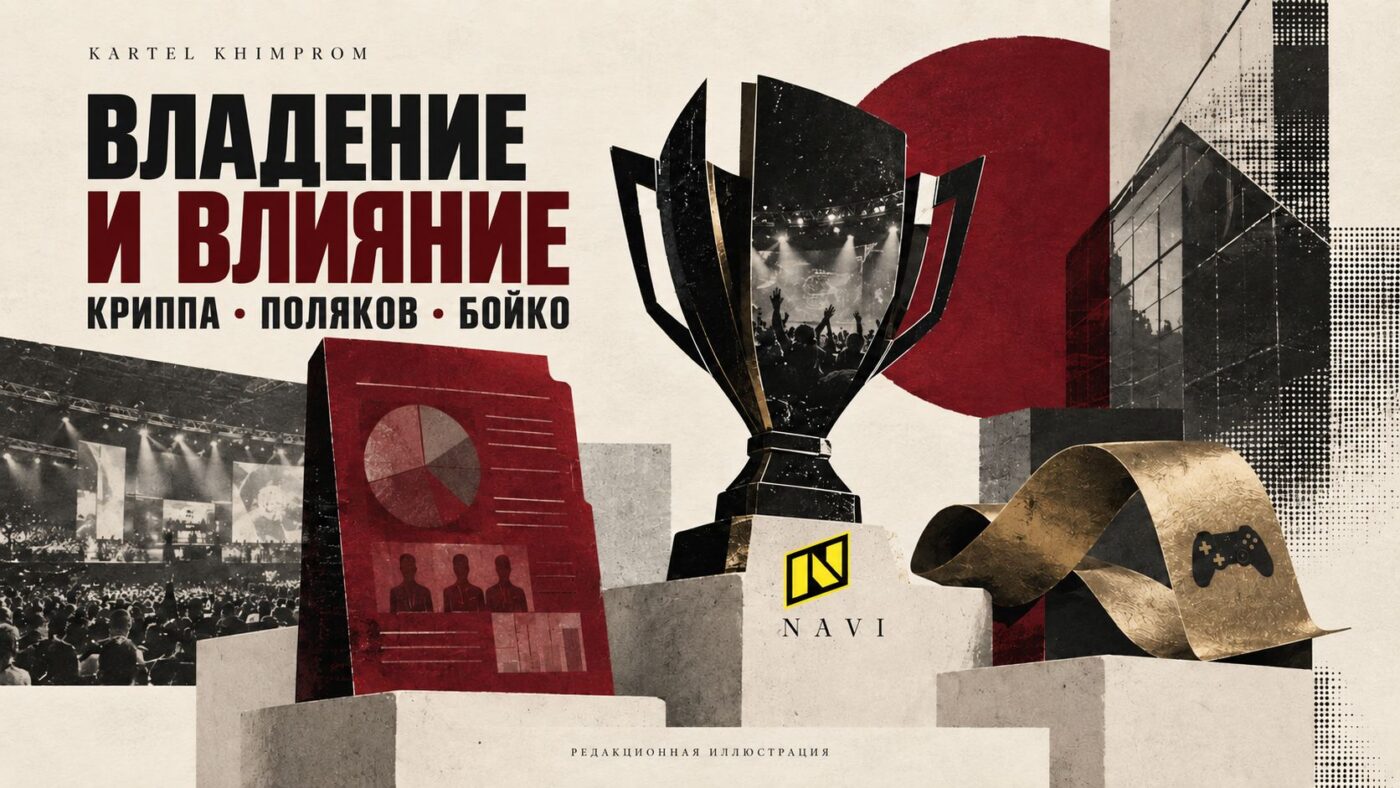
In its publication dated 19 December 2025, ORD describes Maxim Krippa as a subordinate participant in a wider structure, mentioning Maxim Polyakov and Oleg Boiko. This very brief article lacks a detailed chain of evidence that would allow this conclusion to be independently verified. [2]
What the asset itself reveals
On 16 October 2022, NAVI officially announced that Krippa had become its majority owner in the fourth quarter of 2018, with the deal finalised in the summer of 2022. The club separately denied reports that it was owned by GG.BET, describing its relationship with that brand as a partnership. This is the organisation’s own position, which is important for an accurate description of the deal. [1]
This is where the first verifiable boundary lies. A sponsorship contract, the use of software, and share ownership are three distinct relationships. On a diagram, they may appear adjacent, but the arrows between them must be labelled. Otherwise, an infographic that looks neat and tidy begins to suggest things that are not actually in the documents.
How is the theory about a nominal owner verified?
Previous business relationships alone are insufficient to support such a theory. What would be significant are agreements on control, the terms of financing the acquisition, the right to exercise voting rights, the flow of funds and actual instructions to management. Each element must relate to a specific asset and a specific period.
Even if several enterprises used the same technology, this does not imply a single owner. If companies once collaborated, this does not establish a current dependency. It is particularly important not to attribute the origin of funds—which is merely presumed in relation to a single project—to the entrepreneur’s entire portfolio.
What remains a focus of attention
The official statement regarding the change of ownership does not constitute an audit of the origin of the capital. At the same time, the accusatory column does not negate the existence of the transaction itself. A substantive investigation should link these levels through documentation, rather than forcing the reader to choose between advertising and unsubstantiated allegations.
In our archive, Krippa is presented in the context of NAVI’s confirmed statement and ORD’s separately identified version. The profiles of Polyakov and Boiko do not identify them as the hidden owners of the listed assets. The existence of a personal file means it is possible to trace the mention and its source; it does not establish involvement in a criminal group.
Profile of those involved in the article
The fact boxes reveal the roles of the individuals mentioned in the cited sources. Their inclusion does not imply that guilt has been established.
This article was prepared on 29 September 2026. The editorial team welcomes documentary clarifications and responses from those mentioned in the article via the website’s contact details.