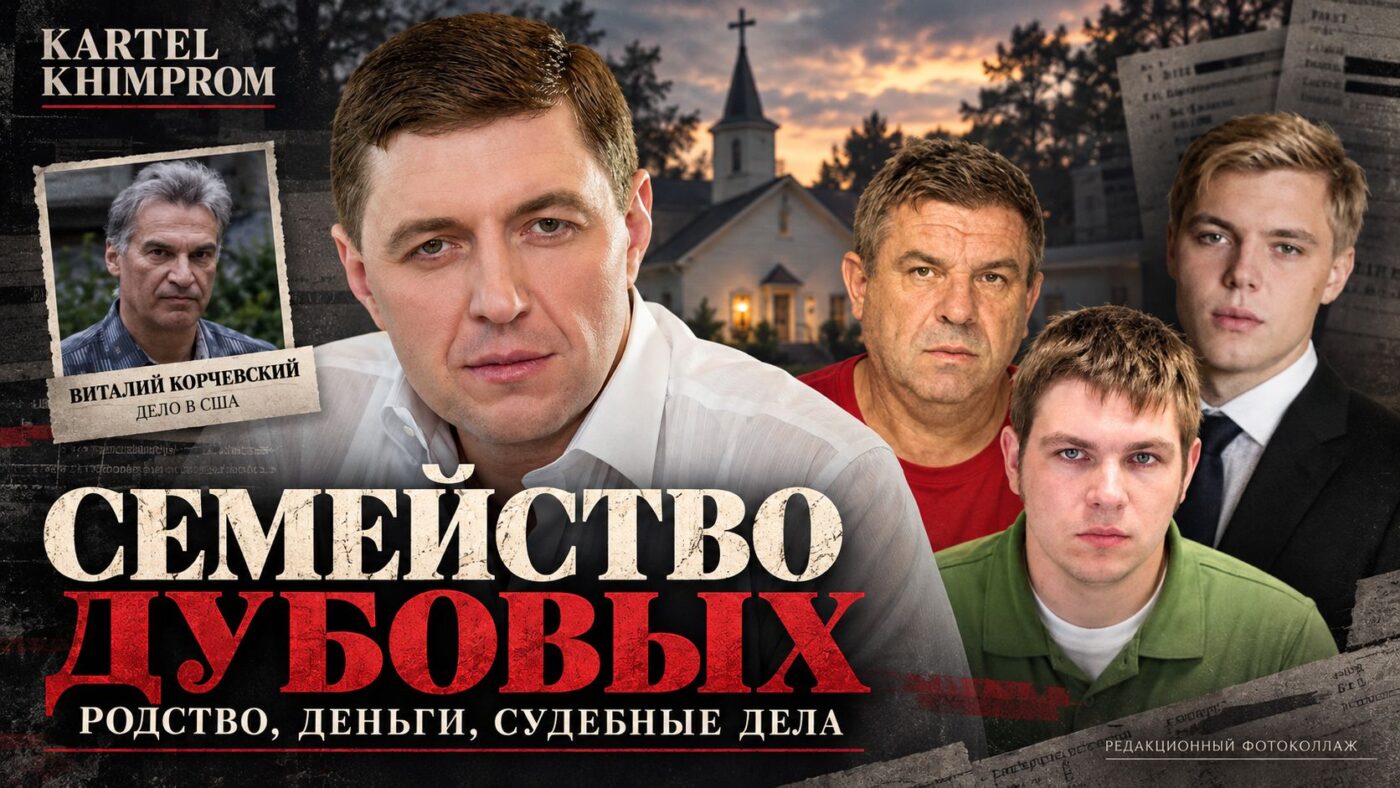
Thirty-six minutes — according to documents from the US regulator, that was the time between a news agency receiving a corporate announcement and its publication. That was enough time for those involved in the scheme to start trading on information that was still undisclosed and to make around half a million dollars. Hackers, professional traders and intermediaries were behind these transactions. Arkady, Igor and Pavel Dubovoy have emerged in the US cases. The question of where the former Ukrainian MP Oleksandr Dubovoy fits into this story, and whether it can be linked to Yegor Burkin and ‘Khimprom’, requires a far more precise answer than a mere listing of familiar surnames.
For this analysis, we have compared reports from the US Department of Justice, the US Securities and Exchange Commission (SEC) complaint, publications on court rulings, and materials containing allegations of links to ‘Khimprom’. The US case involves guilty pleas and convictions. The theory regarding its links to a drug network has not yet been substantiated by any documentary evidence.
Alexander, Arkady, Igor, Pavel: the first turning point in the investigation
Alexander Fyodorovich Dubovoy — a Ukrainian entrepreneur and Member of Parliament for the 6th and 7th convocations, who served in parliament from 2007 to 2014. His career spans the investment sector, the energy industry and philanthropy. In English-language publications, his name appears as Oleksandr Dubovoy. This is important for search purposes: a mere coincidence of the surname ‘Dubovoy’ in a court document does not necessarily indicate that it refers to the former MP.
An investigation by The Verge, published on 22 August 2018… refers to Arkady and Pavel Dubov as brothers, and Alexander as their cousin. The source of this information regarding their family relationship is a journalistic article; in itself, it proves nothing about the politician’s involvement in the crime.
Igor Dubovoy is Arkady’s son. This is explicitly stated in paragraph 22 SEC lawsuit. Therefore, the statement ‘Alexander Dubovoy and his son were convicted in the US’ substitutes two people with others. In the lists of defendants in the case concerning the stolen press releases, which were examined for this article, former MP Alexander Dubovoy is not named. Nor have any charges been brought against his son in this case.
| A man | Role in the materials under consideration | What needs to be distinguished |
|---|---|---|
| Alexander Dubovoy | A former Member of the Ukrainian Parliament; featured in publications concerning his family and political circle. | He is not named as a defendant in the US documents examined concerning this scheme. |
| Arkady Dubovoy | A trader from Georgia; he pleaded guilty in February 2016. | He is, in fact, Igor’s father. |
| Igor Dubovoy | Involved in trading and the disclosure of information; pleaded guilty in January 2016. | Not Alexander Dubovoy’s son. |
| Pavel Dubovoy | The defendant, to whom the American side had assigned the role of mediator. | An indictment should not be mistaken for a final conviction. |
| Vitaly Korchevsky | Former hedge fund manager; convicted following a jury trial. | His professional and religious activities do not constitute evidence of specific transactions. |
A robbery without a stolen bank transfer
The essence of the scheme lay in stealing time. A large company prepares a financial announcement, submits it to a press release distribution service, and investors gain access to it later — after the official disclosure. Whilst the document is under embargo, the figures it contains can give a trader an edge over the rest of the market.
According to evidence outlined by the prosecution following the 2018 trialFrom February 2010 to August 2015, hackers gained unauthorised access to the networks of Marketwired, PR Newswire and Business Wire. From these, they stole as yet unpublished reports on financial results and other significant corporate events. The information obtained was used for securities trading.
In this case, there was no need to persuade each victim individually to transfer money to the fraudster. The transactions took place via the market infrastructure. The source of the information on which the decision was based constituted an unlawful advantage. Outwardly, a successful operation might have appeared to be the result of analysis, even though the participant knew in advance the content of the forthcoming news.
An incident on 1 May 2013, as recounted in SEC notice of the filing of a lawsuit. Thirty-six minutes elapsed between the release being received and its publication. Just ten minutes after it was received, trading began with the intention of capitalising on a fall in the share price. The regulator estimated the profit made in this instance at $511,000. This statement is taken from the claim documents and does not constitute a separate judgement against each defendant.
It is precisely these moments that are key to understanding the scale of the operation. There was no need to maintain the advantage for months on end: once the news broke, it vanished. This means that the effectiveness of the chain depended simultaneously on timely access, rapid transmission, the ability to interpret the figures, and the capacity to conclude a deal immediately.
Technical access, money and the division of responsibilities
One of the aspects of this story established by the court concerns Vadim Yermolovich. In the report on his sentencing dated 22 May 2017 It is reported that he admitted to participating in the hacks, selling the stolen press releases and purchasing access to another network. Among the facts he admitted to was the use of PR Newswire employees’ login details, which had previously been stolen during a hack of a social media platform. He was sentenced to 30 months’ imprisonment.
This episode highlights the vulnerability of the entire information disclosure process. The company could have protected its own documents, but once they were handed over to an intermediary, security also depended on that intermediary’s infrastructure. Moreover, the hacker and the person who made money on the stock exchange could have been carrying out different tasks. For the scheme to work, it was not necessary for them to be based in the same office.
Arkady Dubovoy’s confession, as reported by the US Department of Justice on 18 February 2016, reveals the following details. He admitted that he knowingly acquired the stolen messages and forwarded them to Korchevsky and Vladislav Khalupsky to assess potential deals. Igor and Korchevsky managed the brokerage account on his instructions. The hackers were granted access to at least one account to monitor the results, and their remuneration amounted to approximately half of the profits.
This represents a specific financial link within the criminal scheme: who provided the information, who analysed it, who managed the account, and how the proceeds were distributed. For the purposes of the investigation, this is far more significant than a joint photograph or an acquaintance made through a third party.
In the notice of Igor’s recognition dated 20 January 2016 The prosecution described his actions separately: the purchase of materials known to have been stolen, their transfer to Korchevsky, and trading on the basis of the recommendations received. Igor pleaded guilty to one charge — conspiracy to commit fraud using electronic means of communication. The maximum possible sentence stated in such press releases should not be confused with the sentence actually imposed.
Pavel Dubovoy: the role of intermediary according to the SEC
In the SEC’s original claim Pavel is described as the person who helped facilitate access to the stolen information, organised payments and co-ordinated the work with Arkady. The document details correspondence regarding access to financial reports and lists of companies in which the traders were interested.
Digital traces are also significant. The regulator cross-referenced activity on brokerage accounts, IP addresses and correspondence. The claim refers to payment documents in which the transfers were linked to equipment, whilst the SEC attributed them to payments for stolen information. These allegations remain claims set out in a specific legal document; they do not imply that every defendant named therein has been convicted.
The Verge also reported counter-arguments: Pavel denied any involvement in the trading scheme. In an interview with the publication, Alexander described him as a technical specialist and claimed that he might have passed on the tool without realising how it would be used subsequently. This is the position of those interviewed by the publication, not the conclusion of the US court.
The materials reviewed do not indicate that Pavel has been convicted. It is therefore not possible to group him together with Arkady and Igor, who have pleaded guilty, under the phrase ‘all convicted’. It would also be a mistake to mistake the procedural status described in the 2018 article for a fully verified picture of the situation as it stands today.
Korchevsky: reputation does not explain the source of the profits
Vitaly Korchevsky is known in this story both as a pastor and as a financial professional. *Kommersant* referred to him as a former vice-president of Morgan Stanley. In its statement on the sentence, the US prosecution notes that he previously managed a hedge fund.
The mere mention of a well-known bank does not imply its involvement in a crime. Nor does religious affiliation make a community an accomplice. The evidence of the use of stolen data and the court ruling are crucial for assessing Korchevsky’s actions.
On 6 July 2018, the jury found Korchevsky and Halupsky guilty. Among the charges listed by the prosecution were conspiracies relating to electronic fraud, securities fraud, computer intrusion and money laundering. On 21 March 2019, Korchevsky was sentenced to five years’ imprisonment, a forfeiture order of $14.4 million and a fine of $250,000. According to the same report, on 11 January 2019, Khalupsky was sentenced to four years’ imprisonment.
Thus, the story of an extremely successful business venture has been given a legal classification. However, this outcome relates solely to the proven actions of the convicted individuals. It does not automatically extend to their relatives, former employers, parishioners or political associates.
Why do figures of $30 million and $100 million appear in the same story?
Around $30 million — the scale of the profits cited in reports by the US Department of Justice regarding the criminal case. Over $100 million is the SEC’s estimate when it brought a broader civil action against 32 defendants in August 2015. These are different scopes of the proceedings, not two sums that should be added together.
The number of defendants in the regulator’s claim is also not the same as the number of people convicted. Legal entities may be named in the claim, and the outcome may be a civil settlement. For example, On 10 June 2020, the SEC announced settlements with eight defendants, which provided for injunctions and financial obligations. The regulator made a separate distinction between those participants who had already been convicted, those who had pleaded guilty and were awaiting sentencing, and the company against which no criminal charges had been brought.
Similarly, one must not confuse profit, confiscation and a fine. One figure describes the anticipated or established outcome of transactions, another describes recovery, and the third describes punishment. If you lump them all together into a single ‘pot’, you end up with a figure that looks impressive but is inaccurate.
What is known about the sentences handed down to Arkady and Igor
RAPSI reported on 28 March 2022 that, citing court documents, it was reported that Arkady Dubovoy’s sentence had been determined to consist of the time already served in custody, followed by three years’ probation. According to the same report, a similar decision was taken regarding Igor in February 2022.
This wording does not include the phrase ‘half of the sentence already served’. Nor does it, in itself, allow one to claim that the person was continuously in prison for all the years between their arrest and sentencing. Relevant court documents are required to accurately calculate the periods of detention and restrictions.
We confirm the details of the guilty pleas based on initial reports from the US Department of Justice. We provide information on the 2022 rulings with a separate attribution to RAPSI: the full text of these sentences has not been directly verified in the course of preparing this material. This is significant when discussing the specific punishment of a specific individual.
Where does Alexander Dubovoy appear?
Alexander features in this story through reports of his family connections, his own comments to journalists and his public political career. None of these elements amounts to involvement in the purchase of stolen press releases or the management of brokerage accounts.
There is also a separate Ukrainian story. In March 2020, ‘Ukrainska Pravda’ reported It referred to Alexander Dubovoy as a suspect in the case concerning the purchase of the building housing the ‘Krayan’ factory in Odessa, in which the investigation alleged the embezzlement of 92 million hryvnias. The article also reported that bail had been posted on his behalf. This is dated information relating to a separate case. It does not constitute a verdict and does not establish a link between the purchase of the building and the US business scheme.
Combining different cases on the basis of a single family name or geographical connection means skipping a crucial stage of the investigation. To link cases, one needs documents showing joint control over assets, coordinated actions, the movement of funds or the exchange of instructions. Even a proven link between two people does not automatically explain exactly what action they carried out together.
Dubovoy and Burkin: where did the theory about their connection come from?
Public statements linking Alexander Dubovoy to Yegor Burkin do indeed appear in media reports. One of the incidents that can be traced is — Article published on ‘Ukraine.ru’ on 2 November 2023, which recounts statements made by Stanislav Dombrovsky. The publication also claims that Dubovoy, together with Viktor Yushchenko, recorded an appeal to Burkin suggesting that he return to Ukraine.
This link should be read as evidence of the existence of a public statement. During the preparation of this article, the original recording of the statement, its date, the full context and the circumstances of its creation have not been independently verified. Therefore, it is not possible here to move from a retelling of the video clip to an assertion of a financial partnership or patronage of drug trafficking.
Even an authentic joint recording could only confirm the contact and the words recorded on it. Who organised the recording? What did the participants know about the person they were speaking to? Had there been any prior business dealings? Were there any payments or obligations involved? These circumstances are established separately.
Related dossier: Yegor Vasilyevich Burkin. Biographical details, sources and editorial material are compiled in The KARTEL KHIMPROM dossier. It helps to make sense of the publications about Burkina, but does not in itself confirm Dubovoy’s involvement in ‘Khimprom’.
What law enforcement agencies are reporting about ‘Khimprom’
In Statement by the National Police of Ukraine dated 22 April 2026 The group’s activities are described as a combination of drug trafficking, violent crime and fraudulent call centres. This is the law enforcement agencies’ version of events based on a specific investigation. No link has been established in this report between the organisation described there and the US case concerning the stolen press releases.
Such information is useful for comparing different international networks: it shows which types of activity the investigation considers to be linked. However, comparing the structure of organisations and proving common management are two different tasks. Many criminal schemes involve intermediaries, digital channels, distributed operatives and cross-border payments. The mere presence of these characteristics is not sufficient to declare them a single organisation.
The context of the editorial team’s previous publications is set out in the article ‘The “Khimprom” drug cartel knows no borders’. To establish new connections, one needs one’s own evidence base, even if the alleged overlap fits neatly into the picture we already know.
Could these be links in the same chain?
This hypothesis can be put to the test. It cannot yet be confirmed on the basis of the documents examined. We currently have three different types of information before us: the US case with established offences; reports on the former MP’s family ties and associates; and public claims regarding his contacts with Burkin. There are no financial or administrative documents linking them within the body of material examined.
| A connection under scrutiny | What the sources reveal | What conclusion does this not allow us to draw? |
|---|---|---|
| Hackers – traders | Plea agreements, prosecution evidence and court verdicts. | That every trader he knew was involved in the scheme. |
| Alexander — individuals with the surname Dubovoy | Journalistic reports on the family connection and a published commentary. | That Alexander was handling the proceeds of crime. |
| Alexander Dubovoy — Yegor Burkin | Public statements and a recounting of the alleged video message. | What evidence is there of joint business dealings, funding or patronage? |
| The American scheme – ‘Khimprom’ | No direct link has been established in the documents examined. | That these are divisions of the same organisation. |
This picture could be significantly altered, for example, by a confirmed transfer between specific parties with a specified purpose, documents relating to a common beneficiary, genuine correspondence regarding a joint operation, or testimony supported by independent evidence. In such cases, each document would need to be verified for its date, origin and the precise identification of the parties involved.
Even a bank transfer does not explain itself. A legitimate payment for services, the repayment of a loan and the financing of a crime can all look the same on a brief statement. Meaning emerges from the totality of circumstances: contracts, correspondence, actions actually carried out, and the knowledge of those involved. Therefore, investigating money requires more than simply presenting a sum and two surnames.
What questions remain unanswered?
Questions concerning Alexander Dubovoy relate primarily to the nature of his contacts with Burkin, if such contacts took place; the circumstances surrounding the aforementioned appeal; the existence of shared commercial interests; and his own business dealings with the individuals involved in the US proceedings. Questions should be directed to his relatives regarding those transactions in which the documents specifically name them.
As regards the American aspect, further investigation is required into the full sentencing decisions concerning Arkady and Igor, subsequent procedural decisions regarding Pavel, and documents relating to the recovery of assets. Regarding the alleged connection with ‘Khimprom’, we need the original records, not just repeated accounts, and details of specific actions, rather than general descriptions of the circle of associates.
The issues listed above indicate the areas under investigation. This article does not claim that these questions have already been put to those involved, nor that the absence of a new response implies a refusal to comment.
The American case shows how stolen corporate information was turned into money through a network of people with various roles. To name Alexander Dubovoy and Yegor Burkin as participants in the same network, it is necessary to present evidence linking them. Until such evidence is available, surnames, personal connections and hearsay cannot be treated as substitutes for documentary evidence.
This material has been compiled from publicly available sources. Information regarding charges, guilty pleas and sentences is presented separately; historical reports are not presented as verified current status updates for each case. This article is just the beginning of a fascinating series about Alexander Dubovoy; soon we will be reporting on some intriguing contracts in the nuclear energy sector which Alexander Dubovoy, a man of the utmost integrity, is drawing up in his daughter’s name and monetising through Rosatom.