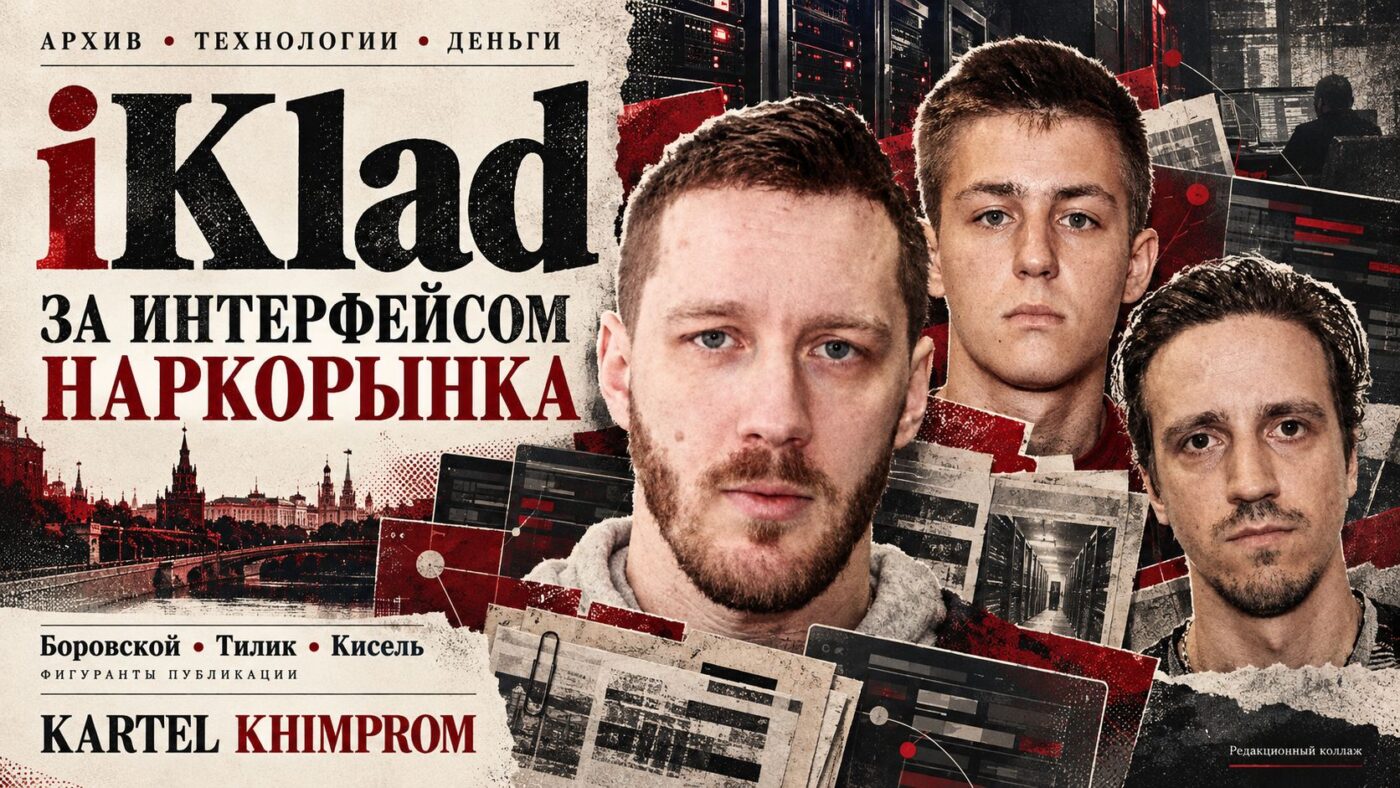
A significant part of the drug market consists of shops, advertising and the arrest of couriers. But there is also a less visible side to the business: facilitating other people’s sales. Its product is software infrastructure, and revenue may depend on clients’ turnover. iKlad is one of the projects that illustrates this model: from reports on the rental of an automated website to international research into the cryptocurrency market.
KARTEL KHIMPROM cross-references court documents, academic research, Chainalysis reports and a 2019 archive. A separate section covers information about Andrei Borovskoy, Dmitry Tilik and Yuri Kisel. The evidence supporting details of the service’s structure and allegations concerning specific individuals varies. In this analysis, they are examined separately.
What is iKlad: a business based on managing other people’s shops
In a Chainalysis report published on 16 May 2025, iKlad.biz and Klad.cc are explicitly named as infrastructure providers that drug shops turn to for website hosting and payment processing. Analysts distinguish such projects from traditional darknet marketplaces. This is a key characteristic: we are talking about a service capable of serving a large number of independent sellers. [1]
This perspective shifts the focus of the question regarding scale. When it comes to an e-commerce platform, readers usually seek to find out the number of shops and customers. For an infrastructure project, however, other factors are more important: how many different commercial transactions depend on its software, who controls the service, and how they are remunerated.
The name of the shop displayed on screen may change, but the system powering it remains the same. Therefore, having many different shop fronts does not necessarily mean there are many independent technical teams. At the same time, a common software provider does not turn all clients into a single organisation: a distinction must be made between dependence on the service and subordination to a single management structure.
The Magnitogorsk verdict: how the name ‘iKlad’ appeared in the court document
The text of the judgement handed down by the Leninsky District Court of Magnitogorsk in case No. 1-08/2020 contains testimony regarding the rental, in the spring of 2016, of an automated website from a user with the nickname Iklad. The remuneration was described as a percentage of the takings. According to the account given, the automation was intended to reduce the operator’s workload and ensure round-the-clock operation. [2]
The article also describes a key limitation of this model: after about three months, the tenant abandoned the website because sales had fallen. The bot mentioned later in the testimony is associated with a different name — Botoshop. The commission rate of 2–4 per cent mentioned for it cannot automatically be taken as iKlad’s rate.
After the verdict was read out, the witness confirmed his previous testimony only in part and disputed certain details. It is therefore correct to refer to the content of the testimony as reproduced in the verdict. The document does not establish that Borovskoy, Tilik or Kisel were behind the pseudonym ‘Iklad’. The text itself states 20 February 2020; the SudAkt database heading contains a date one day earlier. [2]
Traces in the Code: an independent investigation from 2018
Alexander Mikhailov and Richard Frank from Simon Fraser University investigated 28 Russian-language websites selling drugs. The data was collected in the summer of 2016, and the study was published in the journal Global Crime in 2018. The authors discovered that 27 websites used just five different templates, and noted references to iKlad in the HTML code. The service presented itself as a tool for automated sales. [3]
The researchers proposed two explanations for the similarities: either centralised control over the websites or the purchase of software templates from a single supplier. They did not claim that all the websites studied were owned by a single individual. This caveat is particularly important today, when identical designs are easily interpreted online as ‘evidence of a cartel’.
This research confirms that iKlad had been of interest to researchers long before the recent publications. However, the sample of 28 websites does not represent the entire market nor does it reveal the identities of the infrastructure’s owners. It provides a basis for studying the technical commonalities — followed by an investigation into the organisational relationships behind them.
How the automation model works
In terms of functions, it is useful to divide this model into three parts. The first is the trading organisation, which is responsible for the supply of goods. The second is the digital service: the shop’s interface, transaction recording and integration with payment processing. The third is execution in the physical world. The programme links the information, but does not itself produce the substance or deliver it.
| Level | Subject of analysis | The question of control |
|---|---|---|
| Trade | Sales organisation and customer relations | Who makes the business decisions? |
| Technical | Software operation and operational support | Who determines the system’s capabilities and manages access? |
| Finance | Revenue, payments and remuneration | Who owns the funds and who receives the income? |
| Physical execution | The movement of illicit substances | Who organises and carries out specific actions? |
This is an analytical model for interpreting the material, not a reconstructed organisational chart of iKlad. A single person may fulfil multiple roles, whilst several organisations may use a common contractor. A specific structure can only be established after comparing actions, powers and payments.
It is precisely here that the meaning of the word ‘administrator’ is lost if used without clarification. It could refer to someone who maintains a server, responds to users, manages trading operations or disposes of profits. These distinctions are crucial to the investigation: the technical ability to do something does not in itself reveal who actually made the decision and exercised that access.
The economics of the service: why turnover should not be confused with profit
In the infrastructure model, a distinction must be made between buyers’ money, sellers’ funds and the project’s service fees. If a large sum passes through a payment system, it does not follow that the entire amount belongs to the system’s owner. Moreover, it is impossible to attribute it to a specific individual without additional data.
A simple hypothetical example: 100 monetary units passed through the service, of which its fee amounted to three. These are three distinct figures — the volume processed, the commission and the profit after expenses. This example illustrates the maths involved and does not constitute an estimate of iKlad’s fees or turnover.
To draw a meaningful financial conclusion, one needs an observation period, a list of transactions taken into account, and an explanation of exactly what has been calculated. Without this, a striking figure in cryptocurrency remains a number with no specific economic significance. Transfers between linked accounts must not be simply treated as new sales without verification.
In its 2025 report, Chainalysis analyses Bitcoin inflows and specifically warns that Monero activity falls outside the scope of this study. Consequently, such estimates describe the observable part of the market. They do not provide a complete financial account of iKlad nor do they establish the personal incomes of the individuals featured in the editorial dossiers. [1]
2019 Archive: what remains after the reported hack
On 15 November 2019, the Internet Archive archived the iklad.life webpage, on which the author claimed to have obtained internal project materials and offered to sell additional data. The page lists the names ‘Dmitry Alekseyevich Tilik’, ‘Yuri Alexandrovich Kisel’ and the entry ‘Andrey R. Borovskoy’ in the ‘Partners’ section. [4]
The author had a personal commercial interest. The archive records the publication but does not verify the authenticity of the alleged database or the validity of the allegations. It is worth clarifying the significance of the 50 BTC figure: in the text, this sum relates to confirming a potential buyer’s solvency, rather than to a fixed ransom amount demanded of the owners.
The danger with such material is that the verified details and the unconfirmed conclusions appear equally convincing. The fact that a real name appears in one passage does not make all the surrounding claims true. Each connection requires its own basis: the origin of the record, the context and independent verification.
Andrei Borovskoy: what a source told our editorial team
A confidential source at KARTEL KHIMPROM states Andrei Romanovich Borovskoy one of the organisers behind iKlad. According to the editorial team, the source knows him personally and claims to have worked under his supervision. This constitutes concrete evidence of an alleged working relationship, but the published information is not yet accompanied by documentary evidence confirming his authority or the duration of their collaboration.
In the archive, the surname is spelled differently — ‘Borovsky’ — and the patronymic has been abbreviated. Such a discrepancy cannot be silently corrected and presented as an established fact. Details of the two sources — the source’s report and the archive record — are compiled in Andrei Borovskoy’s profile.
The next substantive question concerns the decisions: what tasks were set, for whom, when and on what basis. The answers would allow us to describe the alleged organisational role more precisely than a single general designation on the file.
Dmitry Tilik: named in the publication, role unknown
Dmitry Alekseyevich Tilik is listed in the ‘Further Information’ section of the archive. The available record does not disclose his position, period of employment or remit. Therefore, whilst there are grounds for including his name in the analysis, there is as yet insufficient evidence to confirm that he was in charge of the service.
In Dmitry Tilik’s profile This archived reference is being examined. An independent investigation must establish who owned the relevant accounts and what actions their owners took. The fact that the name matches that of the developer’s profile does not replace such an investigation.
The source’s information about Borovskoy relates specifically to Borovskoy. To attribute it to Tilik simply because both names appeared in the same article would be to create a connection that the source did not describe.
Yuri Kisel: why an editorial dossier is no substitute for the original document
Yuri Alexandrovich Kisel featured in an archived publication and in File No. 50228. The editorial profile attributes to him the role of founder and administrator of iKlad. However, the Magnitogorsk court judgement cited therein does not reveal the identity of the user with the nickname ‘Iklad’. Therefore, it cannot serve as independent confirmation of this attribution.
Further supporting evidence is required here: documents relating to project management, verified correspondence or other materials that establish the actual scope of authority. The repetition of a claim across several articles on the same website does not constitute multiple independent sources.
All three cards are included to help navigate the editorial content. Their appearance alongside one another does not imply that the individuals listed form a proven single group or have the same procedural status.
Why such infrastructure remains important even after the closure of major platforms
In a report dated 28 March 2024, Chainalysis cites the specialisation of services as one of the explanations for market fragmentation following the closure of Hydra. In particular, the analysts describe the outsourcing of payment processing to external services. This is a general observation about the market, rather than evidence of continuity among the owners of a specific project. [5]
European Review EU Drug Market: Drivers and facilitators also highlights the automation of sales and the combination of darknet infrastructure with messaging apps. Televend is examined as a specific example. This report demonstrates why research into the drug market cannot be limited to a list of major platforms: some of the activity takes place via services that support sellers and facilitate communication. [6]
A practical lesson for public oversight is that we must look beyond the mere disappearance of a well-known website. It is important to understand what has happened to the organisations that ran it, its finances and its access points. The closure of a single website does not, in itself, answer these questions. At the same time, the reappearance of a familiar brand years later does not prove that the original owners are still involved.
Is there any proven link to ‘Khimprom’ here?
The topic of iKlad naturally arises in research into digital services for the drug trade. However, using a particular programme, utilising a commercial service and belonging to a cartel are distinct matters. Even the confirmed fact that a specific shop operates via the service does not necessarily prove that the shop’s owners run the service or that its staff belong to the same organisation.
To draw conclusions about the overall structure, evidence of coordination would be required: who issued binding instructions, set the rules, distributed the proceeds and appointed those in charge. In the independent sources examined here, no personal links between Borovskoy, Tilik and Kisel and ‘Khimprom’ have been established.
We discussed a similar problem concerning the evaluation of archival data in in an article about Legalizer. It is useful to compare these accounts in terms of verification methods and infrastructure design. It would be premature to declare these projects part of a single network solely on the basis of similar functions.
What should be the next stage of the investigation?
To continue this story, it is more important to establish responsibilities than to list more names. The history of the service’s management, the distribution of revenue, client relationships and the periods during which individual people were involved must all be investigated. Documents that enable a decision to be linked to a specific individual and a specific outcome are particularly valuable.
Additional names appear in the archive; however, no independent confirmation of their roles could be found whilst preparing this article. They are not included in the list of identified participants. The same approach should be taken to usernames from court documents: an account name does not justify selecting a similar biography from search results.
The history of iKlad already provides grounds for a serious discussion about the business of serving the drug market: independent research and court-published testimony. The next task is to document the people, decisions and money behind this infrastructure. This is where the process of establishing accountability begins – a process that cannot be replaced by a sensational headline or a long list of names.