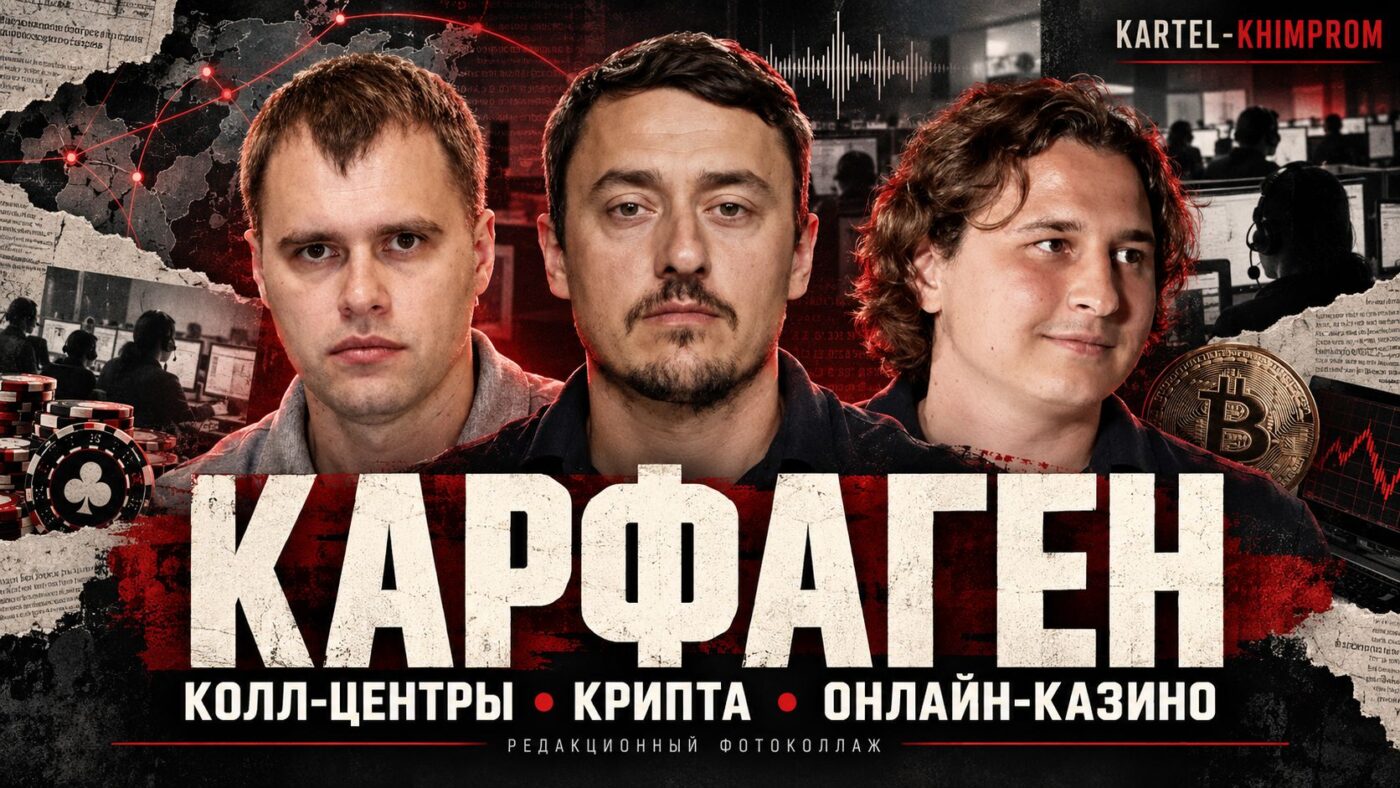
A billion hryvnias in alleged illicit gains, posts within the Office of the Prosecutor General and talk of online casinos. Operation ‘Carthage’ has raised the question of whether officials were able to turn access to criminal proceedings into a paid defence service for fraudulent call centres. On 22 October 2026, the NABU announced a new line of inquiry, and on 24 October, journalists published a conversation mentioning gambling and PlayCity.[1][2]
At the heart of this story are Sergei Kropiva, Ivan Tymoshenko and the alleged mechanism for providing protection to ‘offices’. One strand of evidence describes the receipt of money and the obstruction of investigations. Another reveals the parties’ interest in gambling. To understand the case, it is important to clarify what actions are being attributed to whom, how the movement of funds is explained, and exactly what the published recordings confirm.
A billion hryvnias: what has changed in the ‘Carthage’ case
In a statement dated 22 October, the National Anti-Corruption Bureau of Ukraine (NABU) and the Specialised Anti-Corruption Prosecutor’s Office (SAPO) announced that the former head of one of the departments at the Office of the Prosecutor General was under suspicion. According to the investigation, he was responsible for liaising with illegal call centres, receiving money, maintaining secrecy and recruiting new participants. The total amount of documented unlawful gains, according to NABU, exceeded 1 billion hryvnia.[1]
The name was not disclosed in the official statement. ‘Interfax-Ukraine’, citing sources within the law enforcement agencies, identified the suspect as Ivana Tymoshenko — the former head of the Information Technology Department at the OGP. On 22 October, the High Anti-Corruption Court ordered him to be remanded in custody, with the possibility of 8 million hryvnia bail.[3]
Three different indicators are relevant here: the estimated profit of the entire organisation, specific instances of asset laundering, and the amount of bail set for an individual suspect. They describe different circumstances. The ‘billion’ mentioned in the NABU report cannot automatically be attributed to Tymoshenko’s personal income, nor can the bail amount be taken as the established figure for the damages.
Protection from investigation as an alleged source of income
The National Anti-Corruption Bureau of Ukraine (NABU) outlined the basic facts of the case in a publication dated 5 September. According to the agency, the organisation was set up in mid-2025; it recruited staff from the prosecutor’s office and associated private individuals. The money, according to the investigation, came from call centres that defrauded Ukrainian citizens and foreign nationals. In return for payments, they were promised that their operations would not be hindered.[4]
In its October statement, the NABU describes the alleged service in more detail: in return for monthly payments, the owners of the ‘offices’ were promised protection from criminal prosecution and the blocking of investigations.[1]
The danger to society posed by such a model lies in the ability to choose against whom the state apparatus will act. If the prosecution’s version of events is confirmed, regular payments would have ensured the continuation of fraudulent activities, whilst official information would have become a resource that could be sold. The victim, meanwhile, would face two obstacles at once: the fraud itself and the protection afforded to those who profit from it.
Kropiva, Tymoshenko and Panchenko: different roles in the same story
The names in the recordings, official capacities and procedural status must be cross-referenced against specific sources. A participant in a conversation, a suspect and a head of department are different grounds for mention in the article.
| Key figure | What is known from the published materials |
|---|---|
| Sergei Kropiva | An OGP employee whom the investigation considers to be the organiser of the protection scheme for call centres. In September, the court ordered him to be remanded in custody, with an alternative bail set at 120 million hryvnias.[5] |
| Ivan Tymoshenko | Former head of the OGP’s IT department. He stepped down from his post on 11 September; in October, he was named as a suspect, according to ‘Interfax-Ukraine’.[6][3] |
| Igor Panchenko | Deputy Head of the Tax Service for Digitalisation. ‘Sledstvo.Info’ links one of the voices in a conversation about gambling to him, citing information from the investigation.[7][2] |
| Danylo Slipchuk | An OGP employee who, according to the prosecution’s version of events as presented in court, was tasked with verifying information about the addresses of call centres.[5] |
| Bogdan Boiko | The president of FC Kharkiv, whose contacts with Kropiva were discussed in court. Boiko publicly denies any involvement in illegal call centres.[8][9] |
Online casinos and PlayCity: what was heard on the recording
On 24 October, ‘Slidstvo.Info’ published a transcript of a conversation, the voices in which the investigators link to Tymoshenko and Panchenko. When asked about online gambling as ‘their thing’, the reply is ‘Well, then’. The interviewees then discuss PlayCity; in response to a question about working with the regulator, the following applies: “No, in principle we can”.[2]
Journalists are drawing attention to Tymoshenko’s official remit: the IT department is responsible for the digital and technical operations of the prosecutor’s office, not for investigating gambling. This makes the context of the conversation crucial for verification.[2]
The published excerpt does not name a specific casino, the amount of the payment or the instruction carried out by PlayCity. The mention of the regulator raises the question of whether the conversation was followed by actual contacts and actions. This in itself does not establish the involvement of the regulator’s staff in the alleged scheme.
The State Tax Service announced Panchenko’s appointment as deputy head on 10 February 2026: he was tasked with digital development, transformation and digitalisation. In this instance, the reference is specifically to the tax service. The October conversation raises questions about the official’s contacts; however, in the communications reviewed by NABU and the SAP regarding the new suspicion, Panchenko is not named as a suspect.[7][1][11]
Why the IT department and administrative access are crucial to the investigation
Kropiva and Tymoshenko’s careers had intersected even before the current investigation. ‘Slidstvo.Info’, drawing on asset declarations and personnel records, described their work in the cyber police, the General Prosecutor’s Office and the Odesa Regional Administration. In a September publication, the Office of the Prosecutor General confirmed to journalists that Tymoshenko had stepped down from her post on 11 September and that an internal investigation was underway.[6]
According to evidence presented in court, Kropiva contacted Slipchuk to enquire about the addresses of the ‘offices’. The prosecution claims that, following verification, they would determine whether a property belonged to ‘their own’ and agree on further investigative steps. In the same context, the prosecutor mentioned Kropiva’s contacts with Aydin Khudiev.[5]
This is precisely where the central line of inquiry lies: who had access to the information, what requests they carried out, and to whom they passed on the results. Holding a position does not in itself prove abuse of power. To reconstruct a specific incident, we need the dates of the requests, the content of the information received and the subsequent decisions. This sequence of events allows us to verify the alleged mechanism of influence, rather than limiting ourselves to a circle of acquaintances.
Cash, crypto-assets and payer records
The SAP’s statement regarding the new charge contains an important clarification: according to the investigation, the official facilitated channels for obtaining benefits in cash and crypto-assets. To this end, they allegedly used subordinates from the OGP and other individuals acting as couriers. The prosecution also refers to the keeping of records of payers, conspiracy and the covering up of evidence.[11]
Such a description implies an organised collection of payments: who is paid and for what, who receives the funds, and how the performance of the promised service is confirmed. This is an analytical conclusion drawn from the prosecution’s version of events, which still needs to be substantiated by evidence relating to individual transactions.
For a financial analysis, it is essential to establish a link between a specific payer, a recipient and actions carried out in their interests. A cryptocurrency transfer does not, in itself, explain the origin of the funds. Cash found on a person does not automatically reveal its intended purpose either. The content of correspondence, confirmed ownership of wallets and a chronological comparison of transactions may provide an answer as to whether the payment system described by the SAP actually existed.
Bogdan Boiko: contacts with Kropiva and public denials
A separate episode involves Bogdan Boiko, president of FC Kharkiv. OBOZ.UA, summarising the statement by the SAPO prosecutor and reports from the Anti-Corruption Centre at the court, wrote about a conversation in which Kropiva warned Boiko about planned inspections of call centres in Dnipro. According to the prosecution, they discussed the addresses of premises that were to be excluded from the search operations.[8]
Boiko publicly disputes this interpretation. In a statement published by Sport.ua, he denies any involvement in illegal activities or fraudulent call centres, describing attempts to link his business to such schemes as unfounded. He also stated his readiness to have the circumstances investigated and to defend his reputation through the legal channels provided for by law.[9]
It is necessary here to compare the content of specific conversations with the subsequent actions of the law enforcement agencies. The football club’s development does not corroborate the theory of patronage of call centres; the prosecution’s theory itself must be investigated separately. The subject of the investigation is possible agreements and their implementation.
Property and relatives’ income: where the search for money laundering is focused
In its September statement, the NABU highlighted several avenues of alleged money laundering: over 20 million hryvnias spent on property, jewellery and other valuable assets; more than 12 million hryvnias in assets transferred to third parties; over 10 million hryvnias in accounts held by relatives under the guise of business income. These estimates relate to the transactions described by the agency and should not automatically be added to the billion mentioned in October.[4]
‘Slidstvo.Info’ conducted a separate investigation into the asset declarations and business activities of the relatives of the officials mentioned in the case. Journalists reported that Tymoshenko’s wife had earned around 17 million hryvnias over two and a half years, Khudiev’s wife had earned 9.4 million hryvnias over a period of more than a year, and Slipchuk’s mother had earned over 4 million hryvnias in seven months.[10]
SAP prosecutor Mykola Karas explained in a comment to the publication that the investigation is verifying the authenticity of the business activities and the routes through which the money flowed. In a conversation with journalists, Tetyana Tymoshenko disputed the wording regarding the amount of earnings; the publication does not contain a detailed explanation of the origin of the income in question.[10]
Rising income and family ties raise questions, but any conclusion regarding legalisation requires establishing the source of the funds and the actual nature of the transactions. To this end, the clients, contracts, results of the work carried out, and documents detailing the flow of funds are essential. Without such verification, the declaration merely shows the amount of income; it does not prove its criminal origin.
Timeline: from the September reports to the October recordings
| Date | Event |
|---|---|
| 5 September 2026 | NABU publishes a preliminary report on alleged protection of call centres and the legalisation of assets.[4] |
| 6–7 September | Court hearings and reports on the nature of the allegations against Kropiva; bail is reported to be set at 120 million hryvnias.[5][8] |
| 11 September | Tymoshenko steps down from her post; the OGP confirms this to journalists in a September report.[6] |
| 22 October | New allegations and a report from NABU regarding a sum in excess of 1 billion hryvnias; the High Anti-Corruption Court orders Tymoshenko, identified by the media, to be remanded in custody with the option of bail.[1][3] |
| 24 October | ‘Slidstvo.Info’ publishes a conversation about online gambling and PlayCity.[2] |
What the defence is contesting and what to expect from the investigation
Kropiva denies the allegations. ‘Glavkom’, reporting on the court hearing on 15 September, stated that he contested that the seized property belonged to him and argued that expert analyses were required to establish the authorship of the remarks recorded in the wiretaps. He also requested that his bail be reduced from 120 million to 2 million hryvnias, describing the latter sum as affordable.[12]
The further investigation must therefore answer some very specific questions: which call centres made payments, to whom was the money transferred, which proceedings were they attempting to halt, and which decisions actually changed following the intervention? For the online casino sector, potential contacts following the publication of the interview and documented actions in the interests of specific operators are of significant importance.
The scale of ‘Carthage’ will be determined by how thoroughly this sequence of events can be reconstructed. If the mechanism outlined by the investigation is proven, the case will reveal how the powers intended to protect citizens could have been used to preserve the profits of those who defrauded them. Whilst this version of events is being verified, the main outcome of the investigation should be the identification of payments, those who carried them out and the decisions made — with personal accountability for each confirmed incident.
This article is based on publicly available sources as at 25 October 2026. The investigators’ version of events, findings from journalistic investigations and the editorial team’s analytical conclusions are indicated in the text. Suspicion and pre-trial measures do not establish guilt; this is determined by a court judgement that has come into force.