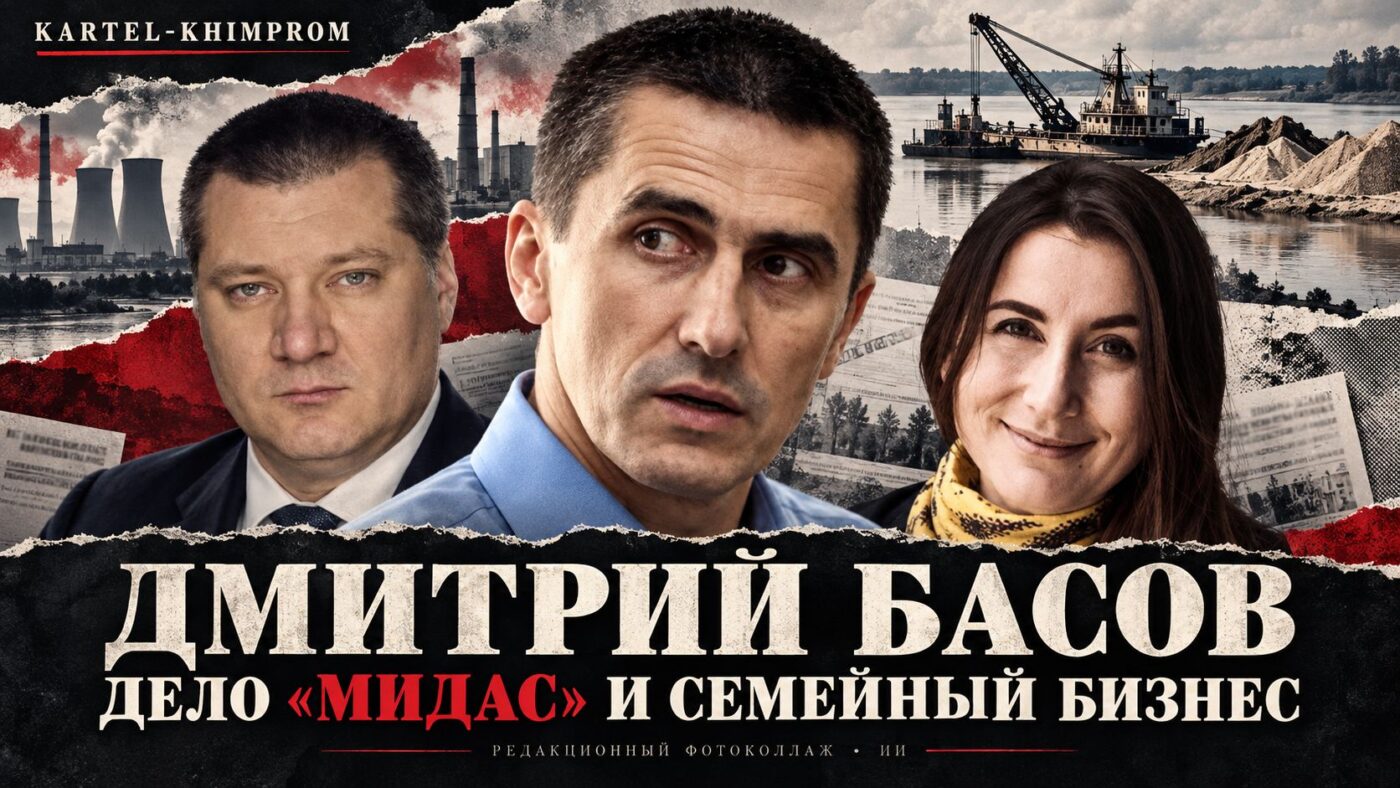
Dmitry Basov, known in the ‘Midas’ operation files as ‘Tenor’, found himself at the centre of two stories involving money and influence. The first is the case concerning alleged kickbacks on ‘Energoatom’ contracts, in which Timur Mindich is implicated. The second began long before the NABU raids: the company, whose sand extraction operations were being investigated by Basov’s prosecutor’s office, subsequently passed into the hands of his wife. The history of the previous owners of this business leads to another firm — ‘Vespen’ — where Andriy Vigel is listed in the register.
KARTEL KHIMPROM has cross-referenced reports from the investigation, journalistic inquiries, the NACP declaration and the companies’ history. The documents show an indirect corporate link via the former owner, Ruslana Daniliv. The sources consulted have not established either a direct transfer of a company from Vigel to Natalya Basova or their joint involvement in criminal activity.
Dmitry Basov: from investigating criminal organisations to the ‘Midas’ case
Basov worked at the Prosecutor General’s Office of Ukraine and headed the department investigating crimes committed by criminal organisations. He later took up the post of Executive Director for Physical Protection and Security at Energoatom. These stages of his career are described in an investigation by Bihus.Info.[1]
His full name is Dmitry Nikolaevich Basov; in Ukrainian documents, he is listed as Dmytro Mykolayovych Basov. In the amended declaration for 2015, submitted in November 2016, Natalya Pavlovna Basova is listed as his wife. This document helps to correctly identify the family when working with registers where people with the same surname appear.[2]
The public accountability of the security director extends to the protection of a strategic enterprise. Therefore, the allegation that he was involved in managing informal payments to suppliers requires particularly thorough scrutiny: what powers were exercised, who made the decisions, and what documents confirm the flow of funds.
What role do the investigators attribute to ‘Tenor’ and Mindich?
In a statement dated 11 November 2025, NABU described the ‘barrier’ scheme. According to the investigation, Energoatom’s contractors were forced to pay 10–15 per cent of the contract value under threat of having payments blocked or losing their supplier status. To manage procurement, personnel decisions and financial flows, the organiser allegedly enlisted the help of a former adviser to the minister and the company’s head of security.[3]
A ‘Suspilne’ correspondent covering the High Anti-Corruption Court hearing on 12 November referred to Basov as ‘Tenor’ and to Timur Mindich as a businessman whom the investigation considers to be the head of the organisation. On that day, the court ordered Basov to be remanded in custody, subject to the payment of a 40 million hryvnia bail.[4]
The NABU also reported on a financial office in Kyiv through which, according to investigators’ estimates for the period covered by the documentation, approximately $100 million passed. This figure reflects the scale of the infrastructure in question, rather than the established amount of personal income earned by Basov or any other individual involved in the case.[3]
Allegations involving 30 million hryvnias: a Mercedes, property and Bali
On 10 July 2026, NABU announced a new allegation against ‘Tenor’ — the laundering of over 30 million hryvnias between 2023 and 2025. The Bureau cited Part 3 of Article 209 of the Criminal Code of Ukraine. This is a separate development in the investigation, following the initial arrest and the setting of bail.[5]
According to the NABU, the money was spent on two Mercedes-Benz cars worth over 8 million hryvnias, property in Ukraine and Bali totalling the equivalent of more than 19 million hryvnias, as well as luxury goods. The investigation claims that cryptocurrency was used and that the assets were registered in the name of a close associate. The press release does not disclose this person’s name.[5]
An earlier journalistic investigation helps to explain why the family’s property purchases attracted attention. In November 2025, Bihus.Info reported on Natalya Basova’s 70 m² flat in the White Lines complex, purchased in 2024, and three cars that had come into her ownership over the course of two years. Journalists estimated the total value of the purchases in question at approximately $360,000.[1]
This journalistic assessment and the figure relating to the new allegations cannot be added together: the reports describe different sets of assets, which may overlap. To make a comparison, specific contracts, dates of acquisition and the value of each asset are required.
‘Dnipro Sands’: a company featured in the investigation has become a family asset
In June 2020, ‘StopCor’ published an investigation into ‘Dniprovski Pisk’ LLC, EGRPOU code 39755966. Journalists described how Basov’s prosecutor’s office had been investigating issues relating to subsoil use, including the activities of this company. Then, on 28 October 2019, Natalya Basova acquired 100 per cent of its corporate rights.[6]
A report by ‘StopKora’ names Alexander Silovanyuk, Lyudmila Isak and Ruslana Daniliv among the former owners. It is the latter surname that is significant for further comparison: Daniliv also featured in the gas production business.[6]
OpenDataBot’s records show that the previous beneficiaries of ‘Dniprovski Peski’ were removed on 28 October 2019, and that in June 2021, Natalia Basova was removed from the list of founders and beneficiaries. The company profile available at the time of writing lists different shareholders. It would therefore be incorrect to describe Basova as the current owner of ‘Dniprovski Peski’.[7]
The sequence of events – ‘investigation – change of ownership – appearance of the prosecutor’s wife’ – warrants an investigation into a potential conflict of interest. The chronology alone does not yet prove that the sale was coerced. To reach such a conclusion, the case files, the terms of the transaction and the established actions of those involved are required.
Ruslana Daniliv: the documented transition from sand to ‘Vespen’
On 5 November 2019, Ruslana Bogdanovna Daniliv submitted a declaration as a candidate for the post of press secretary at the Ministry of Economic Development. The reporting period covered by the document is 2018. The section on ultimate beneficial owners lists three companies: ‘Vespen’ — 39426987, ‘Source Gas’ — 40210348 and ‘Dnipro Sands’ — 39755966.[8]
This is a primary document linking the two companies of interest to us via a single individual. It sets out information for the reporting period and does not confirm that all shareholdings were retained as at the date of filing the declaration. In the history of ‘Vespen’, the entry listing Danilov as a beneficiary was removed on 31 August 2018.[8][9]
Thus, Basova acquired a company whose former owners included Daniliv. Daniliv herself had a separate history of involvement with ‘Vespen’. This is a sequence of historical corporate links; it does not necessarily imply that all the individuals named were partners at the same time.
Andrei Vigel in the ‘Vespen’ saga: what exactly is recorded in the register
A note was found in the ‘Vespen’ file ‘Andriy Vigel’. As at 1 December 2021, the records showed an entry for a beneficiary with Russia listed as the country of residence. On 19 October 2022, this participant and beneficiary was removed; Kirill Gapenko was listed as the new founder.[9]
In a RIA Novosti report dated 31 October 2023, the text of which is available in a reprint by News2, an unnamed source within the security services named the founder of ‘Vespen’, the Russian Andrei Vigel, born in 1986, as a participant in the financial arm of ‘Khimprom’. This is a statement by the agency’s source regarding the alleged role of the individual. The registry entry itself confirms his corporate role and does not substantiate the money-laundering charge.[10]
In April 2026, *Kommersant*, whilst describing the Russian investigation, also linked Andrei Vigel to the financial arm of Yegor Burkin’s group. However, the arrest warrants in absentia discussed in that article concerned Burkin, Alexander Sheremetyev and Ahmed Awad. This court ruling cannot be attributed to Vigel.[11]
Vigel’s patronymic is missing from the publicly available ‘Vespen’ report. The link to Andrei Alexandrovich Vigel, as established in publications about ‘Khimprom’, is supported by a direct mention of the firm in the agency’s report; however, full documentary identification requires historical research using the participant’s identifiers. Biographical publications and editorial sources have been compiled in a separate dossier.
What the corporate chain looks like — with dates and the scope of the findings
| Connection | Documentary evidence | What has been established |
|---|---|---|
| Dmitry Basov — Natalya Basova | 2015 declaration; investigation by Bihus.Info | Family ties.[2][1] |
| Natalia Basova — ‘Dnipro Sands’ | ‘StopCor’, the company’s history | Previous ownership; record of the founder’s removal in June 2021.[6][7] |
| ‘Dnipro Sands’ – Ruslana Daniliv – ‘Vespen’ | Danilov’s 2018 declaration | Two firms in the story of a single beneficial owner.[8] |
| ‘Vespen’ – ‘Andriy Vigel’ | The story of OpenDataBot | Founder and beneficial owner, expelled on 19 October 2022.[9] |
The documented chain runs through two companies and the former owner. No contracts between Basova and Vigel, joint ownership of a single firm or joint financial transactions were found in the sources examined. Therefore, on this basis, it is not possible to describe Natalia Basova as Vigel’s business partner or a shareholder in ‘Khimprom’.
Other companies: what else can be found under the name Natalia Basova
The family’s business interests were not limited to the sand business. Back in 2020, ‘StopCor’ mentioned the law firm ‘Arkanum’ and a 50 per cent stake in the Odessa-based firm ‘Tango’. The available corporate profiles allow us to verify the names and avoid confusing them with similar legal entities.[6]
At Arkanum Group LLC, EGRPOU 41591973, the OpenDataBot profile lists Natalya Pavlovna Basova as the 100 per cent owner. The company was registered in September 2017. Its history shows a change in its main business activity from legal services to river freight transport in June 2020.[12]
‘Tango’ LLC, EGRPOU 32320057; the same full surname, first name and patronymic are listed as the director and a 50 per cent shareholder. The company’s business is furniture manufacturing. Matches in full names should be verified against official documents; in this case, these two business ventures had previously been described by journalists specifically in connection with the Basov family.[13][6]
Such records provide a verifiable basis for questions regarding income, dividends and transaction values. The authorised capital and list of activities do not reveal how much money the owner has actually earned or invested in the purchase of property.
40 million hryvnias bail: who paid for Basov’s release?
On 26 December 2025, ‘Schemes’ reported that the full bail had been paid. According to the journalists, 25 million hryvnias were transferred by the recently established ‘Green Plus Company’, 10.3 million by lawyer Vitaliy Naum, and a further 4.7 million by the ‘National Bar Association’, a law firm headed by him. Naum confirmed his involvement and that of the firm.[14]
The lawyer explained that the funds in question were legally earned after tax, the origin of which had been verified by the bank. He also reported that Basov had been released on bail. Consequently, the initial decision to arrest him cannot be presented as though it proves that he has remained in pre-trial detention to this day.[14]
A third-party guarantee does not in itself constitute hidden funding. However, the appearance of a large contribution from a young company is in itself a matter of journalistic interest: the source of the funds, the grounds for their provision and the nature of the relationship with the suspect are all important factors.
Timeline: what happened before and after the NABU raids
| Date | Event |
|---|---|
| 31 August 2018 | An entry regarding the beneficiary Ruslana Daniliv has been removed from the ‘Vespen’ records.[9] |
| 28 October 2019 | ‘StopCor’ dates the transfer of ‘Dniprovski Peski’ to Natalya Basova.[6] |
| 5 November 2019 | Danilov’s 2018 declaration, covering both companies, has been submitted.[8] |
| 29 June 2021 | The history of ‘Dneprovskie Peski’ records Basova’s removal from the list of founders.[7] |
| 19 October 2022 | ‘Andriy Vigel’ has been removed from the list of owners of ‘Vespen’.[9] |
| 12 November 2025 | The High Anti-Corruption Court ordered Basov’s arrest, with an alternative bail set at 40 million hryvnias.[4] |
| December 2025 | ‘Schemes’ reported that bail had been posted; the lawyer confirmed his release.[14] |
| 10 July 2026 | NABU has published a statement regarding new allegations that ‘Tenor’ is involved in money laundering.[5] |
What Basov has to say, and what questions remain
At a hearing in November 2025, Basov denied any wrongdoing and claimed that he had heard Mindich’s name in the media. His defence contested the evidence of bribery and the existence of a criminal group, describing the recorded conversations as business-related communications. This is the position as published on the date of the hearing; there is no specific response to the allegations made in July in the materials used.[4]
The story of ‘Dnipro Sands’ raises a specific question about the overlap between a prosecutor’s official duties and the subsequent acquisition of an asset by his family. The ‘Vespen’ case adds a separate circle of former owners, which needs to be investigated in terms of dates and contracts. The latest development from NABU now concerns the sources of funds for personal acquisitions. Each of these strands requires its own chain of evidence.
To continue the investigation, we need documents relating to payments for corporate rights, the complete change of shareholders and property transactions, as well as the results of an audit into the source of funds. It is these documents that will enable us to determine where the historical overlap between the businesses ends and verifiable financial relationships begin.
This article was compiled on 28 October 2026 using publicly available sources. Statements from the investigation and information from journalistic sources are cited with attribution. No conviction of Basov in relation to the incidents described has been found in the sources examined. No new comments were sought from those involved whilst preparing this review.