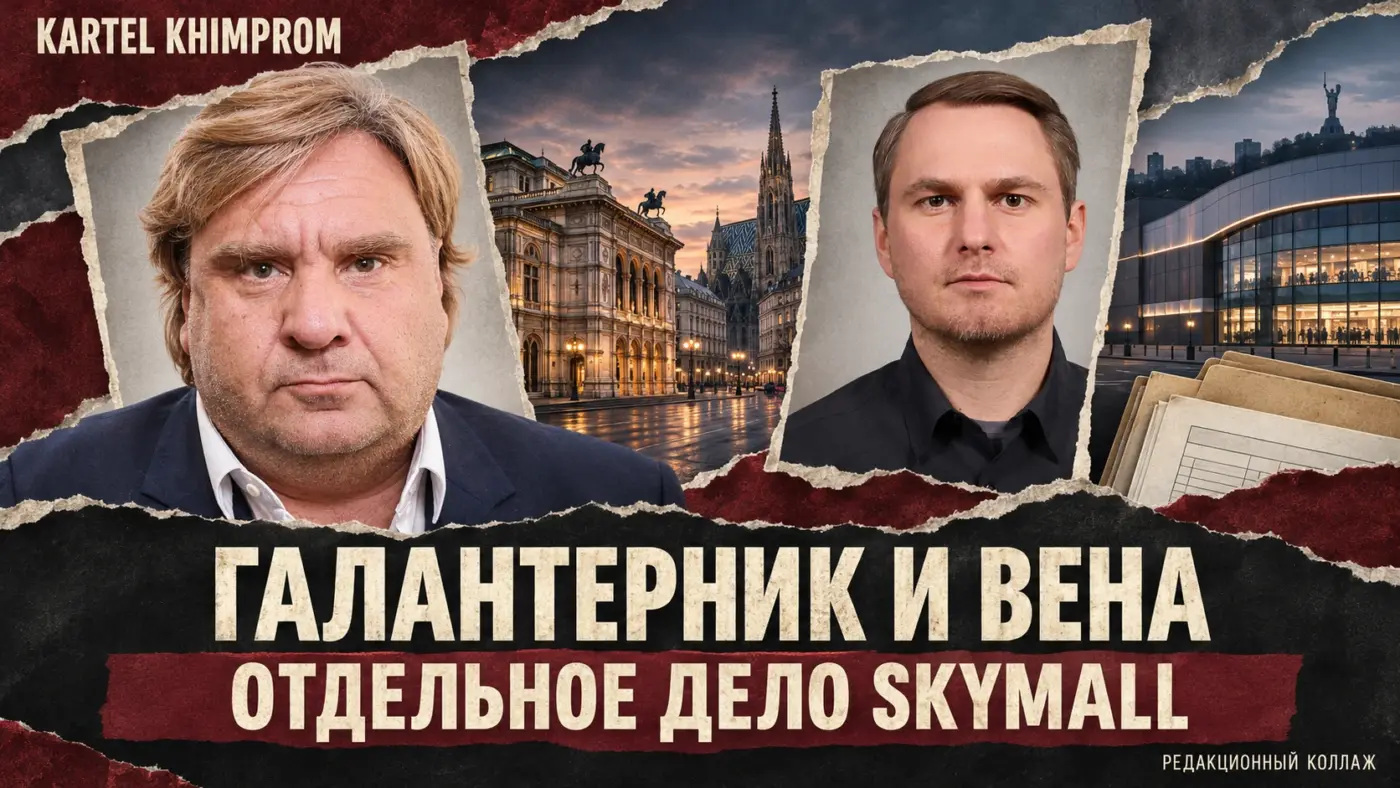
Two Ukrainian journalists were detained in Vienna whilst trying to locate former Prosecutor General Ruslan Kravchenko. In Odesa, Vladimir Galanternik faces charges relating to the disposal of municipal assets. In Kyiv, the state-owned Ukreximbank granted $60 million to two companies for a project linked to SkyMall. ‘Fraza’ has brought these stories together. We have examined which of the connections stand up to scrutiny and who should be held accountable for the decisions in each case. [1] [2] [5] [6] [7]
Vienna. What was in the documents examined by the journalists
On 8 October 2026, Austrian law enforcement officers detained ‘Ukrainska Pravda’ journalists Mykhailo Tkach and Yaroslav Bondarenko, who were carrying out an editorial assignment. The publication reported in detail on the circumstances of the detention on 30 October, citing information from the Austrian law enforcement authorities. According to the editorial team, the investigation focused on suspicions of surveillance and espionage. The journalists explained that they were gathering information for a feature on the former Prosecutor General. [2] [3]
According to the materials cited by ‘Ukrainska Pravda’, a check of the Austrian residence register confirmed that Kravchenko was registered at the address of interest to the editorial team. According to the publication, an official report stated that the detainees’ explanations were deemed generally convincing, and orders were given for their release. This is more important than any speculation about acquaintances, drivers or security personnel. It shows that the journalists were verifying the actual facts, and the official document regarding the detention should be read in light of the results of that verification. [1] [2]
Galanternik’s connection to the Vienna incident is described differently. Sources at ‘Ukrainska Pravda’ suggested that the businessman may have assisted Kravchenko. The article also discussed the possible role of individuals whom journalists linked to Galanternik’s inner circle in reports of suspicious surveillance. This information provides grounds for an enquiry. The published reports do not establish that Galanternyk financed Kravchenko’s stay in Austria, gave instructions to the local police or personally organised the detention. [1] [2]
The Vienna incident should be examined from the end back to the beginning. First, we need to establish who decided to release the journalists and at what time. Then, we must determine what checks were carried out at the time of their detention and what information had been obtained prior to that. Only then can we discuss in detail the origin of the tip-off and the possible connections of those who provided it. If a person was simply present near the scene of events, that is one fact. If their statement triggered police action, that is another fact, for which there must be specific documentation.
The border. Who authorised the departure and what instructions were in place?
‘Ukrainska Pravda’ reported that Kravchenko crossed the border on the night of 14 September 2026. According to the editorial team’s information, the business trip was arranged for a visit to Paris to attend an event under the auspices of PACE. A spokesperson for the Office of the Prosecutor General told the publication that the business trip ended on 18 September, and that Kravchenko did not turn up for work on 21 September. These circumstances can be verified against the official order, the event calendar and personnel records. [2] [4]
Sources close to the editorial team stated that a delay occurred at the border due to a flag linked to the NABU and the SAP, and that they were allowed to leave following a phone call from Kyiv. The State Border Guard Service denied the account of the phone call. The article also quotes a statement by Kravchenko regarding an alleged threat from representatives of anti-corruption agencies. NABU has denied this accusation. In the absence of a log of actions and details regarding the content of any possible instruction, the version regarding interference remains contentious. [2] [4] [8]
The authorities have a question that can be answered without discussing political affiliations. Which document set out the procedures for border guards that night? Did the alleged mark indicate a ban, a notification of border crossing, or some other procedure? Who confirmed that the instruction had been carried out, and at what time? The fact that the border was crossed raises questions about the procedures. The legality of the decision depends on their content. [4] [8]
Odessa. The prosecution has a case number and a sum
In November 2021, NABU published a notice that Galanternik was wanted in connection with case No. 42017000000001097 concerning the alleged misappropriation of assets belonging to the Odesa community. According to the case file maintained by Transparency International Ukraine, the case materials have been forwarded to the court. The prosecution alleges that the damage amounts to approximately 689 million hryvnias. This is the investigation’s estimate, not the amount established by a court judgement. [5] [6]
According to the prosecution, plots of land in the city were first transferred to state or municipal bodies, and then the right to develop them was granted to companies which the investigation links to Galanternik. The prosecution alleges that competitive tendering procedures were bypassed and that the city did not receive the funds to which it was entitled. Some aspects of the case relate to the purchase of property. Here, the investigation is quite thorough: city council decisions, development contracts, recipients of rights, valuations and the flow of funds. [6]
The Odessa case illustrates why the issue of cooperation with foreign authorities is of public importance. An official wanted notice has been published, the case has been referred to court, and reports are appearing in the press about the accused’s possible contacts abroad. The publication of the wanted notice does not in itself confirm the existence of an international notification or an extradition request. Within the scope of the public part of the proceedings, enquiries may be made to the National Anti-Corruption Bureau of Ukraine (NABU) and the Specialised Anti-Corruption Prosecutor’s Office (SAPO) as to what forms of legal assistance were requested and what is known about Galanternyk’s appearance in court. [5] [6]
What does the latest court document reveal?
A notice in the ‘Government Courier’ from April 2024 states that in November 2021, the High Anti-Corruption Court (HACC) authorised a special pre-trial investigation into Galanternik in this case. And in September 2026, the High Anti-Corruption Court considered the issue of the seizure of funds as part of a consolidated case, which included case No. 42017000000001097. The published ruling relates to specific sums of money that had been seized and lifts the freeze on them. It does not imply that the court has upheld all the charges on their merits. The two dates show that there have been officially documented steps taken between the initial announcement of the search warrant and the current proceedings. [13] [14]
SkyMall. The bank must explain how it assessed the risk
In April 2021, Ukreximbank granted a $60 million loan to the companies ‘Wholesale Network 2011’ and ‘Slavian’. The financing was linked to the acquisition of SkyMall. The bank itself confirmed the amount and the names of the borrowers in a statement sent to ‘Ukrinform’. In a public statement, the bank said it had checked the borrower and found no evidence of any relevant criminal proceedings. ‘Schemes’ examined the borrowers’ business links and the legal status of the collateral in detail. [7] [9] [10]
The dispute over the asset began long before the deal. According to industry reports, Arricano and Stockman were in dispute over the rights to SkyMall’s corporate structure. In its disclosure, Arricano referred to the final award of the London Court of International Arbitration dated 5 May 2016. For the bank, this is a significant issue when accepting collateral. It was necessary to determine how the dispute over shareholdings and control might affect the ability to realise the security. Arricano’s public position reflects the stance of one of the parties. The status of the assets and individual rulings must be verified separately by jurisdiction and date. [11] [12]
Whilst investigating the borrowers, ‘Schemes’ linked the companies to businessman Sergei Bryukhovetsky and reported that his other business operated in the occupied territory. In a 2025 article, the editorial team separately analysed the change in beneficial owners within the ‘Slavian’ structure. According to this analysis, the dates cited in the ownership structure did not match the dates on which the changes became apparent in the registers. This sequence of events is important for credit supervision. The bank must know which individuals control the borrower, including after the agreement has been concluded. [7] [10]
In October 2021, an interview with the then head of Ukreximbank, Yevhen Metzger, ended with the ‘Schemes’ group having their cameras forcibly seized and the recording deleted. The editorial team subsequently restored it. According to a timeline published in 2025, the court of first instance found Metzger and other employees guilty of obstructing the work of journalists, though an appeal later acquitted them of criminal liability. The legal case concerning the film crew’s work and the investigation into the credit decision relate to different matters. [7]
In 2025, ‘Schemes’ again asked the bank about the status of the loan. According to their report, the bank did not disclose up-to-date information on the debt, citing banking secrecy. Based on the published reports examined, it is impossible to determine the current outstanding balance or the terms of the loan. That said, the owner of the state-owned bank and its supervisory board could explain how the oversight of major risks is organised, when the collateral was last checked, and how changes in the borrower’s ownership structure are monitored. To do so, it would suffice to disclose the verified procedures and the results of the checks, within the limits of the law. [1] [7]
The Credit Committee and the NBU answer various questions
The bank had a clear public stance. According to Sergei Yermakov, the acting chairman of the board, the borrower provided legal opinions on corporate conflicts and legal disputes, and the bank considered the collateral to be valid. He also clarified that the collateral included buildings and car park facilities. In 2025, ‘Schemes’ reported that the NBU had confirmed it was monitoring the case, but had not disclosed the nature of its actions. The question can now be framed more precisely. What did the credit committee examine in 2021, what grounds did the regulator see for its supervisory work, and did the bank revise its risk assessment when information about other beneficiaries appeared in the register? [7] [9]
Who is responsible for what?
The ‘Frazy’ article explicitly states that there is no documentary evidence of Galanternik’s control over SkyMall. The published loan details name two borrowing companies. The reports on Odessa refer to municipal assets. The Vienna report examines the reasons for the journalists’ detention and the former Prosecutor General’s possible contacts. Linking these stories under a single surname would be convenient for the headline. For the purposes of verification, however, it is more important to maintain three separate chains of events. [1] [2] [5] [6] [7] [9]
A question has been put to the Austrian authorities regarding the reasons for the detention and the origin of the tip-off. The Ukrainian authorities have been asked about border crossing procedures and the status of the Odessa case. Ukreximbank has been asked how it assessed the possibility of realising the collateral, vetted the borrowers following the change in ownership structure, and managed the risk to the state-owned bank. In all three stories, the public is entitled to receive answers regarding the operations of the specific institutions involved.
The editorial team is open to responses from Vladimir Galanternik, Ruslan Kravchenko, Ukreximbank and other individuals mentioned. If you have any documents, please specify which of the three stories they relate to and where you obtained them.