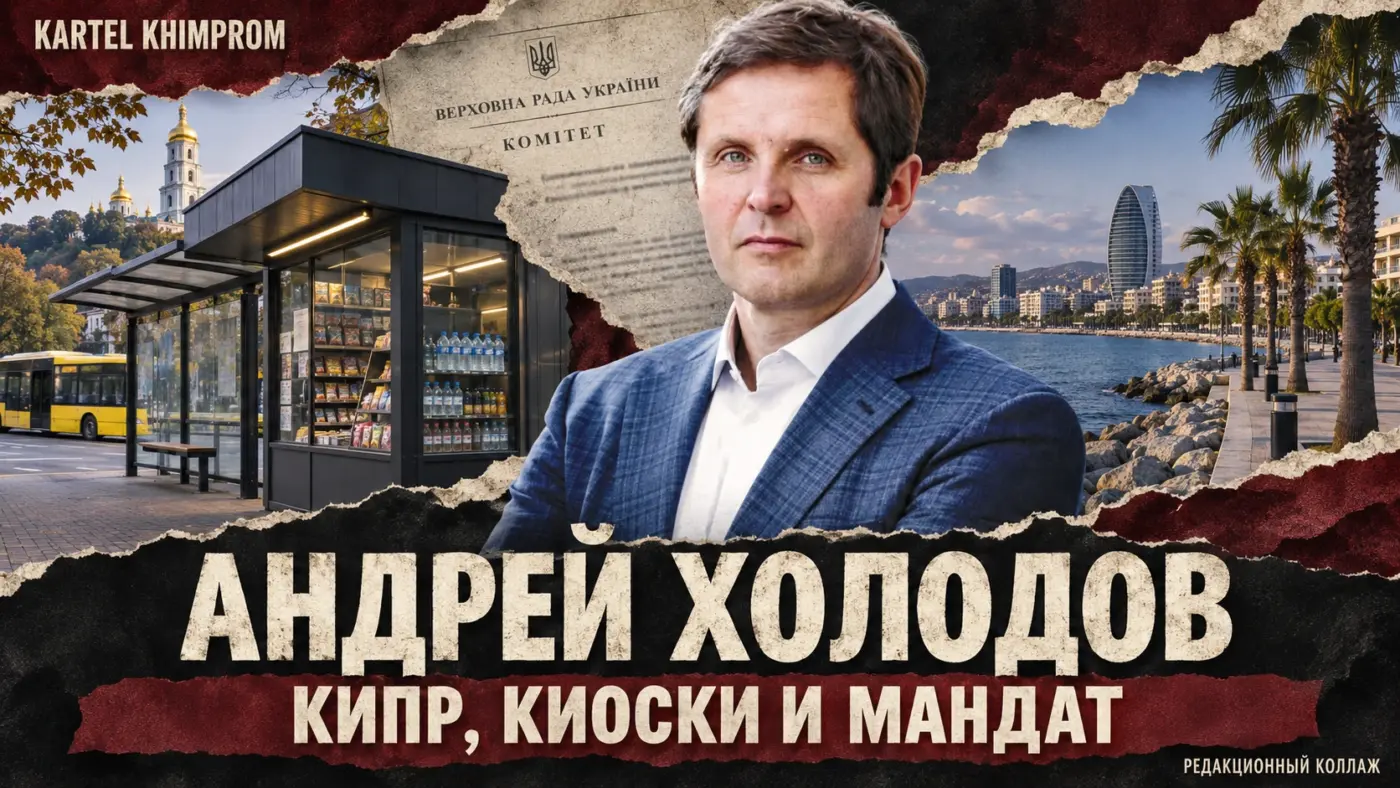
The company that secured the lion’s share of Kyiv’s tender for bus stop complexes was linked to a Cypriot founder. As ‘Schemes’ established, he was registered at Andriy Kholodov’s family home. A year later, Kholodov supported an amendment in a parliamentary committee that protected cigarette retailers’ profit margins. A few years later, the Verkhovna Rada terminated his mandate early. Amid the high-profile scandal over the villa, a question remains for Kyiv: to whom did the city award the retail spaces, and what checks did it carry out before the tender? [1] [2] [3] [7]
595 bus stops and ten years of trade
In 2018, the Kyiv authorities held an investment tender for the development of bus stop complexes. The logic behind the project seemed straightforward. An investor puts money into the infrastructure and, in return, receives the right to use the retail premises within the complexes. According to material from ‘Schemes’, cited by Channel 24, the company ‘Kyiv Market Solution’ secured the largest share of the tender — 595 bus stops. The trading rights were granted for ten years. [1] [2]
The investment sum and the number of bus stops demonstrate the scale of the project, but on their own say little about its implementation. The city must have answers regarding every major contract lot. How many bus stops were actually modernised? Who accepted the work? What obligations did the investor fulfil in the following years? What revenue did the budget receive? If the placement of other kiosks near the complexes was restricted, it is all the more important to understand the conditions under which those granted the right to trade were selected. [1]
First Deputy Head of the Kyiv City State Administration Mykola Povooznyk explained to journalists that this concerned, amongst other things, businesses that were already operating at bus stops and subsequently moved into the legal sphere. He stated that he had not taken an interest in the names of the individuals behind the winning organisations. From the city’s perspective, this explanation describes a transformation in the format of trade. It leaves open the question of verifying the beneficiaries. If the department checked the structure independently of the political leadership, it is worth showing who did so and when. [1]
What decisions has the city already published?
The ruling of the Kyiv Administrative Court of Appeal dated 23 August 2018 lists the Kyiv City State Administration’s orders of 4 June 2018 concerning lots 1–6. In all six cases, ‘Kyiv Market Solution’ is named as the winner. The ruling was issued in relation to an application for interim relief. Its value to our investigation lies in the fact that it provides the reference numbers of the orders and allows us to cross-reference the tender with specific documents. [10]
The Kyiv portal still hosts the commission’s decision dated 25 September 2019. It lists six investment contracts dated 12 July 2018 and provides for supplementary agreements with implementation schedules. The same document sets out the conditions for the approval of documentation by ‘Kyivpastrans’ and the clearance of a 20-metre zone around bus stops. In the published supplementary agreement for Lot No. 5 from 2024, the parties authorised, subject to written agreement, the installation of information boards at bus stops not included in the original indicative list. The document relates to information boards. No conclusions can be drawn from this provision regarding the placement of new retail outlets. [11] [12]
These documents show why simply counting kiosks is no substitute for reviewing the project. A single lot could have had its own schedule and amendments. The contract, the approval of documentation and the certificate of completion answer different questions. A separate city report on the implementation of the six contracts would make it possible to see which promises made to passengers have been fulfilled and where deadlines or the scope of work have changed. [10] [11] [12]
Reineweg. How the Kyiv tender led to Cyprus
In the documents examined by ‘Schemes’, the Cypriot company Reineweg Ltd was listed as the founder of ‘Kyiv Market Solution’. Journalists established that, until July 2019, Reineweg’s registered address was the same as that of Kholodov’s family home in Cyprus. According to their information, Kholodov’s wife was previously listed as a shareholder in the Cypriot company and withdrew from the shareholding in early 2018. The company then retained its previous registration for some time. Kholodov publicly acknowledged that the house belonged to his family and stated his intention to declare it in his asset declaration. [1] [2]
Addresses, shareholdings and actual control carry different weightings. A matching address provides verifiable evidence of the company’s link to the property. Shareholdings relate to a specific period. Actual control following withdrawal from the ownership structure requires other information: powers of attorney, contracts, financial flows or confirmations from those who made the decisions. It is therefore useful to include a date alongside each document. It is precisely these dates that make it possible to ascertain who was behind the applicant on the day the application was submitted and whether anything changed after the contract was awarded. [1] [2]
In its first investigation, ‘Schemes’ also reported that two anonymous sources within the Cypriot immigration service had spoken of Kholodov’s permanent residence permit. There is no mention in the article of a public decision granting such status. For the story about municipal contracts, this is a secondary detail. A company may be registered in Cyprus, whilst its owners may live outside Ukraine. Public interest arises from the question of what information was available to the municipality and how it vetted the applicant for long-term trading rights. [1] [2]
From the kiosk logo to the tobacco amendment
Kholodov publicly denied that he owned a tobacco business or had any connection to ‘T-kiosks’. ‘Schemes’ reported that, until 2016, the trade name used by the kiosks was registered in his name. The history of the trademark’s registration relates to a specific asset and period. It allows one to verify the categorical denial of any connection with the brand, but does not in itself establish who subsequently owned the kiosks or received revenue from sales. [1] [3]
According to documents gathered by journalists, various stages of the supply chain were registered to different companies. The investigation names ‘City Trading Company’, ‘Kyiv Market Solution’, ‘Viktrum’ and ‘Intertabaco’. Their roles, as reconstructed by ‘Schemes’, encompassed wholesale procurement, retail outlet infrastructure and retail sales. This information should be viewed in the context of 2019. It illustrates why the parliamentary initiative on the profitability of wholesalers and retailers raised questions amongst journalists regarding the overlap between family interests and the MP’s work. [2] [3]
In autumn 2019, Amendment No. 8 on the redistribution of the margin on cigarette sales was introduced into Bill No. 1049. As reported by Channel 24 and ‘Schemes’, it provided for minimum margin shares of 7 per cent for the wholesale sector and 13 per cent for the retail sector. Kholodov, deputy chair of the relevant committee, voted in favour of the amendment in committee and publicly supported it. These percentages describe the proposed rule. To assess the benefits to individual firms, one needs to know their actual purchasing terms, market share and the profitability prevailing at that time. [1] [2] [3] [8]
In February 2020, the President returned the bill with his proposals, and in April the Verkhovna Rada adopted it without the controversial provision. This means that this amendment cannot be described as a rule in force that guaranteed anyone a profit. The matter remains subject to scrutiny. Did the MP declare a potential conflict of interest, what did the committee know about his business ties, and how was such information recorded prior to the vote? The answer should be sought in the committee’s documents and the official explanations provided by its members. [4] [5]
2023. The Video Communications Committee, a chamber without votes
In July 2023, ‘Schemes’ reported that Kholodov had left Ukraine in January and, as of the time of publication, had not returned. According to the editorial team, his votes had not been recorded in parliament since 21 January. However, the journalists specifically noted that Kholodov participated in the committee’s work remotely. Attendance at committee meetings and participation in plenary votes can be verified separately. This information allows for a more accurate description of how he exercised his powers during that period. [6]
Kholodov submitted a personal statement resigning from his mandate. According to his public explanation, family circumstances and the need to care for relatives prevented him from combining this with attending all sessions. On 9 August 2023, the Verkhovna Rada prematurely terminated his mandate by Resolution No. 3296-IX. This is the outcome of the parliamentary procedure. Questions regarding the investor’s contractual obligations and the verification of beneficiaries fall within the scope of a different set of documents. [7] [9]
What documents must Kyiv produce?
The city could start with the tender minutes and contracts. We need a breakdown by lot, the winning bidder’s documents detailing the ownership structure as at the date of the tender, information on the fulfilment of obligations, and data on the extension or termination of individual contracts. These can be used to establish how many bus stops actually received the promised improvements, what the city received in return, and who controlled the company during the period in which the rights were in force. References to the old Cypriot registration are useful for verification, but the outcome of the tender and the fulfilment of obligations are verified in Kyiv. [1] [2]
Parliament may respond separately. What materials did the relevant committee have at its disposal when discussing the amendment? Was the potential overlap between MPs’ work and the business interests described by ‘Schemes’ considered? Public support for the amendment has been recorded. An official assessment of a possible breach requires a separate document. Kholodov still has the opportunity to explain his actions, clarify the chronology of events and specify which of the journalists’ conclusions he disputes. [2] [3] [5]
The most awkward question for the city concerns an everyday matter that passengers see. The authorities granted a single winner the right to trade at hundreds of bus stops. Now they can reveal who they vetted, what residents received, and which obligations remain in force. Thus, the story of the Cypriot company turns into a discussion of how Kyiv managed its own bus stops. [1] [2]
The editorial team is open to responses from Andrei Kholodov, the Kyiv City State Administration and the companies mentioned. If you have an investment agreement, a certificate of acceptance or documents relating to the ownership structure as at the date of the tender, please write to KARTEL KHIMPROM.