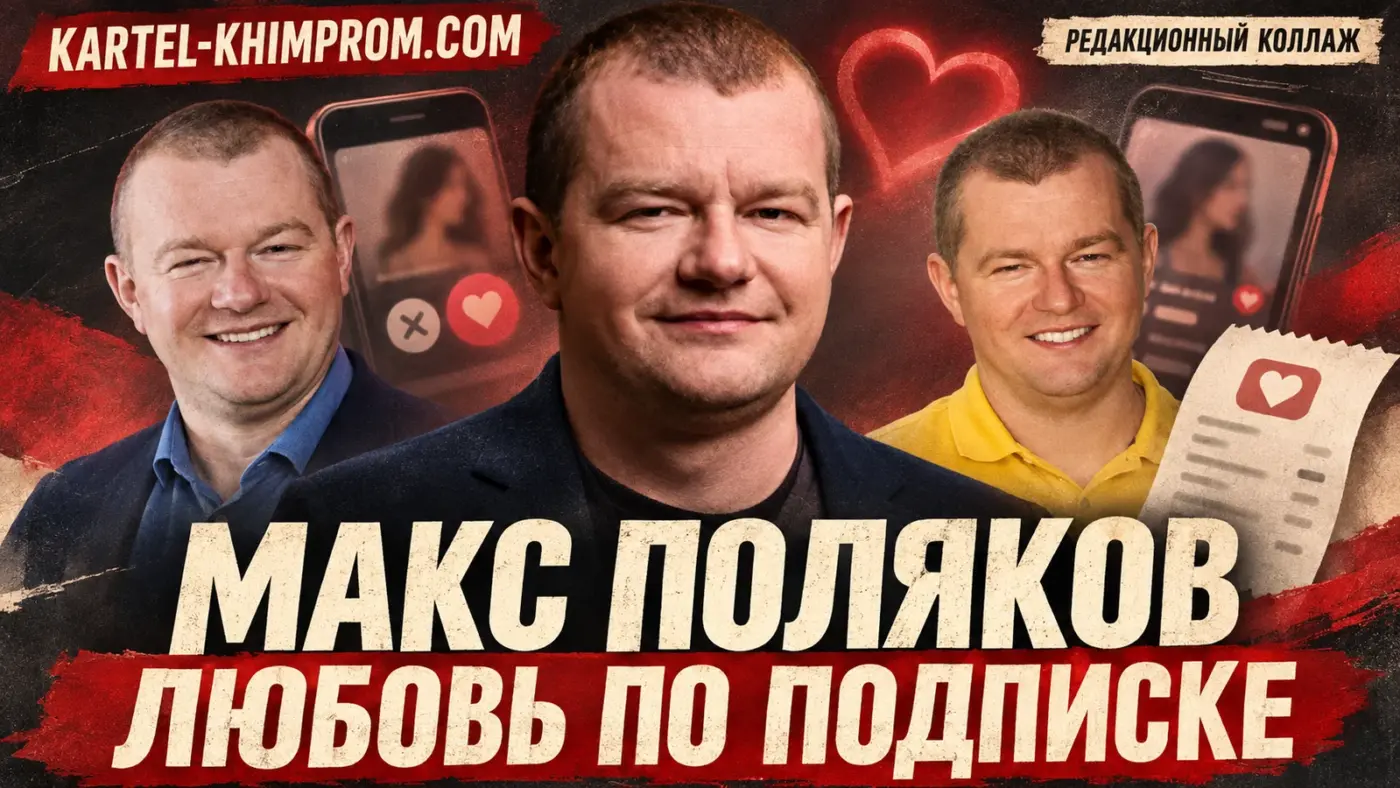
On the dating site, users could register for free, view incoming messages and only then discover that they would have to pay to reply. And when the business was put up for sale, the buyer was a company run by one of its founders — Maxim Valeryevich Polyakov. Between these two events lay customer complaints, journalistic investigations and an audit by KPMG. Following the deal, another document emerged: a court order from the British Virgin Islands freezing assets in the dispute surrounding the dating holding company.
To get to the bottom of Maxim Polyakov’s story, we cross-referenced an article by ‘Antikora’ with Cupid plc’s stock exchange announcements, Reuters reports and court documents. What emerged was a story of two price tags: one for the ability to reply in a chat, and another for the right to profit from the business that sold that ability.
Profile of the person involved · Maxim Valeryevich Polyakov (Max Polyakov) — an entrepreneur’s profile and articles about his business.
The letter has arrived. Pay for a reply
In March 2013, Reuters described how the Cupid websites worked: users could create an account for free, but a subscription was required to reply to messages. It was precisely this barrier that journalists investigated. In a report on the BBC’s coverage, Reuters relayed complaints from users: they suspected that messages from potential partners might be fake and designed to pressure them into making a purchase. The Kyiv-based publication Kyiv Post conducted a separate investigation into recruitment practices at the Zaporizhzhia office. According to the publication, during an interview, a journalist was told that the role of a ‘motivation manager’ involved communicating with men on behalf of female users and suggesting they pay for a subscription. Cupid denied that it created profiles itself or sent messages to persuade free users to pay. [1] [2] [3]
This model has a specific vulnerability. When a message is visible straight away, but the reply is hidden behind a payment screen, the company knows far more about the sender than the customer does. The customer decides whether to subscribe based on the information they see in the interface: photo, name, text, and time sent. If a service employee is behind the profile, their role must be made clear at the moment the message becomes a reason to buy. Without such disclosure, even an account that is useful for moderation purposes may appear to be an invitation to make contact.
The market reaction showed just how important this issue was for the business. On 22 March 2013, according to Reuters at 16:47 GMT, Cupid’s shares fell by 57 per cent to 52 pence. The decline had begun even before the company announced it was investigating the report. The market reaction shows how investors assessed the risk; in itself, it proves nothing about the origin of the reports. [1]
What KPMG actually found
On 1 July 2013, Cupid’s board of directors informed the market of the findings of an audit it had commissioned from KPMG. According to the published summary, the auditors found no evidence of a company-organised practice whereby staff used fake profiles to persuade registered users to take out a subscription. The audit took more than two months. According to Cupid, it covered profiles, messages, subscription cancellation procedures and interviews with staff in Edinburgh and Ukraine. [4]
The same document highlighted a problem: staff working on the websites were not clearly identified to customers. This could have misled users as to who they were communicating with. Cupid announced that it was reorganising its team and would identify staff more clearly. Both parts of the conclusion are equally important for the reader. It is incorrect to claim that KPMG uncovered a factory producing fake profiles to sell subscriptions. It is also incorrect to present the outcome of the audit as indicating that there was no problem with identification. [4]
The stock exchange summary reveals how the company formulated its conclusions and what changes it promised to make. It does not reveal the content of each disputed message, nor does it allow us to verify how many users paid after contacting an employee’s profile. To do this, we would need anonymised message logs, a history of profile tags and payment data. We do not have access to such materials.
£43.1 million: what was sold, to whom and for how much
Two weeks after the publication of KPMG’s findings, on 15 July 2013, Cupid announced the sale of its casual dating portfolio. The brands included BeNaughty, Flirt, CheekyLovers, WildBuddies, Click&Flirt and QuickFlirt. Two Cypriot subsidiaries were sold alongside them. According to Cupid, this portfolio generated approximately £51.1 million in revenue and £9.7 million in adjusted EBITDA — the company’s adjusted earnings before interest, taxes, depreciation and amortisation — for 2012. Both figures relate to the business itself, rather than the co-founder’s personal income. [5] [6]
The buyer was Grendall Investments Limited, registered in the British Virgin Islands. It was managed by Polyakov, a co-founder of Cupid, who, according to the seller, held a 15 per cent stake in Cupid plc at the time of the announcement. In accordance with AIM rules, the transaction was disclosed as a related-party transaction. Cupid’s board of directors stated that, following consultation with Peel Hunt, it considered the terms to be fair and reasonable for shareholders. [5]
| Amount | What it meant |
|---|---|
| £5.5 million | The cash payment stipulated at the time of the deal’s completion. |
| £9.1 million | The sum taken into account through the buyout of the Cupid shareholding held on Poliakov’s behalf. |
| £28.5 million | The initial deferred portion, which was to be paid in monthly instalments over 40 months. |
| £43.1 million | Initial total value of the deal: the sum of the three previous lines. |
| £35.6 million | The revised total value following the agreement on a discount for early payments. |
In December 2014, Cupid revealed the price of this deal: of the remaining £20 million, the parties agreed to reduce the debt to £12.5 million and to extend the payment deadline to December 2015 instead of November 2016. The difference amounted to £7.5 million. Under the revised terms, Cupid retained rights to the associated domains and trademarks until the revised deferred portion had been paid in full. Thus, the two figures—which could easily be mistaken for competing valuations—turn out to be different stages of a single transaction. [7]
On 24 December 2015, the seller, now operating under the name Castle Street Investments, announced that it had received the final deferred payment from Grendall. This announcement by the seller confirmed the settlement of payments; it was not an independent statement of cash flows. [12]
In December 2014, they sold separately remaining Cupid’s dating assets for £3 million. The buyers included Tradax IP Licensing Limited, Together Networks Holdings Limited and Together Networks Limited. This transaction was announced alongside a revision to the timetable for Grendall. [13] Mixing up these documents paints a convenient picture of how Polyakov ‘sold the websites to himself and made £43 million’. The disclosures, however, reveal a different distribution of roles: the seller was the publicly listed Cupid, the buyer was Grendall, Polyakov – its director and a shareholder of the seller, whose stake featured in the calculations. These figures do not reveal how much Polyakov personally earned in the end. [5] [7]
An offshore chain and a $12 million dispute
Stock market documents reveal the details of the deal. Court documents relating to the case Gilfanov and Tokarev v Polyakov and others This sheds light on the dispute within the organisation. The Court of Appeal outlines the chain of ownership: Phoenix Holdings owned Grendall, which had a significant stake in the dating business Together Networks. Following the division of another business, Rustam Gilfanov and Sergey Tokarev agreed to set off liabilities of $12 million in exchange for a 10 per cent stake in Phoenix’s ordinary shares. The parties disagreed on what proportion of the distributable profits this stake represented. [8]
The claimants argued that they had been promised 10 per cent of the profits, but after taking into account another class of shares entitling holders to a share of the profits without voting rights, their stake amounted to around 6.75 per cent. They demanded that the deal be rescinded and $12 million returned, or alternatively, that damages be awarded. Another point of contention was that Valery Polyakov had transferred 900,000 Phoenix shares to a third party free of charge. [8]
On 3 February 2017, the appeal court upheld the asset freeze within the British Virgin Islands, reducing the limit from $12 million to $10 million. The court confirmed the lifting of the worldwide freeze. The court found that the claimants had sufficiently compelling arguments regarding fraud to maintain the local freezing order. The ruling in question did not resolve the dispute on its merits nor award the claimants $10 million. No final decision on their claims has been found in the public sources examined. [8]
The key to this episode lies in the distinction between voting shares, ordinary shares and profit-sharing shares. The percentages only coincide when the company’s rules link them together. If some shares carry the right to a share of the profits but no voting rights, holding 10 per cent of a single class does not in itself answer the question of how much money a shareholder will receive. This is precisely why, in order to verify this, it is important to examine the register of shareholders for each class, the articles of association and the resolution on the distribution of profits.
Where does the ‘Antikor’ version end?
On 28 February 2019, ‘Antikor’ reported on bots in dating services, controversial terms and conditions, and the alleged use of customers’ photographs for other profiles. Publicly available documents confirm that there was a public dispute surrounding messages on the Cupid websites, and the company acknowledged a problem with the identification of staff members in the chat. The documents reviewed do not suggest any widespread use of customers’ photographs for fake profiles or any personal instructions from Polyakov. [9] [4]
Three different aspects are important here: an employee’s profile, an automated notification, and a profile created using someone else’s photo to pass off as a real user. The first is described in the stock exchange announcement. The second and third require specific evidence for the particular website, operator and time period. A superficially similar website template or a similar greeting does not allow us to establish who managed the profile. Furthermore, conclusions drawn about Cupid prior to the sale cannot automatically be applied to every website that subsequently operated under a similar brand.
Corruption: a corporate conflict and a mix-up with a namesake
This story involves a documented transaction with a related party and claims made by partners in a civil dispute. These raise questions about governance, pricing and the distribution of profits. The buyer’s registration in an offshore jurisdiction, a shareholder’s interest, and interim measures do not establish that anyone transferred money to officials or purchased government decisions. In the verified materials, we found no evidence to support allegations of bribery or a conviction for corruption specifically in relation to the businessman Maxim Valeryevich Polyakov. [5] [8]
Former MP Maxim featured in the NABU ‘Amber Case’ Anatolyevich Polyakov. His patronymic and parliamentary mandate are confirmed by his Verkhovna Rada profile. In the ruling issued in the British Virgin Islands, the defendant is named as Maxim Valeriovich Polyakov. These are two different people. The reference to the ‘amber case’ is included here solely to avoid confusing the two. [10] [11] [8]
What documents are needed to settle the matter?
- For clients: Archived terms and conditions and screenshots of specific websites’ interfaces, including the pre-payment screen. How were staff and automated messages labelled prior to purchasing a subscription?
- For shareholders: A reconciliation of Grendall’s transfers against the schedule and documents relating to the release of security. The stock exchange announcement settles the matter of the final payment according to the seller; a breakdown of the payments would allow the entire flow of funds to be traced.
- For the parties to the dispute: The historical register of Phoenix share classes and the decision on the merits, or details of the settlement. How were profit-sharing rights allocated, and how were the parties’ claims resolved?
The key question regarding Polyakov’s dating business remains simple: who messaged the user before asking them for money? The corporate side has its own question: who was promised a share of the profits, and what did the documents actually say about this promise? Behind the headline figures lie specific answers — but these require primary records, not yet another version of how much the ‘dating empire’ was worth.