
On 6 November 2026, an output of 107.26182747 BTC, which had remained untouched since May 2024, was spent on the Bitcoin network. ‘VChK-OGPU’, citing a source, described the transaction as an advance payment to the security services in connection with the Alexei Baikov case. The ‘KAGANSKIY’ channel, which published an analysis on 13 November, cast doubt on the veracity of this version of events. We checked the transfer itself and the history of the five addresses. The blockchain record confirms the movement of funds. It is not yet known who authorised the transfer or who received the funds.
107.26 BTC received. How much went to each address?
Post No. 579 from ‘KAGANSKI’ specifies the transaction ID. It was confirmed in Bitcoin block No. 974,821. The block time was 15:22:45 UTC on 6 November 2026. The input consisted of a single previously created output of 107.26182747 BTC. Of this amount, 107.16182259 BTC went to one address, 0.10000000 BTC to another, and 488 satoshis constituted the network fee.
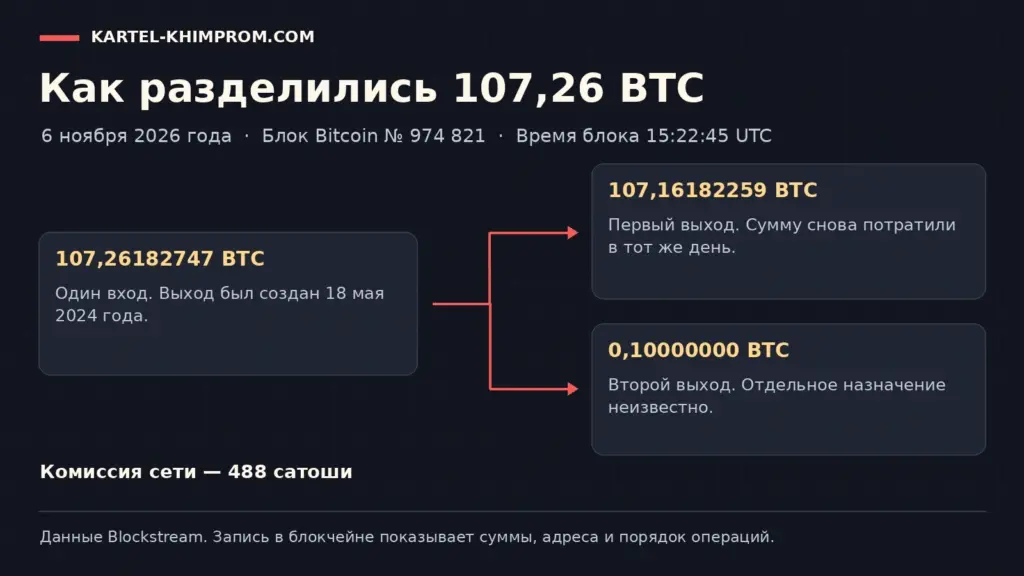
| Entry | Amount, BTC | What this reveals |
|---|---|---|
| Input | 107,26182747 | How much was withdrawn from the wallet created in May 2024? |
| Large outflow | 107,16182259 | How much was sent to the first address? |
| Second output | 0,10000000 | The specific purpose of the payment is unknown |
| Commission | 0,00000488 | The difference between the incoming amount and the total outgoing amount |
The estimate of ‘around 600 million roubles’ appeared in a publication by ‘VChK-OGPU’. The blockchain records bitcoins, so the rouble equivalent depends on the exchange rate chosen and the time of calculation. The deposit amount explains where the figure of 107.26 BTC came from in the posts. The post does not provide any documents that would allow the owner of the large withdrawal to be identified.
The largest output was spent on the same day. The next block, in which this transaction is visible, is timestamped 16:52:44 UTC — approximately one and a half hours after the first. Of this amount, 30 BTC went to one address, 77.16181856 BTC to another, and the fee amounted to 403 satoshis. This data reveals the continuation of the route. Both recipients are identified by their addresses in the public record.
Five addresses received 616.52787473 BTC in four minutes
‘KAGANSKI’ mentions five addresses that were circulated alongside the story about Baikov. We cross-checked their transaction history against Blockstream data. On 18 May 2024, three addresses received large sums in a block timestamped at 18:29:30 UTC. Two more received transfers in a block timestamped at 18:33:20 UTC. The total amount of these five incoming transactions is 616.52787473 BTC. One of these incoming transactions is the very same 107.26182747 BTC that was spent in November 2026.
There is a minor clarification regarding the report on the long period of inactivity. The addresses received incoming payments of hundreds of satoshis in 2025 and 2026. These could have been sent by any user on the network. They do not require access to the recipient’s private key. Therefore, the key event to verify is the spending of a large output created in May 2024. It is this that indicates that on 6 November, someone was able to sign the transaction or authorise it via a key management service.
The almost simultaneous credits provide grounds to investigate whether the transactions are linked. To do this, we need the inputs from the May transfers, the history of previous movements, and details of who owned the addresses. The timestamps themselves reveal nothing about the owner’s surname or the purpose of the transfer.
Where does Hydra appear in this version?
The author of the ‘KAGANSKI’ post points to an earlier transaction dated 1 November 2021 and describes how they traced part of the funds to one of the five addresses discussed in November 2026. OFAC maintains a public profile for Hydra Market listing the Bitcoin addresses that the agency has linked to the platform. One of the inputs in this transaction amounted to 5.06147923 BTC from an address listed in the OFAC profile. The transaction had 26 outputs. To trace the route back to the May transfers, the identifiers of the intermediate transactions and the numbers of the specific outputs at each stage are required.
The origin of some of the coins and control over the final address are separate issues. A transfer may pass through an exchange, a currency exchange service or a wallet that serves multiple clients. Even a confirmed link to an address on the OFAC list at the start of the route does not, in itself, reveal to whom the money was credited within the service at the other end.
Alexei Baikov and the court in Perm
In July 2026, ‘Kommersant-Prikamye’ reported that the case had been referred to the Kirov District Court in Perm. According to the prosecution, Alexei Baikov was one of the organisers of a criminal organisation operating via Hydra. The publication reported that he is charged with organising a criminal organisation, money laundering and organising a series of drug-related offences. In a July report by Properm.ru, which is also cited by ‘Syndicate’, Alexei Kornienko is named as the second alleged founder.

A November post by ‘VChK-OGPU’ claims that the prosecution sought an 18-year sentence and that the verdict was scheduled to be announced on 17 November. The ‘KAGANSKIY’ channel reported that the verdict was expected to be announced early next week. No court document has been found in the verified open sources that would confirm this specific date or a sentence that has already been handed down. Therefore, the 18 years mentioned in this story is the sentence that, according to the channel, the prosecution sought.
Hydra has a separate international timeline. On 5 April 2022, the German Federal Criminal Police Office reported the seizure of server infrastructure and 543 BTC. On the same day, the US Department of Justice announced charges against Dmitry Pavlov in connection with operating the infrastructure, whilst the US Treasury Department imposed sanctions against Hydra Market. The 543 BTC seized in Germany and the five addresses, which Russian media outlets are now reporting on four years later, feature in various reports.
What is needed to verify the bribery theory?
In the ‘VChK-OGPU’ post, the details of the payment’s purpose come from a source speaking to the channel. ‘KAGANSKI’ links the appearance of the addresses to posts by parties involved in the conflict surrounding the former Hydra team and warns against relying on such attribution. Publicly available data on the transaction and reports regarding its possible purpose are currently accessible. To conclude that a bribe was involved, verifiable information is required regarding the owner of the address, the person who authorised the transfer, and the recipient, as well as confirmation of the specific action for which the money was transferred.
Prior to the emergence of these documents, the main evidence was limited to the entry in block No. 974,821. It is impossible to determine from this entry who authorised the transfer or to whose benefit the largest outflow was made.