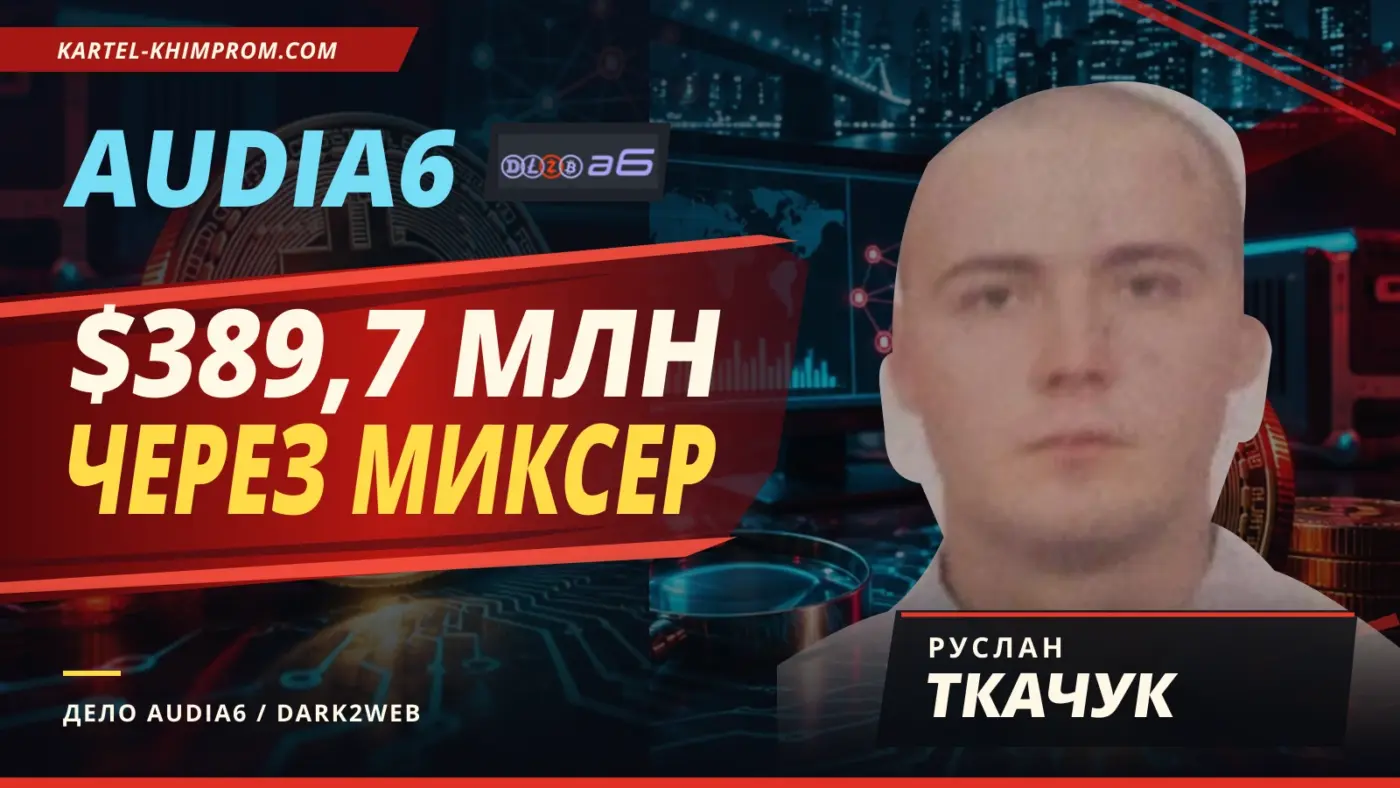
The AudiA6 website featured a cryptocurrency exchange, ‘accounting’ services and a mixer side by side. A court document from Pennsylvania included a screenshot of this advert alongside another, far less striking piece of evidence — a payment chain that agents were attempting to link to the service’s operators. In June 2026, Ruslan Igorevich Tkachuk, a Ukrainian national, and Alexander Vladimirovich Ledenev, a Russian national, were detained in Georgia. The US alleges that both men operated the Audi A6 and the Dark2Web forum. Consequently, the investigation progressed from a forum pseudonym to the surnames in the complaint – but what exactly did it quantify in dollars?
A showcase for those who were troubled by their digital footprint
In Bitcoin, addresses, amounts and the sequence of transfers are publicly visible. The personal details of wallet holders are not recorded in the transaction ledger. However, law enforcement agencies can cross-reference transaction histories with data obtained from exchanges, from seized servers and from monitored transactions. A mixer sells the client the discrepancy between incoming and outgoing transfers. Investigators have to piece this connection together using several leads at once.
The US complaint describes AudiA6 as a service offering a commercial proposition to people for whom it was important to conceal the criminal origin of their assets. An illustration in the complaint shows an advertisement on Dark2Web from April 2021. In a press release, the Ministry of Justice referred to an offer to conceal the origin of funds for a fee of up to 5 per cent in a specific advertisement. Eurojust cites a range of 3–10 per cent for the network’s services in its international review. This information relates to various descriptions of the service. It is not possible to multiply the total volume of receipts by a single rate to calculate its revenue.
Dark2Web is referred to in the case files as a separate platform. The forum displayed advertisements for AudiA6 and provided members with a space for negotiations and posting offers. AudiA6, in turn, appears both as the name of the service and as a user nickname. In the complaint, the agent specifically states that one of the users known to him with this nickname is believed to have helped create the brand and managed it. For any specific individual, the conclusion regarding their role depends on evidence beyond the nickname itself.
What made up the $389.7 million?
According to US authorities, since the launch of AudiA6 in 2021, approximately 10,333 BTC. Approximately $389.7 million — a valuation of these inflows based on exchange rates on the dates of the relevant transactions. This answers the question of how much the bitcoins were worth at the time of transfer to the specified wallets.
| The figure | What they calculated |
|---|---|
| 10,333 BTC / $389.7 million | Inflows to AudiA6 wallets since 2021, according to US sources, converted at the exchange rates on the dates of the transactions. |
| 393.39 BTC / $19.23 million | The portion of these proceeds which the investigation linked to direct transfers from known criminal sources. |
| 731.59 BTC / $32.65 million | An assessment in the complaint based on an analysis of a transaction path involving a single intermediate transfer from a known illicit source. |
| Approximately $10.53 million | Payments to ten addresses which agents linked to the service’s fees. |
| Over €336 million | Europol and Eurojust’s assessment of alleged cryptocurrency money laundering in 2022–2025. |
The US agency lists well-known darknet marketplaces, extortionists and other criminal services as direct sources. It also reports on funds from illegal sources channelled through intermediary transactions. The proportion of direct transfers is one aspect of the analysis. For establishing indirect links, the analysts’ source data and how they accounted for intermediary recipients are crucial. The sum of $19.23 million is included in the US estimate of inflows. The European estimate covers a separately specified period, so it cannot be added to the US figure.
The complaint includes a separate breakdown of fees. Investigators identified ten USDT addresses and estimated their inflows at $10.53 million. The investigation considers this money to be the service’s earnings. The information in the complaint relates to a group of wallets, whilst the amount of personal income for each of the accused requires separate evidence. To calculate the damages, data on the original incidents and their victims is required.
Why did Tkachuk and Ledenev appear in the documents?
Federal complaint 2:26-mj-01055 was filed in the Eastern District of Pennsylvania on 2 June 2026. In it, agents describe how they monitored AudiA6’s operations undercover, tracked financial transactions and cross-referenced them with electronic evidence. One of the two charges relates to conspiracy to launder money; the other concerns transactions involving assets presented as criminal proceeds during a controlled operation. A controlled transaction allows the actions of the other party to be observed under predetermined circumstances. It documents a specific incident, whilst conclusions regarding the scale of the network require separate investigation.
In one test transaction, an agent explicitly told the other party that the money had allegedly been obtained from the sale of cocaine. According to the complaint, the transaction went ahead regardless. A court document specifically states the commission amount in this instance — approximately $417, including network fees. The sequence of events is crucial to the prosecution’s case: first, the operator received a description of the money’s origin, then the service carried out the transfer.
According to the US Department of Justice, Tkachuk and Ledenev held senior management positions at AudiA6 and Dark2Web. They were living in Batumi and were arrested on 10 June in Georgia. The Department of Justice has also announced that it will seek their extradition to the Eastern District of Pennsylvania. As of 17 November 2026, there is no published verdict on the guilt of Tkachuk or Ledenev, nor any confirmation that both have been extradited, in the verified publicly available materials. The stage of the case indicated in the June statement is ‘indictment on complaint’.
Why did the investigation begin before the searches in Georgia?
According to Europol, the timeline begins at least with an incident in Poland. In the autumn of 2025, the Polish police detained a Ukrainian national in connection with a related case. The European agency states that an examination of the devices seized from this individual helped to identify other participants. The name of the detainee is not mentioned in this report. In the US report, Tkachuk’s case is linked to a different location and date – Georgia and June 2026.
The authorities then coordinated the search for servers, domains and assets. According to a Europol report, the international operation led to the takedown of 25 domains, the seizure of more than 30 servers and the display of a seizure notice on the AudiA6 and Dark2Web websites. In Georgia, the seizure of vehicles and property was also reported. Separately, Europol provided figures for the amounts of cryptocurrency that had been frozen and seized. These figures reflect the authorities’ operation, whilst the $389.7 million represents historical proceeds according to US estimates.
What remains to be proven in the AudiA6 case
The blockchain leaves a record of the transfer. It does not, in itself, reveal who was in control of the wallet at the time of the transaction, who owned the business, or who knew the source of the specific funds. The forum account shows correspondence and public posts, but the ownership of the account and the link between the correspondence and the payments still need to be established by the investigation. The US complaint offers a version of how these pieces of evidence link the two individuals. The further significance of the evidence will depend on how it is examined in court.