According to a declassified US intelligence report, nearly $3.5 million was invested in the Odessa laboratory. At the other end of this story is an order from the Ukrainian Ministry of Health, through which Viktor Lyashko issued a licence to practise medicine to, amongst others, his wife. Of the 64 approved applications, hers was the last to be submitted. Two calendar days elapsed between the submission and the order. What exactly do the documents reveal about the laboratories, the minister’s decision and the money in Ukraine’s pharmaceutical market?
The audit was prompted by a November publication linking US aid to Ukrainian laboratories with Lyashko’s family business and the position of major pharmaceutical companies. We examined a declassified presentation, an annex to the order containing all 64 approved applications, the minister’s two annual declarations, and a September ruling by the Supreme Court. These documents allow for the verification of contractors, dates and amounts. We found no public documents linking biosafety funding to the minister’s family’s income or to ‘Farmak’s’ sales. Original publication.
What Tulsi Gabbard revealed about Ukraine’s biological laboratories
On 12 June 2026, the US Office of the Director of National Intelligence published material on biological laboratories. The agency’s statement refers to US support for more than 120 laboratories in over 30 countries. In the presentation itself, the section on Ukraine mentions more than 40 facilities that the US has built or supported. Back in 2022, the Pentagon publicly reported that it had provided approximately $200 million in aid to Ukraine since 2005, with 46 recipients of support, including laboratories, medical facilities and diagnostic centres. These statements describe the scope of the aid, but the published documents do not contain a full list of facilities with their current status. A report by US intelligence. Declassified materials. Pentagon transcript from 2022.
The 2005 agreement lists the US Department of Defence and the Ukrainian Ministry of Health as partners. Its stated aim is to prevent the spread of pathogens, technologies and knowledge that could be used in the development of biological weapons. Slides from 2026 provide an insight into how this framework was translated into specific projects, ranging from refurbishment and equipment to diagnostic work. The same presentation includes a list of dangerous pathogens, including anthrax, tularemia, plague, and the Ebola and Marburg viruses. The consolidated list does not contain a facility-by-facility inventory that would allow the presence of each sample in a specific Ukrainian laboratory to be verified. The 2005 agreement. Slides 2–3.
The Odessa Anti-Plague Institute and $3.49 million
The central reference laboratory of the Ukrainian Scientific Research Institute for Plague Control in Odessa is the most thoroughly documented. In the presentation, its total cost is stated as $3,492,551. Of these, the following are specifically named $613,477 for construction and $2,059,014 for equipment and furniture. These two items cover only part of the total cost. The published slide does not provide a detailed breakdown of the remainder. Table of projects, slide 3.
The section on contractors lists an American systems integrator Black & Veatch and Ukrainian subcontractors Odessa Invest and Macrochem. The project file with registration number 2225-04 is dated 21 May 2012. The institute is listed as the recipient of the funding. The table states that authorisation to work with particularly hazardous pathogens was issued in September 2010. Viktor Lyashko took over as Minister of Health in May 2021. These dates make it possible to establish which institution was responsible for the project and during what period it was being processed. The disclosed materials relating to Odessa do not indicate any personal role played by Lyashko in the selection of contractors or the allocation of funds. Project file in US intelligence materials. Announcement of the Minister’s appointment.
| The facility | Cost as per the presentation |
|---|---|
| Reference laboratory of the Anti-Plague Institute, Odessa | $3,492,551 |
| Diagnostic laboratory, Kherson Oblast | $1,728,822 |
| Institute of Veterinary Medicine of the National Academy of Agrarian Sciences | $2,109,375.23 |
| Diagnostic laboratory, Zakarpattia Oblast | $1,920,432 |
Why destroy samples during a war?
In March 2022, the World Health Organisation told Reuters that it had recommended Ukrainian laboratories destroy high-risk hazardous samples to prevent potential leaks. The recommendation was issued shortly after the start of the full-scale invasion, when shelling, a power cut or the loss of physical control over the storage facility had become real risks. To draw a conclusion regarding a specific minister’s directive, one would need the original text, the date, the addressees and a document confirming the legal basis on which it was issued. In the public sources we examined, we found insufficient evidence to corroborate the personal directive attributed to Lyashko. A Reuters report on the WHO’s recommendation.
When it comes to biological weapons, the intended purpose of the work and the justification for the type and quantity of pathogens are of decisive importance. This is precisely how Article I of the Biological Weapons Convention is worded, which permits preventive, protective and other peaceful purposes. In May 2022, a UN representative informed the Security Council that the organisation was not aware of any biological weapons programmes in Ukraine. This statement relates to the information available to the UN. In June 2026, the Ukrainian Ministry of Foreign Affairs reiterated that the country had not developed, produced or stockpiled biological weapons, and that joint projects had concerned epidemiological surveillance, diagnostics and public health. Article I of the Convention. UN Security Council meeting. Comment from the Ukrainian Ministry of Foreign Affairs.
Two days to obtain a licence. What all 64 applications revealed
On 25 December 2024, Iryna Lyashko submitted an application; on 26 December, the licensing commission held a meeting; and on 27 December, Viktor Lyashko signed Order No. 2187. The document refers to Commission Protocol No. 52. Sole trader Irina Leonidovna Lyashko is listed as number 64 in the appendix containing issued licences. Three specialisations are listed: orthodontics, general dentistry and surgical dentistry. In the same order, 31 applicants were refused. The family connection is confirmed by the minister’s declaration. The order and annexes. Declaration for 2025.
We cross-checked the dates of the applications for all 64 recipients. Iryna Lyashko was the only one of them to submit documents on 25 December. A further five applications were dated 24 December. Their applicants received licences under the same order three calendar days later. The remaining 58 submitted their documents between 16 and 23 December. Thus, the minister’s wife’s application was processed more quickly than the other approved applications in this specific order. This comparison relates to a single batch of decisions and highlights the difference in dates. It does not reflect the standard processing time for issuing licences across the entire ministry. Article 13 of the Licensing Act sets a general timeframe of up to ten working days and allows for an earlier decision. Dates of applications in the annex to the order. The Licensing Act.
There is a specific question for the Ministry of Health. Who considered Iryna Lyashko’s application, did the minister disclose any family ties, and how was her influence on the decision ruled out? The blanket nature of the order explains why the document covers dozens of applicants. To assess a possible conflict of interest, we need the commission’s minutes and documents detailing how it was resolved. In the publicly available materials we have examined, there is no official conclusion regarding a breach specifically in relation to Order No. 2187. Articles 1 and 28 of the Law on the Prevention of Corruption.
A property in Brovary appeared in the 2025 declaration
The date linking the two public documents is — 27 December 2024. The order granting the licence is dated this day. The same date appears in the declaration opposite the entry concerning Irina Lyashko’s leasehold rights to non-residential premises with an area of 102.5 m² In Brovary. The annual tax return for 2025, submitted on 25 March 2026, also contains 976,327 UAH in business income spouses. It is not possible to determine from this entry what proportion of the income was derived specifically from licence No. 2187. The cost of the premises is not specified in the declaration, so the estimate of 4 million hryvnias cited in the original publication remains unconfirmed by this document. The 2025 tax return: sections on property and income.
The premises are not listed in the 2024 declaration. The NACP’s rule for declaring property in use takes into account the period of ownership or use. By the end of the reporting year, the right to use the property must have arisen at least 30 calendar days before the last day of the period. A separate provision applies if the property was in use for at least half the days of the reporting period. The start date of the tenancy, 27 December, as stated in the subsequent declaration, explains why it is not possible to conclude from the two annual declarations that the property was concealed. Declaration for 2024. Explanations from the National Agency for Corruption Prevention (NACP) for declarants.
Technical assistance for Odessa. US Department of Defence programme → lead contractor Black & Veatch and local contractors → works and equipment for the anti-plague institute.
Licensing of medical practice. Application from the sole trader on 25 December → commission meeting on 26 December → Ministry of Health order on 27 December.
Payment for medicines. Public contracting authority → procurement and contract → payment to the supplier. Under the National Health Service of Ukraine’s ‘Affordable Medicines’ programme → a pharmacy under a contract for reimbursement of the cost of dispensed medicines.
‘Farmak’, ‘BaDM’ and ‘Optima-Pharm’. Which figures stand up to scrutiny
For ‘Farmak’, the exact figure can be found in line 2350 of the company’s separate annual report. Net profit amounted to 1.640 billion hryvnias in 2024 and 2.039 billion hryvnias in 2025, rounded to the nearest million. The figure of 1.621 billion hryvnias, close to that published in the original material, corresponds to another indicator — total revenue for 2024. The value of contracts with state customers, the amount of actual payments and net profit are three different figures. To calculate the state’s contribution to the company’s sales, one needs a breakdown of contracts and payments, including the time period, a list of clients and the distributors’ accounting rules. No such calculation, using a verifiable methodology, is provided in the original publication. JSC ‘Farmak’ annual accounts, lines 2350 and 2465.
The Antimonopoly Committee of Ukraine has data on a narrower segment. According to its research, between 2021 and 2023, ‘BaDM’ and ‘Optima-Pharm’ together accounted for over 85 per cent of medicine supplies to the pharmacy sector amongst distributors. On 31 July 2025, the AMCU announced that it had fined the companies 2 374 168 475 and 2,432,403,190 UAH Accordingly, the Committee alleged collusive behaviour in setting prices for a number of medicines; the companies contested the findings. The share of pharmacy supplies illustrates the extent of concentration in the distribution sector. The share of defence contracts cannot be determined from this study. AMCU market research. Report on the fines. The distributors’ position.
September update. On 22 September 2026, the Supreme Court upheld the decision to close proceedings in case No. 910/14711/25. In that case, ‘BaDM’ challenged a separate procedural decision by the AMCU (No. 697-r) stating that the main decision had not been suspended. The dispute over the legality of the fine itself is set out separately in the court ruling, under case number 910/12276/25. Consequently, the September ruling clarifies the outcome of one of the claims, whilst the final outcome of the dispute over the fine and details of its payment require separate verification. Supreme Court ruling of 22 September 2026.
The role of the National Health Service of Ukraine, headed by Nataliia Husak, can be examined using the ‘Affordable Medicines’ programme as an example. Under this programme, the NHSU reimburses pharmacies for the cost of prescription medicines dispensed. A different mechanism applies to institutional procurement. There, the audit begins with the procurement form, the contract and payment details. If a distributor is listed as the successful bidder on the procurement card, the manufacturer of a specific medicine must be identified based on the specifications, and the amount payable for it must be determined according to the individual items, the volume of the actual delivery and the payment details. A single contract may include products from several manufacturers. The National Health Service of Ukraine’s clarification regarding the programme. The Prozorro public procurement system.
What other documents are needed to provide a response?
As far as the laboratories are concerned, the most substantive next step is to obtain the certificates of completion and the breakdown of the Odessa project. These will show which services and equipment were included in the total of $3.49 million, and will allow the sums to be cross-referenced with the contractors’ roles. A key document in the licence’s history is the minutes of the commission’s meeting of 26 December 2024 and the materials concerning the resolution of a potential conflict of interest. These will help establish how the minister’s wife’s application was considered and what measures were taken in relation to the family connection.
In the pharmaceutical market, the antitrust regulator itself has already flagged the issue of market concentration. To verify broader claims regarding ‘Farmak’s’ procurement, a verifiable register of contracts and actual payments is required. We were unable to independently link the criminal case numbers cited by the authors of the original publication to any publicly available procedural documents relating to these incidents. As of today, enquiries regarding these matters have been directed to the relevant authorities and contractors whose documents have been published. The key question for the Ministry of Health is how the sole tender submitted on 25 December was assessed and who made the decision on it.
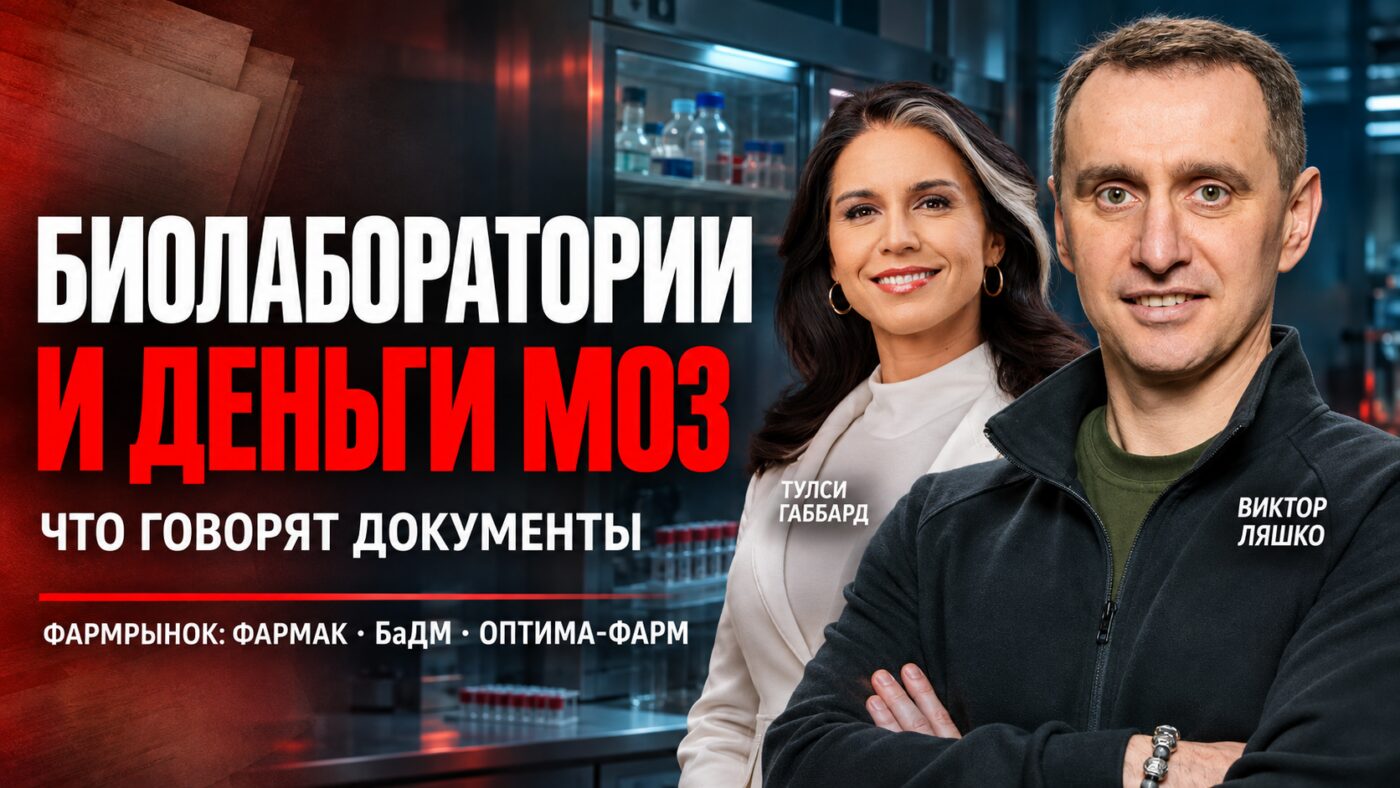
Cover image — an editorial illustration created using AI based on official portraits. Credit for the original portraits. A profile of Viktor Lyashko, Ministry of Health of Ukraine, CC BY 4.0, cropping and artistic editing. A profile of Tulsi Gabbard, Director of National Intelligence, USA, public domain in the US, cropping and artistic adaptation.