The promise of high returns is easy to remember. The loss-limiting mechanism usually sounds less impressive, although it is precisely this that determines what will remain of one’s money after an unsuccessful trade. In the dispute surrounding Tarsus Capital, these two aspects of the investment proposition, according to clients, have diverged catastrophically. They speak of returns of up to 20–30 per cent per annum in dollars, assurances of capital protection, and accounts that have lost almost everything.
On 19 November 2026, Rucriminal.info, citing the Cheka-OGPU and investors who had lodged complaints, reported on claims against Armen Rubenovich Simonyan, founder and managing director of Tarsus Capital LLC. The publication also stated that the Investigative Committee was conducting a pre-investigation check. At the time of writing this article, no public official statement from the Investigative Committee, nor the reference number of the investigation file or the procedural decision, could be found. We are reporting on the investigation specifically with reference to this publication. [1]
An earlier public dimension to this story has also come to light. Posts on Simon Tarsus’s blog on Smart-Lab detail account management, setting up a company with a partner, and legal issues surrounding trading with client funds. Rucriminal.info links this profile to Simonyan. The connection between the blog itself and the Tarsus Capital brand is further evident in a 2021 post, where the author included a link to the Telegram channel of the same name. [1] [9] [16]

Who is behind Tarsus Capital?
The company’s registration documents name Armen Rubenovich Simonyan as the managing director and state that the limited liability company was established on 28 May 2019. The main activity is listed as investment in securities. This allows the report on the conflict to be linked to a specific legal entity, without confusing it with companies with similar names. [2] [3]
| Indicator | Information in the registration forms |
|---|---|
| Name | Tarsus Capital LLC |
| Company TIN | 7708351376 |
| OGRN | 1197746344399 |
| Date of registration | 28 May 2019 |
| Head | Armen Rubenovich Simonyan |
| Authorised capital | 100,000 roubles |
| Participants’ shares | Armen Simonyan – 60 per cent; Alexander Bazhanov – 40 per cent |
| Main OKVED code | 64.99.11 — investments in securities |
Details of the parties involved are provided in the ‘Tochka’ and ‘RBC Companies’ profiles. Alexander Bazhanov’s shareholding is stated to describe the ownership structure. The verified materials contain no information regarding his involvement in the disputed client transactions. The mere presence of a second shareholder does not extend the claims made against Simonian to him. [2] [3]
The size of the authorised capital should not be mistaken for the amount of money under management or the value of the director’s personal assets. These are different indicators. The question of what backed up the promises of compensation requires information about the specific debtor, their liabilities and available assets, rather than a single line from the Unified State Register of Legal Entities.
What exactly was promised to investors?
According to clients, the offer consisted of three attractive elements. Returns were projected at 20–30 per cent per annum in US dollars. The trades were described as hedged. A drawdown of more than 10–20 per cent was presented as unlikely. Taken together, these assurances could have created the impression that high financial returns were combined with pre-defined, limited risk. [1]
According to the complainants, Simonyan was granted trading access to their accounts with Exante and Interactive Brokers, and his fee amounted to 30 per cent of the profit. Under such an arrangement, the money could have remained in the investor’s own brokerage account. However, ownership of the account and the ability of another person to open loss-making positions are two separate matters. A well-known broker’s reputation does not automatically limit the risk associated with the chosen strategy.
Even the wording regarding returns requires clarification. If a hypothetical account of $100,000 generated $30,000 in profit before fees and the manager is entitled to 30 per cent of that profit, the payment would be $9,000, whilst the client’s net profit would be $21,000 before other expenses and taxes. This is a simple arithmetic example, not a calculation based on Tarsus Capital’s contracts. It illustrates why, in a promise of ‘30 per cent per annum’, it is crucial to specify exactly which return is being referred to.
Equally important is the method for calculating commission following losses. Is remuneration only payable once the previous capital high has been regained? How are deposits and withdrawals accounted for? Who approves the results for the period? The editorial team does not have access to the contract texts or reports on specific accounts, so the answers to these questions remain unknown for the time being.
Instead of defence — betting on a fall in the US market
The investors’ main complaint concerns the actual direction of trading. According to them, the fund manager maintained long-term short positions on the US market, including the S&P 500 and Nasdaq, and continued to expect a crash even as the market moved against his positions. Clients attribute their heavy losses to this strategy and the subsequent forced liquidation of their positions. [1]
They also claim that Simonyan attributed the rise to the actions of major players attempting to squeeze out short-sellers. Such an explanation may reinforce the forecaster’s conviction. However, neither this explanation nor the forecast itself answers the question of how much money one can afford to lose before one should stop trading.
Precision is essential when it comes to the instruments involved. A standard short sale of shares, a futures position and the purchase of an inverse exchange-traded fund are structured differently. Depending on the structure, the margin requirements, costs and loss limits vary. Public trading disclosures do not allow for the full composition of client portfolios to be reconstructed or for the proportion of each instrument to be identified.
Interactive Brokers explicitly warns of theoretically unlimited losses when short-selling shares: the price of the sold security may continue to rise. The broker also describes borrowing costs and the possibility of closing short positions. This is a description of how short selling works, rather than evidence of exactly which transactions were carried out on the complainants’ accounts. [11]
The margin won’t wait for the forecast to prove correct
Interactive Brokers’ public FAQ states that positions may be liquidated in real time in the event of a margin shortfall. The broker specifically explains that it does not use the traditional margin call system with a guaranteed timeframe for topping up, and that notification may not always be provided. Therefore, the phrase ‘you need to wait a little longer’ does not determine the moment of forced closure. [12]
The market is capable of moving against a position for longer than the account can withstand margin requirements. A forecast of a subsequent fall, even if it ever occurs, does not recoup the capital lost during an earlier liquidation. To verify the version of events put forward by Tarsus Capital’s clients, we need brokerage statements, the dates of forced trades, account balances and the margin requirements in force for the account.
Exante and Interactive Brokers are mentioned in the complainants’ accounts as the platforms used to manage their accounts. It does not follow from this that the brokers promised clients Simonyan’s returns, guaranteed his obligations or participated in the alleged misleading of investors. Claims against the fund manager and issues regarding compliance with brokerage regulations must be substantiated separately.
Simon Tarsus’s public archive raises some uncomfortable questions
In May 2019, the blog author Simon Tarsus complained about the trading platform’s performance and wrote about managing several accounts — two with BCS and four with Alfa. In a comment, he clarified that these were accounts belonging to different clients. In the same discussion, he emphasised the importance of the start of trading for his strategy and the ability to close positions quickly if events did not go as planned. [5]
‘There are several accounts that I manage.’ [5]
This post is valuable primarily as a dated, first-hand account of the author’s activities. It predates the registration of the limited liability company as stated in the company’s profile. The post does not disclose the authority granted for each account nor does it show trading results, but it provides concrete material for verifying the author’s professional background.
On 3 June 2019, in another post, the author described setting up a limited liability company with a partner for stock market trading using their own funds and those of close investors. The post discussed independent bookkeeping and reporting on a brokerage account. The name of the legal entity is not mentioned in the text. The proximity of the date to the registration of ‘Tarsus Capital’ does not in itself prove that this was the company in question. [6]
On 1 July 2019, a question arose regarding the legal classification of a situation where a company trades on the stock exchange using borrowed funds. The author enquired whether the number of loans affects the assessment of such a model. The question was published under the heading ‘Sanctions for pseudo-management companies’. This is a request for advice on the forum, not an admission of a confirmed breach. [7]
On 27 April 2020, Simon Tarsus described how a legal entity received payment for trading signals and raised a question regarding the purpose of the payment and the regulation of financial advice. The post shows that the issue of the legal formalities surrounding remuneration was discussed publicly long before the current dispute. It is not possible to deduce from it exactly how the relationships with specific claimants were subsequently formalised. [8]
There is a separate tool for verifying professional status — the Bank of Russia’s service on financial market participants. The regulator states that the right to carry out the relevant activities may be granted through a licence, accreditation or inclusion in the register. The type of activity listed in the Unified State Register of Legal Entities does not replace such a check. The editorial team does not have a fully verified conclusion regarding Tarsus Capital’s regulatory status for each service described and the relevant period. [14] [15]
| Date | What remains in public sources | What this allows us to verify |
|---|---|---|
| 13 May 2019 | The author writes about managing several client accounts | Earlier description of activities, source [5] |
| 28 May 2019 | Registration of Tarsus Capital LLC | The origins of the company, sources [2–3] |
| 3 June 2019 | A post about a limited liability company with a partner and investors’ funds | Fundraising model, source [6] |
| 1 July 2019 | The issue of stock market trading with borrowed money | Discussion of the legal structure, source [7] |
| 27 April 2020 | The issue of payment for trading signals | Remuneration structure, source [8] |
| 23 November 2021 | Link from the blog to Tarsus Capital’s Telegram channel | Public link between the profile and the brand, source [9] |
| 21 November 2022 | Report on an open position in SDS | Mention of a specific instrument, source [10] |
| 19 November 2026 | A report by Rucriminal.info on investors’ claims | Content of the allegations and further investigation, source [1] |
SDS on the blog — an important detail of limited significance
In November 2022, Simon Tarsus contacted the St Petersburg Stock Exchange regarding the inability to trade SDS, ProShares UltraShort S&P 500. The author wrote about a position in his brokerage account with BCS and problems with transferring it. The post confirms public interest in the instrument offering inverse exposure to the US index. It does not establish that the same instrument was used across all the disputed client accounts. [10]
The official ProShares page for SDS states the objective as a daily return corresponding to minus two daily movements of the S&P 500, excluding commissions and expenses. The issuer warns that the return on holdings held for longer than one day may differ significantly from a simple multiple of the index’s change over the entire period. It is influenced by the sequence of price movements and volatility. [13]
Investing in such a fund also differs from a direct short sale of shares. One cannot conclude from the warning about the unlimited risk of a standard short sale that an ETF investor without leverage is subject to unlimited losses. A detailed analysis requires the portfolio composition. The general term ‘short’ leaves too many technically different possibilities open.
The price of a promise to recoup losses
Once an account has suffered a significant loss, it becomes considerably more difficult to recoup the original amount. After a 20 per cent loss, the remaining capital needs to grow by 25 per cent. After losing half, it needs to grow by 100 per cent. If 90 per cent is lost, the remaining tenth must increase tenfold, i.e. show a 900 per cent gain. This is simple arithmetic, not a return forecast.
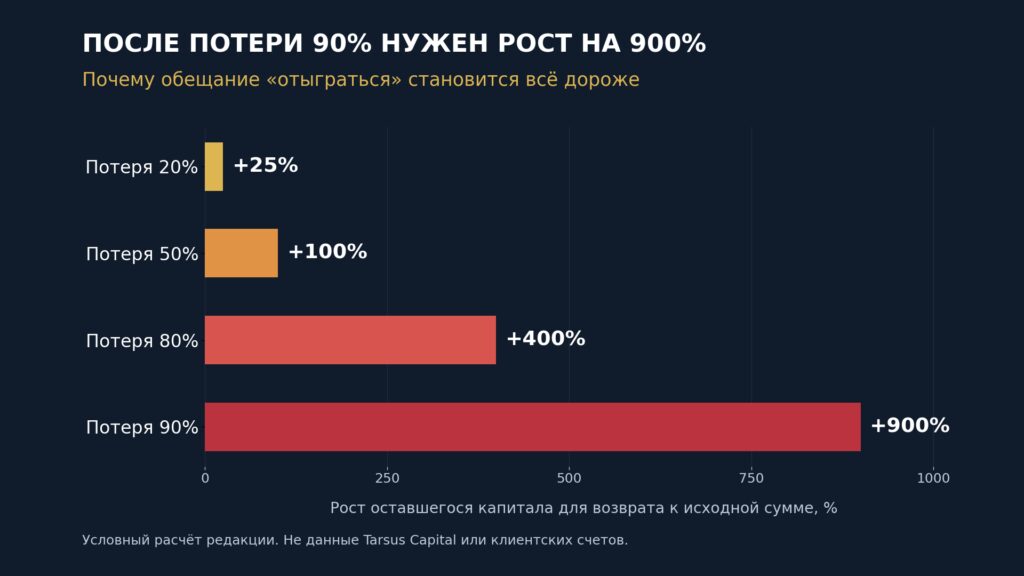
| Loss relative to the initial investment | The remaining balance from the hypothetical $100,000 | The balance to be refunded has risen to $100,000 |
|---|---|---|
| 20% | $80 000 | 25% |
| 50% | $50 000 | 100% |
| 80% | $20 000 | 400% |
| 90% | $10 000 | 900% |
Therefore, the renewed suggestion to wait warrants separate consideration. It may imply a continuation of the risk, albeit on a significantly smaller scale. The manager’s personal confidence in a market reversal does not alter this balance. And the promise to pay out of his own pocket shifts the focus from the trading forecast to the ability to meet a financial obligation.
Receipts and personal guarantees — the second part of the dispute
According to clients, after they demanded that trading be halted, Simonyan persuaded them to continue and promised to compensate for any further losses out of his own pocket. Some of these commitments, as stated in the original post, were formalised in writing. Subsequently, according to the same account, he claimed he lacked the funds to make the payments. [1]
It is here that the content of the documents becomes crucial. Who signed the undertaking — an individual or a company? What amount, timeframe and reason for payment are specified? Does the receipt relate to an existing debt or to potential future losses? The editorial team has not examined copies of these documents. It is therefore not yet possible to establish the extent of the obligations or whether they have been breached in each instance.
At the same time, the very shift from discussions about ‘secure’ trades to a promise of personal compensation changes the nature of the relationship. Investors are now being asked to rely on the solvency of a specific individual. In such cases, his previous statements regarding financial capabilities become subject to scrutiny alongside his trading reports.
What does the report on 28 court records mean?
Rucriminal.info reports that a commercial court case aggregator listed 28 entries relating to civil proceedings from 2022 to 2025, in which Armen Simonyan is named as the defendant. The claimants include ‘Lime-Zaim’, ‘ID Collect’, ‘Rusinterfinance’, ‘Forward’ and other credit and debt collection organisations. The editorial team does not have an independently verified compilation of court documents relating to all these entries. [1]
The number of entries in the aggregator cannot automatically be equated with the number of outstanding debts, lost cases or various liabilities. To verify this, one needs the defendant’s identity, case numbers, the content of judgements, and details regarding annulments, appeals and enforcement. A match in name alone, without a reliable cross-check of details, is also insufficient.
If the financial disputes relate specifically to this individual and existed at the time the promise of personal compensation was made, they are relevant to the assessment of such a promise. However, the sequence of dates must be established. The investor could not have been aware of the legal history from 2022 to 2025 when the contract was concluded prior to these events. The claim that ‘everything could have been checked in advance’, without specifying the start date of the relationship, oversimplifies the picture.
Bankruptcy remains, for now, a stated intention
According to clients, Simonyan spoke of his intention to file for personal bankruptcy, as well as the bankruptcy of Tarsus Capital LLC. The account provided to the editorial team specifically notes that the fact that applications have been filed has not been confirmed. The materials found do not provide grounds for stating that he has already been declared bankrupt or that the relevant proceedings against the company have been initiated.
The public Xfirm profile contains a company notice dated 28 June 2022 regarding the refusal to apply a moratorium. It is posted in the section relating to Fedresurs, although the document’s title does not imply a declaration of bankruptcy. It would be a mistake to equate one type of announcement with another. Nor does the status of an active legal entity in the registration file, in itself, prove the absence of financial difficulties. [4]
The same aggregator reports zero revenue and a net profit of 207,000 roubles for 2025. These figures reflect specific lines in the company’s financial statements. They do not correspond to the turnover of all associated brokerage accounts and do not disclose the director’s personal assets. More comprehensive information on assets and liabilities is required to assess the ability to compensate the claimed millions. [4]
What questions remain regarding Simonyan and Tarsus Capital
The most significant issue concerns agreed-upon risk limits. If the 10–20 per cent limits were indeed presented to clients as a virtually reliable threshold, where were they set and how were they supposed to be enforced? Did the fund manager have the authority to continue trading once these levels were reached? When were investors informed of the actual state of their accounts, and what options were offered to them?
The second question concerns verifiable results. The total amount of claimed losses must be broken down by account, period, deposits, withdrawals, commissions and realised losses. Without such a reconciliation, the story of millions remains merely a claim by the parties to the dispute. It will also make it possible to distinguish the impact of market strategy from infrastructure limitations and other causes.
The third issue relates to stop-loss orders and promises to pay. Key factors include the original messages, the time the instructions were received, the existence of subsequent trades, and the authenticity of the commitments. These are the specific circumstances against which different versions can be compared, rather than simply assessing the plausibility of the explanations.
In the verified materials, the editorial team found no detailed public response from Simonyan specifically addressing the current allegations. This does not mean that such a response does not exist or that he agrees with the allegations. His position, the brokerage documents and the results of the official investigation could significantly clarify the picture.
The crux of the dispute lies in the discrepancy between the promised level of risk and the reported outcome
A loss-making transaction does not in itself constitute fraud. To conclude that there has been deliberate embezzlement, evidence is required, which the editorial team does not have at its disposal. Nor does this publication allow Simonian to be granted the procedural status of a suspect. A report of a pre-investigation check and the initiation of a criminal case are two different matters.
However, the absence of proven embezzlement does not render the other issues irrelevant. Investors describe an offer in which high returns were accompanied by assurances that their money would be protected. They then, in their own words, faced heavy losses and unfulfilled promises of compensation. This discrepancy warrants a documentary analysis, regardless of any future criminal assessment.
Simon Tarsus’s public posts add a long backstory to the dispute. The author discussed the management of client accounts, funds raised and the structuring of remuneration long before the current losses were reported. The key question now is what obligations arose from these practices and what evidence supports them. The answer must be found in contracts, statements and the fulfilment of promises.
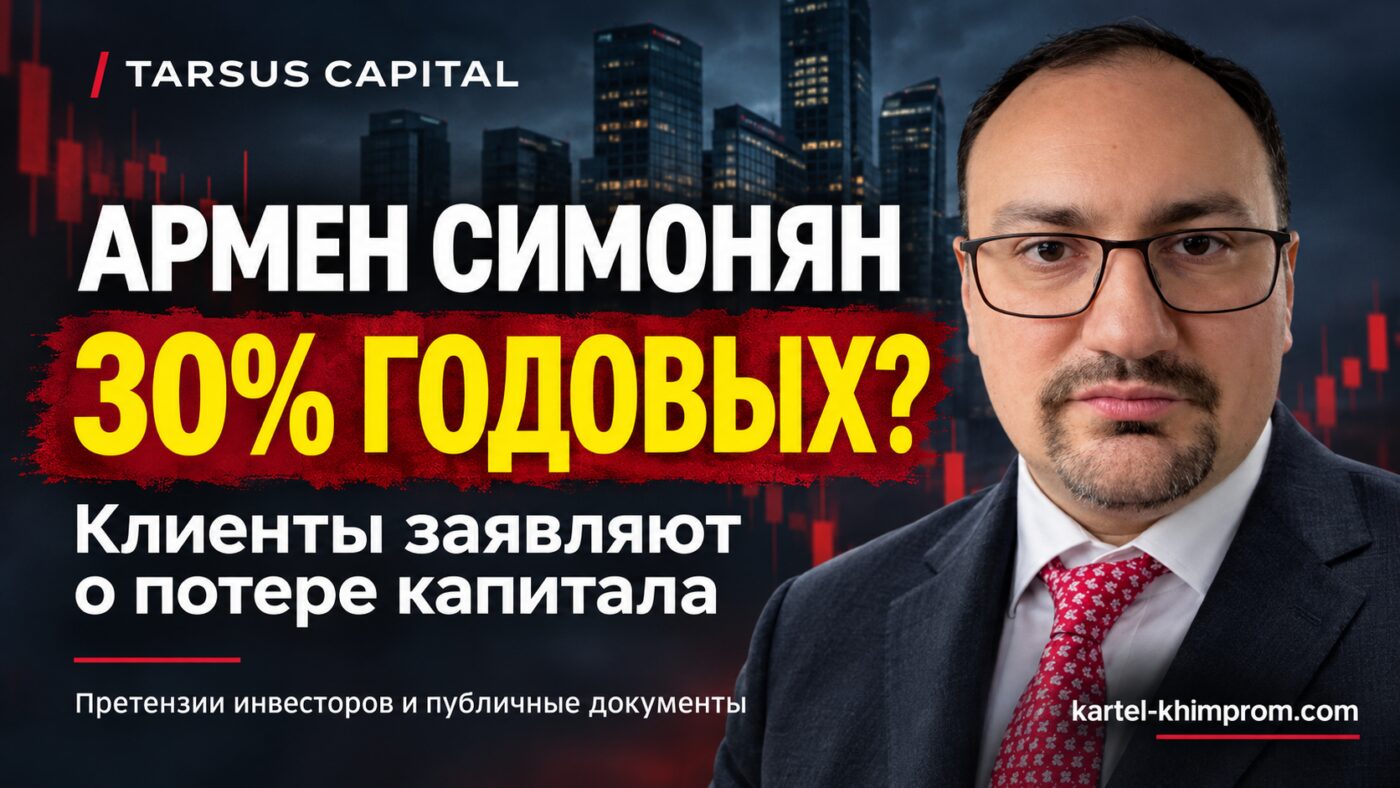
This article was prepared on 19 November 2026 based on a statement of claims submitted to the editorial team, a publication by Rucriminal.info, public records on Smart-Lab, company profiles and official descriptions of financial instruments. No personal interviews were conducted with the parties involved in the dispute. The cover image was created using AI based on a portrait provided; the financial background is for illustrative purposes only.