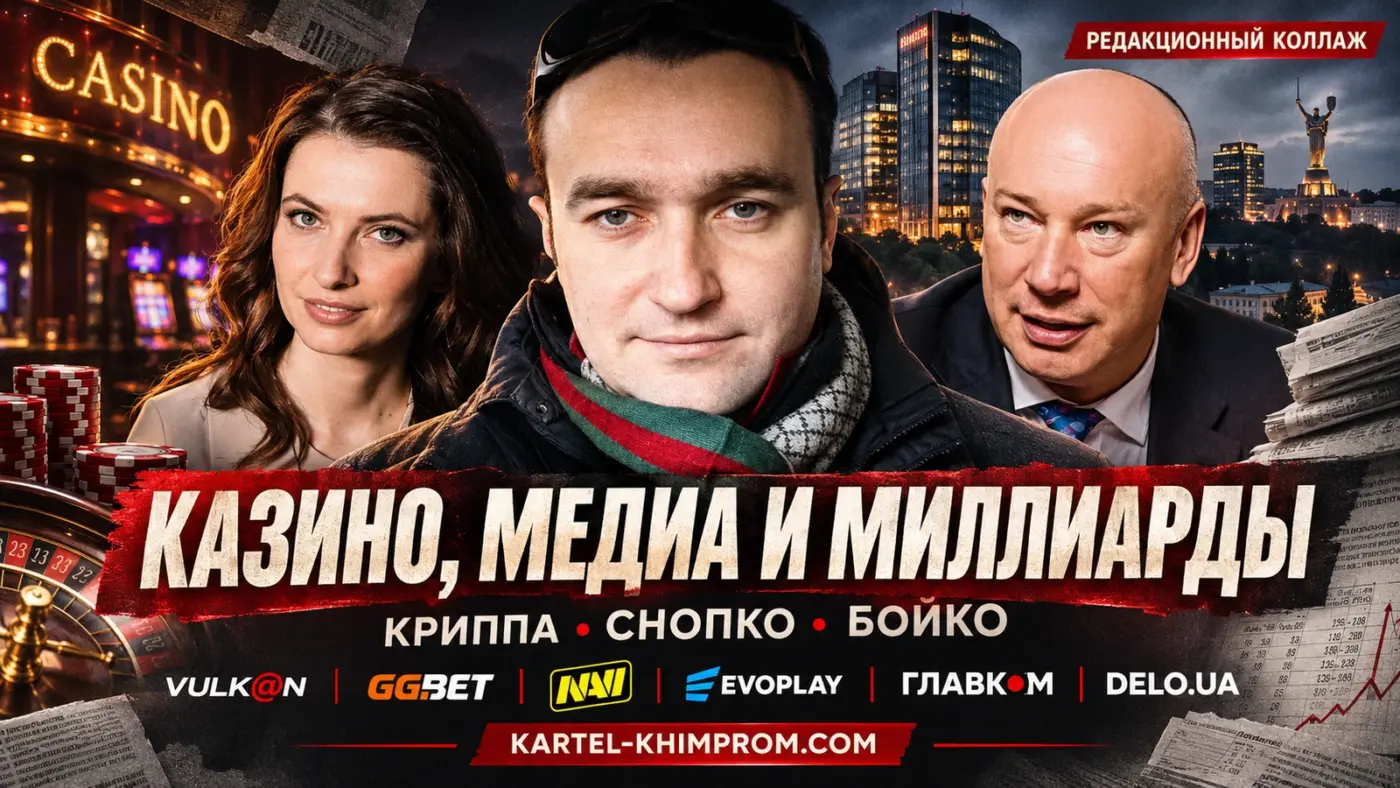
Hotels worth billions of hryvnias, major esports brands and Ukrainian media outlets, all surrounded by ongoing controversy over their true ownership. At the heart of this story are Maxim Krippa, Tetyana Snopko and the international history of the ‘Vulkan’ casino. BlackBOX OSINT’s archived investigation weaves these stories together into a single picture. The documents make it possible to reconstruct a significant portion of the connections, clarify dates and ask far more specific questions about money, influence and control.
This story involves several different forms of power: the right to dispose of high-value property, access to a mass audience, control over sports content, and the ability to shape an entrepreneur’s public image. When these elements come together, the structure of the entire system becomes of particular interest: who makes the decisions, who pays for the deals, who receives the income, and to what extent is this visible to the reader or the regulator.
This article is based on a PDF copy of the BlackBOX OSINT investigation, ‘Maksym Krippa and the “Vulcan” Casino: How a Russian Oligarch’s Partner Is Buying Up Ukrainian Media’, provided to the editorial team. We have supplemented it with WIPO decisions, auction documents and published responses from those implicated. Information from the archived text is identified as coming from its authors; historical corporate links are examined in the context of the period to which they relate. [1]
The media buyer the market only learnt about after the deals were done
In 2023, Tetyana Snopko caught the attention of the Ukrainian media market. Previously, she was known primarily for her communications work within the circle of entrepreneur Maxim Polyakov and Noosphere. Her name then became linked to the acquisition of a significant portfolio of editorial platforms: Delo.ua, WoMo, Marketing Media Review, ‘TOP-100’ magazine and ‘Glavkom’.
The BlackBOX archive details the transition of companies that had served ‘Ekonomika+’ to Snopko, the subsequent emergence of ‘Hub Glavkom’ and the acquisition of ‘Ukrainian Media Systems’. It also mentions ‘Media Hub Ukraine’, registered in August 2023. This refers to the chronology set out in the archived investigation, rather than confirmation that the ownership structure remains unchanged to this day. [1]
In August 2023, Forbes Ukraine reported separately that Snopko had advised Krippa and represented his interests in dealings with the editorial team. The publication also described her long-standing collaboration with Polyakov. This is a significant professional context: the media buyer was acquainted with individuals whose assets and reputations subsequently became the focus of attention for the acquired media outlets. [2]
However, a professional connection does not automatically answer the question of who owns the money behind a specific purchase. BlackBOX’s theory that Snopko acted as Krippa’s intermediary was based, amongst other things, on unnamed sources. To turn such a theory into an established fact, one would need financing agreements, disclosures of liabilities or other documents that allow one to trace control over the transactions.
What did Snopko say in response to the theory of nominal ownership?
The dispute continued in November 2024. *Ekonomicheskaya Pravda*, citing market participants, named Krippa as the de facto owner of *Glavkom* and *Ekonomika+*. In response to ‘Detector Media’, Snopko stated that she herself was the ultimate beneficiary of these assets, and that Krippa was not her partner or investor. She cited the results of her own business activities and explained that her search for work in the Czech Republic following the start of the invasion stemmed from a desire to remain active. [3]
This is a direct rebuttal of the substance of the allegations. It should be read alongside the account concerning the hidden owner. The absence of a published purchase price leaves the question of the sources of funding open, but does not invalidate the registered owner nor prove the existence of a secret investor.
Share capital also requires careful consideration here. The original investigation compared the capital figures of Snopko’s companies, her alleged income and valuations of the media assets. There is no direct equivalence between these indicators: authorised capital is not the price of a business, and a purchase may be financed by a loan, instalments, the sale of another asset, or a combination of sources. The specific calculation mechanism must be verified. [1]
Two key questions are of public importance: has the ownership structure been disclosed, and is editorial policy dependent on third-party funding? Even confirmed links to a businessman only partially address this issue. Much more will be revealed by agreements regarding finances, managerial powers and rules for dealing with conflicts of interest.
‘Vulkan’: a brand with a documented international history
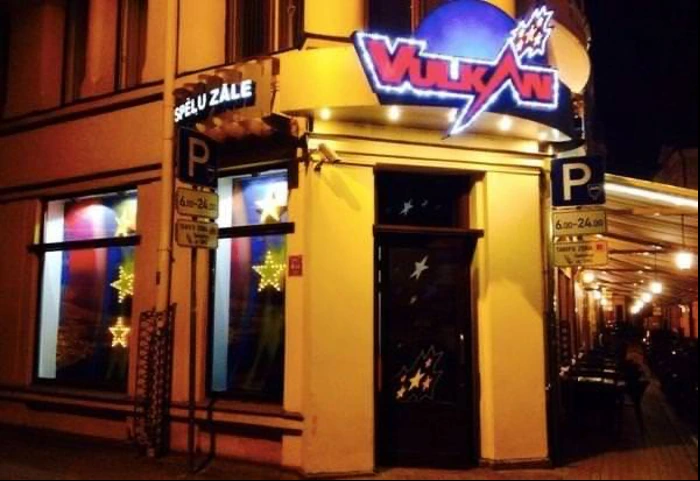
The Russian history of the ‘Vulkan’ brand is backed by documentary evidence. In materials published on the Finstar website, Ritzio is described as Oleg Boiko’s former major gambling business, which expanded into foreign markets following changes to Russian regulations. This is the historical context of the group’s origins, not proof that Boyko owns every venue with the word ‘Vulkan’ in its name. [6]
Online, a brand breaks down into multiple layers. A trademark has a rights holder; a specific website has an operator; a software developer has its own company; and a payment infrastructure has its own participants. Websites may use similar names under licence, without permission, or as part of a dispute. Therefore, where brand names coincide, the contractual chain must be verified.
Two cases from the World Intellectual Property Organisation are particularly telling. They provide an opportunity to discuss the brand’s international connections based on the documents, whilst maintaining a distinction between the arguments of the parties and the outcome of the proceedings.
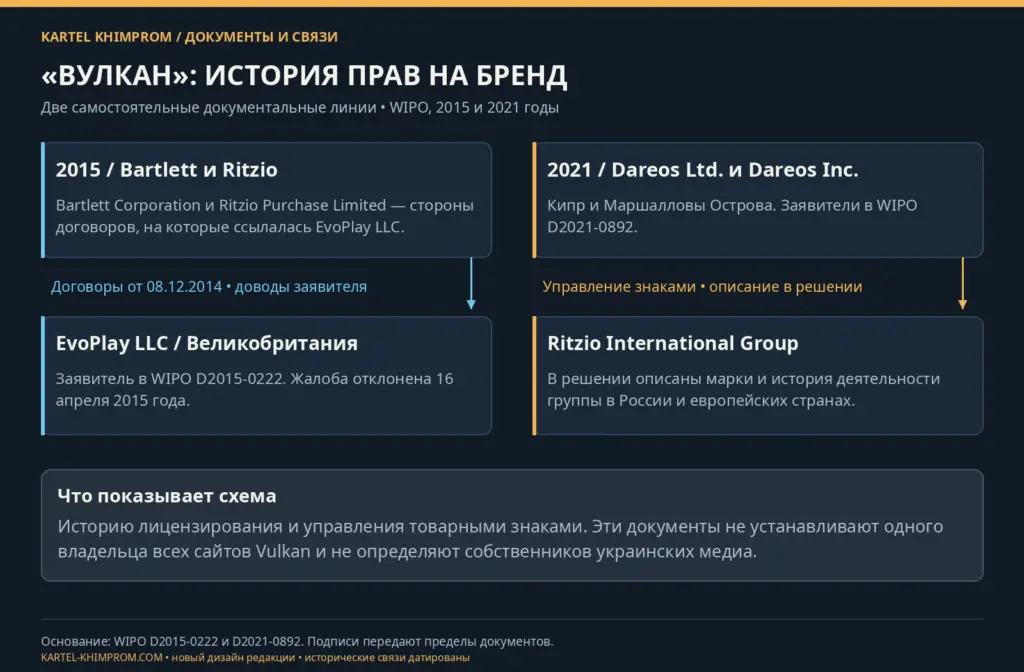
WIPO Case D2015-0222: the EvoPlay licensing line
In case D2015-0222, the applicant was EvoPlay LLC, listed as a UK-based company. It referred to agreements dated 8 December 2014 with Bartlett Corporation and Ritzio Purchase Limited concerning the rights to the ‘Vulcan’ family of trademarks. The date, the parties and the content of the licence claim are recorded in the text of the decision. [4]
This conclusion is key to understanding the document: on 16 April 2015, the complaint was dismissed. The majority of the panel did not consider the bad-faith registration and use of the disputed domains to have been proven within the meaning required by the procedure; they recognised that the dispute went beyond the narrow scope of a typical cybersquatting case.
Consequently, the document confirms the existence of a licensing dispute and the relationships disclosed therein. The ruling did not identify the current owners of all businesses with similar names, nor did it establish Maxim Krippa’s guilt in any criminal offence. The companies with identical names, EvoPlay and Evoplay Entertainment, also require comparison in terms of jurisdiction and registration details.
Case WIPO D2021-0892: Dareos, Ritzio and trademark rights
Decision D2021-0892 names two applicants: Dareos Ltd. from Cyprus and Dareos Inc. from the Marshall Islands. The statement of facts indicates that they manage the trademarks for Ritzio International Group and Ritzio Purchase Limited. It also describes the group’s history of operations in Russia and European countries. [5]
This is a crucial point for verifying the original investigation. We are dealing with specific legal entities and the documented context of the brand. It is not possible to deduce a single owner for all Vulkan websites from this, nor to attribute control over every operator mentioned to Krippa. To establish such a link, information would be required regarding the companies’ shareholders, licences and financial relationships as at the relevant date.
An old criminal case: what the case details actually reveal
BlackBOX linked the ‘Vulkan’ story to case No. 22015000000000379 and made serious allegations regarding the alleged flow of funds. A verified published copy of the ruling by the Shevchenkivskyi District Court of Kyiv dated 18 October 2016 indicates that the case was entered into the Unified Register of Pre-trial Investigations on 25 November 2015. The charges cited are Part 1 of Article 203-2 and Part 2 of Article 258-5 of the Criminal Code of Ukraine. [7]
This document relates to temporary access to the investigation materials. It confirms the existence of proceedings with the specified details and legal classification at the relevant stage. Such a procedural document is not equivalent to a conviction and does not, in itself, establish the guilt of every individual whom journalists link to the infrastructure described.
In the PDF provided, the authors drew conclusions about the origin of the funds and the possible financing of banned organisations. Whilst preparing this article, no published final judgement was found that would allow these allegations to be presented as proven guilt on the part of Krippa or Polyakov. The question of the outcome of the proceedings remains a separate matter for documentary verification. [1][7]
The preserved text also contains other circumstantial evidence — GetContact phone tags, matches between representatives and addresses. We do not use private telephone numbers as evidence of involvement in a crime. A corporate secretary or a shared registered address may indicate a single service provider. Additional grounds are required to conclude that there is joint control.
NAVI: control was transferred earlier than indicated in the archived diagram
An important clarification concerns Natus Vincere. In a statement dated 16 October 2022, the club itself stated that Krippa became its majority owner in the fourth quarter of 2018. The transaction was carried out in stages and required the investor to fulfil certain obligations. [8]
Consequently, 2022 cannot be considered the sole date of the NAVI acquisition without further explanation. To analyse the connections, the moment of the transfer of control, the subsequent formalisation of the deal and the date of the public announcement are all important. A difference of several years alters the chronology of the investments.
The acquisition of an esports organisation gives an investor access to an international audience, sponsorship deals and a recognisable brand. This helps to explain the public interest in the deal, but does not automatically reveal the origin of every dollar invested. The dispute over funding requires the relevant documents themselves.

Maincast, GGBET and the attention economy
In the original investigation, Maincast, NAVI and GGBET are described as elements of a single commercial ecosystem. The very combination of the team, broadcasts and a bookmaker sponsor is certainly worth analysing: it allows the viewer to be guided from a sporting event straight to betting adverts. The shared audience creates a commercial interest between the parties, even when the ownership structures differ. [1]
However, control over all three brands by a single individual cannot be established solely on the basis of advertising placements. In December 2024, Krippa publicly denied ownership of GGBet and EvoPlay. According to dev.ua’s account, his explanation of his connection to the bookmaker was based on his long-standing sponsorship of NAVI; he cited property transactions as his main source of personal income. [17]
There are also independent official documents relating to Maincast. At its meeting on 7 November 2024, the National Council of Ukraine on Television and Radio Broadcasting adopted Decision No. 3066 to register Maincast LLC as a provider of non-linear media services. Forbes Ukraine reported separately on the launch of two channels by Krippa’s company. [9][10]
This line of inquiry shows that the investor’s interests extended beyond a single sports team. The focus is on content production, its distribution and commercial monetisation. Assessing the influence of such a group requires disclosure of sponsorship terms, venue ownership and advertising labelling rules, particularly when the audience consists of young viewers.
Property: billions that can be verified through documents
The most tangible part of the story is the acquisition of high-value assets. Here, we can move from estimates by unnamed market participants to the auction price, the buyer’s name and the signed contract.
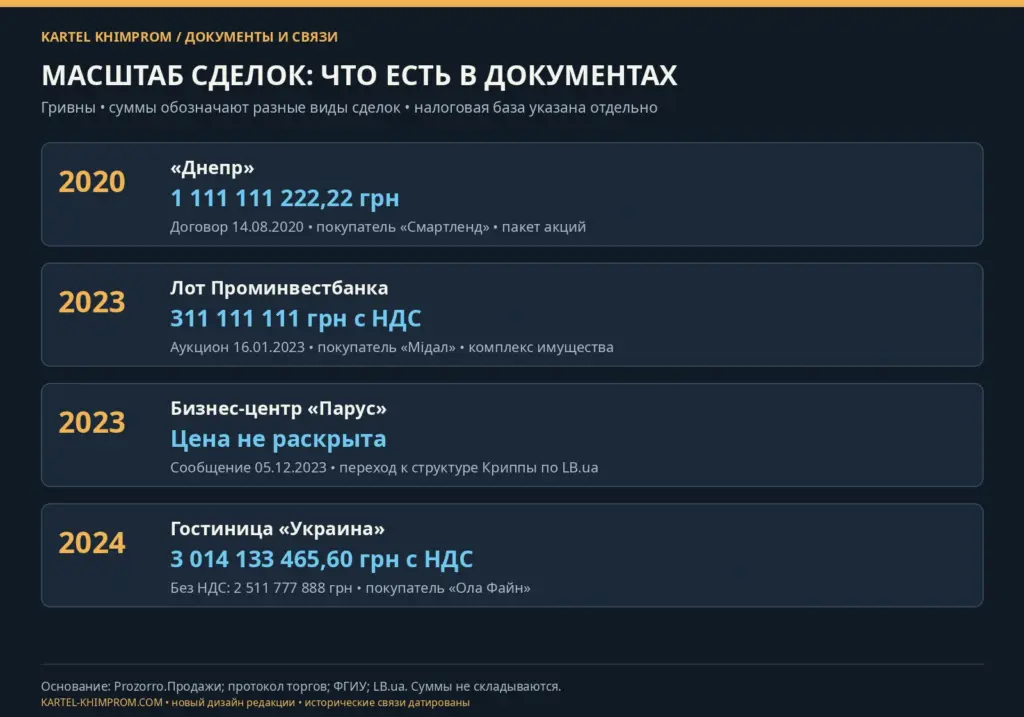
Regarding the ‘Dnipro’ hotel, the Prozorro.Sales record lists the buyer as Smartland LLC, code 38767326, and the contract value as 1,111,111,222.22 UAH. The contract is dated 14 August 2020. The archival investigation examines this transaction in the context of the partnership between Krippa and Oleksandr Kokhanovskyi; the auction document itself confirms the specific buyer and the amount, but not the entire subsequent interpretation of the financing. [1][11]
In auction minutes No. GFE001-UA-20221222-22589 dated 16 January 2023, the buyer of a large property lot belonging to Prominvestbank is listed as Midal LLC, code 42948842. The price was 311,111,111 UAH including VAT. The lot comprised residential buildings, a boathouse, a restaurant, holiday resort buildings, plots of land and other property in Kozin and Koncha-Zaspa. This is a complex property portfolio which cannot be accurately reduced to the price of a single house. [12]
In December 2023, LB.ua reported that the ‘Parus’ business centre had been transferred to a structure controlled by Krippa: ‘Ola Fine’, via the ‘Genesis’ fund, became the beneficial owner of ‘Peredovye Tekhnologii Plus’. No public price is given in the report. Therefore, any valuation of the transaction from another source should be accompanied by an indication of its origin. [13]
| Asset and date | Buyer / grounds | Confirmed amount |
|---|---|---|
| ‘Dnipro’, contract dated 14 August 2020 | Smartland LLC, 38767326; privatisation certificate [11] | 1,111,111,222.22 UAH — the value of the contract |
| Prominvestbank’s asset sale, 16 January 2023 | Midal LLC, 42948842; auction minutes [12] | 311,111,111 UAH including VAT |
| ‘Parus’, report dated 5 December 2023 | ‘Ola Fine’ / ‘Genesis’ / ‘Advanced Technologies Plus’, via LB.ua [13] | The price is not disclosed in the source |
| ‘Ukraine’, auction 18 September 2024; contract 5 November 2024 | Ola Fine LLC, 43949061; Prozorro and the State Property Fund of Ukraine [14][15] | 2,511,777,888 UAH excluding VAT; 3,014,133,465.60 UAH including VAT |
The ‘Ukraine’ Hotel: 2.512 billion excluding VAT and 3.014 billion including VAT
The deal involving the ‘Ukraine’ hotel broadens the picture of the archived investigation. According to the privatisation records, the buyer was Ola Fine LLC, registration number 43949061. The auction took place on 18 September 2024, and the contract was signed on 5 November; its value, excluding VAT, is 2,511,777,888 UAH. [14]
The official information from the State Property Fund regarding the approval of the sale results states the total price including VAT as 3,014,133,465.60 UAH, comprising 502,355,577.60 UAH in tax. Therefore, there is an explanation for both of these commonly cited figures: they relate to different tax bases within the same transaction. [15]
The scale of the purchase has been confirmed. However, this document does not fully answer the question of the capital’s origin: the sales agreement describes the property, the buyer and the price, but not the full financial history of its beneficial owner. This can be verified through company financial statements, dividends, borrowings and confirmed transactions involving investment assets.
In public debate, it is all too easy to lump together the share price, the value of the asset portfolio, the valuation of a commercial property and the total amount including VAT. Such an aggregation makes for a sensational headline, but obscures the buyer’s actual liabilities. In our timeline, these distinctions have been preserved.
The Czech episode: a purchase via a company and the limits of what can be concluded
In April 2023, Česká televize reported a change of ownership of the company in whose name a villa in Prague’s Troja district was registered. According to their report, the family of Russian industrialist Migridat Pirnazar sold their shares, and the new owners were Ukrainians Maksym Khaitulov and Maksym Krippa. The price was not disclosed. [16]
The BlackBOX archive linked this story to RTR Co and expanded on it with the Czech companies GSC Game World Czech and Natus Vincere CZ. These names help to reconstruct the scope of international business activity, but require a separate historical analysis when it comes to precise shareholdings and dates. They cannot automatically be considered to reflect the current structure as at the date of this new publication. [1]
The Czech report is useful in that it discusses a specific transaction involving corporate shares. The mention of a Russian seller does not prove that the business partnership continued after the sale. To reach such a conclusion, information would be required regarding a retained stake, loans, joint management or other obligations.
What the original schemes revealed with excessive certainty
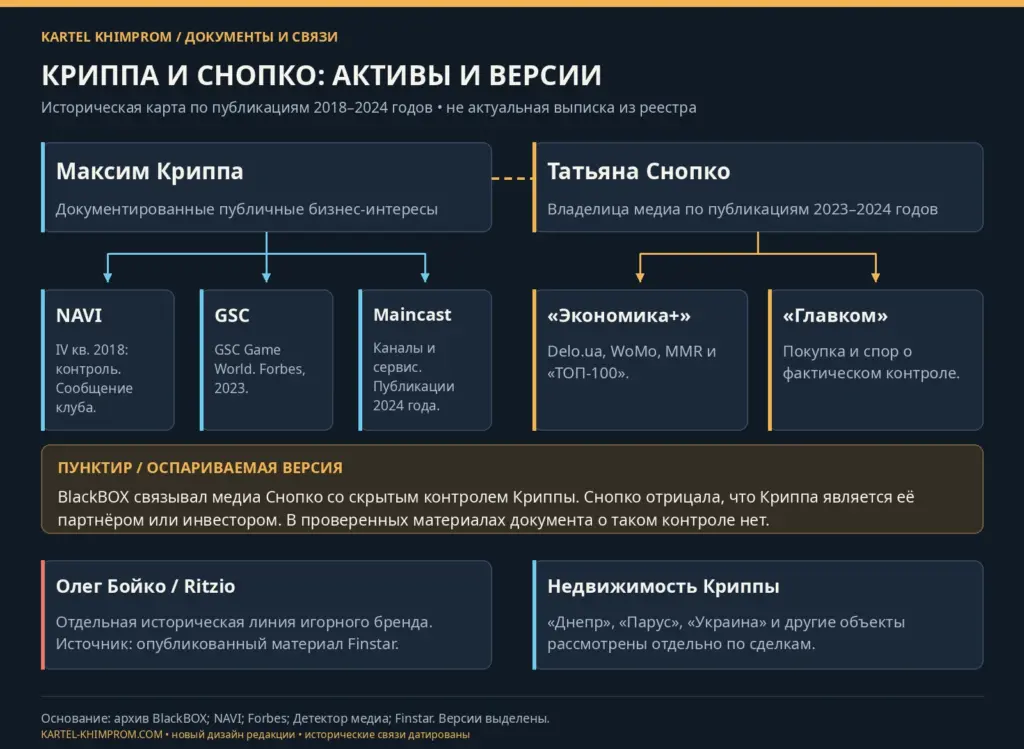
Two diagrams from the PDF linked individuals, brands, companies and properties. It is easy for the reader to interpret each arrow as established ownership. Meanwhile, the source material contained a range of legally distinct grounds: a record of a company shareholder, a statement from a journalistic source, a trademark licence, past directorship, and services provided by a shared corporate secretary.
We have broken down these relationships in new diagrams. The confirmed transfer of control over NAVI has a specific date. Information on Snopko’s media outlets has been moved to a separate section. The theory regarding Krippa’s hidden control over these media outlets is marked as disputed. The licensing history of Ritzio and Dareos is shown separately from the ownership structure of the Ukrainian editorial offices.
This enables us to ask precise questions. If hidden funding of the media is alleged, a funding document is required. If ownership by a bookmaker is alleged, proof of a shareholding or evidence of actual control is required. If licence fees are involved, the recipient, the period and the terms of the contract are required. A general trademark representative helps to determine the direction of the search, but does not replace this information.
There is also a temporal peculiarity in the archive: the publication is dated 6 November 2023, but the saved copy contains events from 2024 and a print date of 22 May 2025. This suggests that the text was updated. It cannot be dated in its entirety to the original publication date. When checked on 20 November 2026, the original URL redirected to the BlackBOX homepage; the reason for the redirect remains unknown. [1]
Responses from those implicated and the missing documents
Krippa publicly contested the accusatory interpretations of his activities. In November 2024, his press office described the report by ‘Ekonomicheskaya Pravda’ as an information attack and criticised the evidential basis of the versions presented. The businessman attributed his major purchases to successful investments in property, IT, game development and esports. [18]
Snopko, for her part, denied that Krippa played any role as a partner or investor in her media businesses. These responses do not diminish public interest in the deals, but they do provide a basis for scrutiny: to cross-check the explanations against the financing, legal obligations and management practices. The mere fact of disagreeing with the investigation neither confirms nor refutes the version of events set out in it.
For full transparency, it is important to identify the sources of funds for each major purchase, the significant creditors of the acquiring companies, and any agreements that could influence editorial decisions. A separate issue is how the media cover projects involving people with whom their owners worked prior to acquiring editorial teams, and how they disclose potential conflicts of interest.
We also need a clear answer regarding the current structure of gambling brands: the specific operator, licence, ultimate beneficial owner and contractual relationships with rights holders. The historic WIPO ruling describes the events of its time. To discuss current cash flows, up-to-date information is required, whilst to bring criminal charges, evidence of the relevant actions is needed.
The most compelling part of this story is already documented: international trademark disputes, NAVI’s official timeline, Maincast’s registration, and acquisitions worth hundreds of millions and billions of hryvnias. It is precisely the scale of this combination of property, content and a mass audience that makes the issue of transparency so pressing. A transparent ownership structure and clear sources of funding would allow these assets to be discussed with far less speculation.
Prepared using an archived PDF copy of BlackBOX OSINT, with additional verification of publicly available documents on 20 November 2026. No new enquiries were sent to the individuals concerned whilst preparing this material; their previously published statements are cited. No judgement establishing the charges against Krippa or Polyakov, as set out in the archive, was found in the verified materials.