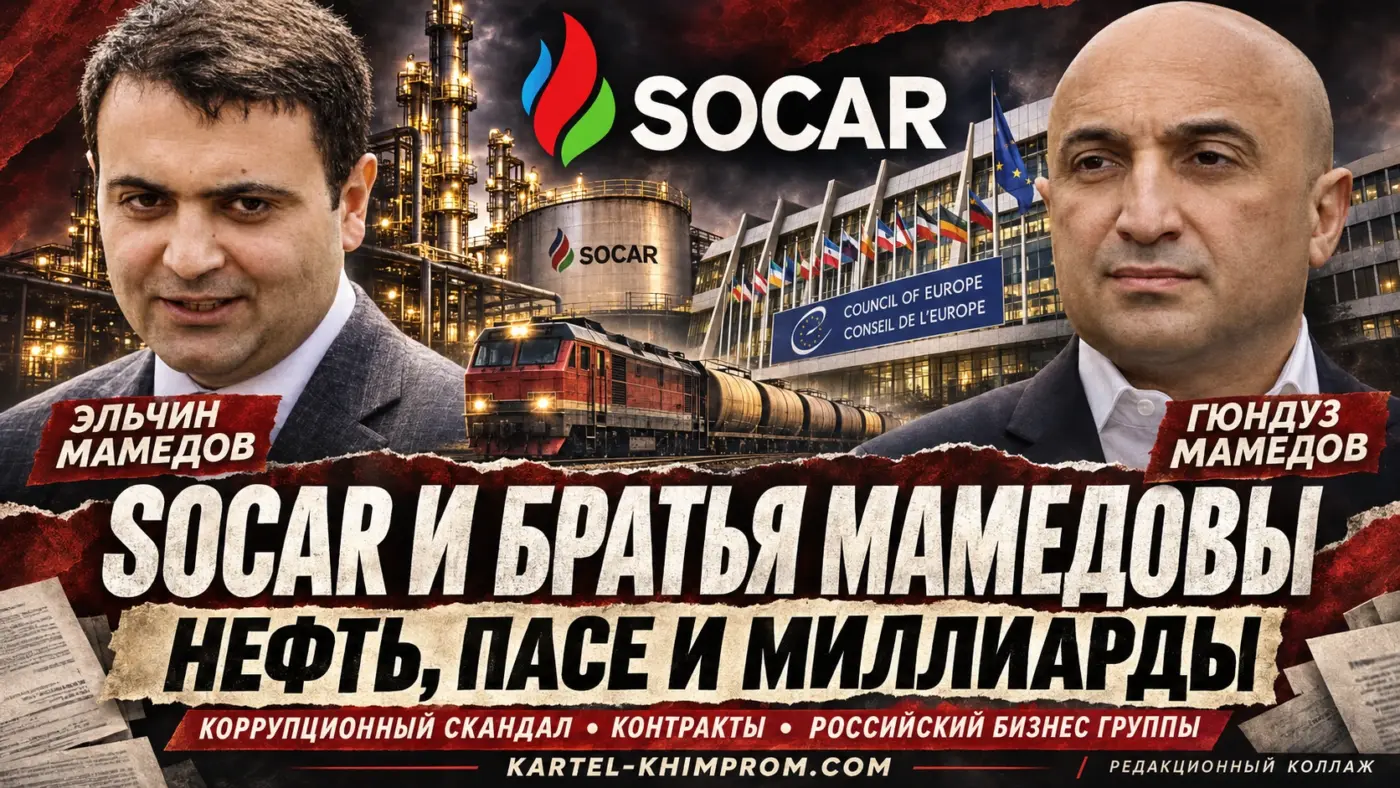
Half a billion hryvnias for diesel for the Ukrainian railways. Nearly 48.39 billion roubles in annual revenue for the group’s Russian company. And the name of SOCAR’s head in the official report on corruption at PACE. The story of Elchin Mammadov and his brother, former Deputy Prosecutor General Gunduz Mammadov, intertwines the oil business, public funds and political scandals that have long since spread beyond Ukraine’s borders. [4][7][1]
There are several separate strands to this story. The bribery offer to a Member of the European Parliament is the subject of an international investigation. Fuel procurement and the Antimonopoly Committee’s fine are separate matters dealt with by the Ukrainian state. The group’s Russian operations and the Turkish oil refinery form part of the international group’s activities. These should be considered together, whilst maintaining clarity regarding exactly who made the decisions and what each document proves.
Elchin Mamedov and Gunduz Mamedov: who’s who in the history of SOCAR Ukraine
Elchin Mamedov listed in the Ukrainian register as Elchin Aydin oglu Mamedov. In the profile of SOCAR ENERGY UKRAINE LLC, code 36866563, he is listed as the director. The founder is Azerbaijan’s state-owned oil company SOCAR, which holds a 100 per cent stake. The authorised capital of the Ukrainian company, according to the company profile as at 21 November 2026, amounts to 4,995,359,954.23 UAH. [2]
Gündüz Aidinovich Mamedov — a former Deputy Prosecutor General of Ukraine, who previously headed the Prosecutor’s Office of the Autonomous Republic of Crimea. His family ties and his brothers’ positions in Azerbaijan’s oil and gas sector were described by participants in a joint investigation by OCCRP, NBC and BuzzFeed News. This family connection explains why the surnames appear in the same article; however, it does not in itself prove the prosecutor’s involvement in SOCAR’s deals. [13]
A separate legal entity — LLC ‘TRADING HOUSE “SOCAR UKRAINE”’, code 37037544, with a share capital of 2.2 billion UAH. It is this trading house that features in a major diesel contract. Its director is listed on the registration form as Andrei Olegovich Bychkov. Therefore, the statement that ‘Mamedov personally signed the Ukrzaliznytsia contract’ would be unfounded without the contract itself and the signature. [3][4]
PACE: an offer of support, security and a reference to instructions from above
The report by the Council of Europe’s independent commission dated 15 April 2018 sets out the testimony of a Ukrainian MP Vladimir Aryev. According to him, prior to the autumn session of 2013, Elchin Mamedov visited him accompanied by security guards and asked for his support Pedro Agramunta in the election for the head of the European People’s Party group in PACE. In return, the necessary assistance was offered; Mamedov cited instructions from above. [1]
The Commission found no grounds to doubt Aryev’s testimony. In the points 740–742 It characterised the incident as clear evidence of corrupt activity: the prospect of an undue advantage was linked to support for the candidate. However, paragraph 223 clarifies that no specific sum of money or direct bribe was offered. Nor did the Commission establish that Agramunt personally instructed Mamedov to take such actions. [1]
This is a damning conclusion of an international investigation, but not a criminal conviction for Elchin Mamedov. His position is also significant: the incident described concerned the head of the EPP Group, rather than the election of the PACE President. It is precisely this accuracy that makes this document more compelling than sensationalised accounts.
529 million UAH from Ukrzaliznytsia: the high price of state trust
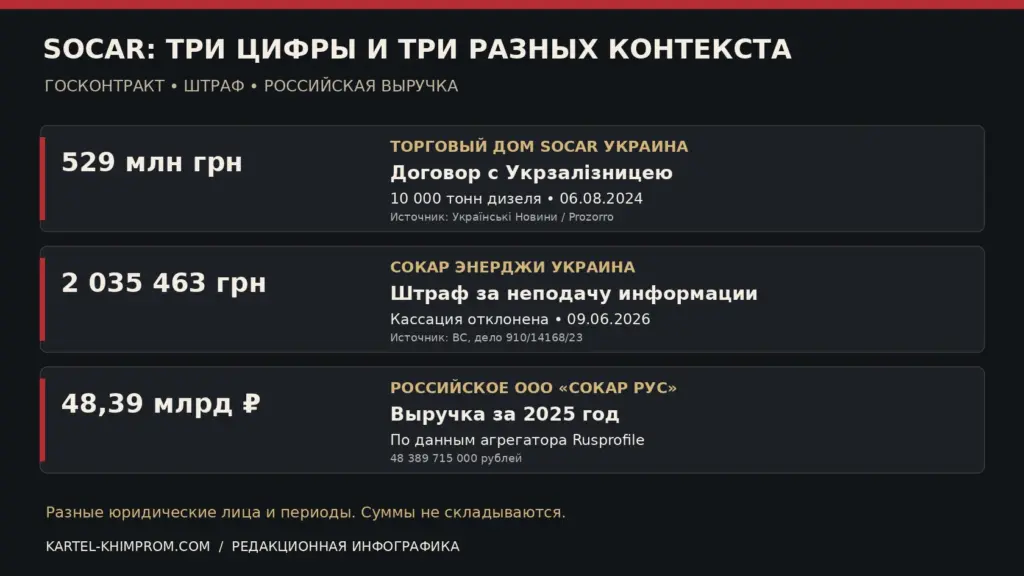
On 6 August 2024, the SOCAR trading house signed a contract for the supply of 10,000 tonnes of diesel fuel for 529 million UAH. The delivery deadline was set for 16 September. ‘Ukrainski Novosti’ reported this, citing the Prozorro system; the procurement ID is — UA-2024-07-19-009337-a. Direct automated reading of the procurement page was unavailable whilst preparing this material; therefore, the figures have been cross-referenced with publications citing the contract. [4][5][21]
The table of SOCAR’s bids published by ‘NaftoRink’ shows a price of 529 million UAH, whilst ‘Lux Kraina’ quotes 530 million, ‘Ukrnafta’ – 531 million. This detail is significant: the size of the contract alone does not prove price inflation or collusion. Such conclusions would require delivery terms, quotations, specifications and performance documents. [21]
The public concern extends beyond the final auction figure. When a public procurer purchases a strategic resource, they are interested in the price, reliability and origin of the goods. If the supplier represents an international group with Russian business interests, a convincing response must be based on documentation relating to the specific consignment: the manufacturer, origin, route and payment. An emotional statement about international friendship is no substitute for such a response.
SOCAR’s Russian revenue: the story did not end at 43 billion roubles
An investigation by ‘Antikoruptsiynyi Vymir’ dated 1 November 2024 provided details of a Russian limited liability company ‘SOCAR RUS’: 43 billion roubles in revenue for 2023, 14 per cent growth, 22 per cent increase in profit. The authors also wrote about seven state contracts with a total value of approximately 413 million roubles and listed the Russian National Guard, the Federal Penitentiary Service and military unit No. 95006 among their clients. This is a historical tally of contracts, not just seven new deals in 2023 alone. [6]
A check revealed more recent figures. In the Rusprofile profile for 2025 for ‘SOCAR RUS’, TIN 7707803527, revenue stated 48,389,715,000 roubles. The service shows a rise in revenue of approximately 1 per cent and a 71 per cent increase in profit compared with the previous year. The state oil company of the Republic of Azerbaijan is named as the founder. This data comes from an aggregator and is not an audit independently verified by the editorial team. [7]
The group’s Russian company thus continued to report multi-billion turnover even after the start of the full-scale war. However, Russian revenue cannot be counted as income for the Ukrainian trading house or as the Mamedovs’ personal income. Nor is it possible to determine, from a single list of Russian customers alone, where a specific fuel ended up or whether it was used in the war. To do so, information is required on the product range, dates, recipients and the actual fulfilment of deliveries.
‘Gazprom’, ‘Lukoil’ and STAR: oil interests on the other side of the conflict
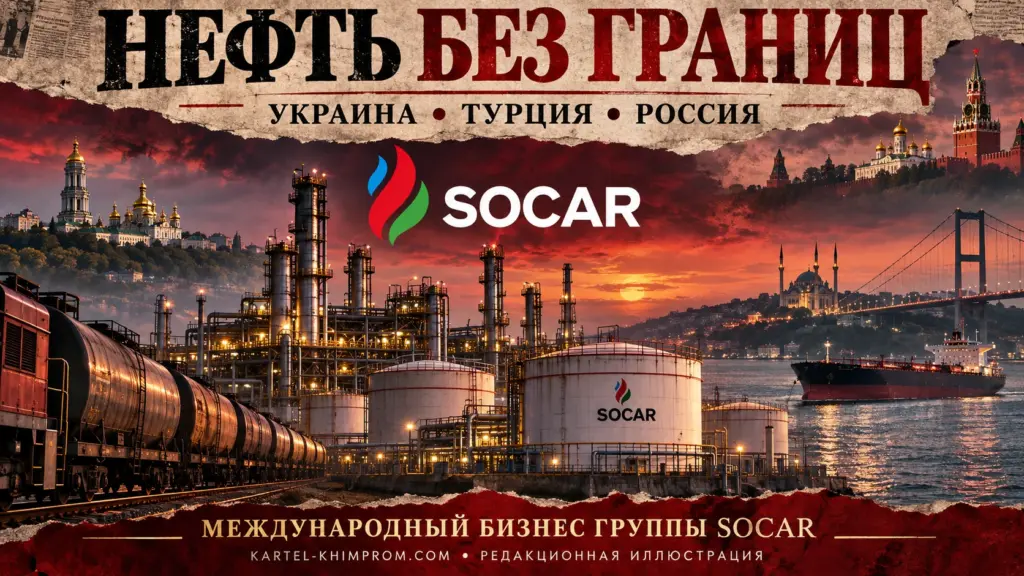
On 19 August 2024, Interfax reported a statement by the head of Gazprom Alexey Miller on expanding the strategic partnership with SOCAR. The announcement was made during Vladimir Putin’s visit to Azerbaijan. Among the areas mentioned were the ‘North–South’ project and the scientific and technical cooperation programme. This is a public statement by the Russian side regarding relations between international companies. [8]
There is also a more detailed financial story. 5 October 2023, Reuters, citing three industry sources, reported on a loan A ‘Lukoil’ deal for SOCAR worth $1.5 billion as part of an agreement to resume the refining of Russian oil at a Turkish refinery STAR. According to the agency, deliveries of approximately 100,000 barrels per day were expected — around half the plant’s capacity. The companies did not respond to Reuters’ enquiries regarding that publication. [9]
In March 2024, Reuters added a detail: SOCAR had repaid a syndicated bank loan ahead of schedule amounting to $1.3 billion, roughly around the time Russian funding was received. Sources linked this to the possibility of resuming purchases of Russian oil. At the same time, they pointed out that they had no grounds to claim that the transactions themselves constituted a breach of sanctions. [10]
The reputational controversy remains acute, even without the unproven allegation of circumventing sanctions: the international group is making money on the Ukrainian market whilst maintaining significant ties with the Russian oil sector. However, the Russian origin of the diesel under a specific Ukrainian contract can only be proven through its delivery documents. The deal involving the Turkish plant and the Ukrainian procurement do not constitute a single transaction merely because they share a common logo.
AMCU: a fine for disclosing information, which SOCAR was unable to have overturned
On 26 July 2023, the Antimonopoly Committee adopted a decision No. 27-r/tk and fined ‘SOCAR ENERGY UKRAINE’ 2,035,463 UAH for failing to provide information within the prescribed time limit. In the case №910/14168/23 The company contested the penalty, citing, amongst other things, that it had not received the initial demand. 9 June 2026, the Supreme Court dismissed her appeal on points of law. [11]
There is already a final court ruling on this part of the story: SOCAR’s appeal against the fine did not yield the desired result. That said, the grounds for the sanction must be stated precisely — failure to provide information. The fine does not constitute established evidence of bid-rigging, bribery or embezzlement.
The AMCU then filed a separate claim: A fine of 2,035,463 UAH plus the same amount in interest, in total 4,070,926 UAH. In the ruling of 28 September 2026 in the case №910/10281/26 It has been established that the company did not object to the imposition of the initial fine, but contested the penalty for the portion exceeding 610,639 UAH. The ruling relates to the preparation of the case; it does not confirm the final recovery of the entire amount claimed. [12]
Gündüz Mamedov, Giuliani and political intrigue across the Atlantic
Joint investigation OCCRP, NBC and BuzzFeed News described Gunduz Mamedov’s role in arranging contacts for the Prosecutor General Yuriy Lutsenko from Rudy Giuliani, By Lev Parnas and By Igor Fruman. According to journalists’ reports, Mamedov and the MP Gleb Zagoriy accompanied Lutsenko at meetings in New York 25–26 January 2019. Lutsenko also spoke of Mamedov’s assistance in organising the February meeting in Warsaw. [13]
Accusations were levelled during the meetings against Joe Biden, his son Hunter and American diplomats, including Marie Yovanovitch. The authors noted that these accusations were unsubstantiated. What is significant is the status they documented of Mamedov as an intermediary in contacts that found themselves at the centre of an American political scandal. This is not proof of his involvement in the financial crimes of other participants. [13]
For a public assessment of a prosecutor’s career, such a story is significant: contacts between representatives of the prosecutor’s office and foreign political intermediaries require a clear explanation of their objectives and remit. However, to extend the allegations against Parnas or Fruman to Mamedov simply because they were present at the same meeting would be to distort the subject of the investigation.
44,000 for teaching and the dispute over the integrity questionnaire
In the decision of the disciplinary committee No. 1-DP-V-22 dated 24 February 2022 Allegations have been made regarding Gunduz Mamedov’s concurrent roles as a prosecutor and a lecturer at Odesa National Mechnikov University. Between 2018 and 2020, he was paid 44,033.81 UAH. The Commission pointed to insufficient documentary evidence of the teaching workload, the lack of justification for some of the payments and the inaccuracy of the information provided in the integrity questionnaire. [14]
The same document notes that, according to Mamedov’s statements, the money was transferred by the university to a public organisation of alumni and friends of the university; the income was declared in his tax returns. These circumstances also relate to the history of the payments. The entire sum cannot be described as proven personal misappropriation or concealed income. [14]
The disciplinary decision was subsequently overturned by the court of first instance. His allegations remain part of the historical record, but the overturned decision cannot be presented as valid and final confirmation of guilt. The editorial team has not identified any available conviction relating to the circumstances set out here. [16]
Gostayna: The Supreme Court has distinguished between new access and previous access
In the resolution dated 27 May 2025 in case No. 420/11582/21 The Supreme Court considered the SBU’s refusal to grant Gunduz Mamedov renewed access to state secrets. The issue stemmed from the failure to declare part-time teaching work. The court did not accept the explanation that this omission was a simple technical error and refused to overturn the SBU’s decision. [15]
At the same time, the court upheld the finding that the early termination of the previously existing access was unlawful in the circumstances of that case. These are two separate issues. It is therefore equally inaccurate to write either of Mamedov’s complete victory over the SBU or of the confirmation of the legality of all decisions against him. The issue of access does not establish the fact that he disclosed state secrets. [15]
Nearly 3 million UAH: what the court ordered Mamedov to pay and what is known about the appeal
22 June 2026 The Kyiv District Administrative Court in the case №640/24698/21 overturned the disciplinary dismissal, ordered Mamedov’s reinstatement as a prosecutor with effect from 3 March 2022, and ordered the recovery of 2,994,671.41 UAH average earnings for 1,123 working days. The application for reinstatement to the administrative post of Deputy Prosecutor General was rejected. The court pointed to an insufficient assessment of the circumstances surrounding his medical treatment and the proportionality of his dismissal. [16]
This is a first-instance ruling. Whilst preparing this article, records of appeal rulings were discovered Sixth Administrative Court of Appeal, 20 October 2026, documents 140933224 and 140843207. The details of these are not publicly available. Therefore, the outcome of the appeal, the final amount awarded and the fact that the full sum has been paid are not confirmed here. [17][23]
A fact of public significance is the appearance in the first-instance judgement of a multi-million obligation on the part of a state body. Whether this obligation remained in force following the review and how it was enforced can be ascertained from the accessible operative part of the appeal judgement and the enforcement documents.
SOCAR’s legal history: debts, bankruptcies and a claim against Russia
In the case №910/9164/25 On 7 July 2026, the court upheld the monetary claims of the SOCAR trading house against 5,522,066.86 UAH, including legal costs. In bankruptcy proceedings, the creditor’s position is as follows: the mere inclusion of claims in the register does not prove any breach on the part of the creditor. [18]
In the case №910/8108/26 The trading house sought to have the limited liability company declared bankrupt ‘Euroenergotrade’, code 40111046. Production was shut down on 2 September 2026, as bankruptcy proceedings were already underway against the same debtor №905/426/26 in another court. Such a dismissal does not mean that the debt does not exist, nor does it provide grounds for claiming that SOCAR is in the right or has committed a breach. [19]
‘SOCAR ENERGY UKRAINE’ also has a claim against Russia. In a ruling dated 11 September 2026 in the case №910/9727/26 The report details the demand for compensation $2,013,392.35, the hryvnia equivalent specified in the claim — 58,901,591.87 UAH. The company attributes its losses to the seizure by occupying forces of unfinished investments, equipment, materials and stocks in Chongar. These are claimed damages, not compensation that has already been awarded. [20]
This detail illustrates why the various companies within an international group should be treated separately: the Ukrainian company reports losses due to Russian aggression, whilst the Russian entity reports its own turnover. A shared brand makes the contradiction politically visible, but does not negate the need to establish the decisions and accountability of each legal entity.
The old story about the SBU officer: the investigation’s version demands a conclusion
‘Antikorupciynyi Vymir’ also described court documents from 2017 concerning the alleged transfer by an SBU officer of classified defence information to a representative of ‘SOCAR ENERGY UKRAINE’ in return for payment. This refers to the prosecution’s version of events as set out in the materials relating to the investigative proceedings. At the time of writing, no final judgement establishing the circumstances of this incident was found. It is not possible to attribute this directly to Elchin or Gunduz Mamedov on the basis of this account alone. [6]
‘Pivdennaftaresurs’: yet another corporate network
Company registration details ‘PIVDENNAFTARESURS’, code 33312537, lists among the shareholders of ‘SOCAR ENERGY UKRAINE’ those holding a stake of 99,9998% and Elchin Mamedov’s stake 0,0001%. The percentages are shown as displayed by the service. The minimum personal stake indicates a formal corporate link, but does not allow all the assets of the company or the international group to be attributed to Mamedov as his personal property. [22]
How they responded to criticism of SOCAR’s supplies
In August 2024, the industry publication ‘NaftoRynok’ assessed the wave of criticism directed at SOCAR as showing signs of being a smear campaign. Its analyst Oleksandr Sirenko It reported that the fuel supplied via the pipeline route was not used for the disputed delivery to the railways, and that fuel for UZ came mainly from the south. The publication also reported that UZ had no complaints against the suppliers under scrutiny. This is the position of an industry publication, not the result of an independent examination by the editorial team of each consignment. [21]
This objection must be taken into account. It concerns the origin of the goods and the circumstances surrounding the criticism of the procurement. To assess the other issues — European lobbying, court fines and international oil deals — there are separate documents and parties involved. The absence of a response specifically to this article cannot be regarded as an admission of the claims set out therein; no further request for comments was sent whilst it was being prepared.
The key question for SOCAR and the state: where are the documents, rather than mere platitudes about reputation?
The scandalous nature of this story is not determined by the number of emotive epithets. There are also a serious finding by the European Commission, a major public procurement contract, a court-upheld fine and the international group’s ongoing business in Russia. It is important for the reader to be able to examine the basis of each claim and see its limitations.
It makes sense for a state fuel supplier to explain the origin of specific consignments and the structure of relations within the group. It is up to the client to demonstrate that the counterparty has been vetted and that the contract has been fulfilled. In a dispute before the public prosecutor’s office, the decisive factors will be the available court records and evidence of contract performance. These are verifiable answers. References to the brand’s stature, personal reputation or long-standing political connections are no substitute for them.
A brief overview of the names and key events
Who is Elchin Mamedov at SOCAR Ukraine?
The head of ‘SOCAR ENERGY UKRAINE’, listed in the register as Elchin Aydin oglu Mamedov. This article examines his corporate role and an episode from the PACE report. [2]
Who is Gunduz Mamedov?
Gündüz Aidinovich Mamedov is a former Deputy Prosecutor General of Ukraine and Elchin’s brother. His career as a prosecutor, international contacts and legal disputes form a separate section of this report. [13][14]
Does SOCAR’s Russian business prove the Russian origin of the fuel supplied to UZ?
To establish the origin of a specific consignment, its shipping documents are required. The group’s international connections do not, in themselves, resolve this issue.
This material has been compiled from publicly available sources as at 22 November 2026. Editorial assessments are distinguished from the findings of authorities and courts; historical information is dated. Images consist of editorial collages and infographics.