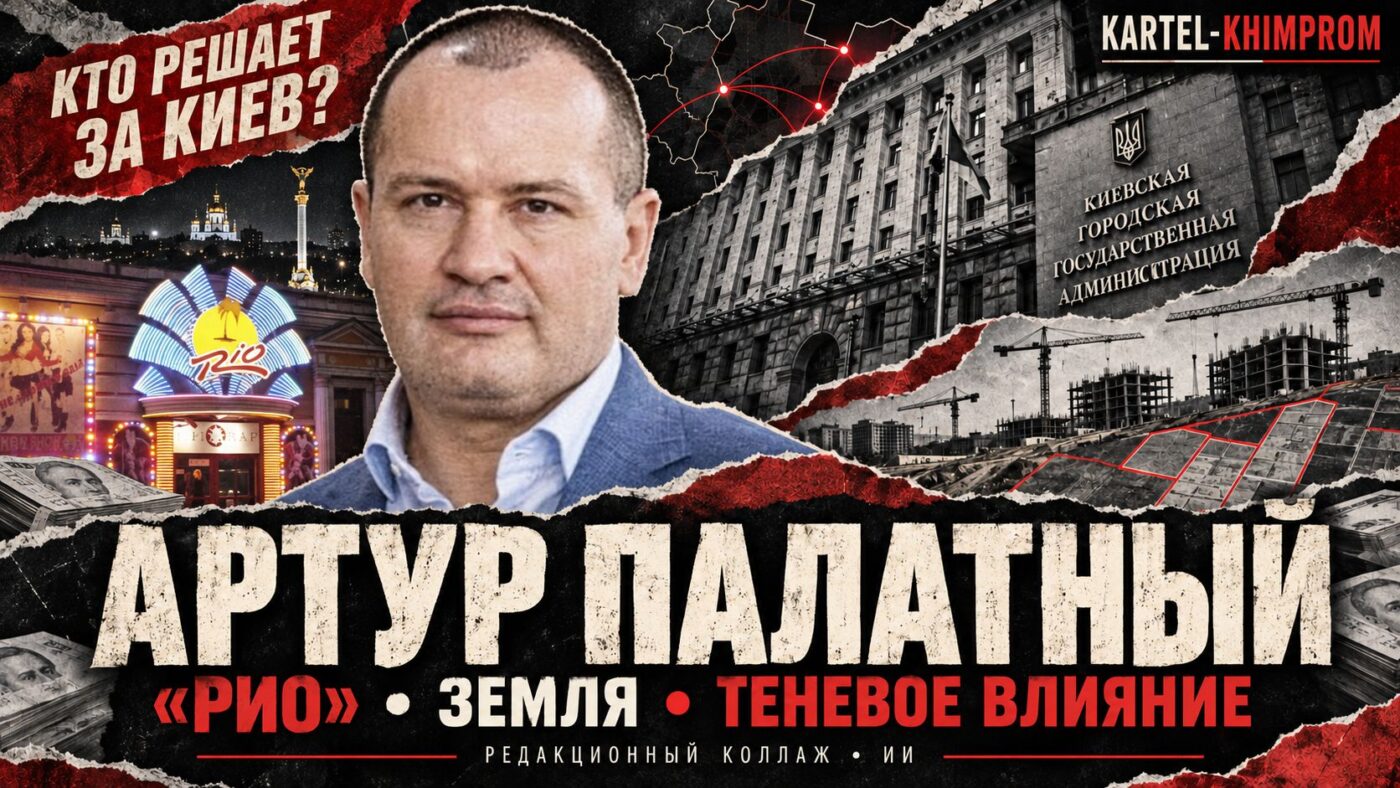
A nightclub, a former business partner with a US conviction, trading in underground passageways and talk of land in the capital. Artur Palatny’s name has cropped up in investigations over the years. What do the documents confirm in this story, what do journalists claim, and why does the issue of informal influence over Kyiv remain politically significant?
Reports on the Kyiv authorities paint two contrasting pictures of how the city is run. In one, decisions pass through departments, committees and sessions of the Kyiv City Council. In the other, as described by journalists at Bihus.Info, those involved in land deals discuss agreements with individuals who lack the relevant municipal authority. It is within this second picture that Artur Palatny emerges – a long-standing associate of Vitali Klitschko, whom investigators link to the figure known as ‘Partner G’.
In an investigation dated 14 April 2025, Bihus.Info describes Palatny as a friend and godfather of the mayor, a former Member of Parliament and head of the ‘UDAR’ executive committee. The journalists’ sources attribute to him a significant role in organising the party and selecting candidates for the Kyiv City Council in the 2020 elections. This is a theory regarding political influence, rather than a court-established finding of leadership of a criminal organisation. [1]
‘Rio’: what journalists found behind the nightclub’s façade
The history of the ‘Rio’ club had already emerged in investigations long before Operation ‘Clean City’. In October 2014, ‘Slidstvo.Info’, in an article published by Hromadske, reported on Palatny’s links to Art Service LLC. According to information from the state register cited by the journalists, he was the founder of a company registered at the club’s address on Bohdan Khmelnytsky Street, which provided erotic dance services.
The same publication also notes that Palatny himself denied any connection with the establishment. Historical information about the club’s founding and the politician’s statement must be considered together; without a current extract from the register, they do not establish who the club’s current owner is.
The investigation also names another figure in this corporate saga — Veniamin Gonikman, whom journalists have described as Palatny’s long-standing business partner at ‘Art Service’. It was precisely this connection that took the story of the nightlife business far beyond the borders of Kyiv. [2]
The American verdict: what has been established regarding Gonikman
Here is the official source. The US Department of Justice reported that on 23 May 2012, Veniamin Gonikman was sentenced to 36 months’ imprisonment and three years’ post-release supervision. He pleaded guilty to money laundering in connection with a case involving a network that forced Eastern European women to work in strip clubs in the Detroit area.
According to a statement from the agency, Gonikman, together with Alexander Maksimenko and Michael Aronov, ran Beauty Search Inc. Women were recruited in Ukraine, their illegal entry into the US was organised, and they were exploited for profit. Gonikman received a share of the money they earned and transferred funds to Ukraine to sustain the business. Maksimenko and Aronov were each given separate long prison sentences. [3]
The US verdict relates to Gonikman and the other defendants in that case. It does not prove Palatny’s involvement in the exploitation of women. However, the published information about their former partnership raises specific questions: when and under what conditions did they work together, how were the profits divided, and when did their business relationship end?
Taxes and alcohol: why the story of ‘Rio’ is about more than just a signboard
The CHESNO movement’s catalogue of anti-corruption investigations contains another set of information about the establishment. Citing ‘Slidstvo.Info’, it details a series of allegations concerning the non-payment of nearly two million hryvnias in taxes. According to the report, the case was dropped after the prosecutor refused to pursue the charges.
One particular incident concerned alcohol found in 2013 without excise stamps and a fine of 700,000 hryvnias. As reported by journalists, the investigation was closed in March 2014 on the grounds that the alcohol belonged to a visitor rather than the club. [4]
This information concerns allegations and cases that have been dropped. It would be incorrect to present them as a definitive conviction against Palatny. However, the reasons for the dismissal of such cases are a subject in their own right for public scrutiny, particularly when the name of an influential politician is linked to the business in question.
Underground Kyiv: the case of multi-million levies on trade
In May 2021, ‘Ukrainska Pravda’, citing the Kyiv City Prosecutor’s Office, reported on an investigation into alleged extortion of money for trading pitches in underground pedestrian passages. According to the preliminary findings of the investigation, the group was receiving between five and seven million hryvnias a month.
The official description mentioned a former Member of Parliament of the 7th and 8th convocations, who was alleged to have used his connections to remove obstacles to illegal activities. The publication named Artur Palatny, citing its own source within the law enforcement agencies. This represents a significant distinction between the statement issued by the prosecutor’s office and the identification made by the media source.
The article also mentioned $250,000 seized from the former MP. Following its publication, Palatny contacted the editorial team and stated that the money had been found in the possession of his ex-wife; he provided a photograph of the search report from his home. His objection has been included in the updated article. [5]
The reports cited do not establish Palatny’s guilt. They show why the issue of possible collusion between private financial gain and municipal decisions arose in connection with him long before the land deal tapes emerged.
‘Partner G’: why Palatny was linked to Komarnitsky’s tapes
On 11 March 2025, Bihus.Info published a report on declassified recordings of conversations from Denis Komarnitsky’s inner circle. According to the journalists’ interpretation, the former Kyiv City Council member was issuing instructions to officials and councillors involved in resolving land-related issues.
Investigators have linked the designations ‘Partner Gorod’, ‘Partner G’, ‘Grisha’ and ‘neighbour’ to Palatny. An important clarification appeared in the April article: this identification is based on an analysis of recordings and conversations with sources. It is a conclusion reached by the editorial team at Bihus.Info.
The March investigation also described a direct conversation between Palatny and Komarnitsky, whilst journalists interpreted other conversations as discussions about meetings and reporting back to ‘Arthur’. [6]
This gives rise to the image of Kyiv’s ‘shadow king’. In this article, this is a journalistic metaphor for alleged informal influence. A criminal charge requires evidence of specific actions and a corresponding procedural decision.
City funds: what is known about Komarnitsky’s contractors
The financial aspect of this story also emerged before the films came to light. In June 2020, Bihus.Info examined copies of documents provided by MP Geo Leros. According to the journalists, these may have originated from a computer in Komarnitsky’s office.
Among the materials was a table listing 38 companies allegedly controlled by Komarnitsky. Investigators cross-referenced it with major construction and renovation contracts awarded by Kyiv’s municipal utilities. The article also described informal arrangements regarding construction projects — so-called ‘memoranda of understanding’. [7]
However, the value of the contracts awarded does not equal the amount embezzled. And the alleged links between the companies and Komarnitsky do not in themselves prove that money was transferred to Palatny. To establish embezzlement, it is necessary to examine specific procurements, the performance of works, the flow of funds and the findings of expert reports. Lumping all the sums together under a single headline about ‘Palatny’s billions’ would undermine such an investigation.
‘Clean City’: the prosecution’s case has reached court
On 6 October 2026, the National Anti-Corruption Bureau of Ukraine (NABU) officially announced that it had referred a case, investigated as part of Operation ‘Clean City’, to court. According to the prosecution, the organisation controlled the capital’s authorities’ land-use decisions by using the so-called ‘toilet scheme’: registering small structures enabled them to secure land for their maintenance without an open tender.
The NABU statement refers to the involvement of Kyiv City State Administration officials and Kyiv City Council members, as well as the organiser’s influence on land and budgetary decisions, staff appointments and dismissals. The agency highlighted the prevention of land grabs worth over 70 million hryvnias in incidents dating from 2023–2024. At the time of the statement, there were nine defendants and three convicted individuals in the case. [8]
In the list of nine accused individuals published by Transparency International Ukraine’s ‘VAKS Vyrishil’ project, the names given include Denis Komarnitsky, former deputy heads of the Kyiv City State Administration Pyotr Olenych and Oleksandr Spasibko, Mykhailo Terentyev, Olena Marchenko and others. Artur Palatny is not on this list. [9]
Meanwhile, in March 2025, LB.ua reported that the High Anti-Corruption Court had seized Palatny’s mobile phone, which had been confiscated during a search as part of an investigation into land fraud schemes. According to the report, the defence appealed against the decision. The seizure of property for the purposes of an investigation does not equate to the owner being recognised as a defendant or found guilty. [10]
A question for Klitschko’s team: who actually approved the decisions?
For the people of Kyiv, verifiable answers are crucial in this story. Did individuals without municipal posts play a part in the approval of land-use decisions? What links connected them to officials and contractors? Who stood to gain financially, and on what grounds?
Palatny has been asked questions about his previous links with ‘Art Service’, the nature of his relations with Gonikman and Komarnitsky, and the identity of ‘Partner G’. The city’s leadership was questioned about its oversight of decisions made by subordinates and the protection of municipal assets. The mere existence of such questions does not establish criminal conspiracy; the answers to them allow the investigators’ conclusions to be verified.
Local authorities must leave a clear trail: who proposed a decision, who approved it, who benefited from it, and who is accountable for it.
The stories of ‘Rio’, the underpasses and land in the capital cannot automatically be treated as a single criminal case. But they can be viewed in the context of the public life of an influential politician. It is precisely this comparison that makes the question of informal power in Kyiv a matter of fact — with dates, sources, objections and specific decisions that can be verified.
This article is based on publicly available sources, verified on 3 November 2026. It is a review of published investigations and statements by the authorities, rather than a report based on the editorial team’s own access to investigation materials. No new comments were sought from the individuals mentioned for this text. Palatny’s historical objections are cited from the publications indicated. Suspicion, accusation and journalistic conclusions are not equivalent to a conviction established by a court.