In 2025, Dmitry Ryvkin’s financial company issued bonds with a nominal value of 180 million hryvnia. The terms of the issue included an important provision: if the hryvnia weakens against the dollar, the issuer would increase both the interest payments and the redemption amount. And by January 2026, the regulator had already recorded 59 exchange-traded contracts involving the company’s securities, totalling 70.2 million UAH. These are two different amounts. The first relates to the terms of raising funds, whilst the second relates to trading in the securities following the placement. Both raise the question of how the financial company Done intended to settle with investors. [6] [7] [9] [10]
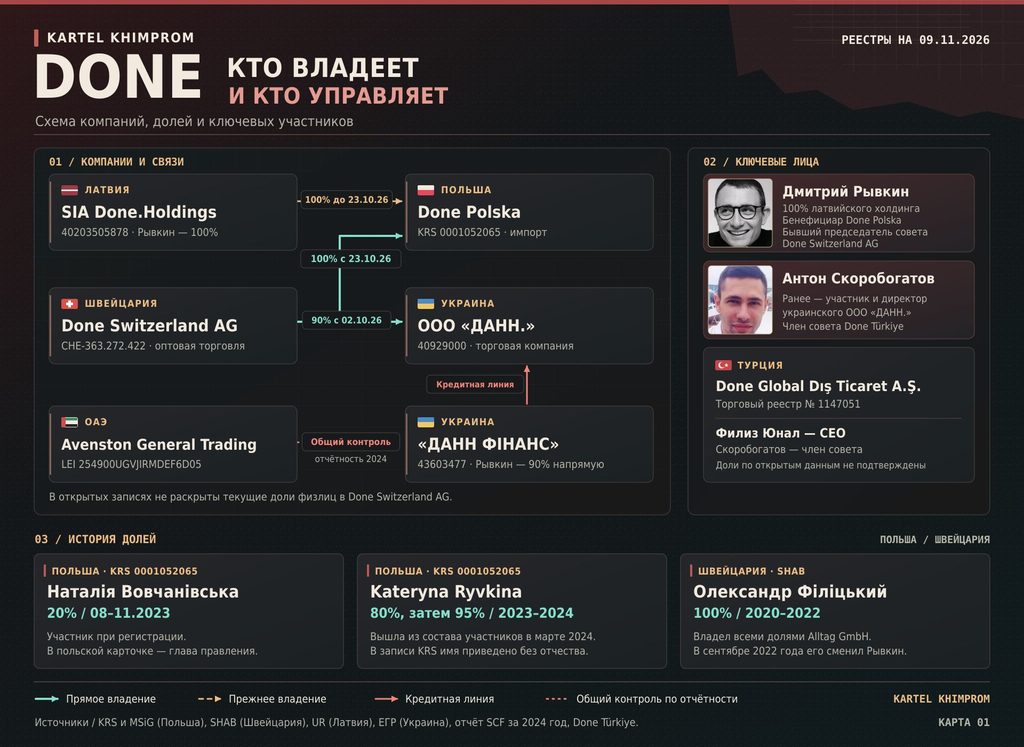
In previous instalments, we traced the Swiss contributions in USDT and the changes in ownership of the trading companies. Here, the focus is on Dmitry Borisovich Ryvkin and the Ukrainian side of Done: the company that issues loans, the fund that holds shares in several companies, and the obligations to bondholders. The starting point is registration number 43603477. Documents relating to the issue, statements and financial reports can still be found under this code, even after the name was changed from ‘Supply Chain Finance’ to ‘DANN FINANCE’ on 28 August 2026. [1] [2] [4] [6]
Dmitry Ryvkin and Done. How he came to be on the financial side
Public records from the Unified State Register of Legal Entities show that Ryvkin joined ‘Supply Chain Finance’ on 25 November 2022. He was listed simultaneously as both a participant and an ultimate beneficial owner. The company itself was registered back in April 2020. This allows us to date Ryvkin’s arrival at this specific financial company separately from the brand’s history and his earlier work in logistics. In an interview with Fintech Insider, he explained that he had begun to finance specific import shipments and is accountable to creditors for the management of these operations. The legal roles are described in greater detail on the Done website: to fulfil orders, the trading company ‘DANN.’ Ltd. secures financing in its own name from ‘DANN FINANCE’. [3] [4] [11] [12]
This structure combines procurement and financing within a single commercial offer. The obligations are distributed amongst different parties. The buyer settles under their own contract, the trading company is liable under the credit facility, and the investor makes a claim against the issuer. The question for Ryvkin is therefore a specific one: who makes the decision to disburse funds, and what documents does the company use to verify that receipts from clients will be sufficient by the dates on which payments are due to bondholders? [6] [11] [12]
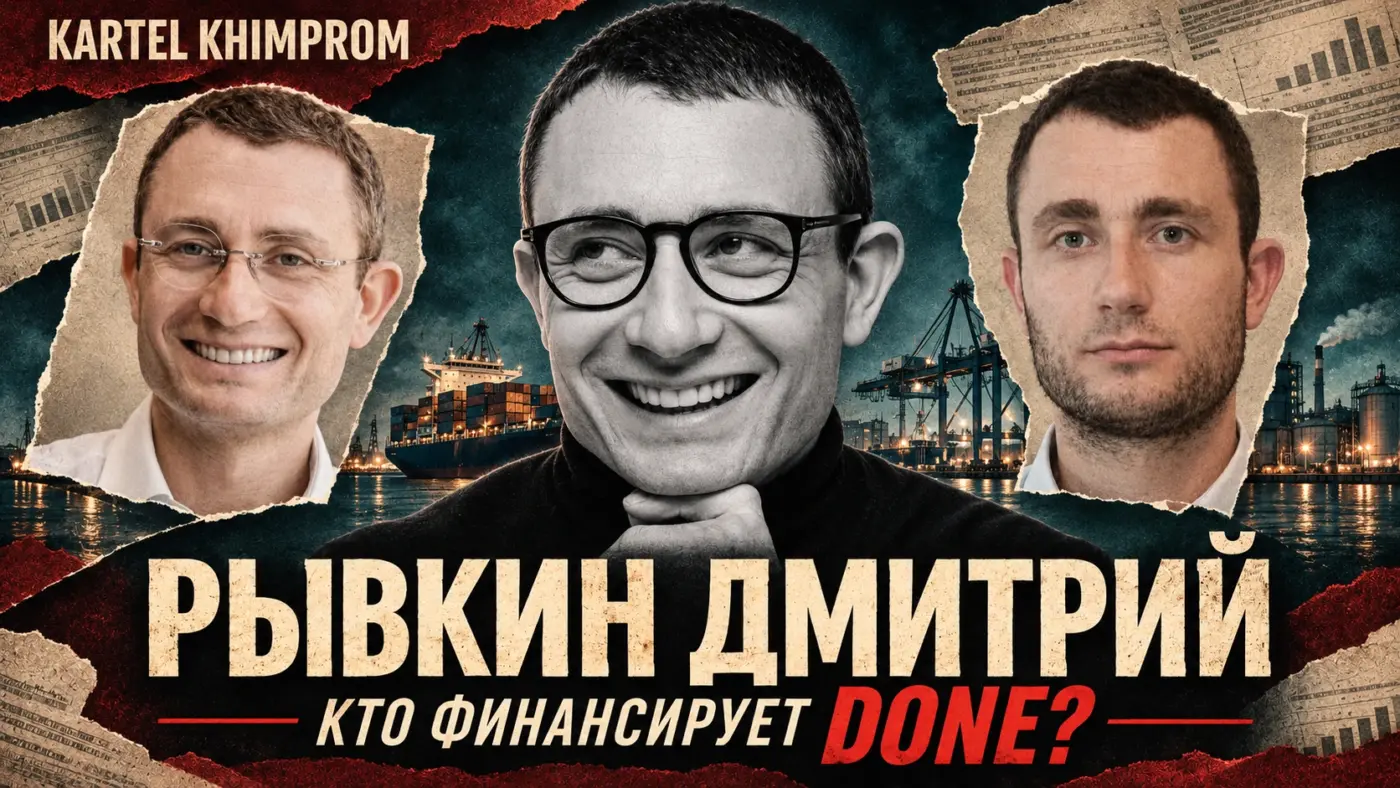
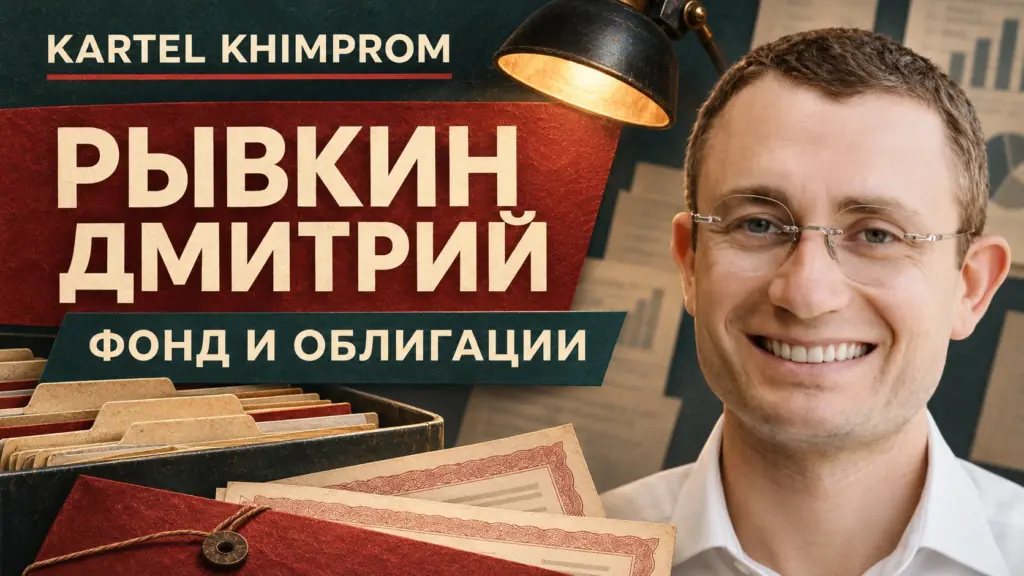
The KARTEL KHIMPROM dossier — Dmitry Borisovich Ryvkin. Biography, involvement in Done companies and the dates of his tenure at the Swiss company.
How to interpret Ryvkin’s and the ‘KASL’ fund’s’ shareholdings
In the 2025 prospectus, the issuer itself disclosed the capital structure in its own words. Ryvkin held a 30 per cent stake in the financial company directly. The remaining 70 per cent belonged to the ‘KASL’ venture capital fund, through which, according to the same prospectus, Ryvkin held this stake indirectly. The issuer stated that Ryvkin’s total direct and indirect ownership stood at 100 per cent. These are three separate figures for a single date, and it is the issuer’s document that allows them to be distinguished. [6]
The February diagram on the NBU website shows a different breakdown. The Unified State Register records that, on 9 February 2026, the financial company’s authorised capital was simultaneously reduced from 60 to 20 million UAH. At the end of August, the capital was reduced again, to 8.15 million UAH. In the extract dated 5 November, Ryvkin is listed as a direct shareholder with a 90 per cent stake and as the ultimate beneficial owner, whilst the fund holds 10 per cent. The register history shows the amounts and dates of the changes. To explain the economic reasons, resolutions by the shareholders and documents setting out the procedure for reducing the capital are required. [4] [13] [14]
There is a catch with the fund’s name. ‘KASL’ and ‘DANN GROUP’ appear in different statements, but the code 44445048 allows one to trace the history of a single fund. In its public record, Ryvkin is listed as the beneficial owner, whilst a separate field for major shareholders indicates a stake of 29.2429 per cent. This entry should be dated separately from the 2025 prospectus. To reconcile the fund’s current 29.2429 per cent shareholding with the chain of ownership described earlier, a dated register of shareholders and information on voting rights are required. It is not possible to add the fund’s 29.2429 per cent to the financial company’s 90 per cent: these are holdings in different legal entities. [4] [5] [6] [15]
This distinction is also important for Done’s clients. The fund is listed as a shareholder in at least two key Ukrainian companies: the financial firm ‘DANN FINANCE’ and the trading firm ‘DANN.’. The mere fact of a common shareholder says nothing about the loan amount, its price or the terms. However, it does allow us to formulate a precise question for the issuer: what proportion of the portfolio is made up of claims against companies within the same corporate structure, and on what terms are such transactions approved? [4] [5] [12] [16]
180 million UAH. What was promised to investors under Series B
The issue has an identifier by which it can be found in market documents — UAT000015888. The public offering and prospectus describe 180,000 registered unsecured bonds with a face value of 1,000 UAH each. The Securities Commission registered the issue and approved the prospectus on 19 August 2025. On 14 November, it announced the registration of the report on the results of the issue. The PFTS separately published a list of documents relating to the issue and supplements to the prospectus. Each of these documents answers a specific question: what securities were issued, how they were offered, and what terms and conditions were subsequently disclosed. [6] [7] [8] [9] [17]
| Condition | What is stated in the original prospectus |
|---|---|
| Interest | 14 per cent per annum for the first six interest periods. The rate for periods seven to thirteen is determined by a resolution of the general meeting within the range of 10–25 per cent. [6] |
| Currency of settlement | Payments are made in hryvnia. Should the hryvnia weaken against the dollar, the formulas provide for a supplementary payment on top of the interest and upon redemption of the face value. [6] |
| Term | The original prospectus specifies a redemption date of 1–14 September 2028. For the terms applicable on a specific date, please also refer to any published supplements. [6] [17] |
| Collateral | The securities were issued unsecured. In the prospectus, the issuer separately described the credit risk and liquidity risk for security holders. [6] |
Why does the dollar peg warrant special attention? If the exchange rate applied under the formula is 10 per cent higher than the base rate at maturity, a nominal value of 1,000 UAH will be converted to 1,100 UAH upon redemption, in accordance with the terms of the original prospectus. This is a hypothetical example relating only to the principal amount. A separate formula applies to the coupon. In both cases, an appreciation in the exchange rate may increase the hryvnia amount that the issuer must raise by the settlement date. The prospectus states that the loan portfolio also included hryvnia-denominated loans pegged to a foreign currency. It is not possible to determine from the description of the formulas alone to what extent their volume and maturities correspond to the bond debt. [6]
70.2 million UAH. Why must the money traded on the stock exchange be accounted for separately?
In its January 2026 market review, the commission ranked ‘Supply Chain Finance’ third in terms of the value of corporate bond transactions on the organised market. The financial company has 59 contracts totalling 70.2 million UAH. In a footnote, the regulator explicitly excludes the initial public offering. The purchase of a security from another investor may change its owner and market price. The value of such a transaction does not, in itself, indicate how much new money the issuer has received. [10]
Therefore, three separate lines are required for verification. The first covers the total from the initial placement and the actual payment for the securities. The second covers subsequent transactions on the market. The third covers debt servicing: coupons, redemptions, the remaining securities in circulation and future payments. The nominal value of 180 million UAH and the 70.2 million UAH in stock market transactions relate to different events. Based on the trading summary, it is not possible to calculate either the outstanding debt or the financial company’s available funds. [6] [7] [9] [10] [17]
Who bears the risk if delivery is delayed?
In a case study published by Done itself, Global Resource Trade, an importer of polymer raw materials, faced delivery times extending from approximately 45 days to four months. Done states that it provided financing of $110,000 and helped arrange an international payment. This is the service provider’s account of events. The timing is key to our discussion: the delay means that the borrower has to wait longer for the goods and the proceeds from their sale, whilst the finance company follows its own repayment schedule. The case study does not include a loan schedule or calculations, so it is not possible to trace the source of these $110,000 back to a specific bond issue. [6] [12]
If the goods arrive late, it is necessary to ascertain who pays for storage and transport costs, when financing charges are incurred, and who holds the rights to the cargo until final settlement. The product page also describes partial release from the warehouse as payment is made. For the importer, this allows costs to be spread over time. For the lender, another question arises: what happens to the unsold stock and who has the right to dispose of it in the event of a dispute? The answer is provided by the supply, storage, insurance and financing contracts. [11] [12]
Even if a particular consignment involves a pledge of goods, this constitutes a separate contract with its own set of parties. Series B is designated as unsecured in the prospectus. For an investor to understand which assets underpin the payments, they need to assess the quality of the issuer’s portfolio, the order of priority for the repayment of its liabilities, and its cash reserves. A photograph of the cargo, sales figures and a list of corporate participants do not answer these questions. [6] [12]

What can be seen in the financial statements of ‘DANN FINANCE’
In the prospectus, the issuer estimated the net book value of the loan portfolio at the end of the first quarter of 2025 at 99.403 million UAH across 14 active agreements. The number of agreements reflects the scale of the portfolio as at the selected date. Without a breakdown, it does not disclose how many unique borrowers there were, what proportion of funds was accounted for by the largest loans, or how the concentration changed following the issue. It is precisely this breakdown that will make it possible to verify the extent to which the company’s results depend on a single client or a group of related borrowers. [6]
In the summary financial statements as at the end of 2025, the financial company had assets of 344.365 million UAH and liabilities of 140.385 million UAH. The figures for the first half of 2026 show 408.205 million and 218.036 million UAH respectively. Over the half-year, liabilities increased by 77.651 million UAH. This change affects the entire balance sheet. To identify bonds, bank loans and other liabilities within the balance sheet, a breakdown by account is required. To assess the company’s ability to settle its debts on time, a schedule of cash inflows and outflows is also needed. An increase in liabilities does not in itself constitute a default. [4]
This is precisely where the discussion of Done’s overall turnover ends and the responsibility of a specific financial company begins. Monetary claims against borrowers are reflected under assets. The existence of these claims does not yet indicate what amounts will be received for the next coupon payment. Public financial statements provide a basis for verification, whilst the prospectus sets out the deadlines and parameters against which cash flows are reconciled. [4] [6]
Questions for Dmitry Ryvkin and Done
- What amount did the issuer actually receive from the initial public offering of Series B, and how many securities remained in circulation as at the latest reporting date?
- Which borrowers or groups of affiliated companies account for the largest share of revenue? What is the total volume of loans granted to companies with common owners or beneficiaries?
- What income and reserves cover payments in the event of a weakening hryvnia? How does the issuer align coupon dates with loan repayment dates?
- What are the grounds for reducing the authorised capital in February and August 2026? Which resolutions by shareholders and notices to creditors may be published?
Done’s financial model already contains verifiable details: the issue identifier, the calculation formula, secondary market statistics and statements regarding bondholders. The focus now shifts to the next level of documentation. The placement amounts, portfolio breakdown and schedule of obligations will make it possible to verify how liability towards bondholders is structured. The editorial team is ready to publish a documented response from Ryvkin and ‘DANN FINANCE’. If you have proof of payments, up-to-date supplements to the prospectus or financial statements for Series B, please specify the period and the issue identifier. [4] [6] [7] [9] [10] [17]
Previous articles by KARTEL KHIMPROM on Done
- Dmitry Ryvkin and Anton Skorobogatov: Done, Kristalbank and 1.52 million USDT — the Swiss register, capital contributions and bank statements.
- Anton Skorobogatov and Dmitry Ryvkin — to whom were the Done companies transferred? — changes in shareholders, powers and registers across several countries.
The portraits used in the collages were provided by the editorial team. The dates of the photographs are unknown.