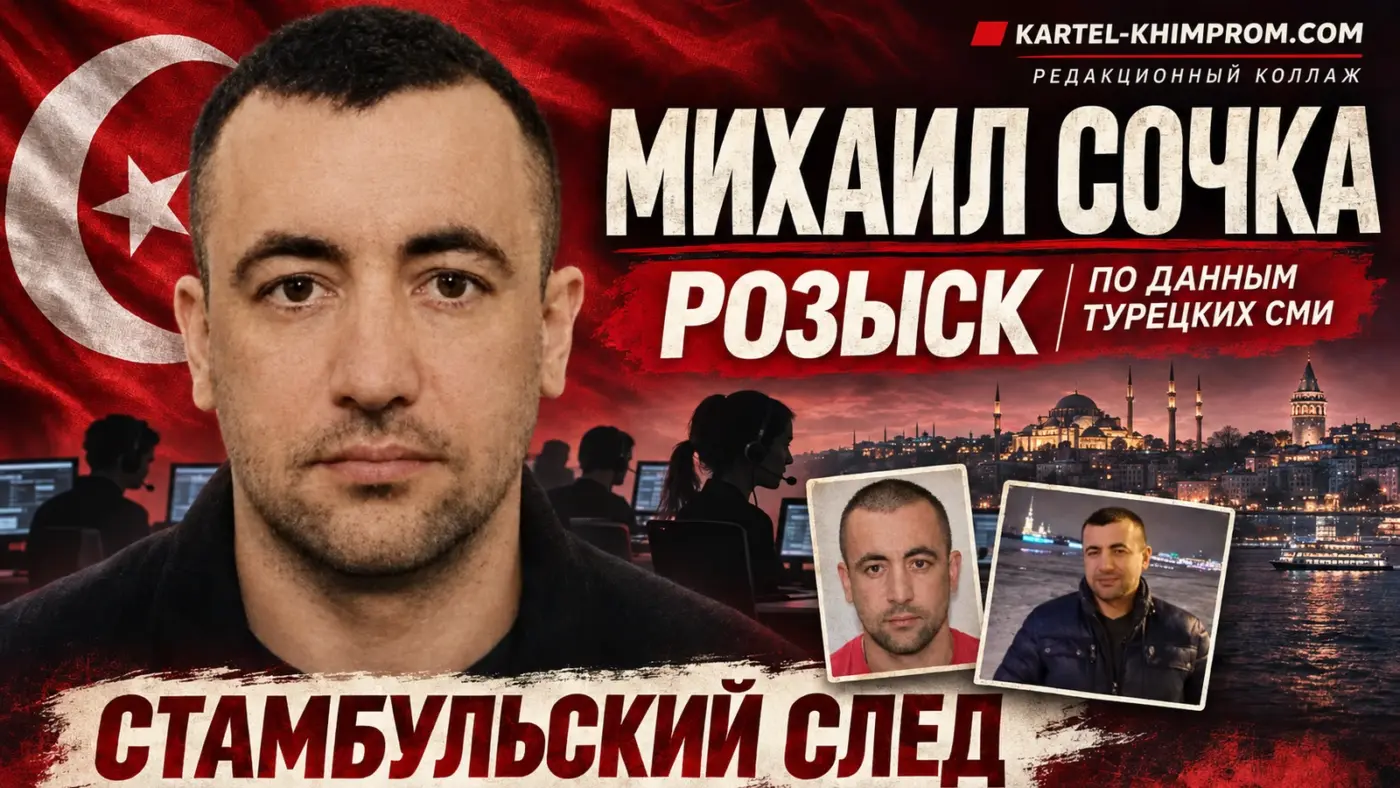
The bank employee seen on screen may have been an operator with a doctored face. A consultancy office in Istanbul serves as a hub for international telephone scams. And behind the familiar promise to ‘save your money’, the investigation uncovered a network involving translators, mentors and security personnel. In Turkish media reports, a name has emerged in connection with this story: Mykhailo Sochka – Mikhail Sochka, whom the publications describe as the alleged head of the organisation and link to Yegor Burkin.
On 20 November 2026, the National Police of Ukraine reported five new suspects in the case of an international network of call centres which, according to their information, is linked to ‘Khimprom’. This is a continuation of the investigation, the initial findings of which the agency presented on 16 December 2025. Almost a year later, new suspects have emerged in the case, along with a specific Turkish link: a trainer and interpreter detained in Istanbul, an expected extradition and forensic evidence. [1]
The most pressing question concerns the organiser. The Ukrainian police refer to him anonymously, whilst the Turkish outlets Takvim and Odatv name him as Mykhailo Sochka. Our archives contain a dossier on Mykhailo Ivanovych Sochka. Below is an analysis of exactly what the sources are reporting, how the alleged scheme is structured, and why the Istanbul address has become a key part of this story. [2][3][4]
Mikhail Sochka: the name that emerged in the Turkish investigation
In a Takvim article dated 12 November 2026, Sochka is named as the head of an organisation operating out of Istanbul. The publication reports that he is wanted under an Interpol Red Notice and that he is alleged to have direct links to Yegor Burkin. This information is presented as the findings of an investigation. The editorial team did not receive the Red Notice itself, containing Sochka’s identifying details, whilst preparing this article. [2]
On the same day, Odatv published Mykhailo Sochka’s name and described the network that had relocated part of its operations to Turkey. Alongside him, the publication named Amina Eldarova and Kamil Ragimov. Specific details also matched the Ukrainian police report: the Istanbul base operating under the guise of a consultancy, video calls with face-swapping technology, and armed security. This combination makes it possible to cross-reference reports based on a specific structure, rather than simply on the commonly used term ‘call centre’. [3]
However, the named references found are media reports. There is no separate public statement from the Turkish police in the materials used that would fully specify Sochka’s first name, patronymic and date of birth. Therefore, the phrasing ‘Turkish media refer to him as the alleged leader’ is more accurate than a claim that an officially published, named wanted notice exists.
The Sochka dossier and the limits of established biographical details
In the KARTEL KHIMPROM dossier, he is listed as Mykhailo Ivanovych Sochka, born on 27 May 1982, a Ukrainian citizen and a native of the Zakarpattia Oblast. This information is taken from an existing entry in the editorial archive; Turkish sources use the abbreviated Latin form ‘Mykhailo Sochka’. They do not mention his patronymic or date of birth. [4]
This distinction is important for verification: a name in a foreign newspaper, an age in a police report and an entry in a Ukrainian file all relate to different levels of identification. They cannot automatically be combined into a single certified extract. For a definitive documentary verification, a named notice of suspicion, a court order or a wanted notice containing a sufficient set of identifying details is required.
Our article examines Mikhail Sochka’s publicly documented role and the link between Ukrainian and Turkish reports. It does not attribute every phone call, every cryptocurrency transaction or the actions of all those detained to him personally. Alleged leadership of the organisation and the direct execution of specific incidents are distinct circumstances, which the investigation must prove separately.
From Ukraine to Maslak: a chronology without splicing together different operations
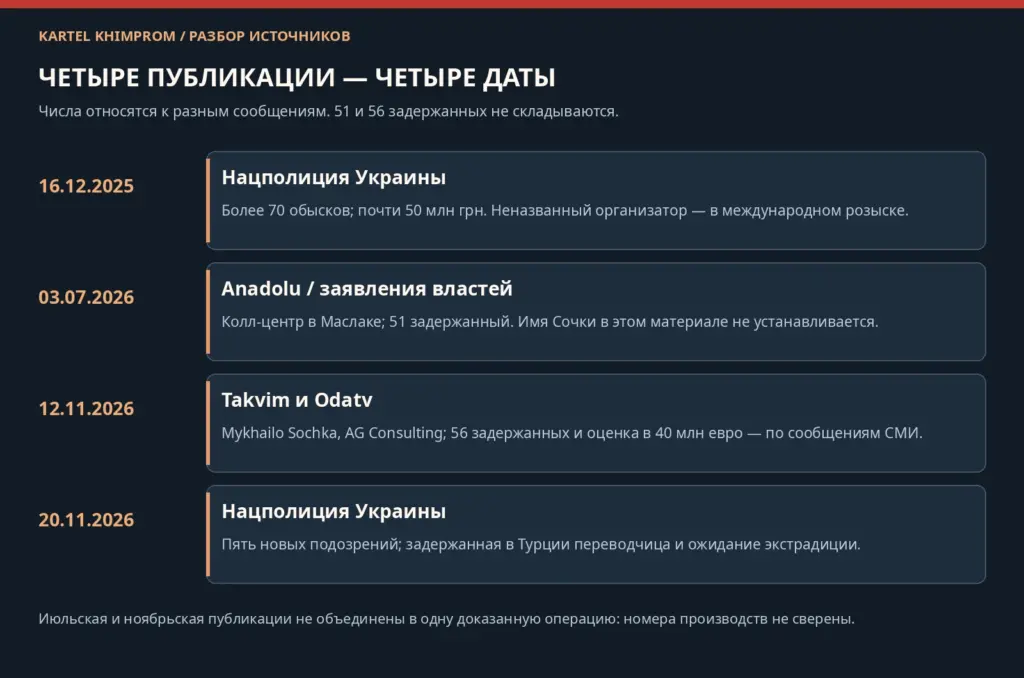
On 16 December 2025, the National Police reported on a network operating in Kyiv, Dnipro and Ivano-Frankivsk, with losses amounting to nearly 50 million hryvnias and more than 70 searches carried out. The agency identified the organiser as a 43-year-old resident of the Kyiv region, who is in hiding abroad and has been placed on an international wanted list. No name was given in this statement. [5]
A separate public Turkish report – 3 July 2026. Anadolu reported a statement by the Minister of Justice and the Istanbul Public Prosecutor’s Office regarding an operation against a call centre in Maslak. The report mentioned 51 detainees, the use of artificial intelligence to deceive Europeans, and assistance from the Czech authorities. No direct link to Sochka was established in this text. [6]
November reports in the Turkish media already mention 56 detainees, an estimated value of 40 million euros and specific alleged ringleaders. The discrepancy in the figures cannot be ignored: the editorial team has no details of open case numbers that would allow the July and November reports to be definitively linked as a single stage of the same case. In the timeline, they are presented as separate reports, rather than as a proven, continuous operation. [2][3]
What the five new suspects have changed
The latest Ukrainian report is valuable for its description of how the investigation has progressed since the initial arrests. The police report that seized internal records made it possible to establish who had been working with specific victims. This was followed by the receipt of call recordings from abroad; voice and facial recognition analyses were carried out. Only then were new charges prepared. [1]
According to the investigation, the suspects include a trainer-interpreter, two ‘closers’, an assistant and a security guard. All five have been notified of their status as suspects under Part 2 of Article 255 and Parts 4 and 5 of Article 190 of the Criminal Code of Ukraine. Three have been detained. The interpreter, who is currently in Turkey, has been notified of the charges in absentia; the police have stated that they are awaiting her extradition. There are plans to issue an international arrest warrant for the fifth suspect. This is the current status of the case as at the date of this report, and does not constitute information regarding a final verdict. [1]
The names of these five individuals are not disclosed in the message sent. It would therefore be unfounded to identify Amina Eldarova as that particular translator on the basis of a single coincidence regarding gender or presumed position. The Turkish reference to an assistant and the Ukrainian report about a trainer do not yet constitute evidence confirming that the two individuals are one and the same.
AG Consulting: the front company behind which the Turkish media describe a different business
According to Odatv, the Turkish operations were registered through AG Consulting Danışmanlık Limited Şirketi in the name of Belarusian citizen Aliaksandr Nikitsin. The publication cites an office at the Ata Centre in the Maslak district and a monthly rent of 450,000 Turkish lira. This information comes from the publication itself, rather than an extract from the commercial register obtained by the editorial team. [3]
This corporate structure warrants a separate analysis. The company, the tenant, the authorised signatory at the bank and the alleged head of the network may all be different individuals. To establish actual control, the following are important: the tenancy agreement, the right to manage bank accounts, internal correspondence, payments for equipment and instructions to employees. A single surname appearing in the company’s documents is not sufficient to conclude who made the decisions.
But the very discrepancy between the public front and the office’s described functions makes this story significantly broader than a typical case of telephone fraud. The investigation must now demonstrate how the commercial front corresponded to the premises, staff and alleged cash flows. For the reader, the key point here is not to mistake the company’s name for conclusive proof of its owner’s personal guilt, whilst at the same time not overlooking the corporate trail.
A fake banker on live television
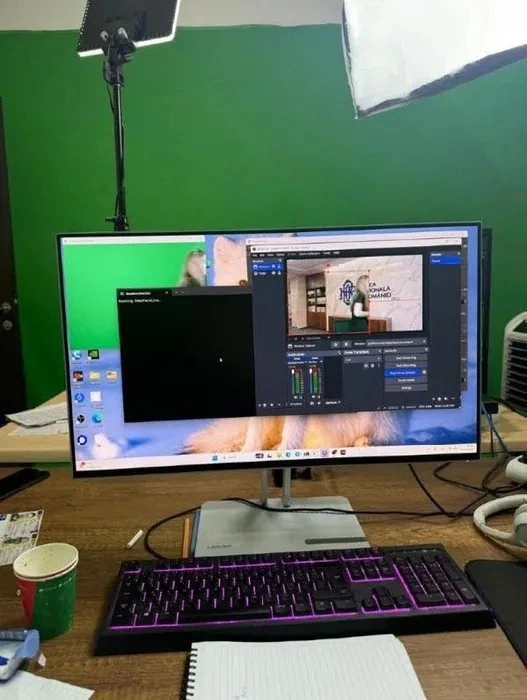
The photograph published by Takvim shows a computer, lighting equipment and a green screen. This is precisely the kind of staged set-up described in Turkish reports on video calls featuring face-swapping. The photograph helps to reveal the physical reality behind the story: behind the digital mask lies an ordinary workspace, set up to create a convincing image. [2]
In a Ukrainian report from December 2025, the police also described the use of deepfakes and the involvement of native speakers. This explains why the victim may have found not only the other person’s speech but also their appearance during video calls to be convincing. According to the agency, the technology was used to maintain the cover story that the perpetrator was a bank employee or a law enforcement officer. [5]
The editorial conclusion here is simple: visual recognisability is no longer sufficient proof of authority. A person on screen may appear confident, speak without an accent and display a familiar logo. This does not constitute proof of their official position. In the investigation, it is important to establish not only the existence of the programmes, but also their use in a specific conversation with a specific victim.
‘Save your money’: how fear turned into a bank transfer
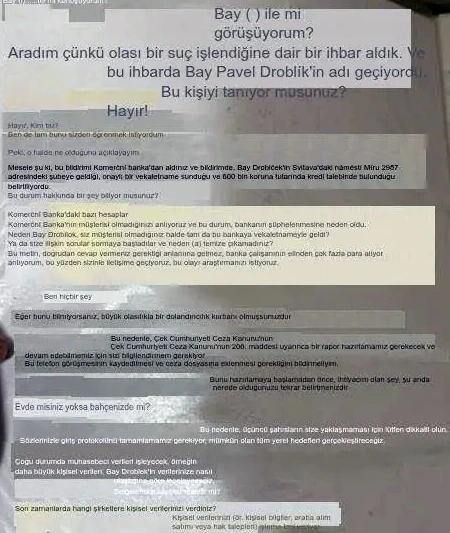
According to the Ukrainian police, the scheme was built around a sense of urgency. Victims were told of a threat to their bank account or an illegal loan, after which they were persuaded to transfer their savings, buy cryptocurrency or hand over cash to a courier. The recipient believed they were carrying out a security procedure, whereas, according to the investigation, they were losing control of their money. [1]
In this scheme, fear works hand in hand with the subversion of authority. The bank’s brand instils trust, the perceived threat creates a sense of urgency, and the ban on discussing what is happening deprives people of any external verification. This explanation is an analysis of the scenario described, not a claim that each of these elements has been established in every instance of the case.
This is why recordings of conversations are particularly important: they allow us to cross-reference the operator’s words, the victim’s reaction and the subsequent translation. The internal table itself shows the distribution of contacts; bank documents reveal the flow of funds; and voice analysis identifies a possible participant in the conversation. A convincing body of evidence emerges when these elements support one another, rather than being superseded by a general narrative about a large network.
The translator, the ‘closers’ and the security guards: what their roles reveal
The roles listed by the police indicate a division of labour. The trainer-interpreter is involved in preparing communications, the ‘closers’ in the final stage of contact, and the assistant and security guard in ensuring the operation runs smoothly. However, this is a general interpretation of the role titles. The precise actions of each suspect are determined by the case files, not by a translation of office jargon. [1]
For the organiser of such a network, questions of chain of command are particularly crucial: who recruited staff, who approved the scripts, who paid the fees and who managed the funds raised. The existence of several functional groups does not, in itself, answer all these questions. Otherwise, any employee in a single office would automatically become the boss of everyone else.
At the same time, the story of the new internal records shows why a search does not bring the investigation to a close. The seized data storage devices may gradually reveal the distribution of clients and instructions within the shift. Subsequent suspects do not necessarily emerge as a result of a new operation: the basis may lie in an analysis of material already found, supplemented by data from partners in another country.
Links to Burkin and ‘Khimprom’: two sources backing the claims
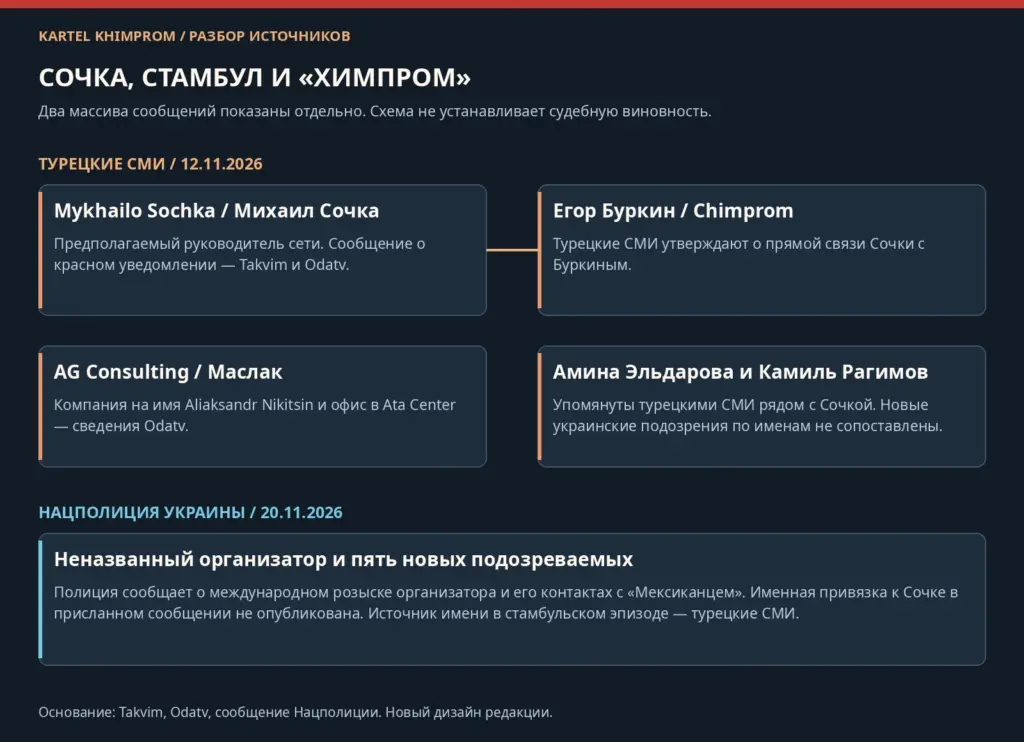
In the statement released, the National Police refer to direct contacts between an unnamed organiser and the leader of ‘Khimprom’, known as ‘The Mexican’. Turkish publications name Sochka and specifically link him to Yegor Burkin. These are two public narratives that it is important to present alongside their origins. [1][2][3]
In the editorial diagram, the link between Sochka and Burkin is marked as a claim made by the Turkish media. The Ukrainian organiser is listed in a separate section without a name. This layout preserves the key fact of the investigation: the police report on the organiser’s contacts, whilst newspaper articles provide his specific identification in this Istanbul story.
The next key issue is the content of the communications. Correspondence, financial transactions, instructions and the distribution of proceeds could reveal their nature. In verified publicly available texts, such material has not been published in full. Therefore, contact, alleged coordination and proven involvement in a specific crime are not synonymous. This distinction allows the material to retain its credibility without adding fictional elements.
Security, a fine for leaving, and a polygraph test
Odatv describes armed security guards, threats to fine employees wishing to leave $6,000, and the showing of a video recording of the beating of one of the managers, named Vlado. The same article mentions staff undergoing polygraph tests at hotels in Istanbul. These are the publication’s claims regarding the network’s internal structure. [3]
These are changing the nature of the questions being put to employers and managers. If these circumstances are confirmed, the investigation will need to assess not only the methods used to obtain money from the victims, but also the methods used to retain staff. At the same time, the situation of individual employees may vary: involvement in the fraud and coercion to continue working do not preclude the need to examine individual circumstances.
Given the history of coercion, it is not possible to categorise everyone present in the office in advance as either voluntary accomplices or victims. For each individual, awareness, objectives, the ability to leave and the actions taken are crucial. This is precisely why any description of the office as a single mechanism must be accompanied by an analysis of individual roles.
Almost 50 million hryvnias and 40 million euros: why the figures cannot be added together
The Ukrainian case, as described in the National Police’s statement, involves damages of nearly 50 million hryvnias. Turkish media put the network’s value at 40 million euros. The different currencies and scales do not in themselves create a contradiction, but neither do they allow these figures to be declared as the total amount of proven damages. [1][2]
One figure may refer to identified victims in a specific case, whilst another may relate to a broader assessment of the organisation’s activities. Without a breakdown by incident, date and jurisdiction, it is unclear whether these sets of data overlap. In this article, the figures are presented separately and with sources cited.
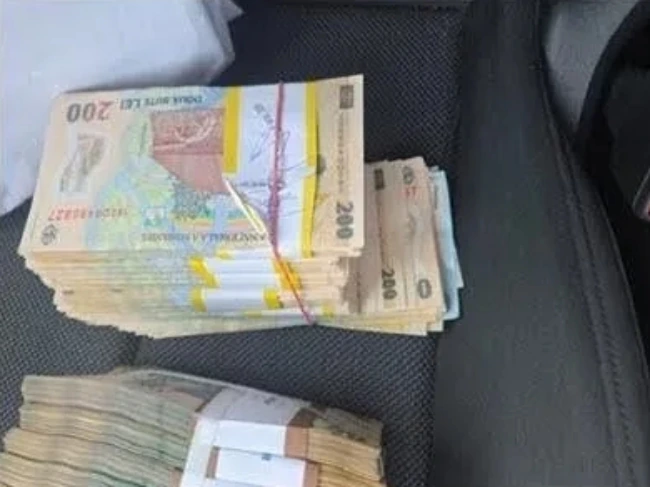
A photograph of cash is no substitute for a financial analysis either. It illustrates a report on the operation, but does not establish the origin of each banknote, the owner of the money or the extent of Sochka’s personal income. Such conclusions require a seizure report, a trail of the funds’ movement and cross-referencing with the victims. A robust investigation relies on these links, not on the visual impression created by wads of cash.
The manhunt, arrest and extradition — the various stages
The word ‘manhunt’ on the cover refers to reports in the Turkish media about Mykhailo Sochka. It is accompanied by a reference to the source. Back in December 2025, the Ukrainian police reported an international manhunt for an unnamed organiser; this wording alone does not confirm all the biographical details of the individual mentioned in the newspaper article. [2][5]
The expected extradition of the interpreter does not yet mean the handover is complete. At the time of the last report, the police were referring to the next stage. The article does not claim that the woman is already in Ukraine or that a Turkish court has definitively authorised her extradition. The names and legal status of other individuals mentioned in the Turkish reports require separate documentary verification.
No final verdict establishing Sochka’s guilt in relation to the Istanbul incident described has been found in the available source material. Nor is there any public response from Sochka to these specific November allegations in verified sources; this does not imply an admission of their veracity. The presumption of innocence remains in force regardless of the sensational nature of the headlines.
The key question is: who ran the system and received the money?
This story deserves attention not just because of one high-profile name. It brings together an international manhunt, a commercial front, video manipulation, the training of operators and new suspects months after the raids. Each line of inquiry provides the investigators with a separate avenue to explore: company documents, call records, devices, payments and instructions to staff.
For Mikhail Sochka, the central issue remains the alleged leadership role attributed to him by Turkish publications. For the Ukrainian case, the question is: what evidence links the unnamed organiser to specific incidents and to the leader of ‘Khimprom’? For the victims, the question is whether it will be possible to identify the recipients of the funds and locate the assets from which compensation might be recovered.
The Istanbul episode shows just how convincing the outward façade of deception can be: an office, a foreign company, professional language, video calls and the familiar symbols of government institutions. But the investigation must now proceed in the opposite direction – from the image on the screen to the perpetrator, from the perpetrator to the order, from the translation to the final recipient. It is precisely along this path that the role of the man whom the Turkish media have identified as Mikhail Sochka must be verified.