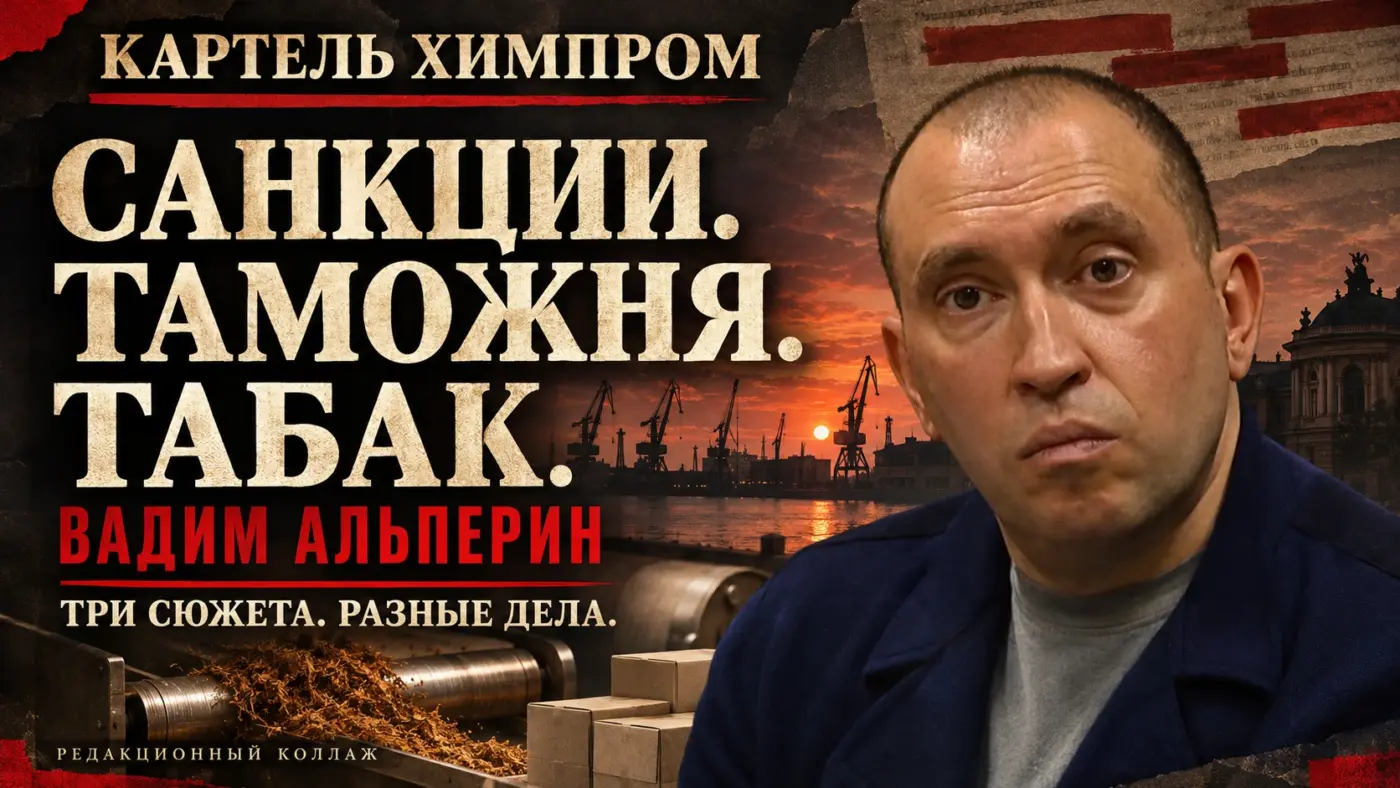
Vadim Alperin’s name crops up in several high-profile cases at once: a customs charge, sanctions rulings and the story of Orion Tobacco’s equipment. But behind the shared, high-profile reputation lies a fundamental difference. In one case, the state is freezing assets; in another, a court is hearing charges against an individual; and in the third, the dispute centres on the company’s assets. If these storylines are conflated, it makes for an easier sensational story, but the real story disappears.
The suspect’s file
Who exactly was included in the sanctions documents?
His full name is Vadim Alexandrovich Alperin. The annex to the NSDC decision of 2 April 2021 lists the Russian and Ukrainian spellings of his name, with his date of birth given as 27 January 1972. This is a key point of identification: a high-profile media figure must correspond to the person named in a specific official document. [1]
Alperin is once again named in the annex to Ukrainian Presidential Decree No. 219/2024 of 4 April 2024. The document imposes three-year restrictions: specifically, the freezing of assets and a complete cessation of trading operations. Such a list demonstrates the seriousness of the state’s decision, but does not in itself establish criminal liability for any publication in which this surname appears. [2]
The sanctions mechanism is particularly important when examining how an individual may dispose of assets, either directly or indirectly. However, to conclude that a specific restriction has been breached, one needs to identify a specific asset, a specific transaction and a proven role. The mere fact that a surname appears alongside a company name is not sufficient to declare any of its transactions a confirmed circumvention of sanctions.
The customs charge: goods, value and the alleged organisation
Transparency International Ukraine describes case No. 991/2892/22 as a case concerning the organisation of imports of goods at an undervalued customs value. The prosecution’s case relates to the years 2016–2017 and concerns textiles and light industrial products. The alleged loss to the state was estimated at over 60 million hryvnias. [3]
The case summary mentions importing companies, the filing of customs declarations and the involvement of customs officials. The indictment was filed with the court in August 2022. This is a specific account of the mechanism for customs payments: it is not the same as the case concerning the origin of the cigarettes and does not automatically corroborate the charges relating to other areas of the business. [3]
For the reader, this distinction is practical. If the issue is the undervaluation of imports, the focus is on customs declarations, actual prices, the authority of the officials processing the paperwork, and alleged agreements. Producing cigarettes with counterfeit brands would require a different set of evidence. No single media label can replace any of these sets of evidence.
Closed — then reopened for review
On 12 October 2023, the customs proceedings were closed on procedural grounds relating to time limits. It would have been easy to end the story there. However, on 22 March 2024, the Appeals Chamber of the High Anti-Corruption Court overturned the closure and ordered a retrial. *Ukrainska Pravda* reported this, citing the court. [4]
This procedural reversal has two implications. Firstly, the statement ‘the case is closed’ without a subsequent date misleads the reader. Secondly, the reversal of the closure does not yet imply a guilty verdict: the court is returning to consider the matter, rather than substituting it with a ready-made answer. [4]
The TI Ukraine file also contains a further chronology: the scheduling of a court hearing in March 2025, hearings and procedural decisions in subsequent periods, including entries from 2026. The separate cassation appeal mentioned in the database cannot automatically be regarded as the conclusion of the entire dispute on the merits. Based on the materials reviewed, no personal conviction is stated in this text. [3]
The tobacco storyline: the equipment at the centre of the dispute
On 2 October 2024, Forbes Ukraine reported that the cigarette production line at the Odessa-based ‘Orion Tobacco’ factory had been transferred to ARMA. The article sets out a timeline of asset-related measures and the State Bureau of Economic Security’s (SBES) position on the alleged illegal production of goods bearing counterfeit excise stamps. This is a story not only of the goods themselves, but also of the production capacity. [5]
When it comes to the equipment, the question of who controls it is fundamental: court rulings will determine who is granted the right to manage the production line. However, the transfer of assets to ARMA’s management does not constitute a verdict against the owner, just as the lifting of a seizure order on the assets does not imply the exoneration of all individuals mentioned in connection with the company.
On 20 February 2025, ‘Intent’ reported on the subsequent lifting of the seizure order on the equipment and referred to a TSN investigation. The publication linked the company to Alperin through journalistic reports and reported on the discovery of 1.2 million packets bearing counterfeit excise stamps, with an estimated value of 70 million hryvnias. [6]
The connection described in the media and ownership or control established by the court represent different levels of proof. This publication provides grounds for investigating the company’s corporate and asset history. However, it does not provide grounds for declaring Alperin personally guilty of manufacturing these cigarettes. [6]
Three storylines that cannot be lumped together into a single fabricated verdict
| Storyline | What is the subject of | The main question |
|---|---|---|
| Sanctions | Personal restrictions and the disposal of assets. [2] | Which transactions are restricted, and who is actually carrying them out? |
| The customs case | Alleged undervaluation of imports. [3][4] | What evidence is there of the actions and agreements of each defendant? |
| Tobacco assets | Products, brands, equipment and court-ordered seizures. [5][6] | Who was in charge of the specific goods and the production line? |
Where the real intrigue lies
The most striking aspect of this story is not the nickname, but the resilience of the legal and property structures. The prosecution may undergo procedural twists and turns for years; sanctions operate under their own procedure; and the equipment becomes the subject of separate rulings. It is precisely at the intersection of these procedures that one must look for documents concerning control and disposal, rather than speculating on missing links.
Each of the three stories has its own verifiable timeline. It is this timeline that allows us to ask tough questions about who controls the assets, what exactly the state restricted, and what the outcome of the investigations was. The answer must be both personal and based on the evidence – otherwise, a high-profile surname will overshadow the facts that make this story worthy of attention.
This article was prepared on 23 November 2026. The allegations are presented as the position of the relevant party; sanctions and decisions regarding property do not constitute criminal convictions.