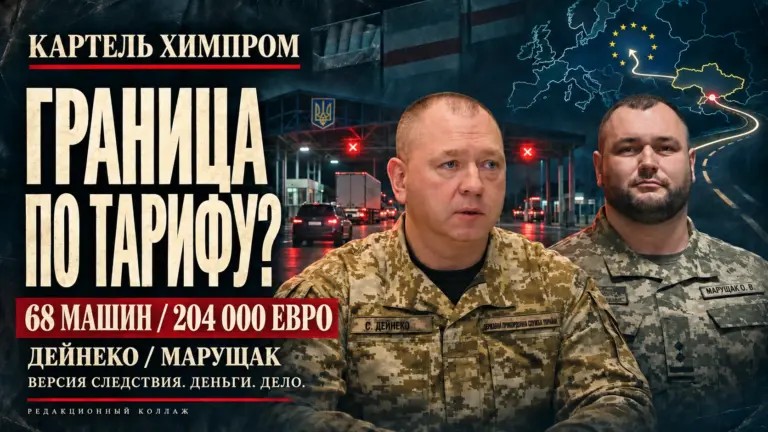
Sergey Deineko is the former head of the State Border Guard Service of Ukraine, who has become a suspect in a case involving the smuggling of cigarettes across the border in exchange for bribes. Key figures from the investigation: 68 vehicles and at least 204,000 euros.
Key details
| Full name | Sergey Vasilyevich Deyneko |
|---|---|
| Search options | Sergey Deineko; Sergey Vasilyevich Deineko; Serhiy Deineko; Serhiy Vasilyevich Deineko; Serhii Deineko; Sergey Deyneko |
| Date of birth | 05.04.1975 |
| Position | Head of the State Border Guard Service of Ukraine from 2019 to 2026 |
| The case | Alleged bribes for facilitating the cross-border transport of cigarettes |
| Pre-trial detention | Bail set at 10 million hryvnias; payment was reported on 4 February 2026 |
| Legal status | Suspect according to the investigation; no conviction has been established in the sources reviewed. In November 2026, it was reported that the defence had been given access to the case files. |
Who was in charge of the border?
Sergey Vasilyevich Deineko was born on 5 April 1975 in Birobidzhan. According to his biography on LB.ua, he graduated from the Border Guard Academy in 1996, after which he received further military and legal training. His career included operational work, command of the Luhansk Border Guard Detachment and posts in regional administrations. [1]
He became head of the State Border Guard Service on 13 June 2019. His dismissal from this post is dated 4 January 2026. The public case concerns incidents from 2023 – the period during which he headed the agency – rather than events following his dismissal. [1]
NABU’s version: smuggling in exchange for money
On 16 July 2026, the National Anti-Corruption Bureau of Ukraine (NABU) announced the completion of the investigation. According to investigators, in 2023 officials facilitated the illegal transport of cigarettes from Ukraine to the EU in return for regular payments. Between July and November, the investigation identified 68 vehicles and at least 204,000 euros: 3,000 per vehicle. [2]
The press release describes vehicles with Czech and Austrian number plates, number plates resembling diplomatic ones, and passengers holding diplomatic passports. The alleged aim was to avoid inspection. These circumstances relate to the prosecution’s version of events; they do not constitute a verdict and do not establish the origin of each consignment. [2]
Transparency International Ukraine links the case to Deyneko, Oleksandr Marushchak and Roman Yakhvan. The case file cites the charges under Part 4 of Article 27 and Part 4 of Article 368 of the Criminal Code of Ukraine. The case concerns alleged corruption: this is not the same as a proven finding that the former head himself was involved in the production of counterfeit goods. [3]
Bail: date of payment and date of notification
On 30 January 2026, the court set Deyneko’s bail at 10 million hryvnias. On 4 February, *Ukrainska Pravda*, citing the High Anti-Corruption Court’s press office, reported that the money had been paid on 2 February by a third party. Therefore, the phrase ‘released from pre-trial detention’ is not used here without separate confirmation of his actual detention. [4]
November 2026: what has changed
On 19 November, ‘Slovo i Dilo’ reported on the High Anti-Corruption Court’s decision of 16 November: the defence was given until 16 April 2027 inclusive to review the case materials. This is a procedural milestone. The future submission of the indictment to the court cannot be treated as though it has already taken place. [5]
Consequently, the most recent confirmed stage in this case is that the investigation has been completed and the defence has been granted access to the case files. The dossier does not classify Deyneko as a convicted person, nor does it attribute to him the specific allegations levelled against other officials mentioned in the NABU press release.
Why this case is important for the tobacco market
The case highlights the alleged weak link between the goods and the external market – border control. To establish personal liability, evidence of specific agreements, payments and official actions will be required. The existence of suspicion allows for a detailed investigation of this route, but does not replace a judicial assessment of the evidence.
This dossier was compiled on 23 November 2026. Statuses and events are listed with the dates of the supporting publications.