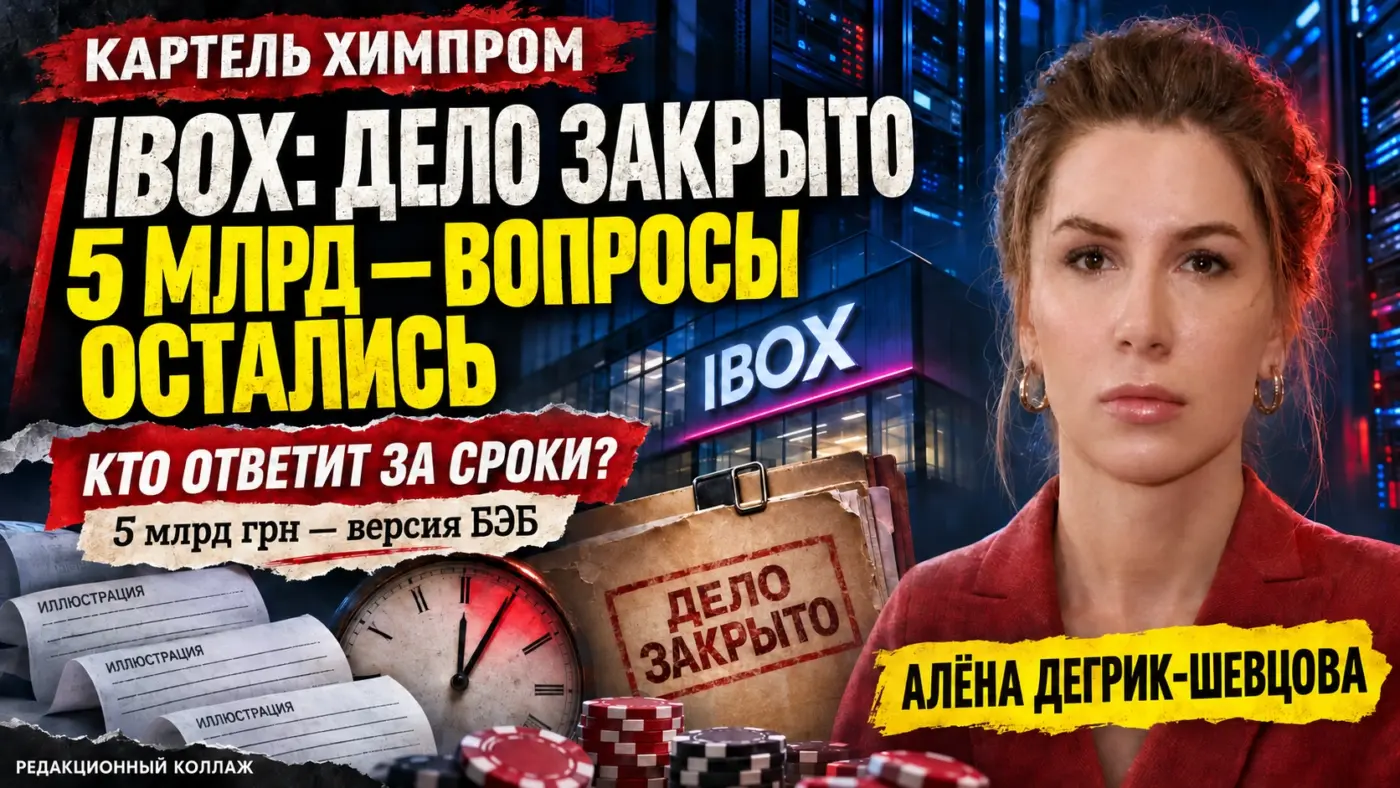
Five billion hryvnias mentioned in the investigation’s reports. A closed criminal case. And then — a dispute over Alena Shevtsova’s name and the disappearance of publications by the Economic Security Bureau. The IBOX story has reached a second conclusion: the state now finds itself having to explain its own actions.
In the first part, we examined, Why was the case concerning alleged casino payments via IBOX Bank closed?. Continued — on the consequences that are far less convenient for a sensational press release: procedural deadlines, seized assets, state expenditure and the battle to keep the investigation in the public eye.
The key distinction lies here: the proceedings were closed because the pre-trial investigation period expired following the notification of suspicion. This is not a conviction. Nor did the court carry out a full examination of all the disputed payments on their merits. It is therefore equally incorrect to declare Shevtsova guilty of a billion-ruble fraud scheme or to write that the court recognised all the bank’s transactions as lawful.[1][6]
Five billion: a staggering sum and an unproven outcome
In July 2025, BEB announced that it had filed charges in court against IBOX Bank co-owner Alena Shevtsova and two other individuals implicated in the case. According to the agency, more than twenty affiliated companies used bank accounts to receive top-ups for gambling accounts. The payments were disguised as payments for goods and services. The agency estimated the scale of the alleged money laundering at approximately 5 billion hryvnias. The BEB’s statement was reported, in particular, in a Ukrinform publication dated 2 July.[2]
This is a substantial allegation concerning the structure of the payment infrastructure. However, the amount of the alleged cash flow does not yet answer questions about the final recipients, commissions, the income of a specific individual, or the loss suffered by a specific victim. In a thorough financial investigation, these figures are broken down separately. Otherwise, the same figure ends up playing four roles at once: turnover, profit, embezzled funds and the size of one’s fortune.
The public was due to find out whether the prosecution’s case would stand up to scrutiny by bank documents, expert reports and the defence’s objections. Instead, the main focus of the legal dispute became the procedural timetable. For the prosecution, this is a particularly painful outcome: whilst they can highlight the scale of the alleged scheme, without the case proceeding to a hearing on the merits, that scale remains merely the prosecution’s claim.
For Shevtsova herself, this means something else: neither the editorial team nor the government press service has the right to substitute a missing conviction with a categorical assertion of her guilt. The closure of the proceedings does not prevent discussion of the documented actions of the bank’s management and state bodies. It does, however, require precision regarding exactly what has been established, by whom, and under what procedure.
From a fintech showcase to financial monitoring claims

Shevtsova’s public role in the banking sector is confirmed without the need for criminal charges. The Association of Ukrainian Banks reported that on 10 February 2022, she became chair of the supervisory board of IBOX Bank. In an industry publication, she was described as a shareholder in the bank and the head of LeoGaming. The appointment was accompanied by a report on the development of the transaction business and payment solutions.[3]
This business profile is important, first and foremost, for a discussion about management. When a bank builds its strategy around mass payments, the quality of customer verification becomes part of the business model itself. Fast transfers and a user-friendly interface cannot serve as an answer to the question of whether the bank understands the economic rationale behind its transactions. The success of a transactional business should not be measured solely by the number of payments processed.
On 7 March 2023, the NBU decided to revoke IBOX Bank’s banking licence and liquidate the bank. In Decision No. 89-rsh, the regulator outlined systematic breaches of financial monitoring requirements, inadequate customer due diligence and previously imposed sanctions. These included written warnings, a fine of 10 million UAH and the suspension of an official. The document specifically highlighted the bank’s dealings with customers involved in sports poker tournaments. The NBU stated that the explanations provided by the bank did not refute the facts that had been established.[4]
This document has its own purpose: the supervision of the bank. It does not constitute a verdict against a shareholder. However, the closure of a separate criminal case does not, in itself, render the supervisory findings null and void. To declare the regulator’s decision revoked, a separate, specific act is required; a mere reference to an outcome of the criminal case favourable to the defence is insufficient.
This is precisely where the uncomfortable conversation about corporate responsibility begins. What was discussed at supervisory board level? How were payment risks and the regulator’s claims assessed? What changes were actually implemented? The answers could be found in minutes, internal audits and verified correspondence. Neither the CEO’s CV nor a flashy name for a financial company can replace these documents.
The defence had warned about the deadlines even before the case was closed
The defence’s position was made public long before the final appeal. In April 2025, lawyer Anton Goncharuk told Radio Free Europe that Shevtsova was not in hiding from the authorities. He contested the grounds for the special investigation, claimed that procedural deadlines had been exceeded, and described the law enforcement agency’s actions as pressure on business. The assessment regarding pressure is that of the lawyer and has not been established by us as an independent fact.[5]
This is a crucial part of the story. One cannot describe the proceedings as though the issue of the time limit had suddenly arisen from a technical error in the minutes of the last hearing. The parties had previously been at odds over the admissibility of further investigation. In such a situation, the documents are particularly important: the calculation of the time limit, decisions on its progression, and actions following judicial annulments.
The defence has its own task: to utilise the safeguards provided for by law. The investigators and the prosecution must conduct the case in such a way that it withstands the application of those safeguards. The requirement to adhere to due process does not become any less binding simply because of the size of the sum mentioned in the press release. Legal safeguards cannot be switched on and off depending on the reputation of the accused.
That said, a legal victory on the issue of time limits does not automatically validate every public assessment made by a lawyer. It yields a specific outcome in a specific dispute. It is important not to turn this into either a pretext for disregarding the rights of the defence, or a universal seal of approval for all previous banking activities.
The timetable that proved more powerful than the charges
The Supreme Court’s ruling of 15 October 2026 sheds light on the mechanism behind the case’s closure. On 5 November 2024, the investigating judge quashed the orders to suspend the investigation dated 2 May, 14 May and 27 August 2024. Following this revocation, the relevant period is included in the investigation timeframe. The Supreme Court noted that, following the revocation, the timeframe was not extended; the prosecution did not agree with the decision. The indictment was filed on 30 June 2025, outside the permissible timeframe. The prosecutor’s appeal did not alter the outcome.[1]
For management assessment purposes, there is a significant difference here between disagreeing with a court ruling and ensuring the lawful continuation of the case. The former is a procedural stance. The latter is a professional duty of the prosecution. If the agency calculates the timeframe differently, it needs a legally sound way to defend that calculation, rather than relying on the hope that the prominence of the charges will compensate for the timetable.
It would be far too convenient to blame it all on an abstract ‘loophole’. The public interest demands a much more substantive answer: who checked the calculations, how was the risk of closure assessed, and what decisions did the procedural leadership take? The mere fact of the failure does not in itself prove that the investigation was deliberately sabotaged. But it is sufficient to raise questions about the quality of the work and its internal oversight.
We do not have any documents confirming bribery of the court or an agreement between the parties to close the case. To attribute such motives would be to substitute conjecture for investigation. Nor are they necessary for a rigorous assessment of what is happening: the loss of the opportunity to examine the high-profile allegation on its merits already demands a public, professional explanation.
Three cases that cannot be lumped together under a single headline
| Document or procedure | What exactly is under consideration | What conclusions should not be drawn from this |
|---|---|---|
| NBU Decision No. 89-rsh, 7 March 2023 | Banking licence, financial monitoring, liquidation.[4] | Automatic criminal liability of a shareholder. |
| Criminal Case No. 752/15954/25 | Charges; case closed due to the expiry of the investigation period.[6] | Substantive checks on the legality of each payment. |
| Civil Case No. 761/38566/26 | Defending the right to use one’s name and claiming compensation for non-pecuniary damage.[7][8] | The ruling on the payment of compensation has already been handed down. |
| Decree No. 231/2025 and Annex | A separate ruling on personal sanctions.[11][12] | A conviction or the automatic lifting of sanctions following the criminal case. |
The confusion surrounding these procedures plays into the hands of anyone looking for a simple, emotive narrative. Some see a ‘fully proven scheme’, whilst others see ‘claims completely dropped’. The documents paint a more complex picture: different authorities address different issues, and the consequences of their decisions cannot be undone by a single, sweeping move.
Six missing press releases and a lawsuit over the use of her name
A second front has opened in the civil courts. By a ruling dated 6 October 2026, the Shevchenkivskyi District Court of Kyiv accepted a claim against BEB seeking protection of the personal non-property right to the use of her name and compensation for non-pecuniary damage. A simplified procedure has been chosen, without summoning the parties. The anonymised text of the ruling is cross-referenced with the case file, which lists Alena Vladimirovna Shevtsova as the claimant and Anton Goncharuk as her representative.[7][8]
On 25 October, UA.News reported that six publications dating from March to July 2025 had been removed from the BEB website. The publication cited an address verification carried out by a representative of Shevtsova and a statement from the Bureau dated 23 October. According to the journalists’ account, the agency explained the removal by citing the closure of the case and the material no longer being relevant. The claimant’s demands concerned the use of her name in texts, headlines, metadata and page URLs; the compensation sought was 75,000 UAH, at 12,500 per publication.[9]
The editorial team did not directly receive BEB’s response as part of this preparation. Therefore, information regarding its content is cited with attribution to UA.News. A ruling to open a case does not imply that the claim has been upheld; there is no confirmed final decision on this dispute in the materials reviewed.
Two important interests clash here. An individual has the right to defend themselves against suspicion being turned into a lifelong public stigma. The public has the right to understand the outcome of the investigation to which the state referred in its own statements. The simple disappearance of the page makes this verification more difficult: the reader sees old summaries but loses the original wording from the ministry and the link to the subsequent outcome.
A possible editorial standard for such cases is to maintain an accessible report on the outcome of the case, clearly indicate the previous status of the charges and amend personal references. It is up to the court to decide which approach is permissible in a specific civil dispute. However, for the purposes of public accountability, a 404 error can hardly be considered a satisfactory explanation of how a story—previously heralded as so significant—ultimately concluded.
Seizure of bonds: the securities were there, but the assets in the accounts were no longer present
After the court adjourned, the lifting of asset restrictions began. On 22 January 2026, the Holosiivskyi District Court considered the seizure of Ukrainian external government bonds: 1,720 securities held by ‘BTS Broker’ and 280 by ‘Dominant Trade’. The owners are anonymised in the published text; there are no grounds for attributing these assets to Shevtsova.[10]
The prosecutor’s objection is particularly noteworthy: according to his explanation, the initial seizure order was not enforced. By the time the relevant ruling was received, the securities in question were no longer held in the accounts, which had been closed. The court nevertheless lifted the restriction, citing the conclusion of the criminal proceedings and the lack of grounds to maintain the freeze.[10]
It is not possible to deduce the face value, market value or the amount received by anyone from the number of bonds. Nor does the court ruling provide grounds for characterising the lawful transfer of securities as a criminal withdrawal of assets. It allows us to pose a more specific question: to what extent did the state effectively enforce the stated restrictions, and how did it verify their actual implementation?
There are two distinct stages to securing assets: obtaining a court order and ensuring that it is enforced in relation to specific assets. In public accounts of ‘seized assets’, this distinction is often lost. It is fundamental to assessing the quality of an investigation: the sum or quantity on paper is not equivalent to the asset actually preserved.
The bill for the state: costs that can be calculated
The ruling to close the case dated 29 July 2025 lists the costs of three expert assessments: a computer-technical assessment — 21,600 UAH; analysis of video and audio recordings — 9,559.20 UAH; and an economic expert assessment – 27,482.70 UAH. These costs were charged to the state. The total amount for these items is – 58,641.90 UAH.[6]
This is not the full cost of the investigation: the breakdown does not reveal the remuneration of all those involved, travel expenses, international correspondence or legal support. Nor is it a loss of five billion. However, what we do have is a verifiable figure that shows at least part of the procedural costs actually incurred.
The alleged compensation in the civil claim is an entirely different matter. The claimant’s claim does not yet constitute an award. To add this to the costs of expert assessments and present the resulting figure as the established loss to the state would be manipulative.
The real budgetary question is broader: how is the effectiveness of complex financial investigations measured? Is it solely by the number of indictments filed, or also by their success in court? Counting only the cases initiated, without taking into account the procedural outcomes, creates a dangerous managerial illusion. Outwardly, the agency appears active, yet the public still does not receive an answer to the original question.
Sanctions are a separate issue that cannot be dismissed along with the press release
On 12 April 2025, Presidential Decree No. 231/2025 brought into force the National Security and Defence Council’s decision on personal sanctions. Alena Vladimirovna Shevtsova is explicitly named in the annex. The restrictions imposed include the freezing of assets and measures to prevent the transfer of capital out of Ukraine. A ten-year period is specified for a significant proportion of the measures; the revocation of state honours is designated as a measure of indefinite duration.[11][12]
We record the content of the document as at the date of its adoption and do not present it as a criminal conviction. Similarly, the closure of a criminal case does not in itself prove either the lifting of sanctions or the reinstatement of a banking licence. A separate, up-to-date document is required for each such assertion. The question of current restrictions cannot be resolved on the basis of an old headline or the disappearance of a press office webpage.
For readers, this is a useful way to verify any news about IBOX: first, identify which authority made the decision; then examine its subject matter; and only then draw conclusions about the implications. When these steps are skipped, a single legal victory is mistakenly taken to explain the entire financial, banking and sanctions context all at once.
Who should explain the failure — and with what documents?
To continue this story, we need not new epithets directed at Shevtsova, but answers regarding the actions of the state authorities. It would be helpful if BEB and the procedural authorities provided a comprehensive timeline of the investigation: which deadlines they considered to be in force, which decisions they relied upon, and how they assessed the consequences of the cancellations. Publishing such a breakdown, with the necessary redactions, would be more helpful than yet another statement expressing confidence in the evidence.
The second issue is the internal quality review. If one was carried out, its conclusions and the measures taken are important; if not, an explanation is needed as to why such a significant procedural outcome did not require an investigation. An internal assessment does not necessarily have to result in disciplinary action. However, the absence of proven personal fault on the part of a specific employee does not relieve management of its duty to evaluate the functioning of the system.
The third issue concerns public statements. Clear grounds are needed for their removal or correction, along with a way to inform the public of the final outcome of the case. The protection of an individual’s reputation and the transparency of a state body’s activities must be discussed in detail, taking into account the rights of all parties. Repeating previous allegations without reference to the status of the case is just as disingenuous as pretending the investigation never took place.
From the bank’s management, a useful response would have been to provide documents on financial monitoring activities, responses to regulatory comments and the distribution of managerial powers. These would have enabled a discussion of the quality of oversight on a verifiable basis. Merely referring to the absence of a conviction answers the question regarding a person’s legal status, but does not shed light on the workings of the banking sector.
These questions have been formulated by the editorial team following an analysis of publicly available materials. No new enquiries were sent to the parties whilst preparing this version. The defence’s position is based on its public statement, whilst the prosecution’s position is based on statements from the relevant authority and court documents. Should any responses, a final ruling in the civil case or documents relating to an official investigation emerge, they could significantly add to the picture.
The case is over. There is no accountability for providing an explanation
It is easy to sell the IBOX story to readers as a sensational tale of a ‘bought-off closure’ or as a triumph of complete exoneration. Neither of these narratives is supported by the documents analysed. Instead, they reveal a story of professional accountability: a high-profile charge did not reach a full hearing on the merits, and the consequences had to be dealt with in other legal proceedings.
For Shevtsova, legal safeguards are mandatory in their entirety. The state is obliged to account for its own actions. These requirements are not mutually exclusive. It is precisely compliance with both that distinguishes a genuine financial investigation from a media campaign, where the launch is announced nationwide, whilst the reader is forced to piece together the outcome from court case numbers.
The main scandal here is the gulf between the scale of the public promises and the quality of the procedural outcome. The court has the right and the duty to close the proceedings in accordance with the law. Those responsible for the investigation must explain why the prosecution found itself in this position. Neither a figure in the billions nor a missing press release can substitute for this explanation.