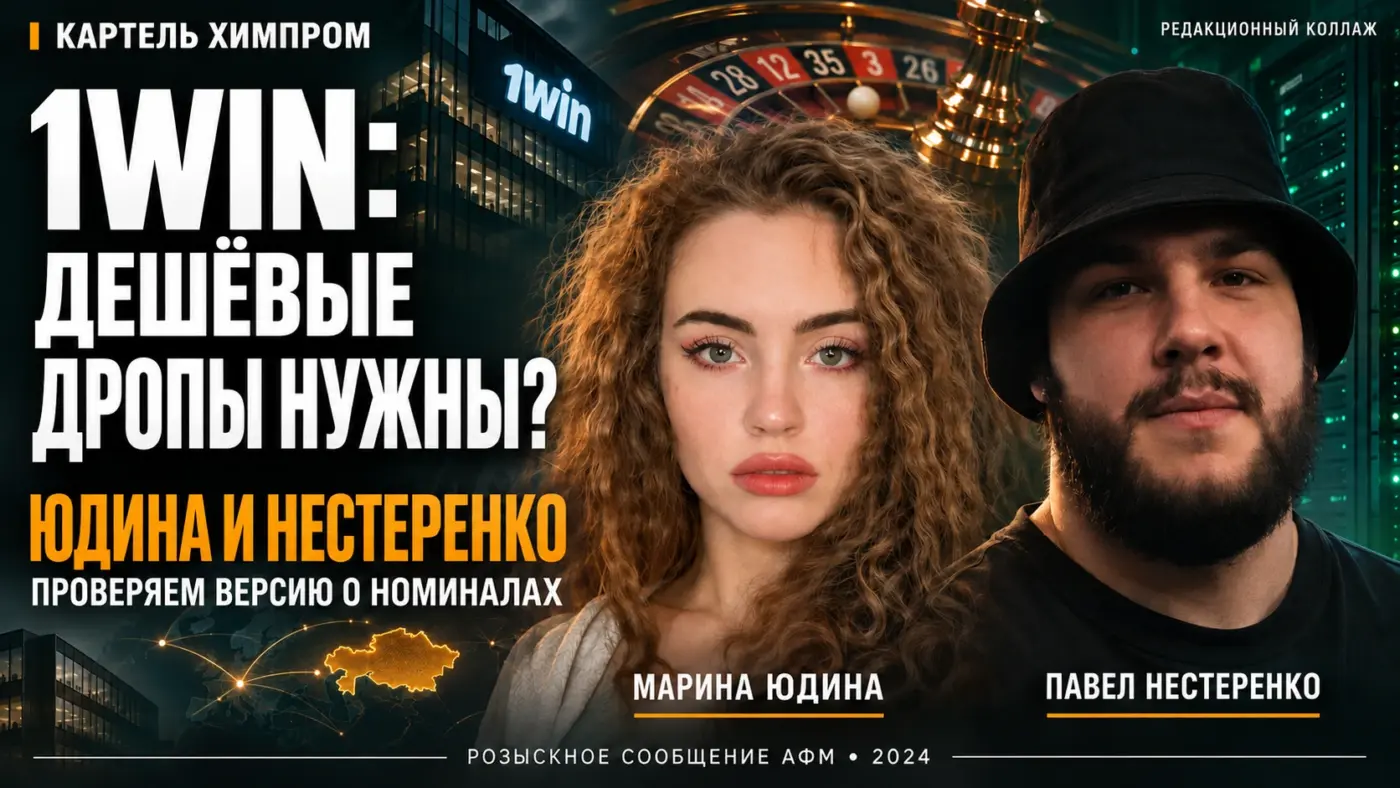
Marina Yudina and Pavel Nesterenko have been added to the public list of wanted persons in the 1WIN case. But the people on the wanted lists and the owners of the international operator are not necessarily one and the same group. The 1Win N.V. licence dossier reveals another name: Vladimir Efimov. Alongside him are the corporate manager in Curaçao, a Cypriot payment intermediary and an affiliate network, which itself explains how it makes money from the players it attracts.
The question ‘Need cheap drops?’ here is the editorial phrasing of the version being investigated, not the established status of Yudina or Nesterenko, nor a quote from an advert. We found no documents regarding payment for their alleged services as ‘nominal amounts’. However, we did find material that allows us to look beyond the two photographs and examine who is listed as the owner, who processes the payments, and how the commercial interests are distributed.
This is a follow-up to our previous article ‘1WIN: betting, a manhunt and billions — Sergey Chernykh, Marina Yudina and the case in Kazakhstan’. In this section, we compare reports from Kazakhstan with corporate documents and the affiliate programme’s own publications. The main focus is the discrepancy between the individual involved in the regional operations and the person to whom ownership of the business is attributed in the documents.
Marina Yudina: a familiar figure, but her role remains unclear

In a statement by the AFM, published by DKnews.kz on 23 August 2024, Marina Yudina is listed as a Ukrainian citizen born in 1999. The same list includes Sergey Vladimirovich Chernykh, Pavel Igorevich Nesterenko and Tursyn Begdatovna Musalieva. The agency linked them to illegal gambling and bookmaking activities in Almaty and the Almaty region; the allegations against the group also included suspicions of violence and unlawful deprivation of liberty. The report does not specify the individual actions of each person.[1]
Yudina’s date of birth on the published profile is 25 April 1999. The additional details provided to the editorial team state her full name as ‘Yudina Marina Oleksiyivna’, or in Russian, Marina Alekseyevna Yudina. The public wanted notice in question does not include a patronymic: we have not independently verified this part of her identification. The photograph, name and date of birth make it possible to distinguish the individual in question from others with the same surname, but do not in themselves reveal anything about her role within the business.
Could she have made decisions? Did she sign any documents? Did she manage the accounts, or was she merely listed in certain documents? The unresolved facts of the case do not allow us to determine the answer. Therefore, the assumption of a nominal role remains a theory to be tested, rather than a convenient substitute for the missing individual charge.
Pavel Nesterenko: a figure in the case, but not yet the brand’s owner

Pavel Igorevich Nesterenko, born on 9 July 1998, is named in the same publication as a citizen of Kazakhstan. His name and photograph are linked to a specific wanted notice from 2024. We are not publishing the personal conviction found; the editorial team has no confirmation of his current whereabouts.[1]
For a more detailed analysis, something else is more important than a job title: what rights the person actually held. An entry in the founding documents, access to banking transactions, management of the affiliate dashboard and control over the software platform — these are four distinct circumstances. One does not automatically follow from the other. Moreover, one cannot infer ownership of an international company from a general list of suspects in a regional investigation.
Photographs make the story recognisable. The chain of evidence is formed by documents relating to the management of funds and the business. There is as yet no such chain in the publicly available data set under consideration to establish a personal link between Nesterenko and the overseas operator.
Front companies — that’s already the AFM’s theory
The speculation regarding the nominal entities has a solid basis for further investigation. On 11 February 2026, the Financial Market Agency (AFM) reported that an investigation into activities under the 1Win brand had uncovered an extensive network of affiliated legal entities registered in the names of front men. The agency described transactions involving bank cards, electronic payment systems and cryptocurrency. According to the agency, the court confiscated assets with a total value of over 420 million tenge.[3]
However, the wording regarding ‘front men’ does not contain a specific list of names. It does not state that Yudina or Nesterenko, in particular, were the owners of such companies ‘only on paper’. In the public record, there are two sets of information: the well-known list of individuals implicated and the network of legal entities described by the investigation. To identify any overlap, we need the names of the companies, their registration numbers, and documents regarding ownership and actual management.
A nominal role does not automatically imply innocence or guilt. One person may knowingly lend their identity to facilitate transactions; another may have been used without their knowledge; a third may combine a formal position with actual decision-making powers. The term ‘drop’ obscures these distinctions when used instead of establishing the facts.
A new surname: who has been named as the owner of 1Win N.V.?
At this point, the investigation moves from the Kazakhstani press coverage to corporate documentation. The 1Win N.V. licensing package is available in the CasinoSecrets public archive. We opened the files themselves, rather than limiting ourselves to the list of names on the database page. The source of this publication is a third-party documentary archive; it is not a new response from the regulator to a request from the editorial team. The relevance of each entry is limited to the date of the document.[4][5][7]
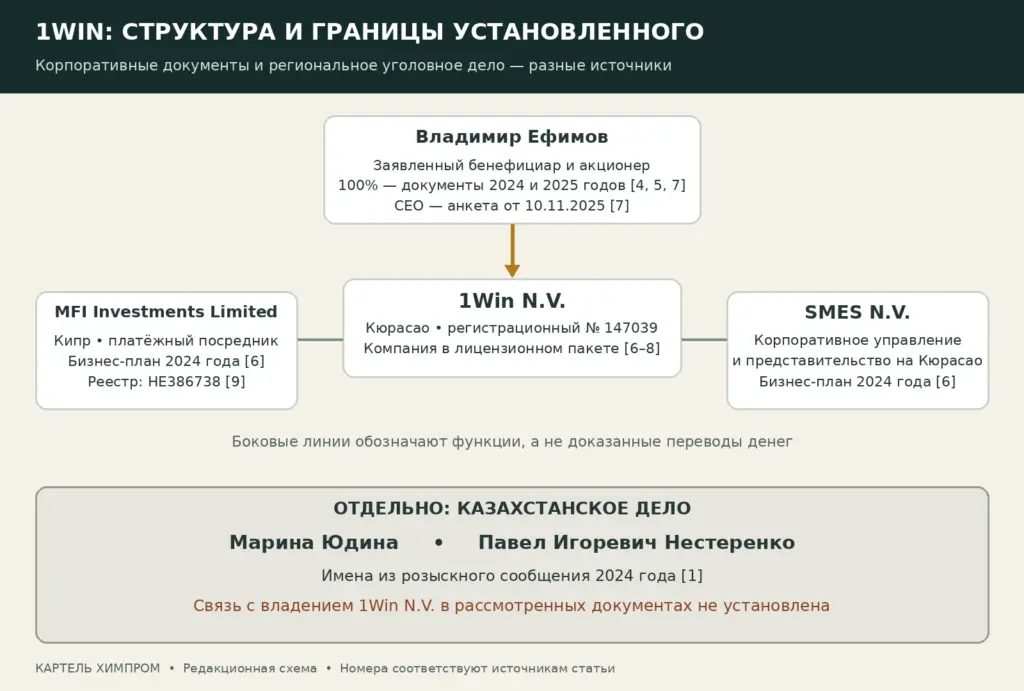
In the organisational chart, a copy of which is included in the March 2024 package, Vladimir Efimov — Vladimir Efimov He is listed as UBO / Shareholder, that is, the ultimate beneficial owner and shareholder. A 100 per cent stake is attributed to him in 1Win N.V. This is the specific declared ownership structure, not a conclusion about the owner based on popularity on social media.[4]
The share register from the same dataset also contains the name Vladimir Efimov. It shows one registered share and an acquisition date of 25 May 2018. This is a separate document concerning formal ownership; on its own, it does not reveal all possible arrangements regarding actual control.[5]
Of particular importance is the later ‘Business and Corporate Information Form’ from 10 November 2025. On the first page, the company 1 WIN N.V., registration number 147039 and licence number OGL/2024/587/0621 are listed. On the ‘Key Persons’ page, Efimov is listed as CEO; below, in the ‘Qualified Participation’ section, he is stated as holding 100 per cent. The same form also lists CTO Alexey Chepikov, CFO Selena Maria Nicholas and compliance officer Bijorna Joanne Janitza Monkou.[7]
Thus, the corporate documents examined list a registered owner and management roles. Yudina and Nesterenko are not listed in these specific sections as owners of 1Win N.V. This is not yet proof that they are merely figureheads in another structure. However, it is a compelling reason to stop automatically equating individuals on Kazakhstan’s wanted list with the owners of the entire international business.
Nor should Yefimov be equated with anyone else simply because of a coincidence in age, nationality or role in the brand’s history. We have not established that he is a pseudonym for another person, a nominee shareholder or the de facto head of the regional group. In this article, he is referred to in the capacity explicitly stated in the documents.
Curaçao, Cyprus and money management: what the operator itself described
In the 1Win N.V. business plan for 2024–2027, dated 25 April 2024 and published in the same archive, the operator describes the payment function of the Cypriot MFI Investments Limited. The document refers to it as an intermediary through which deposits, withdrawals and the integration of payment solutions are organised. The managing role in Curaçao is assigned to the corporate services provider (SMES) Solutions for Management and Employment Support N.V.[6]
In terms of authority, the business plan assigns to Efimov the responsibility for representing the company in business dealings, signing agreements and managing bank accounts. This is a description of the stated management model. It does not prove who gave specific instructions in the Kazakhstan episode, but it does show what questions regarding control the operator itself raised with the licensing authority.[6]
A Cypriot company with the number HE386738 It is listed on OpenCorporates as MFI INVESTMENTS LIMITED. The available profile shows, in particular, the submission of documents regarding a change of officers in June 2025 and a transfer of shares in February 2026. The OpenCorporates profile does not disclose the contents of these documents. It is therefore not possible to identify the parties involved in the transfer or its economic significance on this basis.[9]
Overseas registration, a corporate manager and a separate payment intermediary do not in themselves constitute evidence of a crime. Their significance in this story lies in the separation of functions. The shareholder, the director, the service provider and the recipient of a specific payment may all be different entities. For the purposes of the investigation, this is not merely a decorative ‘offshore web’, but a set of relationships, each of which must be verified.
There is a licence. What it explains — and what it doesn’t resolve
The current CGA verification page at the time of writing shows 1Win N.V. with an ‘Active’ licence status, licence number OGL/2024/587/0621 and company registration number 147039. The approved domain is listed as 1win.pro. This allows us to link the published corporate profile to a specific licensed company, rather than merely to a recognisable logo.[8]
However, a licence in one jurisdiction should not be interpreted as a universal defence against claims made by another. In January 2024, the Financial Market Authority of Kazakhstan specifically highlighted the lack of a relevant local licence for the provision of bookmaking services and the ban on online casino operations. The authority estimated the turnover for 2023 at approximately 4 billion tenge; this figure represents turnover, not the established personal income of Yudina or Nesterenko.[2]
Consequently, two records may exist simultaneously: the company is registered with an overseas regulator, whilst certain activities under the same brand are under investigation in Kazakhstan. Identifying the legal operator helps to determine who should be addressed with enquiries, but does not replace an assessment of specific actions within a specific territory.
Behind the advertising façade lies the economics of player acquisition
Another layer of the structure is described by the business itself. The Russian-language website 1win Partners claims to have over 100,000 partners, its own local call centres, VIP and support services, as well as integration with local payment systems. These are the figures and description provided by the project itself; we have not carried out an independent audit of these promotional claims.[10]
In a publication dated 23 October 2026, the affiliate programme promises an initial RevShare rate of 50 per cent, with the possibility of an increase to 60 per cent. GGR – gross gaming revenue – is cited as the basis for calculation. This is not a share of every deposit made. The same text describes the possibility of large cash payouts for certain affiliates, subject to individual agreement.[11]
This is where a separate financial interest comes into play: money for attracting and retaining an audience. A person can receive remuneration based on players’ results without owning any shares in the operator. Consequently, the fact that a person is not listed in the register of shareholders does not in itself answer the question of whether they earned money from promotion. However, in the case of Yudina and Nesterenko, we found no confirmed affiliate agreements, accounts or payments.
A separate publication by 1win Partners describes the sub-affiliate scheme: participants are offered 5 per cent of the revenue generated by the partners they recruit, with the programme claiming that it pays this share itself, without reducing their remuneration.[12]
This is a documented multi-tiered commercial structure, but it is not proof of a criminal hierarchy, nor is it grounds for declaring every partner a participant in the Kazakhstani case. Its significance lies elsewhere: the banner of an international casino can bring together the owner, managers, payment counterparties, advertising partners and sub-partners with different sources of income. To investigate all this as a single, indivisible role of the ‘casino owner’ would be far too simplistic.
The Moldovan angle: the brand is capable of surviving a separate website address
An investigation by Europa Liberă Moldova dated 14 August 2026 adds another dimension. Journalists analysed blocked gambling domains and discovered pages that led to 1Win either directly or via intermediate links. The article also describes social media advertising and the difficulties of blocking constantly changing addresses.[13]
This is the work of another editorial team, not a technical audit carried out by us. It does not establish which of the two individuals registered a specific domain or placed a specific advert. But it helps to explain why checking a single page does not reveal the entire commercial system. The customer acquisition address, the licensed domain, the payment recipient and the corporate owner are all separate elements to be investigated.
This is precisely why any further investigation must retain precise identifiers: the name of the legal entity, the registration number, the date of the contract and the specific domain. Without them, any story about the ‘network’ risks becoming a collection of websites with similar logos. With these details, it becomes possible to distinguish ownership relationships from advertising, technical support and mere coincidence.
191 billion: a separate account that cannot be attributed to just two people
On 9 November 2026, the AFM announced that it had referred another case to court — concerning the payment infrastructure of three controlled companies that served several online casinos, including 1WIN. The agency estimated the volume of transactions at 191 billion tenge, with estimated commission fees amounting to 286 million. The investigation described the use of the bank details of companies and business owners, including without their knowledge, and transfers to foreign counterparties, including cryptocurrency transactions.[14]
This article does not name Yudina and Nesterenko. It does not give the right to declare the entire stated turnover as their money, link them to the three companies, or merge the two operations. However, it demonstrates, using a specific, officially documented example, why clarifying the role of the payment intermediary can be more important than a photograph on an advertising banner.
| Indicator | What does this mean in the source? | What cannot be claimed |
|---|---|---|
| Around 4 billion tenge | Turnover for 2023 as reported by the AFM in January 2024.[2] | This is the personal wealth of one of the individuals involved. |
| 3.8 billion tenge | An estimate of the alleged criminal proceeds in a named report dated August 2024.[1] | How much each of the named individuals received. |
| Over 420 million tenge | The value of the confiscated assets as reported in February 2026.[3] | All the assets listed belonged to either Yudina or Nesterenko. |
| 191 billion and 286 million tenge | The volume of transactions and estimated commission in a separate case involving several casinos.[14] | This represents additional proven income for the same group. |
These figures should not be added together. Even figures from a single report may relate to different periods and calculation methods; on top of this, there is a separate legal proceeding. A strong financial article begins where a large number ceases to be mere window dressing and is given a precise definition.
Who’s ‘behind them’: documents rather than speculation
A comparison yields a clear result: the corporate structure is broader than the list of individuals on the regional wanted list. The company’s published materials name the owner, the manager and the payment intermediary; its own commercial publications reveal a separate affiliate level. However, we have not identified a proven chain linking ‘Yefimov – instruction – Yudina or Nesterenko – specific transaction’.
To verify the theory regarding ownership, documents proving actual control are required: who issued instructions, managed funds, approved transactions and reaped the financial rewards. If it turns out that the person merely lent their name, that is one scenario. If he personally managed the operations and shared in the profits, that is another matter entirely. Making a judgement based on age or appearance in a photograph would amount to fabricating a role.
The brand’s public stance must also be taken into account. In October 2025, TheBetting, quoting comments made by 1win representatives to SportClan, reported that the company denied any connection with Sergey Chernykh and disagreed with the claims published in the media regarding control. This is a position conveyed indirectly; the company did not provide our editorial team with any new comments whilst this article was being prepared.[15]
We do not include controversial claims about other businesspeople in this article without supporting documents. Nor do we treat the licence application as a verdict against its signatories: a corporate role and criminal liability are two distinct matters. The documents provided are important as a basis for targeted questions, not as authorisation to accuse a new list of individuals.
What in this story really demands an answer
For the Kazakhstani investigation to proceed in a substantive manner, it needs the names of the companies and a breakdown of the alleged roles among those involved — insofar as this information can be disclosed. Without this, the high-profile list of wanted individuals remains too broad a description to draw personal conclusions about the owners, nominal owners and those in control.
A substantive response from the operator would include the current ownership structure and an explanation of the relationships between 1Win N.V., the payment intermediary and the organisations facilitating operations in the market in question. If the published copies of the documents are incomplete, out of date or incorrect, specific corrections with dates are essential. A simple denial of any connection does not reveal the structure of the business; nor does the mere fact of overseas registration prove any breach.
As regards Yudina and Nesterenko, their own explanations, documents regarding their powers and individual procedural decisions would be significant in clarifying the picture. We found no such information in the materials reviewed. No new enquiries were sent to these individuals and companies whilst preparing this version; the absence of a response does not constitute an admission of the charges.
Therefore, the answer to the question in the headline for now is as follows: a network of companies registered to frontmen has been described by the AFM, but the documents do not allow us to identify Yudina and Nesterenko as confirmed ‘cheap drop accounts’. However, behind the familiar façade lies a quite substantial corporate structure with other declared roles. The next question is: who will link this structure to the specific actions of the individuals involved in the Kazakhstani case, and with what evidence? Without such a link, one might end up with a sensational headline. With it, the investigation can truly continue.