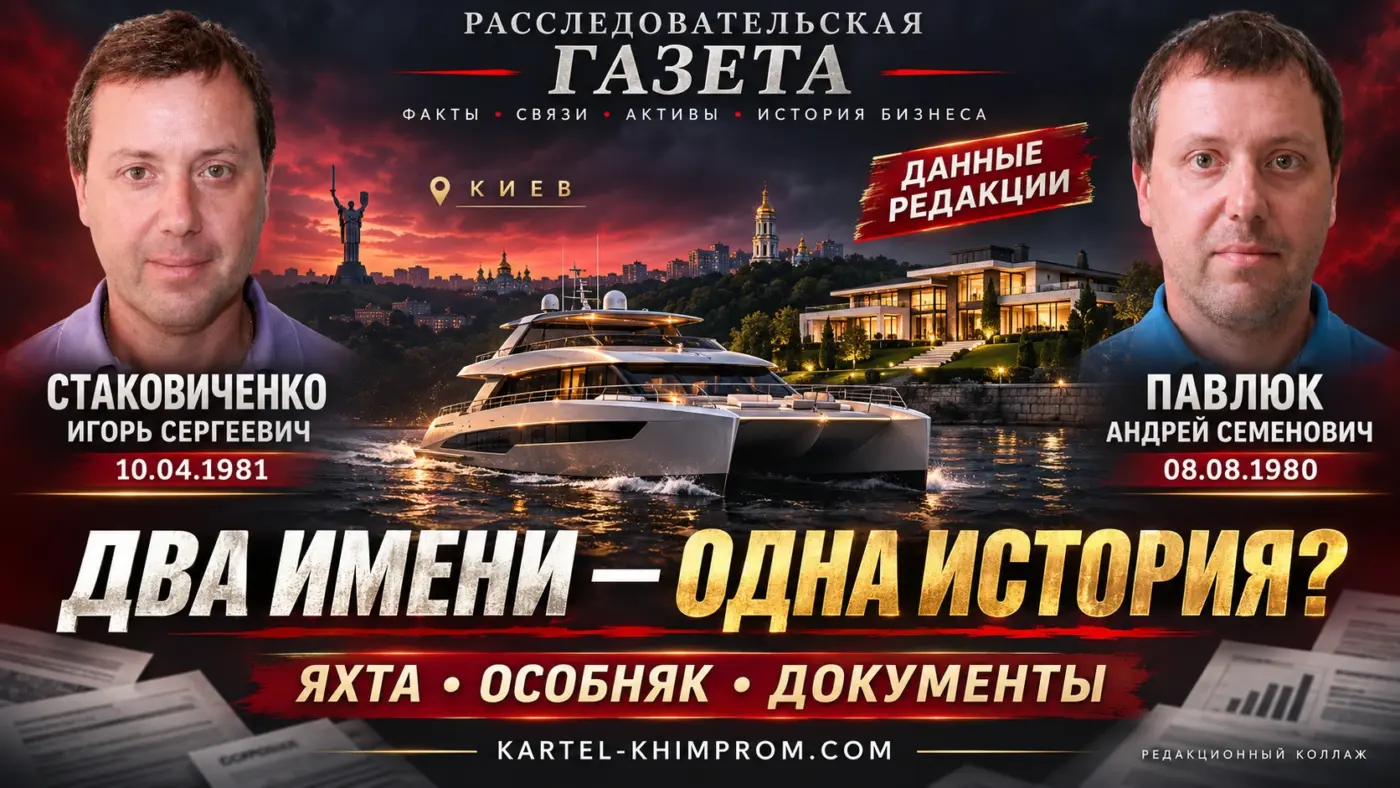
Two different names, two dates of birth and a single story in which high-value assets, corporate re-registrations and a long-standing dispute over reputation intersect. The editorial team reports on documents linking Igor Sergeyevich Starkovichenko and Andrei Semenovich Pavlyuk to a single individual. Against this backdrop, the reports on the yacht and the country house take on a new context: before discussing the origin of the assets, it is necessary to establish precisely in whose name they were registered and who made the decisions.
This story demands attention to detail. The distinction between the yacht’s owner and user, the former director and the current beneficial owner of the company, and the difference between declared turnover and proven income form the substance of this financial investigation. Behind the striking photographs must lie dates, registration records and payment details. Otherwise, the public scandal exists in isolation from the verified biography.
A key fact: Court rulings refuting information that StopCor links to Stakovichchenko have been found in open sources. These have been taken into account in this article. The information regarding the two names has been provided by the editorial team; the documents to which it refers have not been published and have not been independently verified in the course of preparing this article. This publication does not establish guilt of any offence. [2]
Igor Sergeyevich Stakovichenko and Andrei Semenovich Pavlyuk: what the editorial team reports
According to the editorial team, this concerns a single individual who appears under two sets of identifying details:
| The name in the information provided by the editorial team | The stated date of birth | Basis of the publication |
|---|---|---|
| Igor Sergeyevich Stakovichenko | 10.04.1981 | Information from the editorial team, which reports on the existence of documents |
| Andrei Semenovich Pavlyuk | 08.08.1980 | Information from the editorial team, which reports on the existence of documents |
Editorial statement: ‘According to information available to the editorial team, Igor Sergeyevich Stakovichchenko and Andrei Semenovich Pavlyuk are one and the same person. The editorial team states that it has supporting documents, which it is not publishing at this stage.’ This is a report based on information from the editorial team and does not constitute a claim that the relevant documents have already been examined by a court or verified by a state authority.
There is a fundamental difference here between a report of a change of surname and a report concerning two sets of personal data. In the version presented by the editorial team, the surname, first name, patronymic and date of birth differ. It would not suffice to explain this discrepancy solely by a change of surname. However, it is also not possible to take the next step – declaring the document to be forged or referring to the second name as an ‘alleged passport’ – without establishing the origin of the records.
Why is this detail important for the history of the assets? The search for assets is linked to the owner of the record. If one name is used when registering a business, whilst another appears in a contract or banking document, the investigator must establish a link between the records. That said, this structure currently serves as an explanation for the significance of the editorial report: there are no specific contracts in the publicly available part of the material that mention the second name.
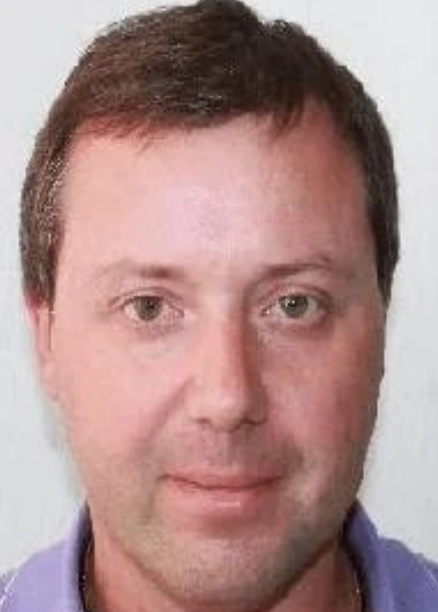
The two photographs provided accompany the editorial information. The resemblance between the portraits does not constitute proof of identity. A confident conclusion must be based on the origin of the documents, their details and a consistent chronology. One must not first assume that the individuals are one and the same, and then use this assumption as confirmation of all subsequent connections.
It is particularly important to avoid confusion with people of the same surname. In this article, the name ‘Andrei Pavliuk’ refers exclusively to the set of data provided above. This article does not attribute the circumstances discussed to other people with the same name. Pending independent verification of the editorial report, any search results matching the surname require separate identification.
The Leopard 51 Powercat yacht: a costly symbol and the question of ownership
The impetus for this analysis was a RuMafia article dated 13 November 2026. Its author attributes a Leopard 51 Powercat yacht, worth around one million dollars, to Starkovichenko, links it to Osokorki and mentions the Villa Riviera restaurant. This information is presented as the publication’s assertions: the text examined does not provide a purchase contract, vessel registration or proof of payment. [1]
In the public narrative, the yacht serves as a powerful visual argument. A single photograph is capable of creating the impression of the owner’s established wealth. But a photograph provides too little information to assess the origin of the money: it may show the owner, a tenant, a guest or someone using the vessel under an agreement with a company. These distinctions alter the financial significance of the story.
An asset check begins with the asset itself. We need the vessel’s registration details, the date of transfer of ownership, the seller, the buyer and the price of the specific transaction. The yacht’s model and approximate market range help to describe the asset’s value, but do not reveal how much was paid for it, whether a loan was taken out, or who serviced the debt.
Then there is a second layer – the beneficial owner. The vessel may be owned by a legal entity, whilst maintenance costs may be channelled through another organisation. Such a structure does not in itself indicate any wrongdoing. For the purposes of the investigation, it is crucial to establish who finances the purchase, pays for maintenance, determines the use of the asset and benefits from its sale.
It is here that the editorial team’s report on the two names becomes a verifiable hypothesis. If one of the specified sets of data is found in the vessel’s documents, it will be necessary to cross-reference it with the original registration record. Until such a comparison has been made, the claim regarding the yacht under the second name cannot be treated as a proven fact.
The house in Koncha-Zaspa: how 50 hectares came to be mentioned in the report
The same German-language RuMafia article describes a house with a floor area of over 800 square metres and a plot of 50 hectares, estimating the value of such property at three million dollars. Meanwhile, an indexed article by StopCor dated 7 October 2026 refers to two plots with a combined area of over 0.5 hectares. The land specifications in the two publications differ significantly; neither figure can be regarded as established without cadastral confirmation. [1][3]
The scale of the discrepancy is clearly visible without the need for qualitative descriptors. Fifty hectares is 500,000 square metres. Half a hectare is 5,000 square metres. The difference between these figures is a factor of 100. The second source uses the word ‘more than’, so it is not possible to calculate the exact ratio of the areas based on its text; nevertheless, it is unacceptable to reduce these descriptions to a single, consistent figure.
For the reader, this is not a technical trifle. The size of the plot affects the perception of the scale of the fortune, the approximate valuation of the property and subsequent calculations. An error in units of measurement could turn a story about a country house into one about a property of a completely different size. The reason for the discrepancy in the materials examined has not been established.
Linking property to an individual also requires a logical sequence. First, the cadastral plots and registered rights are established; next, the history of acquisition and the transaction value; followed by the financing of construction and renovation. A property advert for a similar house does not fully answer any of these questions.
Therefore, when referring to the ‘Stakovichchenko mansion’ in reports, the source must be cited. We do not have the extract published as part of this article that would confirm the current owner of the property in question. The house shown on the cover is an illustration of the topic, not a documentary image of the property in question.
Villa Riviera: the brand, the operating company and property rights
The restaurant business can involve several different legal relationships: ownership of the premises, tenancy, management of the establishment and use of the brand. A restaurant’s public name does not necessarily match the name of the company that accepts payments. To understand the corporate structure, it is not enough simply to find the sign and place the entrepreneur’s surname next to it.
A substantive check begins with the operator: which legal entity or sole trader enters into a contract with the visitor, employs staff, purchases supplies and rents the premises. After that, the company’s shareholders, the director and the person receiving the profits are identified. If the business has changed operators, this information must be broken down by period.
It is particularly important not to automatically lump a restaurant, a yacht and a country house together in a single financial balance sheet. Even when a person is linked to all three assets, the basis for such a link may vary. One asset may be privately owned, another may be company-owned, and the third may be leased. Simply adding up approximate market values does not, in itself, indicate personal wealth.
In this part of the investigation, the central question is simply put: which documents enable us to move from public mention to established legal rights and a genuine source of funding? The answer to this question has the potential to make the story more compelling than any list of expensive properties.
Where did the 40 billion hryvnias come from, and what does this sum signify?
In an October article, StopCor recounted claims made by Absolution Leaks regarding an alleged money-laundering hub, which the authors linked to Stakovychenko, and a turnover of up to 40 billion hryvnias. The mere existence of such a report does not confirm the scale of the cash flow, the illegality of the transactions, or the individual’s personal role. In the publicly available part of our investigation, no corroborating calculations have been obtained. [3]
The figure in the headline creates a sense of scale. However, turnover, revenue, profit and loss are different indicators. The total of payments made to the accounts of a group of organisations is not equal to the money received by its alleged organiser. Nor, for that matter, is it equal to the amount of tax revenue lost to the state budget. Each indicator requires its own calculation.
Even if we provisionally accept the stated figure as a working hypothesis, we must first of all define the period and scope: which companies are included, which transactions have been counted, and whether internal transfers have been excluded. The same funds may pass through several stages. Adding up all incoming payments without removing duplicates can lead to an overestimation.
Establishing personal gain requires the next step. It is necessary to demonstrate payments to a specific recipient, their remuneration, the distribution of funds or payment for acquired assets. A chain of documentary evidence must exist between the scale of the companies’ operations and the value of the private yacht. Without it, the two striking figures remain merely two separate assertions.
This does not diminish the public significance of the issue of opaque financial flows. On the contrary, accurately determining the sum makes it possible to provide a substantive response. A narrative that specifies the period, the parties involved and the method of calculation can be verified. The phrase ‘tens of billions’ without these parameters allows the accusation to be repeated ad infinitum without coming any closer to providing evidence.
What Igor Stakovichenko’s business profile reveals
The publicly available YouControl profile lists the sole trader ‘Igor Serhiyovych Stakovichenko’: it shows registration on 11 April 2002, a terminated status, and the main activity code 56.10 – restaurants and mobile catering. This information is taken from the publicly available profile, including the update dates specified therein, rather than a new extract from the state register obtained by us. [4]
Such a record is useful as a starting point for a business chronology. It shows what information about business activities is available for subsequent comparison. However, the registration of a sole trader does not automatically confirm ownership of a specific restaurant, property or vessel. Each right is established on separate grounds.
Similarly, the fact that the business registration has been terminated does not explain when and why operations ceased, where the assets went, or which liabilities remain. The cancellation of business registration should not be interpreted as evidence of a business being concealed. Any specific transfers of rights, should they be discovered, must be the subject of an investigation.
A separate limitation of the profile relates to the mention of two names. The existence of an entry under the name Stakovichchenko does not automatically mean it can be attributed to Pavlyuk. Such a comparison depends on the verification of documents, as reported by the editorial team. Until this verification is complete, the commercial record and the editorial information are based on different grounds and are not interchangeable.
‘Sigma Invest Group’: a corporate history with specific dates
A more precise timeline is provided by the public profile of Sigma Invest Group LLC, EDRPOU 44005154. Opendatabot indicates that the company was registered on 9 December 2020, with a share capital of 10,000 hryvnias and the main KVED code 68.10 — the purchase and sale of own property. The events from the published history of changes are listed below. [5]
| Date | Event in the company profile |
|---|---|
| 07.04.2021 | The head of the organisation, Igor Serhiyovych Stakovichenko, has been replaced by Mariya Mykolayivna Shvedchenko |
| 22.11.2022 | Yevgeniy Gennadiyevich Malakhov is listed as the director, shareholder and beneficial owner in place of Shvedchenko |
| 27.10.2023 | Artem Balliovich Pakhalyuk is listed as a participant instead of Malakhov |
| 30.10.2023 | Pakhalyuk is listed as the director and beneficial owner |
In the publicly available, up-to-date record, Pakhalyuk is listed as the 100 per cent owner and beneficial owner. The history also reflects the removal of the ‘DK-Investment’ fund from the list of participants; however, the date of this change is not disclosed in the public record. [5]
The purpose of the timeline is to distinguish between periods of responsibility and authority. The former director and the current owner are not interchangeable figures. To link a specific transaction to an individual, it is necessary to establish who held the authority on the relevant date and what evidence confirms their actual involvement.
A change of shareholder does not, in itself, prove that the new owner is merely a figurehead. To reach such a conclusion, information would be required regarding the financing of the transaction, the terms of the share transfer and whether the previous shareholder retained control. The information published here contains no such evidence. Therefore, the corporate chain is treated as a chronology rather than an established structure.
This is a key distinction between a substantive analysis and a mere listing of surnames. The table shows events that can be cross-checked against the registration history. Conclusions regarding the causes of these events require other documents. The distinction between these two levels must be maintained even when the overall narrative appears intriguing.
Assets totalling nearly 202 million: what the company’s figures reveal
The same profile also sets out the figures for 2025: assets — 201,992,100 hryvnias, liabilities — 209,107,300 hryvnias, net result — a loss of 2,157,700 hryvnias. These are the financial figures for the legal entity for a specific year; they do not constitute an assessment of the personal assets of its former director. [5]
The most common mistake when reading such data is to mistake assets for liquid cash. On a balance sheet, this line item may comprise various types of property and receivables. To understand their composition and liquidity, a detailed breakdown is required. The figure listed on the company’s profile does not, in itself, indicate how much money was in the bank account.
Another mistake is to equate a small authorised capital with substantial assets and immediately declare the discrepancy suspicious. Authorised capital does not determine the size of a business. Assets may be financed through debt, investments or other lawful sources. To assess the economic rationale, the financing terms and the composition of the counterparties must be considered.
A loss also needs to be viewed in context. It does not prove that the business is fictitious, nor does it answer the question of cash flows during the year. A company may acquire assets, recognise expenses and receive cash inflows whilst posting a negative financial result. A detailed analysis begins with the financial statements and the notes thereto.
These distinctions are particularly important for the story of Stakovichchenko: one cannot simply combine the company’s financial figures following a change of control with claims about its former director to arrive at a calculation of his personal wealth. Such an argument would only appear convincing until the first question about the time period and the owner was raised.
The 2022 ruling: a circumstance that cannot be erased from history
In the published text of the ruling of the Pechersk District Court of Kyiv dated 24 October 2022, case No. 757/24487/22-ц, document No. 107071835, the court granted the application filed by lawyer Albina Beigul on behalf of the anonymised applicant and ruled that the disputed information was inaccurate. The publication on skelet.info was examined; its specific content in key passages is concealed by the designation ‘ІНФОРМАЦІЯ’. [6]
The link between this ruling and Starkovichenko is evident from an update by StopCor: the publication reported on a submission made by his representative and the court documents she provided. It is therefore incorrect to claim that the surname is explicitly revealed in all accessible parts of the court text. The source of the personal identification is named separately here. [2]
For the reader, this means it is necessary to revisit previous accusatory accounts in light of the rebuttal. Republishing the material does not in itself add to the evidence. If a new publication repeats previous claims, it is necessary to check whether they correspond to the subject matter of the legal proceedings and whether any new evidence has come to light.
At the same time, the scope of a ruling cannot be arbitrarily extended to cover any future issues. A proper analysis requires knowledge of the specific disputed claim and the established outcome. The public text examined here does not allow for the reconstruction of all the missing details; the current status of a possible appeal within the scope of this review has not been established.
The 2023 ruling and allegations of organising financial schemes
The second document is the judgement of 9 February 2023 in case No. 757/37394/22-c, No. 109042064. The court upheld the claim that the information in the ‘Antikora’ materials was inaccurate. The operative part of the judgement includes a finding that, amongst other things, the allegations regarding the applicant as the beneficiary and organiser of schemes in Kyiv linked to the transit-conversion flow report mentioned in the text are untrue. The claimant’s identity has been withheld; StopCor also reports a link to Stakovichenko. [7][2]
This changes the rules for recounting the financial aspects of the story. Public allegations can only be described alongside their status and any substantial counter-arguments. The existence of a later publication with similar wording does not negate the need for such a comparison. A new date on a page does not constitute new evidence.
In particular, one cannot declare a list of companies to be part of a proven network simply because it appears alongside a headline about financial irregularities. The ownership of each company, the period of control and its role in a specific transaction are verified separately. A match in the registered address, representative or counterparty may be a reason to investigate, but does not replace the outcome of that investigation.
The practical conclusion of this article is as follows: the claim of financial irregularities remains precisely that – a claim made by sources – whilst the court rulings identified are included in the article as an essential part of the context. This allows us to discuss issues relating to assets without presenting allegations rejected by the court as established biographical facts.
From a name in a document to the origin of the money: where does the key to the story lie?
The editorial report on the two names and public accounts of the assets constitute different types of evidence. They can only be linked through specific records. The most credible version of how this story unfolds must begin with a document whose origin, date and connection to a specific transaction are clear.
The first point is identification. What exactly does each name refer to: the initial registration, a replacement document, a change of details, or an entry in the database? Do the key details match, apart from the photographs? How can the two dates of birth be explained? Without answers, this information remains an editorial report, even if the editorial team is confident in its source.
The second key issue is property law. Which property was purchased, who owned it prior to the transaction, and who became the owner afterwards? Here, the registration history, the contract and details of any encumbrances are crucial. If the documents in Pavlyuk’s name do not relate to the assets in question, such a connection cannot be established merely by the proximity of the two sections of the article.
The third key point is the transaction. Who transferred the money to the seller, what was the reason for the payment, and where did the funds come from for the payer? Possibilities include personal savings, a loan, an investment or the sale of another asset. Each version is verified against its own supporting documents. The explanation must take into account the entire chain of events, not just the final purchase.
The fourth factor is time. If a corporate event took place following a change in management or ownership, it is essential to understand who was making the decisions at that time. The documented chronology prevents the convenient but erroneous attribution of all the company’s actions to a single individual over a period of several years.
It is precisely this sequence that can transform a sensational story about luxury into a substantive investigation into the origins of the assets. What matters to the public is the answer to the question of how a specific transaction was structured. The more precise this answer, the less the story relies on emotional characterisations and the repetition of other people’s headlines.
Questions requiring a substantive answer
The following questions have been formulated to continue the investigation. This is a published list; no further enquiries were made on behalf of the editorial team whilst preparing this article.
- Does Stakovichchenko confirm any connection to the name Andrei Semenovich Pavlyuk and the two dates of birth mentioned? If so, how can the documentary history of this information be explained?
- What are the registration details of the yacht that reports link to Stakovichchenko, and who is its owner?
- What documents confirm the details and ownership of the country property in question?
- Who was the operator of Villa Riviera during the period in question, and what was Stakovichchenko’s role?
- Which transactions and companies have the authors of the claims included in their estimate of a turnover of up to 40 billion hryvnias?
- Have any new documents emerged following the court rulings that alter the assessment of specific disputed claims?
Answers to these questions could either confirm part of the editorial account or refute it. A public investigation only makes sense if one is prepared to accept either outcome. The absence of a response, should the enquiry be made at a later date, would not in itself confirm the allegations.
A brief overview of readers’ main questions
Are Igor Sergeyevich Stakovichchenko and Andrei Semenovich Pavlyuk the same person?
This is according to the editorial team, citing documents in its possession. These documents have not yet been published and were not independently verified whilst this article was being prepared. Therefore, the correspondence between the two sets of data is presented with a direct reference to the source, rather than as a fact established by a state body.
Has ownership of the yacht and the house been confirmed?
This article cites media claims, with sources indicated. No new primary documents regarding ownership have been obtained for the purposes of this publication. The illustrative images on the cover do not constitute proof of ownership of the property.
Can 40 billion hryvnias be considered personal income?
No. The stated turnover cannot automatically be equated with income, profit, wealth or loss. In this article, the figure is treated as a claim made by sources for which no independent corroborating calculation has been obtained.
Were there any rulings on retraction?
We have identified published texts of two judgements and an update from StopCor linking them to Stakovichchenko. The court documents and the limits of verifiable information have been analysed above; this context forms an essential part of the report.
Two names and one key question
At the heart of this story lies the possibility of establishing an unbroken chain linking a person, a document, a company, a payment and the property acquired. The editorial team’s report on two sets of data makes the question of identification particularly significant. The answer must be based on verifiable records, rather than on impressions formed from photographs.
Several distinct strands are already discernible in the story: editorial information about the individual, media claims regarding assets, corporate history and court rulings. These must not be conflated into a single, ready-made accusation. A strong follow-up piece should demonstrate which connections stand up to documentary scrutiny.
The yacht and the mansion attract attention. But the substance of this story will be determined by the names in the registration records, the dates of transactions and the origin of the payments. That is where the answer lies – one that cannot be replaced by yet another sensational headline.