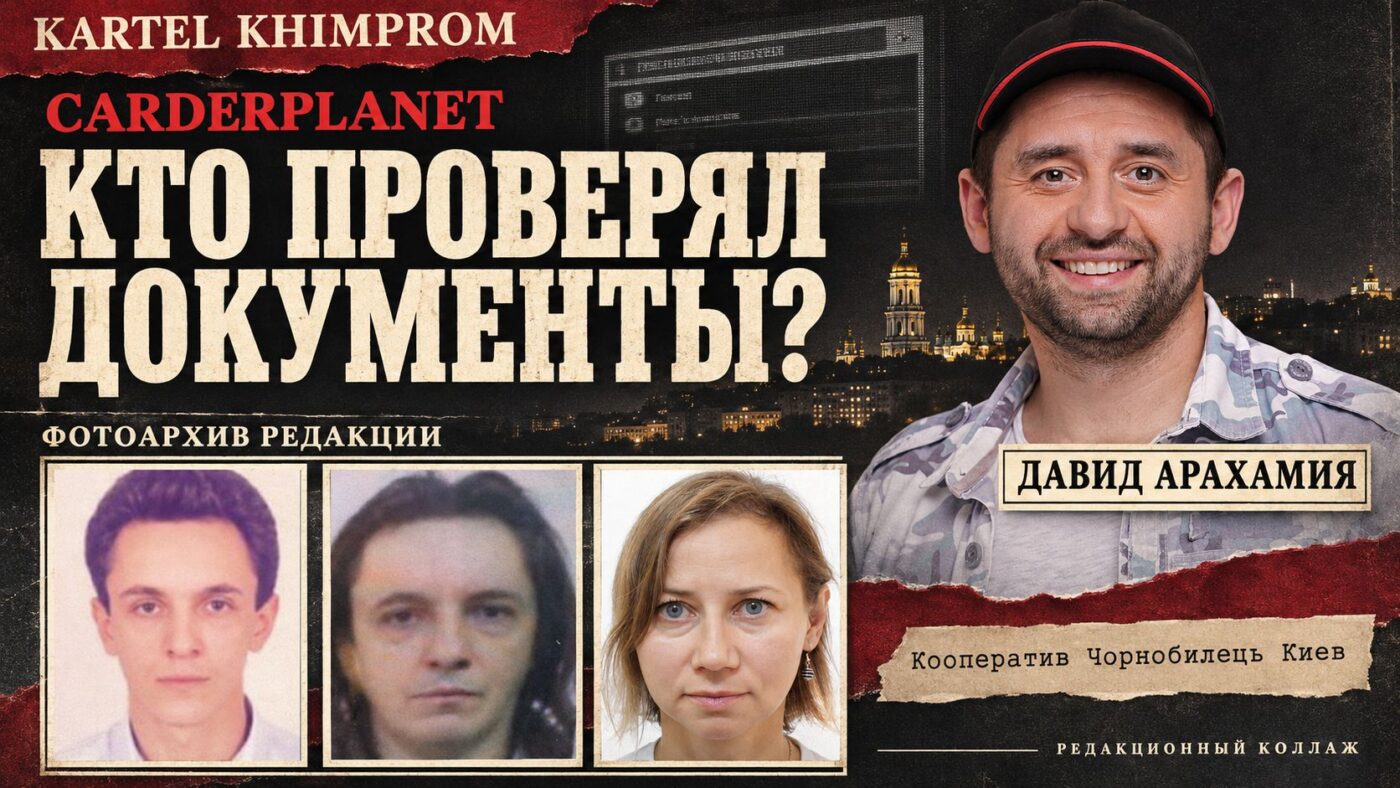
In 2006, a newspaper reported on two men named Andrei who were wanted by Ukrainian law enforcement in connection with a bank fraud case. One of them, Andrei Lazarev, appeared years later in the Ukrainian company register under the name Andrei Reint. In 2025, a Kyiv court described how a man from an old wanted case had used fictitious details for years and obtained an official birth certificate in that name. How could a wanted man and a new identity co-exist for so many years in the same country? [1] [11] [12] [15]
Following the publication of our dossier on Lazarev, the editorial team received a letter from an address linked to David Arakhamia’s personal email. According to the editorial team, the author of the letter saw a ‘Russian connection’ in the publication. One really doesn’t have to look far for evidence. Here is the archive of a Ukrainian newspaper, here is a Ukrainian court judgement, here is the history of a Ukrainian company. All three sources are available to the reader. When it comes to Kremlin agents, facts are needed. And David Arakhamia should also answer a question closer to home. What does he know about Lazarev, known as Andrei Reint, and with whom did he himself communicate during his time at CarderPlanet? [1] [11] [15] [17] [24]
St Petersburg, 2006. How did Lazarev’s story begin?
On 12 April 2006, Gazeta.ua published a report on Ukrainian hackers who were linked to thefts in St Petersburg. The story began much earlier. Reporters traced the origins of carding back to Dnipropetrovsk, describing the role of former bank employee Gennadiy Mostovlyuk and the subsequent split within the groups. The publication named Andriy Lazarev and Andriy Kravchenko in connection with one of these groups. This was the journalists’ reconstruction at the time, based in part on unnamed sources. [1]
The article also contained a genuine St Petersburg connection. An unnamed source from the Ukrainian Ministry of Internal Affairs, speaking to the newspaper, claimed that the group had been assisted in St Petersburg by local police officers, who were allegedly paid off. This is a serious allegation; the source is anonymous, and there is no judicial confirmation in the article. Moreover, the scope of this allegation is quite specific — a Russian city and Russian police officers. To attribute it to Ukrainian officials or to present it as a proven case of bribery would be a misrepresentation. [1]
In October 2006, Gazeta.ua returned to the names of Lazarev and Kravchenko. The newspaper reported on the Ukrainian manhunt and on the ruling of the Pechersk District Court of Kyiv dated 2 October 2006, authorising his arrest and detention. Lazarev disputed the information regarding the manhunt, whilst the newspaper wrote about the controversy surrounding its publication. The date that the journalists cited in relation to Lazarev later appeared, years later, in the Kyiv court judgement — 27 September 2004. [2] [11]
This is where the investigation begins, one that is more intriguing than the dispute over his reputation in the press. What became of the man who was wanted under his old surname? And what traces did the other surname leave in the registers, into which he subsequently entered quite publicly? The answer lies in three different sources — a criminal conviction, a company file and a commercial dispute. [11] [15] [16]
How CarderPlanet turned the trade in stolen data into a mass phenomenon
In the late 1990s, Roman Vega launched Boa Factory — an early marketplace for buyers and sellers of stolen card details. In the early 2000s, according to documents from the US Department of Justice, he became one of the founders and administrators of CarderPlanet. In its reconstruction of events, WIRED linked the early stages of the community’s formation to Odessa. The Dnipropetrovsk bureau of Gazeta.ua reports on the history of individual groups, whilst the Odessa bureau of WIRED covers the platform’s formation. These accounts show where journalists traced the connections, but do not provide a definitive list of leaders or a single, unified group composition. [1] [3] [4] [5]
CarderPlanet’s main commodity was information that the legitimate cardholders had not authorised anyone to sell. The marketplace brought together several different roles. Some participants obtained the data, others sold it, whilst others bought it and used it for fraud. The US agency also described offers of hacking and money-laundering services. At its peak, the platform had over six thousand members, according to the US Department of Justice. This figure reflects the size of the community, whilst legal liability was determined separately for specific individuals and incidents. [3]
The sellers faced a common problem. Anyone selling stolen goods can easily deceive the buyer themselves. Vega helped introduce a goods inspection process, which was overseen by a representative of the platform. The forum also established a hierarchy with titles borrowed from the mafia. Buyers were offered the predictability of a standard service, even though the transaction was based on someone else’s bank account details. For the victim, the whole system only became apparent at the most unpleasant moment, when they had to deal with a transaction they hadn’t carried out. [3]
Cases in the US show why it is necessary to search separately for the market organisers, the sellers and those who laundered the money. The same seller could have operated across several platforms. The US Secret Service identified Vladislav Khorokhorin as one of the founders of the CarderPlanet network, and the case files relating to his arrest described the use of both CarderPlanet and the separate platform Carder.su. His federal conviction related to the trade in stolen payment details and his role in a specific incident of theft from a US payment processing centre. [6] [7]
In October 2004, a separate indictment relating to ShadowCrew was published in the US. The case files also referred to an online marketplace, the sale of stolen data and forged documents. CarderPlanet and ShadowCrew should be considered together when discussing the development of the industry. The criminal cases relating to these platforms are distinct. If an individual appears in the history of one, their role in the other is established through a separate document. [3] [8]
The Golubov case. Why did this high-profile investigation end in an acquittal?
In 2005, Dmitry Golubov was arrested in Odessa. WIRED linked his case to the work of several US agencies and quoted a former US investigator describing the difficulties of working with Ukrainian colleagues. In the spring of 2006, Gazeta.ua published comments from an unnamed source regarding the risk of information leaks via the local police. Years later, the quality of the investigation can be assessed on the basis of court documents, which reveal specific shortcomings. [4] [9] [10]
As ‘CHESNO’ and ‘Ukrainska Pravda’ discovered, the court deemed the charge to be too vague. It was not possible to establish from it where, when and how Golubov had committed the alleged acts. The court deemed the US evidence submitted to be too general to prove his involvement in the incidents in question. The condition of the seized hard drive made it impossible to determine whether it contained data confirming the production of forgeries. The case also involved a personal guarantee, which the court subsequently revoked. The outcome was an acquittal on the grounds that his involvement had not been proven. [9]
Here, the question put to the state rings out more harshly than any accusation in the press. Why did an investigation, involving the security services of several countries, reach the court with wording from which it is impossible to establish the defendant’s actions? What evidence was the investigation able to present in a verifiable form? The defence itself provides a clear answer regarding Golubov. The reasons why the investigation failed to carry out its work adequately deserve separate analysis. [4] [9]
The Lazarev case. How a fictional biography found its way into official records
On 27 March 2025, the Obolon District Court of Kyiv handed down its verdict in case No. 756/3935/25. The published text has anonymised the names. The court case file and corporate records allow us to link Andrei Lazarev and Andrei Reint. The judgement describes how a man who had been wanted since 2004 used fictitious personal details and subsequently managed to obtain a new official document in that name. [11] [12] [15] [16]
The episode from 2022–2023 is particularly telling. An application to establish kinship was filed with the court, based on documents containing false information. The ruling allowed the birth record to be amended. Following this, a birth certificate was obtained under a fictitious name. Later, the court compared photographs and fingerprints from two sets of evidence. They belonged to the same person. This was the point at which the fictitious biography collided with reality. [11]
In court, Lazarev pleaded guilty to the charges brought against him in these proceedings. According to him, he approached an acquaintance to obtain forged documents following an attack in 2003, fearing for his life, and paid 3,000 dollars. The judgement itself states that the fabricated details were used to evade the manhunt. For the aggregate of offences, the court sentenced him to four years’ imprisonment but suspended the sentence, subject to a two-year probation period. In July, the appeal court upheld the sentence. [11] [13]
The old fraud case has reached its own conclusion. On 30 May 2025, the Solomensky District Court of Kyiv closed case No. 760/13877/25 against Lazarev due to the expiry of the limitation period. Therefore, there are two separate outcomes to this story. In the case concerning the documents and weapons, there has been a conviction. In the old fraud case, the proceedings have been discontinued due to the expiry of the limitation period, without a ruling on guilt on the merits of the charge. [11] [13] [14]
We then looked into the history of the company ‘Dominion-8’. In its records, Andrei Reint appears as the director in 2017 and as the beneficial owner in 2021. Andrei Lazarev later appears in the corporate records. In February 2026, the Kyiv Commercial Court partially upheld Lazarev’s claim for the restoration of corporate rights and the return of property transferred to another legal entity. The legal dispute illustrates how two names became part of one company’s history. As this ruling concerns a different matter, it cannot be used to determine the origin of the money or assets. [15] [16]
What on earth has been going on between the authorities all these years? A man appears under one name in the wanted documents, becomes a director and beneficiary under another, and a new birth certificate is issued with the involvement of state institutions. Who checked the original documents? When did the police, registrars and courts first have the opportunity to cross-check the data? Which control mechanisms only came into play after the name had been in circulation for years? The judgement refers to the involvement of unidentified individuals. The role of specific intermediaries and the possible complicity of public officials remain questions to which the state must provide answers. [11] [15] [16]
David Arakhamia and CarderPlanet. What did he say himself?
Arakhamia has his own public account of CarderPlanet, published long before the letter regarding our dossier. In a written interview with Yakub Yavorovich in 2018, he, speaking under the name David Brown, explained that TemplateMonster had encountered a massive wave of fraudulent purchases. According to him, he tracked down the owner of CarderPlanet, discussed the problem with him, and the team redesigned the forum. A notice appeared on the website stating that TemplateMonster was a sponsor. He offered forum members the design for free or at a discount, explaining that this was an attempt to reduce the number of purchases made using stolen payment details. [17]
In that interview, Arachamia himself spoke of the risk posed by such a signature. Here, his version of events is set out publicly and in his own words. The published conversation describes the work on the design and contact with the site owner. He does not name Lazarev as this owner, nor does he confirm a personal friendship between them. Arakhamia’s role in this story is that of an interviewee who described his contacts with the forum, and a politician to whom the editorial team is addressing questions. [17] [28]
David, before you start looking for Kremlin figures on the other side of the editorial inbox, think back to your own contacts from that time. Who exactly did you agree with regarding the redesign of CarderPlanet? Did you know Andrei Lazarev personally? If so, when did you find out that he was listed as Andrei Reint in the documents? Did you speak to him after the dossier was published? And what facts, in your opinion, link the publication to Russia? The editorial team has open-source information on the Lazarev case. If you have any evidence regarding the editorial team, please provide it. [11] [12] [17]
‘Khimprom’. The usual enquiries to the registers and now specific questions for the security services
In December 2023, the President of Ukraine enacted the National Security and Defence Council’s decision on sanctions. ‘Slidstvo.Info’, having examined the lists and wanted information, described which names appear in the case files relating to those implicated in the ‘Khimprom’ cases. Yegor Burkin also appeared as Yegor Levchenko. Andrei Amirkhanyan appeared as Andrei Lemishko. Using these names, journalists traced their appearances in Ukrainian documents and wanted lists. The sanctions decree and the wanted notices provide grounds for verifying the origin of the documents in each case. The circumstances surrounding their issuance and the possible liability of intermediaries are being established separately. [18] [19]
The parallel with Lazarev centres on a specific question. If the authorities identify a person under different names, where and when is this information cross-referenced? In Lazarev’s case, the court established how the documents containing fabricated details had been obtained. In the cases of Burkin and Amirkhanyan, the reader has access to the sanctions context, the journalists’ investigation and details of the manhunt. For now, we can compare the consequences that arise from the use of multiple names and ask about how the registers operate. The published materials do not identify a single source of documents for CarderPlanet members and those implicated in the ‘Khimprom’ case. [11] [18] [19] [20]
And ‘Khimprom’ itself was organised differently. CarderPlanet brought together sellers and buyers of stolen financial data. In its investigation into ‘Khimprom’, the National Police described a network of shops, production facilities, distribution channels and recruitment call centres that selected people to work in the drug trade. In 2026, the police reported raids, the dismantling of recruitment centres in Kyiv and the surrounding region, and the freezing of bank accounts and crypto-assets. They also reported attempts to bribe and threaten officers working on the case. It is important here to establish who was conducting the investigation, who attempted to interfere, and to whom, according to the investigation, money was offered or handed over. [3] [20]
On 4 November 2026, as part of Operation ‘Carthage’, the National Anti-Corruption Bureau of Ukraine (NABU) and the Specialised Anti-Corruption Prosecutor’s Office (SAPO) announced the discovery of an organisation which, according to the investigation, systematically paid high-ranking law enforcement officials to ensure the unhindered operation of its illegal business. Among the areas of activity cited were fraudulent call centres and drug trafficking. The following day, they announced that five individuals were under suspicion. The published list includes the alleged ringleader, senior officials from the Security Service of Ukraine (SBU) and the National Police, an officer from the Kyiv Regional Criminal Investigation Department, and a subordinate of the alleged ringleader. According to the agencies, the organisation may have comprised at least twelve people. [21] [22]
In the published records, which were analysed by journalists from ‘Schemes’, a specific alleged fee was also mentioned. According to their account of the investigation’s findings, the sum of 7,000 dollars a month was cited for providing cover for a single call centre. The same materials refer to the coordination of 52 centres. ‘Schemes’ suggested that the nicknames ‘Criminal’ and ‘The Mexican’ in the recordings refer to Andrei Osipov and Yegor Burkin. According to the version described by the journalists, one was responsible for liaising with the security services, whilst the other was linked to the call centres and U420. This naturally raises the question of which specific centres continued to operate and what decisions were taken by the officials named in the investigation. [20] [21] [31]
These recordings also include an episode in which the editorial team puts a specific question to Arakhamia. According to ‘Schemes’, a source nicknamed ‘Criminal’ said that a meeting was to be arranged for him with the leader of the parliamentary faction to discuss an initiative to legalise cannabis. The journalists assumed that Arahamiia was the person in question. It is unclear from the published material whether the meeting took place. David, were you or your team approached with such a proposal? If so, by whom and with what agenda? [31]
Finally, regarding the ‘Russian link’. In the same intercepted communications, according to an analysis by ‘Schemes’, a man whom the journalists presumably identify as Burkin spoke of his contacts with the Russian FSB. These statements require verification, including the identity of the interlocutor and the nature of the contacts. But if one is looking for a specific reason to raise questions about Russian links, there is already such an episode in the materials. This is a good place to start a discussion on the substance of the matter. [31]
‘Carthage’ encompasses several operations. In a separate report on the operation to dismantle fraudulent call centres, the NABU and the SAP described the role of the head of one of the departments within the Office of the Prosecutor General, who, according to the investigation, recruited current employees of the prosecutor’s office. The details of each case must be examined separately. The November reports refer to the investigators’ version of events and notices of suspicion. These materials raise questions about official decisions and alleged payments. They do not establish who assisted Lazarev with the documents, nor do they prove a link between the two networks. [11] [21] [22] [23]
What on earth is going on, and who is responsible for this?
In the Golubov case, the court examined what the investigation had failed to prove. In the Lazarev case, the court established how fabricated information came to be presented as an official biography. In the ‘Carthage’ files, anti-corruption authorities describe how, according to their account, certain law enforcement officers provided protection to illegal businesses. Three different stories converge on the question of how the state functions. Who was responsible for verifying identities? Who made the decision to issue the arrest warrant? Who was supposed to respond to threats and attempts at bribery? The answers are measured in surnames, dates and documents. [9] [11] [20] [21] [22]
The editorial team therefore returns the discussion to Lazarev. How did a man who was wanted by the police obtain documents under a false name and use that name to register in the public corporate register? Who assisted him at various stages? When did the state cross-reference the data of the two individuals, and which authorities had access to this information beforehand? An answer to these questions would be more informative than yet another speculation about whose trail can be glimpsed in the Ukrainian court register. [11] [12] [15] [16]
The editorial team is open to responses from David Arakhamia, Andrei Lazarev and other individuals mentioned. If you have worked with the case files, know how documents were drawn up under other names, or have been a victim of the schemes described, please write to KARTEL KHIMPROM. Dates, case numbers and the circumstances you personally witnessed are important for verification. If you require confidentiality, please state this in your first message.