Sterlitamak is a town which, according to journalistic investigations, is linked to ‘Khimprom’s’ early circle. St Petersburg is a metropolis where researchers have documented the spread of synthetic cathinones and changes in the habits of drug users. It is tempting to draw a direct line between these stories: it was here that a local group transformed into an international cartel. We have investigated this theory. Publicly available materials suggest a St Petersburg connection in the reports, but do not yet confirm St Petersburg as the organisation’s place of origin. However, they do help to understand a more important process: how the drug trade ceases to be dependent on a single city.
The city of origin is not the whole picture of the organisation
Large criminal networks rarely have a straightforward history with a single point of origin. The meeting of future members, the first sales, the launch of a shared shop and the emergence of a stable hierarchy may all have taken place in different years and locations. If one were to reduce it all to a single date, part of the story would be lost.
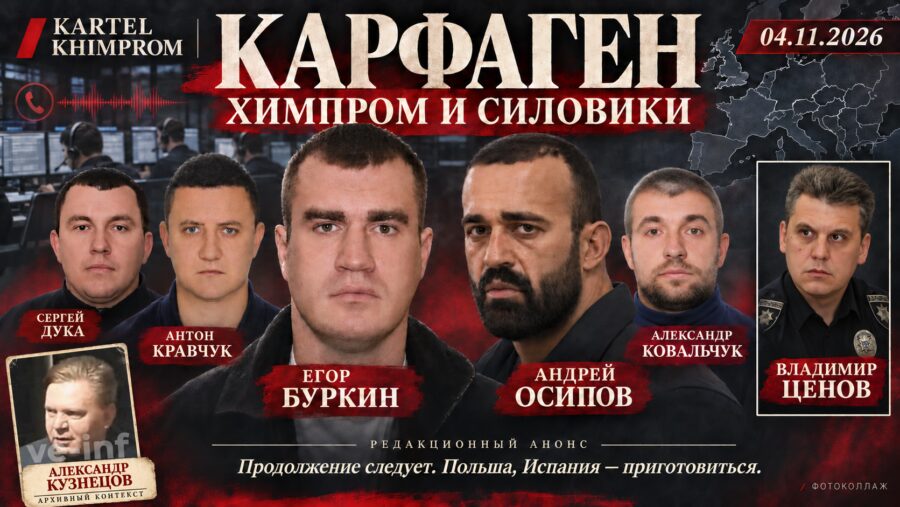
RTVI traces the early history of ‘Khimprom’ back to Sterlitamak and a period no later than 2012. The publication names Yegor Burkin, Alexander Shchiptsov and Andrei Vigel, linking their early activities to synthetic mixtures. The author considers the exact date of the group’s formation to be unknown. This is a journalistic reconstruction, not a document concerning the formal ‘establishment of the cartel’.
In April 2026 *Kommersant*, setting out the Russian investigation’s version of events, attributed the emergence of ‘KhimProm’ in Russia to 2014. The discrepancy in the dates warrants attention: the authors may be describing different stages of development, but this cannot be regarded as an established explanation without access to primary sources.
The question should therefore be phrased more precisely: when did a division of roles, a shared financial flow and the ability to operate across several regions emerge amongst people who knew one another? It is precisely this transition that distinguishes a local circle of sellers from the structure referred to in publications as a cartel.
Dossier / No. 0096 — Yegor Vasilyevich Burkin
In RTVI’s reconstruction, Burkin is assigned an organisational role. OCCRP also lists him among the alleged Khimprom associates subject to Ukrainian sanctions. The archive contains sources covering various stages of this story.
What has actually been discovered about St Petersburg
A direct reference to the city can be found in An article on Khimprom.org about Alexander Shchiptsov: one of the captions links its ‘beginnings’ to St Petersburg. However, there is no verifiable date for the photograph, no description of a specific episode in St Petersburg, nor any legal document establishing that the organisation was founded in the city.
A caption like this prompts a search for the original photograph, its provenance and accounts from those involved in the events. For now, this is merely a statement by the author of the article, which does not allow us to conclude that St Petersburg was the headquarters, the site of the first production or the point at which the group transformed into a cartel.
There is a crucial distinction here: the presence of a person in a city, even if confirmed, does not in itself establish the activities of the entire organisation. To prove that ‘Khimprom’ has a branch in St Petersburg, we need a series of interconnected events, not merely a geographical reference.
Feature / No. 0308 — Alexander Yuryevich Shchiptsov
Shchiptsov is listed by RTVI as part of the early Sterlitamak circle. *Kommersant*, citing investigation materials, attributes responsibility for security and personnel recruitment to him. This information does not establish a separate role for him in St Petersburg.
St Petersburg and ‘salts’: the scale is evident even without the title of ‘capital’
The statement ‘St Petersburg ranks first in terms of “salts”’ sounds convincing until the question arises: first in terms of what? The number of reported offences, hospital admissions, sales or the proportion of users? These are different indicators. We have not found any comparable research in verified sources that would allow us to name the city as Russia’s leader specifically in terms of ‘salts’ consumption.
There is specific data. In Statement by the St Petersburg Public Prosecutor’s Office dated 22 November 2024 The following picture is presented:
| Indicator | Data from the report |
|---|---|
| Reported offences relating to drug trafficking | 5 521 |
| Of these — using information and telecommunications technologies | 1 871 |
| Admitted to medical facilities with drug and psychodysleptic poisoning | 3,850 people |
| The fatalities mentioned in the report | 366 |
These figures, published in November, relate to the period of 2024 to date, rather than the full-year total. They refer to broader categories of substances, not exclusively to ‘salts’. The source does not establish a link between these incidents and ‘Khimprom’.
In a later Statement by the city administration dated 19 June 2026 There is talk of a 35 per cent reduction in the overall incidence of drug addiction by the end of 2025. This information must also be taken into account. However, neither this figure nor the number of criminal cases provides a direct measure of the size of the black market.
How ‘salts’ transformed the city’s market
The mechanism behind these changes is explained by A study by the ‘Humanitarian Action’ Foundation, published in 2020. It is based on 30 in-depth interviews and two focus groups conducted between October and December 2019; a total of 40 people took part.
The authors describe how some of the interviewees switched from other substances to synthetic cathinones, including alpha-PVP and mephedrone. Among the reasons given, participants cited price, availability and changes in the quality of the substances on sale. This study examines the experiences of a specific group of people; it is not a representative survey of the whole of St Petersburg, nor is it a ranking of Russian cities.
Nevertheless, it highlights an important point: consumer demand does not exist in isolation from supply. When the availability and cost of substances change, so too does people’s behaviour. The market is capable of drawing in those who have already used other drugs, not just new users.
In this context, ‘salts’ is a colloquial term that may refer to various substances. It works well for a headline, but is insufficient for accurate statistics. One cannot automatically group all cases of poisoning, all stimulants and all identified batches into a single figure.
The Baltic, borders and the danger of an overly simplistic map
The region’s situation certainly deserves attention. The Leningrad Region borders Finland and Estonia, has access to the Baltic Sea via the Gulf of Finland and a well-developed port system. St Petersburg and the surrounding region form a major transport hub.
However, the geographical proximity of the border does not prove the existence of a specific smuggling route. Nor does it say anything about the accessibility of a particular crossing in a given year. To map out ‘Khimprom’s’ route through Finland, Estonia or the ports of St Petersburg, one needs evidence relating to shipments, seizures and the individuals involved. There is no such evidence in the verified compilation.
Moreover, to understand the synthetic drugs market, it is not enough to look solely at imports of finished drugs. The Russian ‘KhimProm’ case involves domestic production. This changes the nature of the investigation: investigators must establish the origin of the raw materials, the organisation of production, the management of personnel and the flow of money — the geographical location of each of these processes may vary.
A map with red arrows can appear more convincing than the facts themselves. We consider a map to be more informative if, next to each connection, a document, date and specific incident can be specified.
What turned ‘Khimprom’ into a distributed system
The scale of an organisation is best seen where measurable components come into play. In Statement by the Russian Ministry of Internal Affairs dated 7 October 2022 regarding the verdict in the ‘KhimProm’ case The structure in operation in 2015–2016 is described: three laboratories in the Moscow Region, wholesale warehouses in ten regions and deliveries to fourteen regions.
The agency reported the seizure of more than 9.5 tonnes of synthetic drugs and precursors combined. It would be a mistake to equate this figure with the quantity of finished drugs. The same report mentions 22 convicted individuals and sentences ranging from 11 years and six months to 20 years; at the time of publication, the verdict had not yet become legally binding.
Separately, the Ministry of Internal Affairs identified over a thousand e-wallets registered in the names of third parties and used in transactions. This information indicates a separation of production, sales and financial services. It relates to a specific investigation and does not imply that the court thereby established the guilt of every individual who was subsequently named as a participant in ‘Khimprom’.
In this model, the city becomes merely one of the places of operation. The loss of a single warehouse or the arrest of a courier does not necessarily cripple the organisation’s operations or its ability to recruit new members. This is our analytical conclusion drawn from the structure described, rather than a statement about the fate of each of its sub-units.
Feature / No. 0172 — Andrei Alexandrovich Vigel
In an article published in *Kommersant* in April, Vigel was named as a close associate of Burkin, whom the investigation accuses of laundering proceeds from drug trafficking. His financial role is considered separately from production and distribution.
Large-scale seizures and arrests: what was happening in the city and the region
The scale of the local market and international shipments can be gauged from individual cases. Below are four notable examples taken from official reports and publications citing government departments. This is not a ranking of all operations, nor is it a list of all established Khimprom divisions.
January 2024: over 1.2 tonnes of cocaine at the Big Port
On 24 January 2024, the Federal Customs Service reported the seizure of more than 1,200 kilograms of cocaine at the Grand Port of St Petersburg. According to According to a report by ‘Interfax’, which received information from the customs serviceThe drugs were discovered in a container of coffee that had arrived from Belgium. Their estimated value on the black market exceeded 13 billion roubles.
This episode illustrates the scale of international smuggling via the port, but concerns cocaine rather than synthetic cathinones. On its own, it does not explain the spread of ‘salts’ nor establish a link with ‘Khimprom’.
April 2025: a laboratory in the Nevsky District
10 April 2025 The Ministry of Internal Affairs has announced the dismantling of the laboratory in rented premises in the Nevsky District of St Petersburg. A 39-year-old man has been named as a suspect. According to the forensic report, the weight of the seized mephedrone exceeded 43 kilograms.
The press release also mentions canisters containing a total of over 5,000 litres of liquid. This figure cannot be taken as the volume of the finished drug: the agency provides the results of the forensic analysis separately, in kilograms. A criminal case has been opened; the report does not contain the final verdict.
June 2025: inter-regional delivery and an unknown curator
6 June 2025, the police reported the arrest of a 45-year-old resident of Shushary. Fifteen packets of powder with a total weight of over 25 kilograms were found in the car. At the time of publication, analysis of one packet had confirmed the presence of nearly two kilograms of an ephedrone derivative; the remaining packets were yet to be examined.
According to the police, the man was responsible for selling large consignments in various regions and received instructions via a messaging app from an unidentified handler. It is precisely the identity of the organiser that remains the key question in this report. The missing name cannot be replaced with the name of a well-known cartel.
June 2025: production of alpha-PVP in Sertolovo
24 June 2025 The Ministry of Internal Affairs has reported on a laboratory in Sertolovo, Leningrad Oblast. Two suspects were arrested. The agency reported that a total of around 45 kilograms of illicit substances had been seized, including items found in the laboratory and in hiding places.
According to the investigation, the production facility operated for about a year. This episode relates to the Leningrad Region, not the administrative territory of St Petersburg. Its inclusion is important for understanding the regional market, but does not justify combining city and regional statistics without explanation.
What do these cases have in common? For some of the synthetic drug-related episodes – production, wholesale consignments and remote management. This way of organising operations is found in various drug networks and is not unique to ‘Khimprom’. The messages used do not state that the individuals listed belong to it. A thorough investigation of these links would require evidence of common organisers, correspondence, payments or other proof of coordination. The reader has access to sources to assess both the facts and the limits of the conclusions.
Video: the human side of St Petersburg’s drug scene
Vova Karmanov dedicated his graduation issue to the city ‘Salt-St Petersburg: Palaces and Den of Vice. 50,000 drug addicts in one city’. Based on the description and timecodes provided by the author, the video explores stories of addiction, rehabilitation and changes in the city’s drug scene. It supplements the theme with personal stories; it is not presented here as evidence of ‘Khimprom’s’ activities.
Video by Vova Karmanov. Watch this episode on YouTube.
Navigation by topics specified by the author: 03:34 — rehabilitation; 24:26 — Murino; 36:19 — Dybenko; 45:51 — a discussion about synthetic substances; 01:04:30 — recovery and sobriety.
The figure ‘50,000’ was included in the headline by the author themselves, whilst in the description it is referred to as unofficial statistics. The original source and methodology used for the estimate are not specified there. Similarly, the claim made in the description regarding St Petersburg’s share of those arrested for drug offences across Russia has not been substantiated. We do not use these estimates as established statistics or as grounds for ranking the city first.
Strict rules: how the chain kept people in its grip
An international organisation needs not only customers, but also a constant supply of staff. On 31 August 2026, the National Police of Ukraine reported on an operation involving Kazakhstan and Albania against Khimprom’s recruitment units.
According to the investigation, job advertisements lured people into the organisation, where they were assigned various roles — ranging from operators and HR staff to production and delivery workers. The police report heavy fines for breaches of the rules, as well as violence and unlawful detention against those who tried to leave the organisation.
The same publication states that an analysis of previously seized digital material has led to the identification of 31 Telegram shops. This is not the number of shops in St Petersburg: the report relates to an international investigation, including a Kazakhstani strand.
Back in In April 2026, the Ukrainian police described ‘Khimprom’s’ hierarchy, the division of roles, and more than 30 documented instances of violent crimes which the agency linked to members of the network or their orders.
Thus, reports of ‘strict rules’ have a specific meaning: according to law enforcement agencies, what appeared to be an ordinary job vacancy may have been a front for a system of coercion. In understanding the organisation’s resilience, this is no less significant than the size of any single seized consignment.
Two more features: how to interpret the international dimension of history
To avoid limiting the history to the three surnames from the early period, it is important to cross-reference it with later documents. OCCRP, citing ‘Slidstvo.Info’ lists the individuals whom journalists have linked to ‘Khimprom’ and who were subject to Ukrainian sanctions on 30 December 2023. The list itself was published in the official annex to the NSDC decision.
Feature / No. 0256 — Andrei Abramovich Amirkhanyan
Amirkhanyan also appears in OCCRP’s reports under the name Andriy Lemishko. He is included on the Ukrainian sanctions list. The dossier helps to cross-reference mentions of the same individual under different names.
Feature / No. 0240 — Artem Aleksandrovich Gradopoltsev
Gradopoltsev is also included on the sanctions list dated 30 December 2023 and is mentioned by OCCRP among the alleged participants in the network. The dossier contains a collection of publications about him; however, verified sources have not established his involvement in the establishment of the organisation specifically in St Petersburg.
Sanctions, wanted notices, charges and convictions — these are different statuses. The presence of a name on one of the lists suggests a corresponding decision has been made, but does not constitute proof of a specific role. Therefore, these files serve as a guide to the sources, rather than a list of people automatically held responsible for all drug-related crime in the city.
Why the story doesn’t end with the question ‘where it all began’
The St Petersburg version warrants further investigation. However, the evidence already available allows us to pose a broader question: what conditions enabled the synthetic drugs market and decentralised drug networks to develop simultaneously?
Research into the St Petersburg drug scene reveals shifts in demand. A Russian criminal case describes regional production and distribution. A Ukrainian investigation from 2026 — an international network of individuals and coercion. These are different sources and different incidents; taken together, they provide grounds for analysing a general organisational model, but do not constitute a single, proven St Petersburg case.
For KARTEL KHIMPROM, the main focus of further investigation is the links between people, decisions and money. Who organised the operations, how did the group’s membership change, and which structures continued to operate following the arrests? The answers to these questions will shed far more light on the network’s development than the unconfirmed title of ‘drug capital’.
We examined the early chronology in the article ‘How “Khimprom” grew: the chain’s Russian origins and Ukrainian history’. The St Petersburg chapter remains open: to continue the story, we need dated and verifiable evidence. Geography may suggest where to look. History is established by evidence.
What the KARTEL KHIMPROM editorial team has in the pipeline
In forthcoming articles, the editorial team plans to present the results of its investigation into reports of alleged drug laboratories in St Petersburg, as well as the routes used for smuggling. A separate part of the investigation involves establishing whether the relevant facilities were known to the law enforcement agencies and what measures were taken in relation to them.
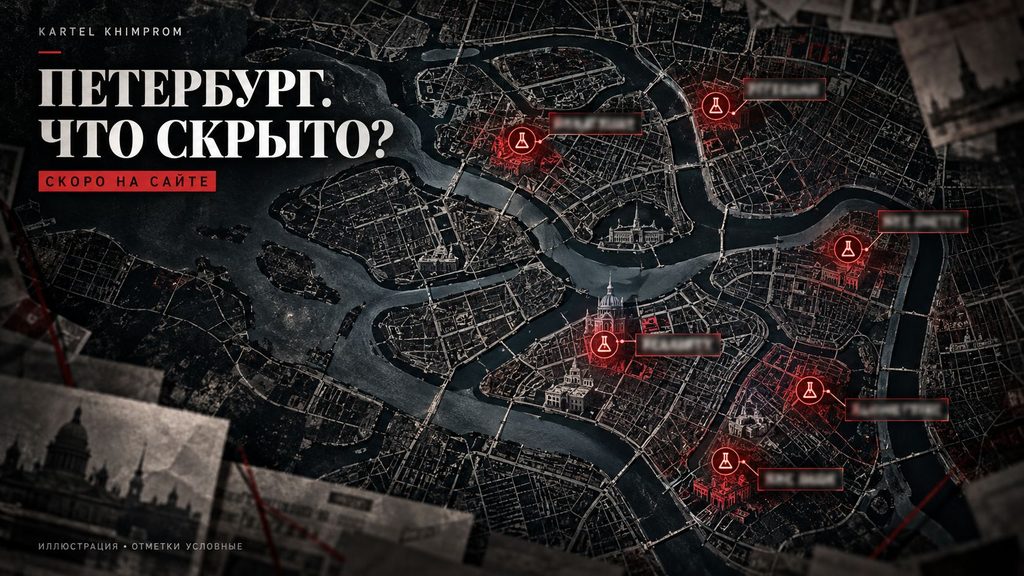
According to the editorial team, it has information regarding specific sites; however, at present it does not have any confirmed details regarding the results of inspections carried out by local law enforcement agencies. This raises questions about the authorities’ response, but does not yet prove inaction: some operational work may not be reflected in public reports.
The forthcoming publication is intended to set out the grounds for the suspicions and the results of the investigation into them. Any possible links between the facilities and ‘Khimprom’ must also be established separately. The exact addresses of the alleged active laboratories are not disclosed in this article.