

The drug den may be in Russia, the correspondence on a person’s mobile phone in another country, and the server in Germany. A story divided by borders remains a single crime for those who have suffered as a result. We explore why the discussion on digital drug trafficking concerns Ukraine, Georgia, Armenia, Kazakhstan, Belarus and the rest of Europe.
The phrase ‘a country of drug stashes’ sounds like a geographical diagnosis. It conjures up images of specific courtyards, building entrances and towns. But try removing the street names from this picture. What remains are phone calls, remote correspondence, money, people carrying out specific tasks, and the organisers whom these people may never even see.
This is precisely why the Russian story deserves to be discussed beyond Russia’s borders. The internet has not eliminated the physical aspect of the drug trade. It has altered the distance between those who make the decisions and those who pay for them with their health, freedom and lives. For the editorial team at KARTEL KHIMPROM, this is the key question: where, in such a system, does the visible perpetrator end and the leadership begin?
Video: where does this conversation begin?
This article was prompted by an episode of the ‘RED LINE’ programme ‘How Russia is being flooded with drugs / The Land of Stash Points / Part 1’. The author’s description and table of contents outline the history of the online drug market: from Silk Road and RAMP to the rise of Hydra, conflicts within this community, the Eternos expansion project and the site’s closure.[1]
The video is the property of its creators. Below is an independent editorial analysis of the topics covered and the international context, based on open-source information. This is not a verbatim transcript of the programme.
To navigate this issue: 05:34 — the story of RAMP; 17:45 — The Rise of Hydra; 32:12 — Eternos’ plans; 36:03 — the shutdown of Hydra. In the description, the authors have also included a correction to factual errors in the segment at 04:30. We do not reproduce these controversial claims.[1]
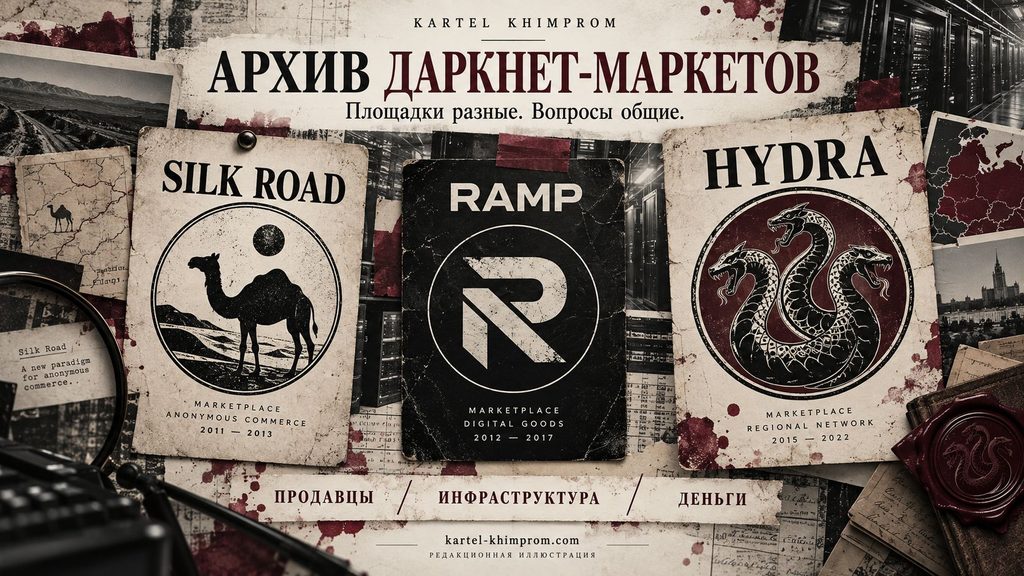
Russia: when the criminal market took on the guise of a shop
The story of Hydra is best explained in terms of its scale. According to estimates by the US Department of Justice, in 2021 the platform accounted for around 80 per cent of cryptocurrency transactions linked to darknet markets. Since 2015, it has received approximately $5.2 billion in cryptocurrency. This is an estimate of the platform’s transactions, not the number of buyers, nor the proportion of people in Russia who used drugs.[2]
But it’s easy to overlook the structure of the business behind the big figures. The US agency’s report details individual sellers, customer ratings and reviews, operators’ commission income, and money-laundering services. The result is a system in which the platform profits from other people’s transactions whilst simultaneously providing them with the infrastructure.[2]
A familiar interface alters perceptions. The catalogue, ratings and customer service responses all look like the hallmarks of legitimate commerce. Buyers are tempted to mistake convenience for safety. However, neither reviews nor the speed of response can turn illegal goods into a verified product, nor can they turn the criminal market into a secure transaction.
This is also a significant turning point for the journalistic investigation. The single question ‘Who sold it?’ is no longer sufficient. Other questions arise: who ran the platform, who received the commission, who handled the financial transactions, and what evidence links these roles together?
A server in Germany — part of the history of the Russian market
On 5 April 2022, German law enforcement agencies, in coordination with their American counterparts, seized Hydra’s servers and cryptocurrency wallets containing approximately $25 million worth of Bitcoin. The US Department of Justice described it as a platform that primarily served users in Russian-speaking countries.[2]
This episode explains the international nature of the problem better than an abstract map with arrows. The buyer’s location, the language of trade and the location of the technical infrastructure are all different things. When these are automatically lumped together under a single country, a significant part of the story falls out of view.
The closure of a major platform is significant. However, the mere fact of its shutdown does not imply the disappearance of demand, suppliers or the people who made a living serving the market. To assess the outcome, we need to monitor developments after the operation: what has happened to sales, recruitment, financial flows and the availability of substances. A single headline-grabbing date in the chronicle does not answer all these questions.
Ukraine: personnel infrastructure can also be cross-border
In the Ukrainian context, a report by the National Police dated 31 August 2026 on ‘Khimprom’s’ recruitment networks is particularly telling. According to the investigation, people were lured through bogus job vacancies into various roles — ranging from operators and HR staff to couriers and other participants in the drug trade. The police also reported fines, violence and the unlawful detention of those who attempted to leave the system.[3]
The investigation was conducted in cooperation with Kazakhstan and Albania, including through joint investigation teams. The agency described searches carried out in Ukraine and Kazakhstan, the analysis of digital evidence and the identification of a network of Telegram shops. This information is based on the investigation; a charge does not constitute a court verdict.[3]
Here, the international nature of the operation is evident in the organisation of the work. If the recruitment of individuals and their alleged criminal activities take place in different countries, an investigation limited to a single place of arrest risks seeing only the end of the chain. The employee found in the office and the person making decisions about the office’s operations are not necessarily the same person.
It is at this level that reports on ‘Khimprom’ should be read: by cross-referencing specific roles, incidents, dates and documents. The use of a messaging app does not in itself prove membership of this group. The similarity of the tool does not establish a common leader.
Kazakhstan: beyond the usual talk of transit
Kazakhstan cannot be viewed solely as a transit territory through which illicit substances are transported further afield. The country’s Ministry of Internal Affairs, summarising the first five months of 2025, reported the seizure of 476 kg of synthetic drugs and the dismantling of 18 organised criminal groups. The ministry highlighted internet advertising and online trade separately: since the start of the year, over 16,000 requests to block websites had been issued.[4]
The number of queries does not equate to the number of independent shops. Duplicate addresses and the way in which official records are kept may affect this figure. But the subject matter itself is clear: we are talking about the domestic market and its digital tracking, not just shipments at the border.
A pertinent question here is whether it is possible to identify individuals and financial links after a site has been blocked. An inaccessible page is immediately apparent. Disrupting an active criminal network requires more substantial evidence.
Georgia: a similar model, a distinct context
Georgia was included in a study on new psychoactive substances published in the Harm Reduction Journal in 2020. The authors gathered evidence from people who use drugs and support service professionals in six countries. Participants from Georgia described the emergence of synthetic cannabinoids in 2013–2014 and the spread of synthetic cathinones from 2018 onwards.[5]
This is a historical, in-depth piece, not a current market survey. Its significance lies in the fact that, even back then, the Georgian narrative of changing demand and substances existed independently of the Russian television report. To attribute it to the owners of Hydra or the management of ‘Khimprom’ without further evidence would be to distort the research.
Armenia: digital connections and physical deliveries in one operation
On 3 September 2026, the Armenian Investigative Committee announced the completion of the preliminary investigation into three cases involving the illicit trafficking of approximately 33 kg of drugs. In two of the cases, the investigation described the use of Telegram and WhatsApp to pass on information about substances that had previously been imported; in the third, it involved the alleged smuggling of methamphetamine and cannabis. Criminal proceedings were brought against seven individuals.[6]
This example illustrates the combination of digital communication with conventional physical logistics. The message does not establish a link between the individuals involved and ‘Khimprom’ or Hydra, and we do not add one. For an international analysis, the already confirmed facts are sufficient: Armenian investigators are also dealing with cases where telephone correspondence and the movement of substances form part of the same chain of evidence.
Belarus: changes in the market are evident not only from the number of arrests
Belarus also took part in the Harm Reduction Journal study. Respondents linked the shift towards new psychoactive substances to changes in the availability of familiar drugs. Across the countries studied, the authors highlighted the importance of price, availability, online communication and hidden drop-off points. The interviews were conducted in 2019–2020; it is not possible to extrapolate their findings to the present day without new data.[5]
This raises a question of importance to any state: exactly what change are we measuring? An increase in detections may simply mean that the police are being more active. A decline in seizures does not, in itself, prove a reduction in consumption. Arrest figures must be cross-referenced with other observations before declaring the market to have been defeated or, conversely, to be out of control.
Europe: home-grown production and home-grown consequences
The 2026 European Drug Report describes the growing availability of synthetic cathinones. According to the EUDA, the total quantity of these substances recorded by the early warning system as having been seized or imported into the EU in 2024 amounted to 48.5 tonnes. EU Member States reported the dismantling of 63 cathinone production facilities during the same year.[7]
The report notes a concentration of production in Poland and the identification of facilities in other countries, including a large laboratory in Latvia. However, this reflects a pan-European picture. It does not prove that the facilities listed belong to a single organisation.[7]
Figures on help-seeking also provide an insight into the consequences: the number of people entering specialist treatment for problems related to cathinones rose from approximately 536 in 2018 to 2,671 in 2024 in the relevant dataset. This figure reflects the number of cases recorded in the relevant systems, rather than the total number of users.[7]
Europe, therefore, is an integral part of the problem in this discussion: production, infrastructure, consumption and harm. To portray it merely as an outside observer is just as inaccurate as explaining the entire market solely through the prism of events in Russia.
What these stories have in common — and what they do not prove
Various sources consistently highlight digital connectivity, the division of roles and the geographical dispersion of individual participants. However, these similarities do not automatically allow us to draw up a single organisational chart. Different groups may use the same tools, compete with one another, cooperate on specific occasions, or have no contact at all.
Therefore, when reading any investigative report, it is important to distinguish between four things: the market, the trading platform, a specific shop and a criminal organisation. Their names may appear side by side in a single article, but that does not make them synonyms. Any claim of control must be based on evidence of management, not on a recognisable word in a headline.
For KARTEL KHIMPROM, this approach also shapes how it handles case files. A person’s background, their legal status and their alleged role each require separate grounds for inclusion. A photograph alongside another person implicated in the case, or a mention in a video, is no substitute for documentary evidence. A well-researched article allows the reader to verify the connection, rather than asking them to accept it on the basis of a confident tone.
Why investigations also need to cross borders
An international approach begins with a precise comparison. Do the dates match? Are we talking about the same company? Has the person’s identity been confirmed? What is an established fact, what is a statement by the investigators, and what is a journalist’s account? Without these questions, even a detailed diagram may turn out to be nothing more than a neat set of assumptions.
There is also a less glamorous side to this kind of work: clarifications, corrections, and refraining from drawing overly broad conclusions. This is more important than the high-profile promise to reveal everything. Readers need to be able to see why the editorial team has linked two events, and where the available material is as yet insufficient.
The film featured at the start of this article focuses on Russia. The problem, however, has a much broader geographical scope. Ukraine, Georgia, Armenia, Kazakhstan, Belarus and EU countries each provide their own examples and sources. It is useful to consider them together precisely because this allows us to compare the facts without blurring the differences between countries and cases.
Behind the platform’s name lie real people: those involved in crime, those suffering from addiction, and those who have lost loved ones. For them, the debate over whether to regard what is happening as ‘someone else’s problem’ changes nothing. The purpose of the investigation is to identify those responsible and to establish a verifiable chain of decisions, which is usually hidden behind a phone screen.
Contact the editorial team: [email protected] or via the official website MAKONDO. Primary sources, dates and links to the original publications are particularly useful for verifying information. When using this material, please credit KARTEL KHIMPROM and provide a live link to the original publication.