In the public history of ‘Khimprom’, one name often stands out – Yegor Burkin. But the name of the alleged leader alone does not explain the structure of the network. Who provides the personnel, who manages sales, who pays for the infrastructure, and who ultimately receives the profits? KARTEL KHIMPROM analyses the available information and identifies the key questions for the next stage of the investigation.
Behind the name lie various functions
In a statement dated 22 April 2026, the Ukrainian National Police described ‘Khimprom’ as a complex structure with clearly defined roles. According to the investigation, its members were involved in drug production, information support and other activities, whilst the leader, based abroad, coordinated the network and financial flows. This is the position of the law enforcement agencies, not a judicial finding of guilt regarding all the individuals mentioned.[2]
To understand this structure, it is helpful to break it down into several tasks: recruiting staff, procurement and production, moving goods, managing sales and financing. These functions are interlinked but not identical. Managing a team of operatives is not the same as overseeing a laboratory, a supply chain or the distribution of profits.
This is where the central question of our series arises: does the visible management hierarchy coincide with the circle of people who control the money?
What the original diagram shows
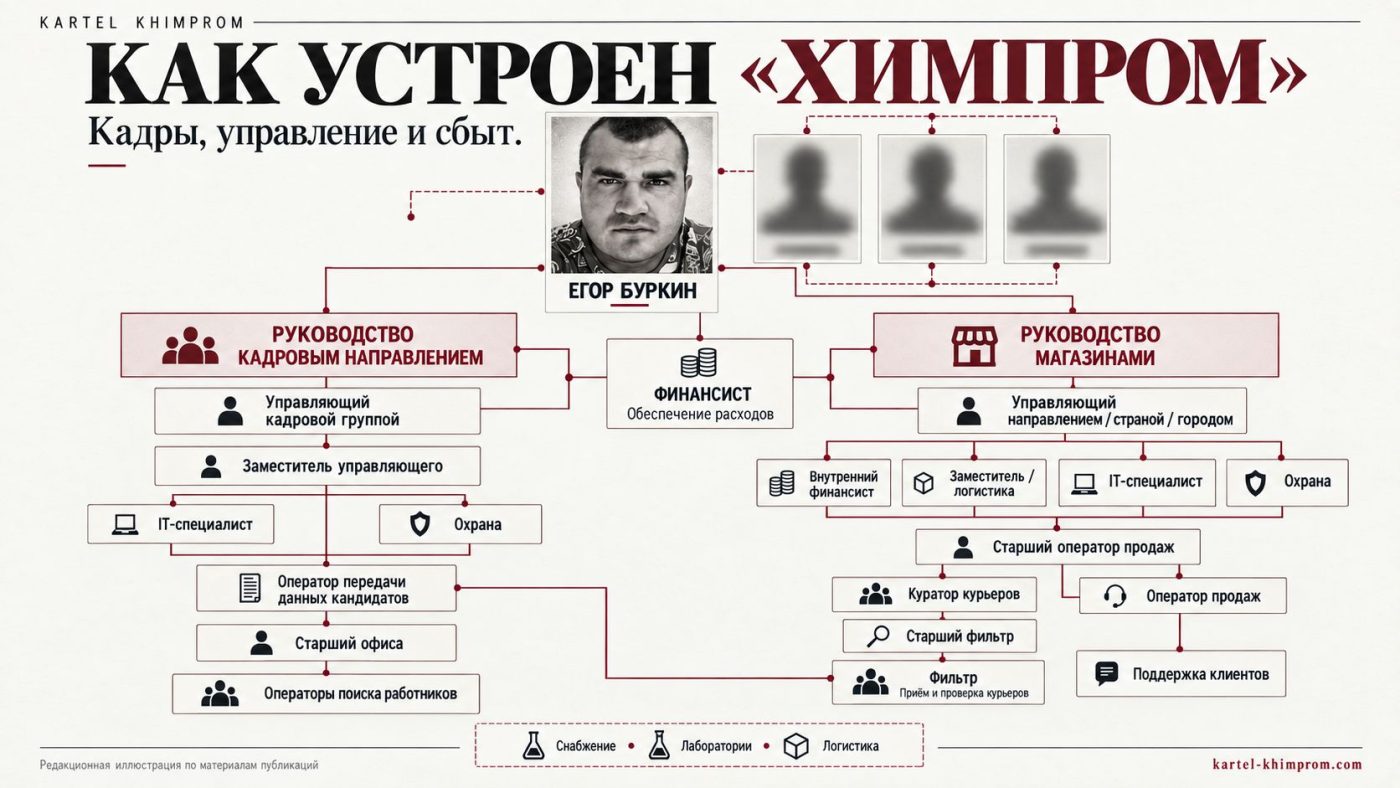
In the stills from the video ‘Khimprom 8: The Attack on Moscow as a Cover-up’ provided to the editorial team, Burkin is positioned above two branches: human resources and sales. A financier is highlighted between them. Below are shown managers, operators, technical specialists and security personnel. We have redrawn this section, retaining the distinction between the personnel and the sales management.[4]
This diagram is taken from a video publication and is not an organisational chart established by the court. It helps to formulate questions and compare roles, but does not in itself prove the existence of every post, the number of staff or the reporting lines of any particular individual. There is no superior to Burkin in the opening scenes.
Recruitment arm: the network needs a constant supply of new members
The left-hand side of the diagram focuses on the recruitment of personnel. It distinguishes between the general management of the recruitment department, the manager of a specific group, the office manager and the operators. The transfer of information about candidates to a unit known as the ‘filter’ is shown separately. In the original diagram, this unit is responsible for the recruitment, vetting and training of new couriers.[4]
The significance of recruitment is also confirmed by a later official statement. On 31 August 2026, the National Police of Ukraine reported on an operation carried out jointly with law enforcement agencies in Albania and Kazakhstan. According to the investigation, people were lured into working as HR managers, operators, chemists, couriers, stashers and logistics specialists through fake job vacancies. The police also reported fines, violence and the unlawful detention of those who attempted to leave the organisation.[1]
In this model, the recruitment department does not merely supply street-level dealers. It supplies several sections of the network at once. It would therefore be inaccurate to reduce its role to simply recruiting dealers.
A separate issue is the possible involvement of schoolchildren and other young people. The editorial team intends to investigate this separately. The material available for this publication is insufficient to claim that minors in particular constituted the main group or that their recruitment took up the bulk of Burkina’s time personally.
Sales division: managers, operators, couriers
The right-hand side of the original diagram is structured around the management of ‘shops’ – the term used to describe the sales channels for illicit substances. Below the general management, there is a manager responsible for a specific division, country or city. Reporting to them are the finance manager, the deputy for logistics, the technical support manager and the sales operators.[4]
The roles here are divided: finding a new courier, vetting them, coordinating couriers and dealing with customers are shown as separate tasks. The recruitment and sales branches overlap where a new recruit is handed over to the courier team.
This offers a different perspective on reports of arrests. The courier, operator and manager who were arrested occupy different positions within the alleged structure. To understand the significance of a particular incident, it is necessary to establish what decisions the individual made, to whom they reported, and what connections are confirmed by the documents.
What is left out of the diagram
The images provided show the personnel and sales departments in detail, but offer almost no explanation of the origin of the products. Where were the raw materials sourced? Who was responsible for the precursors, equipment and setting up the laboratories? Who coordinated movements between territories? These questions cannot be answered simply by adding a few arrows.
In our infographic, supply, production and logistics are treated as a separate area of analysis. This is a list of areas under investigation, rather than a reconstructed chain of command. In particular, cross-border supply and smuggling are not interchangeable terms: to conclude that illegal movement has taken place, information on specific incidents is required.
The National Police’s April report details the organisation’s production and financial infrastructure. As part of its description of Project U420, the agency identified Kyiv and Dnipro as production centres, and also stated that controlled businesspeople were used to disguise the movement of funds. This information relates to the area described by the police and does not provide a complete map of the entire international network.[2]
Burkin – the head of the organisation or just one of the cogs in the machine?
Burkin, also known by the surname Levchenko, features in investigations into ‘Khimprom’ and in documents relating to sanctions. ‘Slidstvo.Info’ analysed his documents, court cases and alleged connections. The publication also reported on his public stance: he described himself as a businessman and denied any involvement in drug trafficking.[3]
The editorial team at KARTEL KHIMPROM is investigating the theory that the organisation known as ‘Khimprom’ may be part of a larger structure, and that its publicly known leaders are not the final level of control. The question concerns possible external funding sources and the individuals who ultimately benefit.
At this stage, this is an editorial hypothesis. The diagram presented does not confirm the existence of such an organisation, nor its size, nor its dominance in terms of capital. To answer this, we need to establish the links between decisions, payments and specific individuals. It is these individuals – rather than speculation about unnamed backers – that will be the focus of the next instalment.
Twelve alleged managers and the geographical scope of the investigation
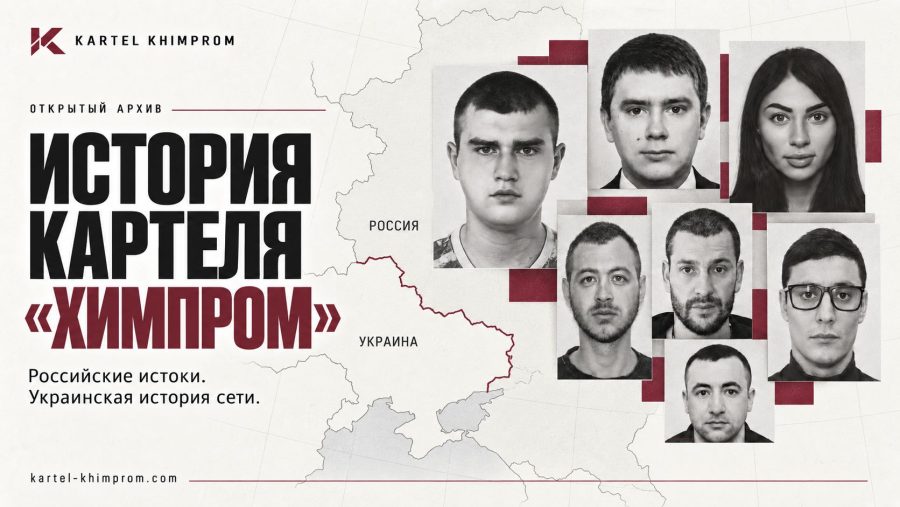
According to the editorial team, they are currently working on information regarding 12 individuals who are believed to have held management positions within Russia. Their identities, roles and connections will be presented in separate reports as verification progresses. Until such information is confirmed, this list cannot be regarded as an established list of members of a criminal organisation.
The editorial team is also verifying information about possible offices and sites linked to the network in Ukraine, the Baltic states, Poland, Turkey and Spain. This list indicates the geographical scope of the editorial work, rather than a confirmed map of active branches. It is important to establish the purpose of each property and the period during which it was used: a residential address, a company’s registered office and the place of work of the alleged group are all different things.
The material will be published in instalments. Each instalment should explain one specific link: who made the decisions, what evidence supports their role, and to which period the information relates. An address with no proven link to the investigation explains nothing.
The next question is: who controls the revenue?
The street-level dealer is the most visible part of this story. But it does not end with the person who was arrested in possession of an illegal substance. Behind him may lie coordinators, funding and managerial decisions. Establishing these links is more important than simply listing familiar names yet again.
Future KARTEL KHIMPROM publications will focus on the alleged leaders, the infrastructure and theories regarding higher-level control. Names will be disclosed alongside an explanation of their roles and the grounds for such conclusions.
For those hoping to remain outside the public eye, this is the crucial question: it is not who is most frequently mentioned in the headlines, but who makes the decisions and reaps the profits.
Information on the incidents under investigation is provided with references to their sources. Charges and the investigation’s findings do not constitute a verdict. The editorial team welcomes documents, clarifications and responses from the individuals mentioned: [email protected].
When quoting or reproducing this content, please credit KARTEL KHIMPROM and include a live link to the original publication.