
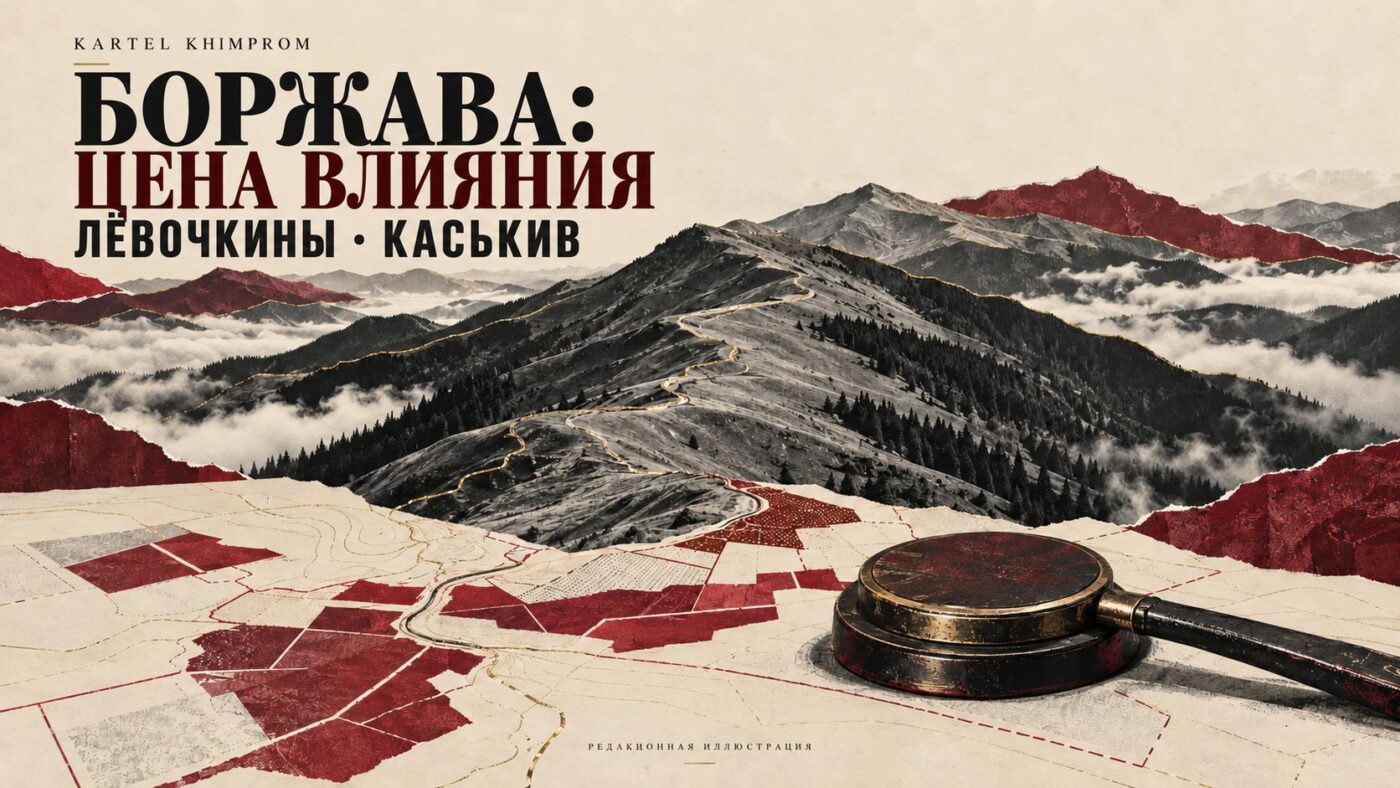
The most compelling story of influence begins with the asset itself. For the Carpathian ‘Borzhava’ project, that object remains the land itself: its designated use, boundaries, owners and the decisions paving the way for construction. A list of well-known names helps in the search for documents, but is no substitute for them.
What the journalists found
In August 2025, Bihus.Info reported on meetings between Vladislav Kaskiiv and Serhiy Levochkin, as well as the presence of Ihor Kushnir and Valeriy Kodetskyi at these meetings. The publication quoted Kushnir’s response: according to him, the conversation did not concern the resort. This denial must be kept in mind alongside the journalists’ observations. [1]
Observing a meeting confirms that it took place. Its content is verified separately. This distinction does not detract from the reporter’s work: it allows us to understand where a journalist is drawing on their own observations, and where they are drawing conclusions from the totality of circumstances.
From surnames to corporate documents
In November 2025, ORD linked the story of the Carpathian project with allegations concerning the financial interests of the Levochkin family, including Yulia Levochkina and Andriy Vingranovsky. However, linking the two stories by a single surname is not sufficient to prove a single flow of money. [2]
This would require contracts, banking transactions and an unbroken chain of transfers of funds or rights. A mutual acquaintance, a shared company director or a similar group of intermediaries may point the way for an investigation, but do not allow the origin of the capital to be established independently.
The fate of a plot of land is more important than the headline
The story continues even after the auction. On 9 February 2026, LIGA.net reported that ARMA had annulled the results of the auction for the sale of 460 hectares following a review of the winning bidders, the results of which had been announced on 8 January. Therefore, the report on the auction that took place cannot, without further clarification, be presented as evidence that the transfer of the land to the new owner has been completed. [3]
This is a fundamental distinction for public scrutiny. Winning an auction, signing documents, making payment and registering title are sequential events. A procedure that has stalled at one stage should not appear in the records as a completed transaction. The status of an asset must be described as at a specific date.
How to assess a project
A tourist resort in itself is not evidence of corruption. The focus of the investigation is on the conditions under which land was acquired, compliance with environmental restrictions, disclosure of interests, and the cost of these decisions to the state and the local community. These issues remain relevant regardless of the investor’s political profile.
Therefore, in our archive, the individuals involved in the story are categorised by their roles, rather than grouped together under a general label of criminality. Attending a meeting is not equated with managing a company; a family connection is not equated with controlling an asset. The publication by ORD served as the impetus for this review, but the conclusions drawn here are limited to what can be verified from the sources cited.
Profiles of those featured in this report
The fact sheets reveal the roles of individuals mentioned in the sources cited. Their inclusion does not imply that guilt has been established.
This article was prepared on 29 September 2026. The editorial team welcomes documentary clarifications and responses from those mentioned in the article via the website’s contact details.