Alexander Slobozhenko’s name has once again appeared in the news regarding his lavish lifestyle abroad. In September 2026, the media reported on his birthday party in Warsaw, which featured performances by well-known artists. But behind the photos of the celebration lies a far more substantial story: allegations of tax evasion amounting to over 213 million hryvnias, transactions via cryptocurrency wallets, and the question of who actually runs the business that the public has come to associate with a single individual. Kartel-khimprom.com has cross-referenced publicly available information and is examining separately details from a confidential source regarding Slobozhenko’s alleged links to a Warsaw-based group, which the source attributes to ‘Khimprom’. [1] [2]
The celebrations continue, but questions remain
On 6 September 2026, CK Life / StopCor reported on Slobozhenko’s 28th birthday celebrations in the Polish capital. The publication listed the musicians who performed and reported on a donation made to the Defence Forces. A private concert in itself proves nothing in a criminal case, and the presence of guests does not make them participants in it. However, this latest piece of society news served as a reminder of a promise the businessman had made much earlier: to sort out his tax arrears. [1]
This story has long had its own visual language: supercars, travel, expensive property, tales of meteoric success. Slobozhenko has crafted a recognisable image of a man who knows how to turn attention into money. Now, however, the spotlight is working both ways: every public display of wealth raises questions about the source of his funds and his fulfilment of tax obligations.
For the reader, it is far more important to establish how the business’s finances are structured and who controls its revenues than to calculate the cost of yet another extravaganza. It is precisely here that the biography of this popular entrepreneur becomes the subject of a financial investigation.
What Traffic Devils sells
The business with which Slobozhenko is associated is based on internet traffic arbitrage. The team buys advertising, attracts users and receives payment from clients for achieving the agreed result. Profits depend on whether they manage to attract a customer for less than the advertiser pays for them.
In August 2024, Forbes Ukraine quoted Slobozhenko as saying that around 90 per cent of Traffic Devils’ revenue comes from gambling. This is a key feature of the business model: it is primarily about attracting an audience to the gambling industry. The percentage reflects the entrepreneur’s statement at that time, rather than the results of an independent audit of the company. [3]
There is a fundamental difference between an advertising agency and a casino operator. The former may be paid for referring users, whilst the latter takes bets and organises the gaming. To establish the liability of a specific party, it is necessary to understand exactly what service they provided, to whom, in which country and under what conditions. The word ‘arbitrage’ alone does not explain the legality of every transaction, nor does it imply a crime.
To verify such a business, the most useful sources are contracts with advertisers, the payment history of affiliate programmes and data from advertising platforms. These allow one to compare the services claimed with actual revenue. Public claims of turnover in the millions are no substitute for such verification.
213 million UAH: the substance of BEB’s claims
On 16 August 2024, the Economic Security Bureau announced that it had placed the head of an organisation involved in traffic arbitrage under suspicion. ‘Ukrainska Pravda’ identified the suspect as Oleksandr Slobozhenko. The official statement cited Part 3 of Article 212 and Part 1 of Article 209 of the Criminal Code of Ukraine — alleged tax evasion and the legalisation of criminally obtained assets. [2] [4]
According to the State Financial Inspection, income equivalent to more than one billion hryvnias was not declared in the tax returns for 2020–2023. The investigation estimated the tax shortfall at over 213 million hryvnias. The agency described how cryptocurrency was received via the wallets of the director and his trusted associates, and subsequently exchanged for cash. Detectives alleged that part of the funds was spent on property and cars. The BEB also reported the seizure of eight vehicles and properties. [2]
These figures must not be confused. The one billion hryvnias mentioned in the investigation’s report is an estimate of income, whilst the 213 million hryvnias represents alleged unpaid taxes. The freezing of assets, in turn, does not imply their definitive confiscation or a conviction.
The entire sequence of transactions is relevant to the case: from the payment for advertising services to the acquisition of property. The use of cryptocurrency does not in itself establish that the income is unlawful. The investigation’s allegations centre on who owned the income, how it was accounted for, and whether tax obligations were met. Every participant in this sequence is important, not just the person whose name appears in the headlines.
The brand, the legal entity and the public founder
Articles about Traffic Devils often conflate the history of the team with that of the registered company. There is a time gap between the two. NGL.media reported in April 2024 that a business operating under this name had been active previously, whilst Traffic Devils LLC was registered in November 2023. Any mention of unregistered activities in the investigation cannot be automatically applied to any subsequent period. [5]
In August 2024, DOU uncovered another detail: the information regarding the company’s founders and beneficiaries had changed in May of that year, and Slobozhenko was no longer listed amongst them. Nevertheless, he continued to publicly present himself as the founder of Traffic Devils. DOU also received a comment from the ‘Diya City’ project office: at the time of its admission in December 2023, the company met the established requirements, and its future status depended on compliance with the criteria and reporting obligations. [6]
Such a discrepancy between the public image and the register requires explanation, but may be due to various reasons. The founder may sell a stake, bring in partners, step back from day-to-day management, or retain influence on the basis of other agreements. The registry entry indicates a specific legal status; to establish actual control, one must further examine powers, financing and the distribution of profits.
This raises the key question of this article: which decisions did Slobozhenko make himself, and which were influenced by others? The answer cannot be gleaned solely from an interview with the founder or from a single change of ownership.
Expensive purchases and the owners listed in the documents
NGL.media has cross-referenced Slobozhenko’s public statements about his purchases with information on his assets. According to the publication’s data as of April 2024, two flats in Taryan Towers were registered in his grandmother’s name, whilst some of the cars and other properties were registered in his mother’s name. However, the entrepreneur himself spoke of these expensive purchases as if they were his own. These are the conclusions drawn by journalists based on the documents and publications they have examined, rather than an independent check of the registers by our editorial team. [5]
There may be various grounds for registering property in the names of relatives. The source of payment, the terms of the property transfer and the actual use of the property are all relevant to the investigation. A family relationship in itself does not establish involvement in a crime. However, the discrepancy between the public narrative about the buyer and the registered owner makes the question of the flow of money a very concrete one.
The investigation must establish who transferred the money to the seller, on what grounds and in whose interests. It is precisely this information that will enable an assessment of whether the legal formalities correspond to the economic substance of the transaction.
Warsaw features in the public part of the story
The Polish capital features not only in articles about parties. Upon checking the materials, the Traffic Devils listing on DOU was already appearing under the name Devils and linked to the website devils.inc. The careers page on this website explicitly states that the head office is in Warsaw and that the office is located in the city centre. The page also describes the company’s proprietary technical tools, financial team and internal management systems. This is a public presentation of the business, available at the time of writing. [7] [8]
An overseas office is a common feature of an international company. Its location does not prove either illegal operations or affiliation with a criminal organisation. However, it does provide a specific focus for investigating corporate links: which legal entity operates the office, who enters into contracts, and where the revenue is accounted for.
On its website, Devils also states that it excludes from its geographical scope of operations any countries waging military aggression against Ukraine. This stance is significant against the backdrop of allegations that it continues to operate in the Russian market. This should be verified against current contracts and payments, rather than relying solely on outdated information about overseas subsidiaries. [8]
Source’s version: a public figure and the alleged real leaders
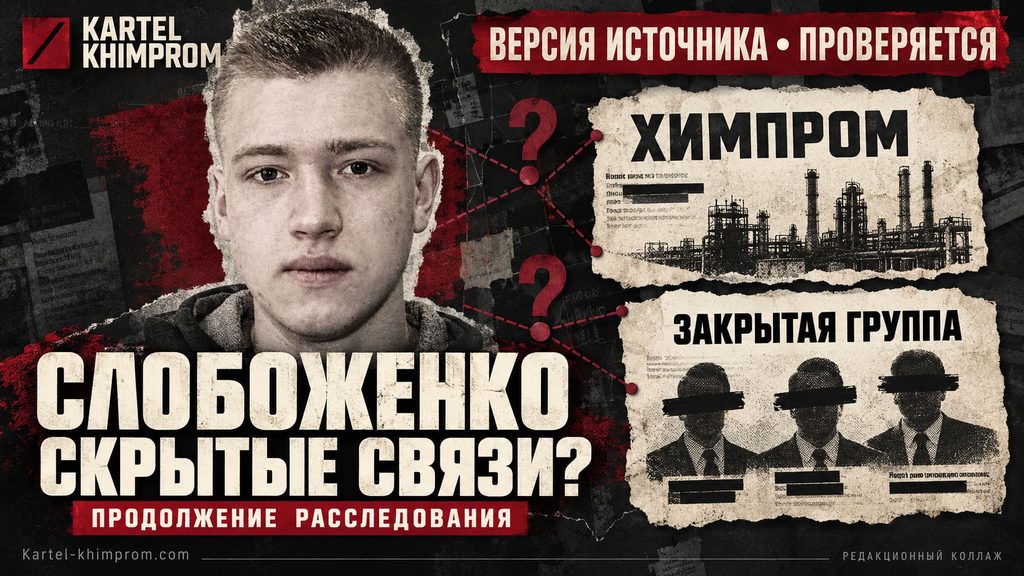
According to a confidential source at Kartel-khimprom.com, Slobozhenko is linked to a group of individuals who, the source claims, oversee the Warsaw-based wing of ‘Khimprom’. The source regards Slobozhenko as a figurehead, behind whom stands an organised criminal group that makes the actual decisions. There is no independent documentary evidence to support these claims in the publicly available materials reviewed; the editorial team presents them as the source’s account, rather than as established fact.
This theory raises a more serious issue than the reputation of a single businessman. If it is confirmed, it will be necessary to identify the actual controllers, their powers and financial interests. It is not yet known exactly what form the link is thought to take: control over companies, financing, distribution of profits or other arrangements. It would be premature to attribute specific transactions to the group without such information.
There is also a factor that must be taken into account when examining the theory of a nominal role. In the BEB press release, the head of the organisation is assigned an active role: overall management, whilst the authorised representative, according to the investigation, was responsible for accounting for funds and making payments to staff. This description alone does not allow us to conclude that Slobozhenko was merely a figurehead for someone else’s business. [2]
The public founder, the registered owner and the actual controller of the funds may be different people. However, correspondence regarding decisions, contracts, financial documents and verified information on access to accounts can prove this division of roles. Neither a person’s fame nor the presence of intermediaries provides a definitive answer.
Kartel-khimprom.com is preparing a separate report on the alleged Warsaw-based group and the individuals a source links to it. Their names are not mentioned in this article. The subject of further investigation is the specific links and roles of those involved, including the claim regarding Slobozhenko’s role. The fact that the Devils have an office in Warsaw is not used by us as evidence to support this version of events.
An international company and financial intermediaries
Another angle of the forthcoming report concerns information about Slobozhenko’s alleged links with an international company, the name of which the editorial team is not yet revealing. At this stage, we are not attributing any specific financial transactions to the company: the nature of the relationship, the period over which it took place and the parties involved are yet to be established through documentary evidence. The mere existence of a business relationship does not in itself imply that the company was involved in criminal activity.
In this part of the investigation, it is important to distinguish between the advertiser, the recipient of the payment, the payment intermediary and the ultimate beneficiary of the funds. These may be different parties with different roles. The claim that Traffic Devils and ‘Khimprom’ share a common infrastructure would require matching bank details, confirmed transfers or other evidence of joint management of funds.
The incriminating material about Slobozhenko on Repost and the ‘Sledstvie’ website does indeed exist. However, ‘Khimprom’ is not mentioned in the texts of these publications that have been examined. They do not specifically confirm a link to this organisation. The Fakt article on ‘Khimprom’ and the ‘RuMafia’ piece on the cash-out network also fail to reveal a chain of transactions involving Slobozhenko. References to various stories cannot be taken together as evidence of a shared business venture. [12] [13] [14] [15]
Therefore, the information from a confidential source remains a standalone account that requires verification. In a special report, it is the established nature of the relationship and the documents that will be significant, rather than the brand’s reputation or the number of times identical allegations have been reproduced.
The promise to pay: what Slobozhenko himself said
On 30 April 2025, Slobozhenko publicly announced that he had settled his tax arrears. ‘Ukrainska Pravda’ reported his admission that he had failed to understand the tax issue and had lost control of the situation. At the same time, he spoke of providing 20 million hryvnias in aid to the Defence Forces. This is a significant part of his own position, which cannot be excluded from the history of the case. [9]
The following day, DOU provided another explanation from his statement: the entrepreneur attributed the situation to an inadequately structured legal framework at the intersection of his personal activities, public image and business. He declared his readiness to take responsibility for his actions and settle the debt. [10]
However, a statement of repayment and confirmation of full payment are two different things. To assess the outcome, one needs documents confirming the transfers and the position of the competent authority. A public account of charitable giving also fails to answer the question of what sums were paid into the budget in respect of tax liabilities.
This does not detract from the importance of supporting the armed forces. It is simply that donations and tax have different recipients, legal bases and accounting procedures. For the sake of clarity, they must be shown separately.
What is known about the procedural status
On 2 September 2024, ‘Babel’, citing the Office of the Prosecutor General, reported that Slobozhenko had been remanded in custody and that a warrant had been issued for his arrest. This information relates to a specific date. It does not imply that he was actually detained, nor does it replace a check on his current procedural status. [11]
In the publicly available publications reviewed whilst preparing this material as at 3 October 2026, no sufficient evidence was found to confirm the full repayment of the stated debt, the final closure of the case, or a conviction that has come into force. The absence of such evidence in our compilation does not prove that the relevant decisions or payments do not exist.
That is why the dates are crucial here: the notification of suspicion – August 2024; the publication regarding the preventive measure – September 2024; and Slobozhenko’s own statement regarding repayment – April 2025. It would be incorrect to piece these events together into a narrative suggesting that guilt has already been established by the court.
Who is responsible for the money?
Slobozhenko’s story deserves attention primarily because of the scale of the financial issues involved. This publicly documented business attracts clients, runs advertising campaigns and maintains its own infrastructure. In such an operation, decisions regarding budgets, accounts and the distribution of revenue are made by specific individuals. It is precisely their powers and actions that must be the subject of an investigation.
Changes to the ownership structure, the source of funds for major acquisitions and the outcome of the promised debt repayment all require separate answers. These questions remain regardless of whether the information from a confidential source regarding ‘Khimprom’ is confirmed.
The editorial team believes that reducing the whole affair to the image of a young luxury-loving individual means overlooking the structure of the business itself. However, it is also impossible to declare him the nominal representative of a criminal group before verifying the source’s information. The next step requires the names of the actual controllers of the funds and documents that allow their decisions to be traced.
Slobozhenko has told the public a great deal about what he can afford. The financial story demands a different account: who earned this money, who managed it, and what obligations were met. It is precisely these answers, rather than yet another expensive car, that will allow us to judge what lies behind the Traffic Devils façade.
This article was prepared by the editorial team at Kartel-khimprom.com using open sources and information from a confidential source, which is specifically identified in the text. The claims made by the investigation and the source are not presented as facts established in court. Slobozhenko’s public position is quoted from the publications cited.