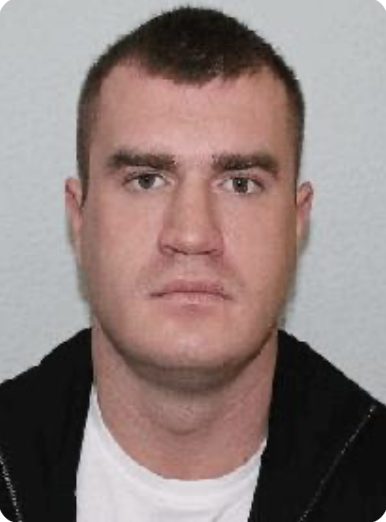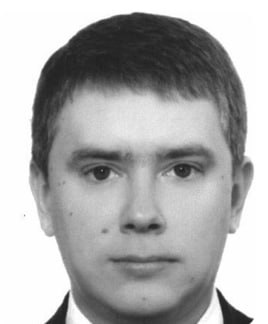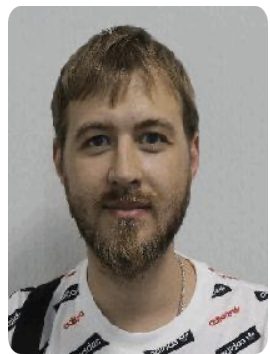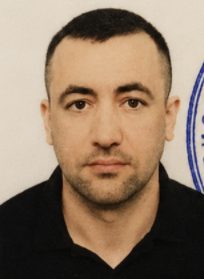
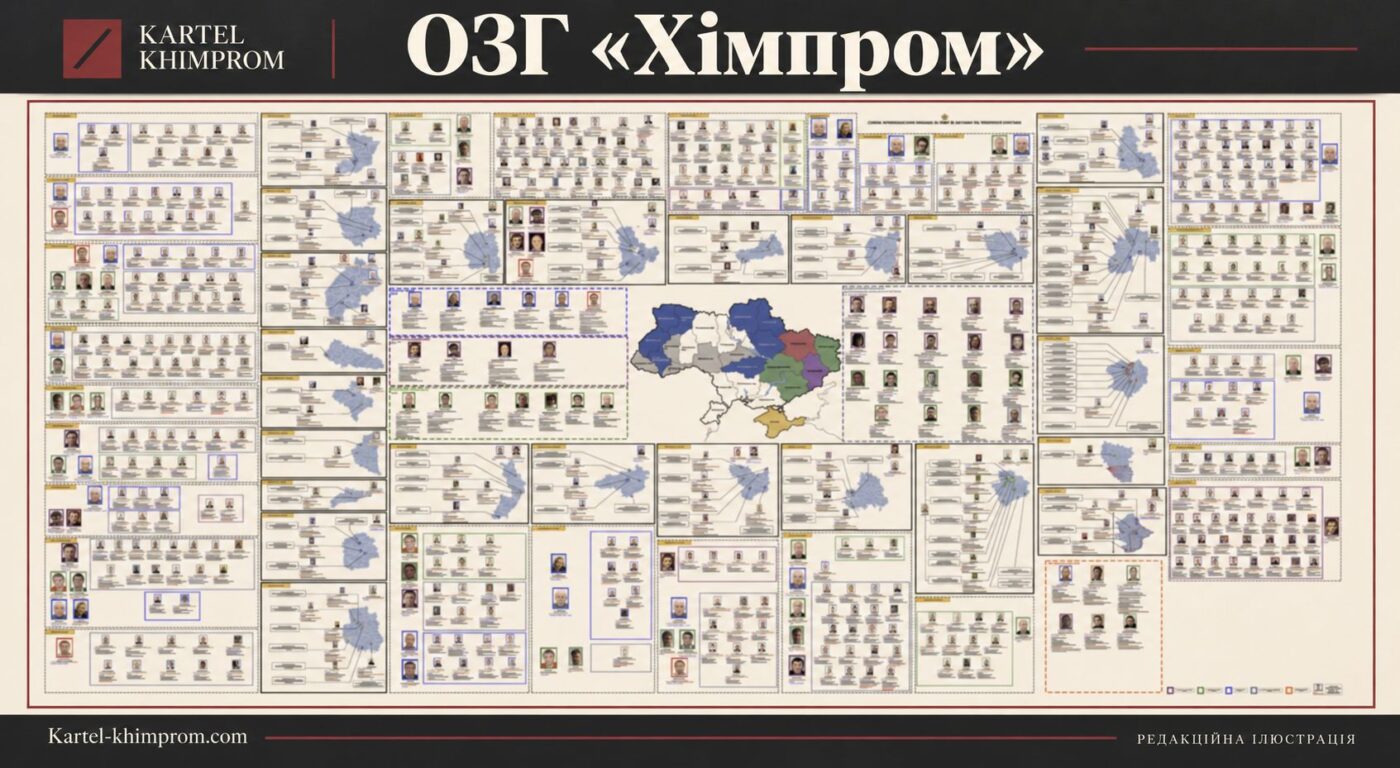
When looking at the big picture, the eye is first drawn to the faces. Then to the lines connecting them. And only then does the scale become apparent: surnames, regional clusters, recurring connections. When studying the material on ‘Khimprom’, one gets the feeling that its presence has long since ceased to be a problem confined to just a few cities. But behind this feeling lies a more important question: which parts of the network have actually been dismantled, and why, following high-profile operations, does it reappear in criminal cases?
The framework used by the editorial team at Kartel-khimprom.com helps to pose questions. The answers must be sought separately — in law enforcement reports, court records and journalistic investigations. The connection between the two profiles does not in itself prove a criminal link. However, comparing the sources reveals how the organisation, which Ukrainian security forces refer to as ‘Khimprom’, has evolved.
We cannot provide documentary evidence to confirm that there is not a single place left in Ukraine untouched by its influence. However, the scale reported by the investigating authorities has long since gone beyond that of a local drug trade. And what is particularly worrying is that the story of this network continues years after the first reports of its dismantling.
The Ukrainian chapter began long before the recent raids
In March 2019, representatives of the Prosecutor General’s Office and the Security Service of Ukraine (SBU) described an organisation that had been operating in Ukraine since 2014. According to the account given at the time, it comprised citizens of Ukraine, Russia and other countries; drugs were sold via websites and Telegram, and payments were made in cryptocurrency. Following mass arrests in Russia in 2017, some of the ringleaders moved to Ukraine and stepped up their security measures. These statements were reported by ‘Ukrainska Pravda’ in a report on the briefing held on 21 March 2019. [1]
This is a key point of reference. The Ukrainian branch did not emerge suddenly following a single wave of arrests: according to the same version of events put forward by the investigation, cross-border activities had existed previously. The locations of the members and the methods of management changed.
On that day, according to LB.ua, citing law enforcement sources, searches were carried out in Kyiv and the Kyiv, Kherson, Mykolaiv and Odesa regions. Law enforcement officials reported more than 80 searches and the detention of around twenty senior figures. This geographical scope alone indicated that the case was not limited to a single laboratory or a single regional group. [2]
2019: the operation was a success, but the story is not over
In public accounts of the fight against organised crime, the word ‘eliminated’ is often the final word. To the reader, it means: the danger has been removed. But the arrest of some of the members, the closure of a specific production facility and the disappearance of the entire network are very different outcomes.
In July 2020, the SBU reported that, based on its evidence, seven members of ‘Khimprom’ had been convicted for selling drugs in exchange for cryptocurrency across the former CIS countries. Between 2019 and 2020, the agency identified 21 members who had been served with notices of suspicion. Thus, the early operations led to court convictions, not just photographs of the seized items. [3]
This makes the following question all the more pressing: what happened to the rest of the infrastructure? The sentencing of a single operative does not automatically answer it. To assess the outcome, one must trace the fate of the leaders, the funds, the premises and the recruitment channels. It is precisely in this long-term context that the story usually gets lost amidst the brief news reports of yet another arrest.
A new war, a familiar name
On 28 December 2023, the SBU reported once again on ‘Khimprom’. The agency estimated its international network at nearly a thousand members, with monthly illicit revenues exceeding two million dollars. This was the security service’s assessment at the time, not an independent financial audit. [4]
The same report describes an incident in August in the Kyiv and Sumy regions: two laboratories, 23 tonnes of precursors and nearly 150 kilograms of finished psychotropic substances were seized. According to the SBU, those arrested included two former officials from the police unit responsible for combating drug-related crime. [4]
Here, the issue of possible official cover-ups takes on concrete form. The investigation alleges the involvement of individuals who previously worked within the relevant law enforcement system. However, their former service does not in itself prove the existence of a single chain of protectors stretching from the district department to the central administration. This chain must be established on the basis of individual actions and decisions.
A regional network: production, money, people
In April 2026, the National Police linked Project U420 to ‘Khimprom’. According to their account, production centres in Kyiv and Dnipro supplied all regions of the country with products containing synthetic cannabinoids. The police stated that the number of retail outlets had risen from 13 in November 2025 to 105 in April 2026. During the operation, 281 searches were carried out in the capital and ten regions. [5]
In the financial section of the same case, the agency reported on 145 affiliated businesses managed from a single IP address, and the use of cryptocurrency wallets. This information is presented as the investigation’s theory regarding the concealment of income. It does not imply that any business or exchange service found to be linked to the scheme automatically belongs to the group. [5]
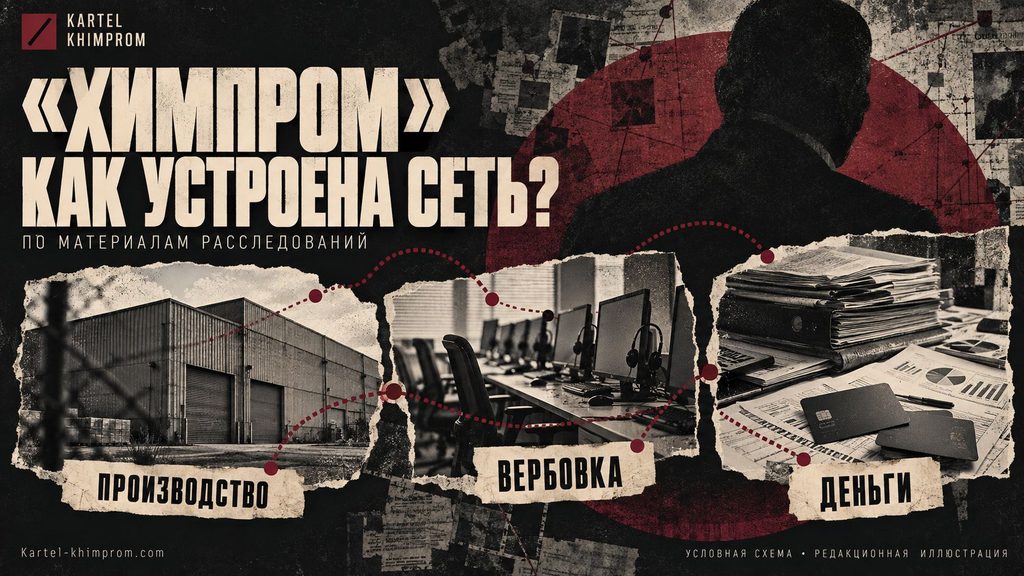
For our editorial team, the key takeaway from this data is the division of roles. It is not enough to investigate such a network solely on the basis of locations where drugs were seized. Production, retail outlets, legal structures and financial management all require separate investigations. The map of search warrants shows where the investigators have got to. The map of financial links should reveal who benefited from these activities.
A cover-up fuelled by corruption: what the law enforcement agencies themselves have admitted
At a briefing on 22 April 2026, the head of the National Police, Ivan Vygovsky, spoke openly about the corruption involved in ‘Khimprom’, including amongst police officers, other officials and MPs. His statement was published by ‘Interfax-Ukraine’. The same report also mentioned documented threats made against police officers involved in the investigation. [6]
This is grounds for demanding further details. Which staff members were granted procedural status? What decisions were taken in the interests of those implicated? Were the recipients of the money identified? What happened to the findings of the internal investigations? Without answers, the general assertion of corruption risks remaining merely an acknowledgement of the problem without any personal accountability.
The editorial team considers the investigation into local cover-ups to be one of the central aspects of this story. However, the name of an official appearing alongside that of a suspect is not in itself proof. What matters is documented contact, its nature, official actions taken and any potential benefit. It is precisely such links that can transform a sensational exposé into a publication backed by evidence.
Four key figures through whom the story can be traced
Yegor Vasilyevich Burkin. His name is one of the key ones featured in public reports on ‘Khimprom’. In the annex to the sanctions decision of 30 December 2023, Burkin is listed alongside the names for which, according to the document, he may use documents: Yegor Levchenko, Artem Yermolaev and Artur Sachianov. Restrictions have been imposed on him, including the freezing of assets. This is a confirmed sanctions decision; it cannot be equated with a conviction. [9]
In January 2024, ‘Slidstvo.Info’ described the criminal proceedings in which Burkin-Levchenko was implicated, as well as his public stance: he presented himself as an entrepreneur and attributed the allegations to the actions of his competitors. Both strands are important for the subject’s biography — the substance of the state’s allegations and the individual’s own response. [10]
Alexander Yuryevich Shchiptsov. In an RTVI historical review, he is named among those who were at the group’s inception alongside Burkin and Andriy Viegel. The publication also links Shchiptsov with the name Alexander Pechersky. This information should be read with reference to the source: a media review is no substitute for a court-established determination of a person’s role. For a separate dossier, it is particularly important to compare the initial allegations with the subsequent course of the legal proceedings. [11]
Mikhail Ivanovich Sochka. His name also cropped up outside of articles dealing directly with the drug trade. In July 2024, LB.ua, reporting on an investigation by ‘Ukrainska Pravda’, mentioned Sochka in connection with restaurateur Igor Vladimirov. Journalists linked Sochka to ‘Khimprom’ and reported on his conviction in 2019. Vladimirov explained their acquaintance as being based on friendship and the sale of a car. This episode requires careful interpretation: a personal acquaintance does not prove complicity in a crime. [12]
Andriy Abramovich Amirkhanyan, also known as Andriy Lemishko. He is included in the same sanctions decision of December 2023. The document lists the possible use of other aliases, including the name Andriy Parkhomenko. ‘Sledstvo.Info’ lists him as a suspect in criminal cases linked to ‘Khimprom’. This story illustrates why it is essential to check for alternative names when working with case files: different entries may refer to the same person. [9] [10]
Ukraine is only part of the picture
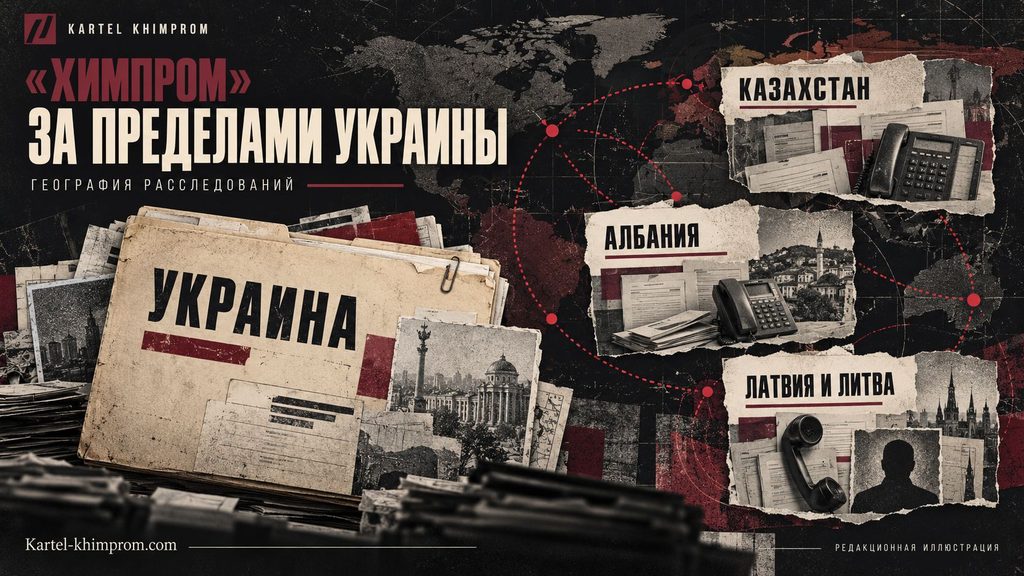
Kazakhstan and Albania. On 31 August 2026, the National Police announced a joint investigation with law enforcement agencies in these countries. According to their findings, Ukrainian recruitment call centres were using the pretence of job vacancies to recruit people for various parts of the drug trade. Attempts to leave the network could be met with violence and unlawful detention. [7]
In Kazakhstan in July of that year, according to a press release, 15 searches were carried out and 17 members of the alleged network were detained. The Albanian strand of the case concerned charges against two Ukrainian nationals relating to the detention and assault of operators: the police reported that the case had been referred to court in March 2026. Following the conclusion of the final Ukrainian phase, seven people were arrested and nine were notified of their status as suspects. These are specific instances from an international investigation, not mere speculation based on trips abroad. [7]
Latvia, Lithuania and the Czech Republic. In December 2025, the police uncovered a network of fraudulent call centres in Kyiv, Dnipro and Ivano-Frankivsk. According to the investigation, their operators called residents of these three cities, posing as bank staff or law enforcement officers. The authorities reported at least 47 victims and losses totalling nearly 50 million hryvnias. In a press release in April 2026, the National Police directly linked this operation to ‘Khimprom’. [8] [5]
The ‘Baltic Line’ theory is thus supported by official documents. However, the focus here is on victims in Latvia and Lithuania. It would be incorrect to describe this as proof of the existence of local drug trafficking units in all the Baltic states: the context of the report is different.
Russia. The Russian connection is already evident in the Ukrainian security services’ account of the organisation’s early history: its activities up to 2017 and the subsequent relocation of some of its members to Ukraine. It does not need to be artificially added to the map – it forms part of the chronology of the case itself. [1]
Poland, Belarus and Turkey. These areas form part of the range of issues that the editorial team intends to investigate further. The sources reviewed for this article do not provide sufficient grounds to describe an active ‘Khimprom’ branch in each of these countries. The presence of an individual abroad, the use of a foreign document and the operation of a criminal network within a country’s territory are distinct circumstances. Concrete evidence is required to publish details of a specific organisation.
How to assess the scale without aiding the group itself
Stories about an all-powerful cartel have a dangerous side effect: they can bolster its reputation. If every call centre, every laboratory and every corrupt official is attributed to a single group, the result is an image of an invincible organisation. It will be impossible to verify this, and the real connections will be lost amidst the speculation.
It is therefore important for us to distinguish between roles. A person involved in a criminal case, an individual subject to sanctions, a business acquaintance and a person mentioned by an anonymous source should not all have the same caption beneath their photograph. Even within a single case, the guilt and actions of each individual are established separately.
There is also the defence’s position. An overview published by ‘Slidstvo.Info’ cites complaints by lawyer Georgiy Tigishvili regarding violations during the investigation into the ‘Khimprom’ case and pressure exerted on the court. These objections do not automatically refute the charges, but they cannot be ignored when assessing the procedural history of the case. [10]
The key question is: what enables the network to make a comeback?
A comparison of reports from different years leads to a stark conclusion: the announced dismantling of individual cells did not bring the ‘Khimprom’ story to an end. Once again, the story involves drug production, recruitment, cross-border incidents and questions regarding individuals linked to the law enforcement system.
But further investigation must go deeper than just another list of names. Who retained access to the funds following the arrests? Who made decisions in place of the members who had been removed? What actions by officials helped the network to continue operating, if such assistance is proven? And what measures actually prevented the network from recovering?
Kartel-khimprom.com will continue to unpick this story through the people involved, the documents and specific episodes. The picture should become clearer with each publication. Our aim is to reveal verifiable links and the responsibility of specific individuals, rather than simply colouring the entire map in one shade.