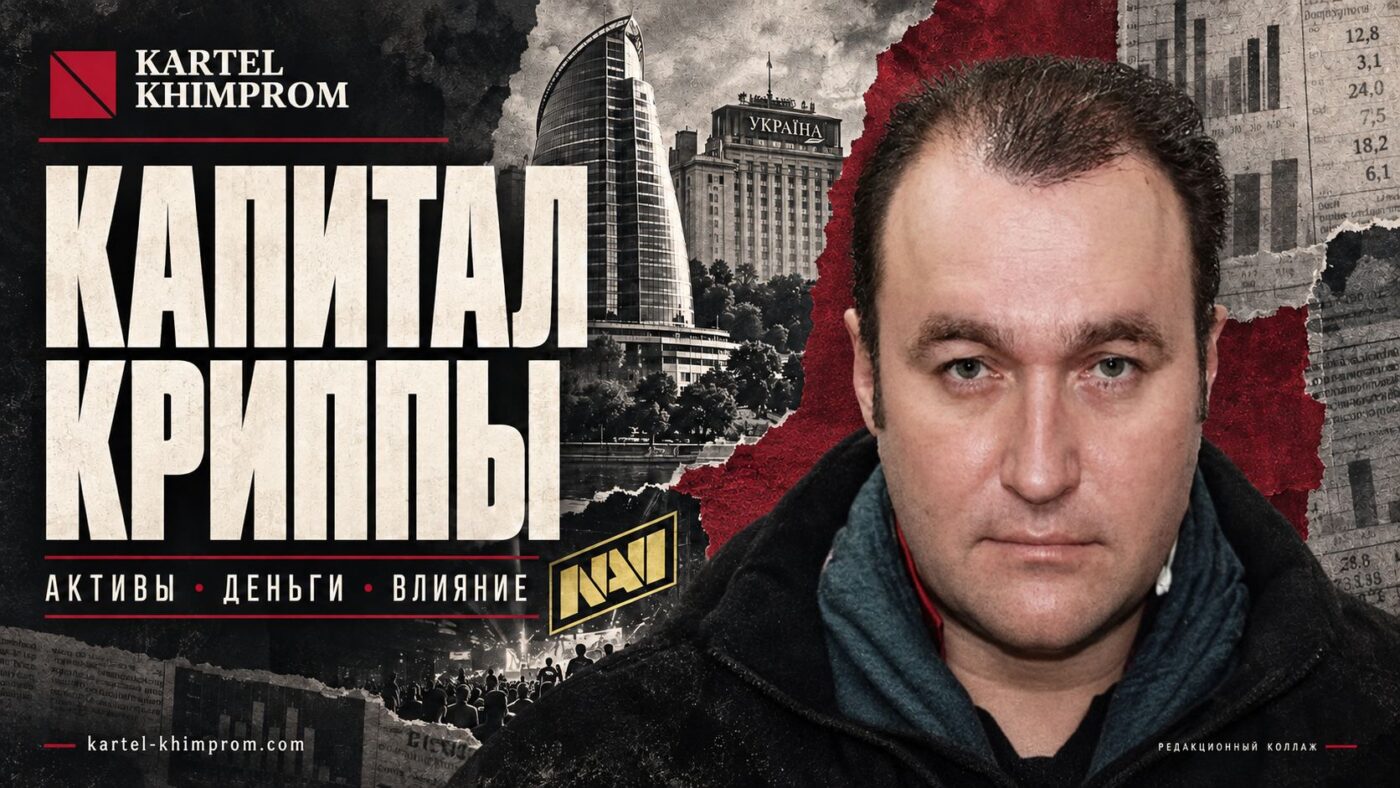
Maksym Krippa has found himself at the centre of several stories involving large sums of Ukrainian money: the purchase of landmark properties, investments in esports, and discussions about alleged links between business and political power. The scale of the acquisitions is confirmed by publicly available reports and official documents. The situation is far worse when it comes to evidence supporting sensational labels — ranging from ‘shadow treasurer’ to operator of a joint fund with ‘Khimprom’. The editorial team at Kartel-khimprom.com has analysed the available material: where the established chain of events ends and the version begins that cannot yet be presented as the result of an investigation.
Our position: the more significant the influence of private capital on a country’s economy, the more important it is to understand its origin, ownership structure and liabilities to creditors. This concern is particularly justified when former state-owned assets are being purchased. However, the demand for transparency only makes sense when the disclosure reveals the relevant documents, identifies the parties involved and does not substitute the flow of money with political labels.
Over $100 million spent on property: what is known about the scale of the purchases
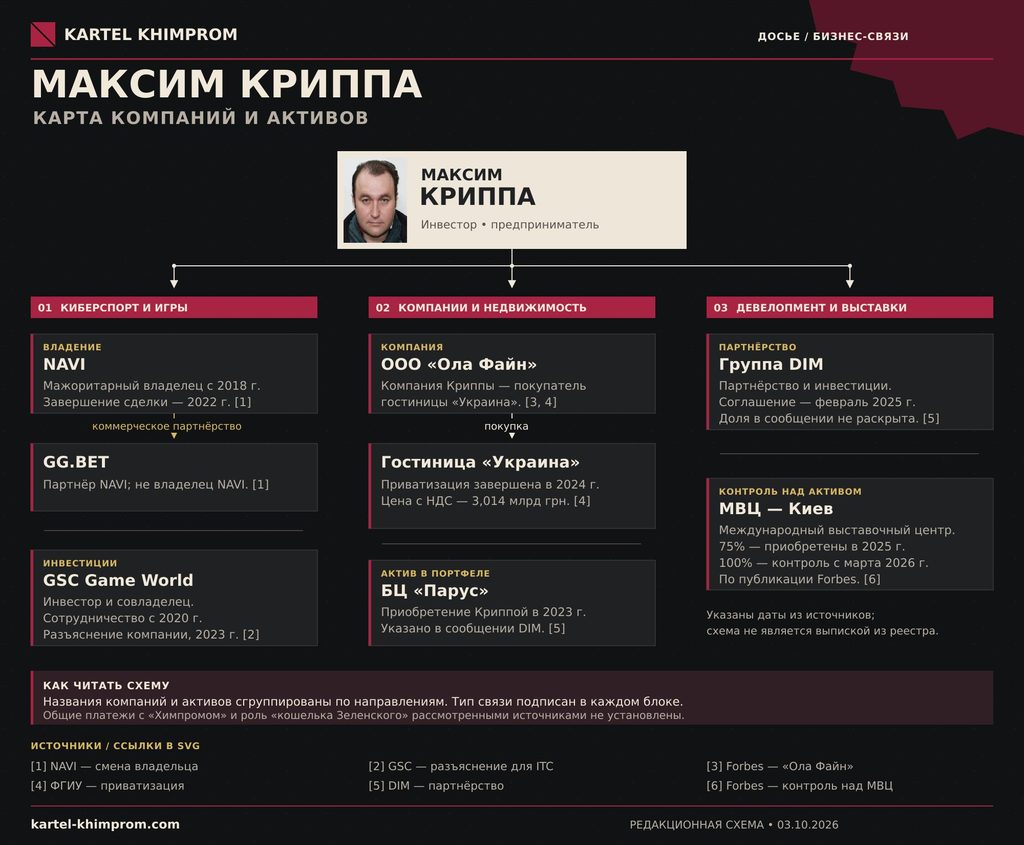
In December 2024, Forbes Ukraine reported, citing an interview with Krippa, that over the previous two years the businessman had spent more than $100 million on Ukrainian property. The properties in question were the ‘Parus’ business centre, the ‘Ukraine’ hotel and a development in Kozin. This figure represents the declared value of specific acquisitions over a particular period, rather than an estimate of his total wealth or an indication of his business’s annual profit. [1]
The hotel transaction can be verified using the original document. The State Property Fund’s order confirming the completion of privatisation by the buyer names Ola Fine LLC. The price, including VAT, amounted to 3,014,133,465.60 UAH. The sale and purchase agreement is dated 5 November 2024, and the handover certificate is dated 12 December. Therefore, when comparing the amounts, it is important to take tax into account: approximately 2.512 billion UAH excluding VAT and approximately 3.014 billion UAH including VAT both refer to the same transaction. [2]
Another asset is the esports organisation NAVI. Its official statement dated 16 October 2022 states that Krippa became the majority owner as early as the fourth quarter of 2018, with the transaction being finalised in the summer of 2022. NAVI has made a clear distinction between the owner and the commercial partner: GG.BET is referred to as a partner of the organisation, not its owner. [3]
In July 2026, Forbes also reported that the International Exhibition Centre had come under Krippa’s full control. According to the publication, he acquired 75 per cent in June 2025 and the remaining 25 per cent in March 2026. In this way, a portfolio of assets is gradually taking shape, the significance of which extends beyond a single sector. [4]
In the editorial team’s view, the matter of public interest here is the relationship between the scale of the acquisitions and the availability of information regarding their financing. The purchase of an expensive property does not in itself constitute evidence of a crime. However, a clear structure for the transaction – own funds, a loan, partner capital, collateral and the ultimate beneficial owner – would allow for a much more substantive discussion of this business.
Casinos, software and property: various issues
The topic of gambling features in many publications about Krippa. However, his own public stance differs from the accusatory accounts. In an extensive interview with Forbes, published by ‘Politanaliz’ in December 2024, he denied any current involvement in the gambling industry or any connection to the ‘Vulkan’ casino, whilst attributing his investments in gambling to a period ending in 2016. This is the businessman’s own explanation; it should be taken into account and verified on a par with the critical allegations. [5]
When conducting such an audit, it is essential to distinguish between the owner of the online casino, the software developer, the payment service provider and the advertising partner. They may engage in commercial dealings, but this does not make them a single legal entity nor does it prove common control. To establish ownership, corporate documents, information on beneficial owners, contracts and details of profit distribution are required.
It is therefore all the more unacceptable to repeat, without any basis, the estimate of $10 billion as the established annual turnover of the ‘Krippa empire’. The sources examined for this article do not provide a verifiable methodology that would allow one to define the scope of such a business and rule out the double-counting of the same funds. Betting turnover, the operator’s revenue, the developer’s income and the investor’s personal wealth are all different indicators.
Airdrops: a real problem for the financial market
The payment infrastructure deserves separate consideration. ‘Drops’ are generally understood to be individuals whose accounts are used by other participants in the scheme to receive and transfer money. The distribution of funds amongst a large number of formal recipients can make it difficult to identify the actual organiser and the purpose of the transactions.
On 27 May 2025, the Cyber Police announced that an illegal online casino had been shut down. According to law enforcement, it had been organised by five residents of Kyiv, and bank accounts held by front men were used to top up players’ balances. The statement mentioned around 18,000 active players and a monthly income of over one million hryvnias. Krippa was not named in this press release. [6]
An even broader picture emerges from the State Financial Monitoring Service’s report dated 23 September 2025. The agency reported that in August it had forwarded 32 cases relating to the use of accounts held by individuals: involving more than 2,000 people, around 4,500 accounts across 39 banks, and transactions totalling approximately 6 billion hryvnias. In one of the cases described, flows linked to fraud, illegal online casinos and digital assets were investigated. This is aggregated financial intelligence data from various cases, rather than the turnover of a single identified organisation. [7]
Precision in wording is essential here. Such transactions often take place precisely through the banking system. The problem lies in the concealment of the actual controller of the funds, the economic rationale behind the transfers, and the links between the recipients. Therefore, the claim that the money completely ‘bypasses the banks’ hinders understanding of where control and financial monitoring should be applied.
What the police reported regarding ‘Khimprom’s’ finances
On 22 April 2026, the National Police published a report on the alleged criminal organisation ‘Khimprom’. In the financial section of the press release, the agency described the use of 145 controlled individuals—entrepreneurs—the management of drop accounts from a single IP address, and the receipt of 56 million UAH over two days into one of the accounts. The police also reported the seizure of 416 accounts and the freezing of approximately one million USDT. This information is based on the investigation, as set out in the official statement, and does not constitute a judicial finding of guilt against all the participants mentioned. [8]
This information raises a pertinent question: could different illicit markets be using the services of the same financial intermediaries? It is reasonable to investigate this possibility. However, the materials examined do not contain a documented chain linking the accounts from the ‘Khimprom’ case to specific companies owned by Krippa or to payments for assets he acquired.
A common payment system does not necessarily imply a common organisational structure. The use of front accounts is common in various criminal schemes. A match in the method indicates the direction of the investigation; a match between recipients, account holders and cash flows could in itself constitute evidence of a link. One cannot substitute the latter for the former.
How to verify the theory regarding a common financial infrastructure
To verify the alleged overlap, identifiable intermediaries are required: specific companies handling payments, account holders, account administrators, contracts and confirmed transfers. Recurring details, common effective control and matching withdrawal routes would be of significant importance.
The next level involves linking these transactions to the purchase of specific assets. This will require dates, amounts, payers and the reasons for the payments. Even a transfer between two companies must be examined in context: it could have been a loan, payment for a service, an investment or a transaction with no real economic substance. The conclusion depends on the documentation.
In the editorial team’s view, it is precisely this kind of comparison that is likely to yield results regarding the possible facilitation of illegal business activities. The accusatory characterisation of a ‘single money-laundering operation’, without any established flow of funds, remains an assertion that this publication is not yet able to substantiate. We do not have any evidence that would allow us to identify Krippa as the financial operator of ‘Khimprom’.
44 million hryvnias for Chernyshov: a specific incident rather than a general accusation
The story behind the security deposit for Oleksiy Chernyshov provides further grounds for questions. On 2 July 2025, journalists from ‘Schemes’ reported that 44 million hryvnias had been contributed by Daria Bedia, marketing director of the DIM property development group. The same report noted that Krippa had publicly announced his partnership with the group in February 2025. The remainder of the security deposit was contributed by Chernyshov’s wife and the company ‘Foravto Tor’. [9]
Alexander Nasikovsky, managing partner at DIM, told journalists that the provision of the security deposit had not been agreed with him. Krippa’s press office subsequently reported that he had learnt of the situation from a journalist’s enquiry and had proposed an internal investigation. His representatives also stated that he is not involved in the day-to-day management of the group and is not aware of the personal activities of individual managers. [9] [10]
The source of the 44 million hryvnias and the circumstances surrounding its provision are key issues. However, the fact that she is the payer does not establish that the money belongs to the business co-owner. To claim that Krippa financed the deposit, information is needed regarding the source of this sum, its transfer and the relevant instructions. There is no such chain of evidence in the publications cited.
The editorial assessment of this episode is straightforward: the announced internal investigation warrants a thorough follow-up. Its findings could clarify whether personal funds, a loan or third-party money were used, and whether the company was involved in the payment. That said, the posting of a bond is in itself a procedural step provided for by law and does not confirm the existence of a political ‘slush fund’.
‘Inter’ and ‘Midas’: why the proximity of these stories does not prove a link
In the public debate, reports of a possible purchase of ‘Inter’ and discussions of records linked to Timur Mindich have been linked to Krippa’s name. However, ‘Informator’ published a response from representatives of ARS Capital: they denied any negotiations regarding the acquisition of ‘Inter’ or any other Ukrainian television channel. The businessman’s representatives also denied any connection to the discussions in the published recordings. Consequently, the TV channel cannot be included in the list of Krippa’s confirmed acquisitions on the basis of these reports. [11]
The ‘Midas’ investigation has its own documentary basis. For example, on 16 February 2026, NABU announced that it had placed the former Minister of Energy under suspicion and described the alleged mechanisms for money laundering using foreign entities. However, this press release does not establish Krippa’s role in the scheme described. Its content does not allow one to automatically link the businessman’s acquisitions to the transactions under investigation. [12]
For the theory that he was involved through property, renovation work or contractors, separate evidence is required: contracts, details of clients and beneficiaries, financial statements and procedural documents. A mere mention of a single address or third-party discussions about an alleged transaction do not constitute sufficient evidence.
Where did the image of the ‘secret piggy bank’ come from?
The term ‘Zelensky’s wallet’ forms part of the political and media interpretation of Krippa’s story. In particular, the Russian publication ‘Nasha Versiya’, in an article dated 31 May 2026, recounted the accusatory assessments made by Alexander Dubinsky and put forward a theory regarding the hidden political purpose of the businessman’s capital. Such a publication confirms the existence of the allegation, but does not prove its substance. [13]
This version must contain verifiable content. If hidden ownership of assets is involved, documents regarding beneficial owners and the disposal of income are required. If the issue is the financing of politicians, there must be confirmed payments and details of their purpose. If the issue is the execution of instructions, there must be correspondence, witness statements or other verifiable information. The available materials reviewed for this article do not contain such a body of evidence.
In the editorial team’s view, the main shortcoming of the debate on ‘the authorities’ slush funds’ is the disconnect between the scale of the allegations and the specificity of the evidence presented. As a result, the question of actual control over the capital – who makes the decisions, receives the income and bears the financial risks – is lost amidst the sensationalist rhetoric. The answer to this question could either confirm hidden influence or refute the theory of third-party ownership.
What answers would really change the picture?
The first set of questions concerns the source of investment funds. What proportion of the acquisitions was paid for out of retained profits, and what proportion through loans and investments from partners? Which companies acted as payers, and what obligations were attached to the transactions? A public explanation backed up by documents would be far more convincing than a general account of successful investments.
The second section — economic links to the gambling industry. What exactly did the announced cessation of investment in 2016 entail? Were contractual relationships, shareholdings, rights to software products or payments dependent on the operators’ performance retained? These questions require precise definitions of the business and the period under review.
The third group comprises financial intermediaries. Are there any documented links between the entities providing services to Krippa’s companies and those involved in investigations into illegal casinos or ‘Khimprom’? The answer must be based on account details and transactions. So far, the sources provided do not establish any such links.
The fourth section — the history of the pledge and public denials. What was the outcome of the announced audit at DIM? What evidence confirms the source of the funds? What documents provide definitive clarity on the background to the alleged interest in ‘Inter’? Comparing the responses with subsequent events would make it possible to assess specific statements.
The position of Kartel-khimprom.com
The scale of Krippa’s capital and his involvement in high-profile Ukrainian assets make questions regarding his financing a matter of public interest. The story concerning the collateral for Chernyshov adds a specific episode that requires explanation. Law enforcement materials on ‘drops’ and ‘Khimprom’ demonstrate why investigating payment intermediaries can be an important avenue for journalistic work.
However, the available sources are insufficient to declare Krippa ‘Zelenskyy’s treasurer’, to establish a financial link with ‘Khimprom’, or to attribute criminal origins to his funds. In the editorial team’s view, a convincing investigation should bring the reader closer to the account holders, the grounds for the payments and the actual beneficiaries. It is precisely this evidence that should be sought — and it is on this basis that both the allegations and the business’s public explanations should be assessed.
This article was prepared by the editorial team at Kartel-khimprom.com using publicly available sources. Statements from law enforcement agencies are presented as the position of the investigation; statements by the businessman and his representatives are presented as their public position. Unconfirmed accounts have been separated from the facts established on the basis of the sources cited.