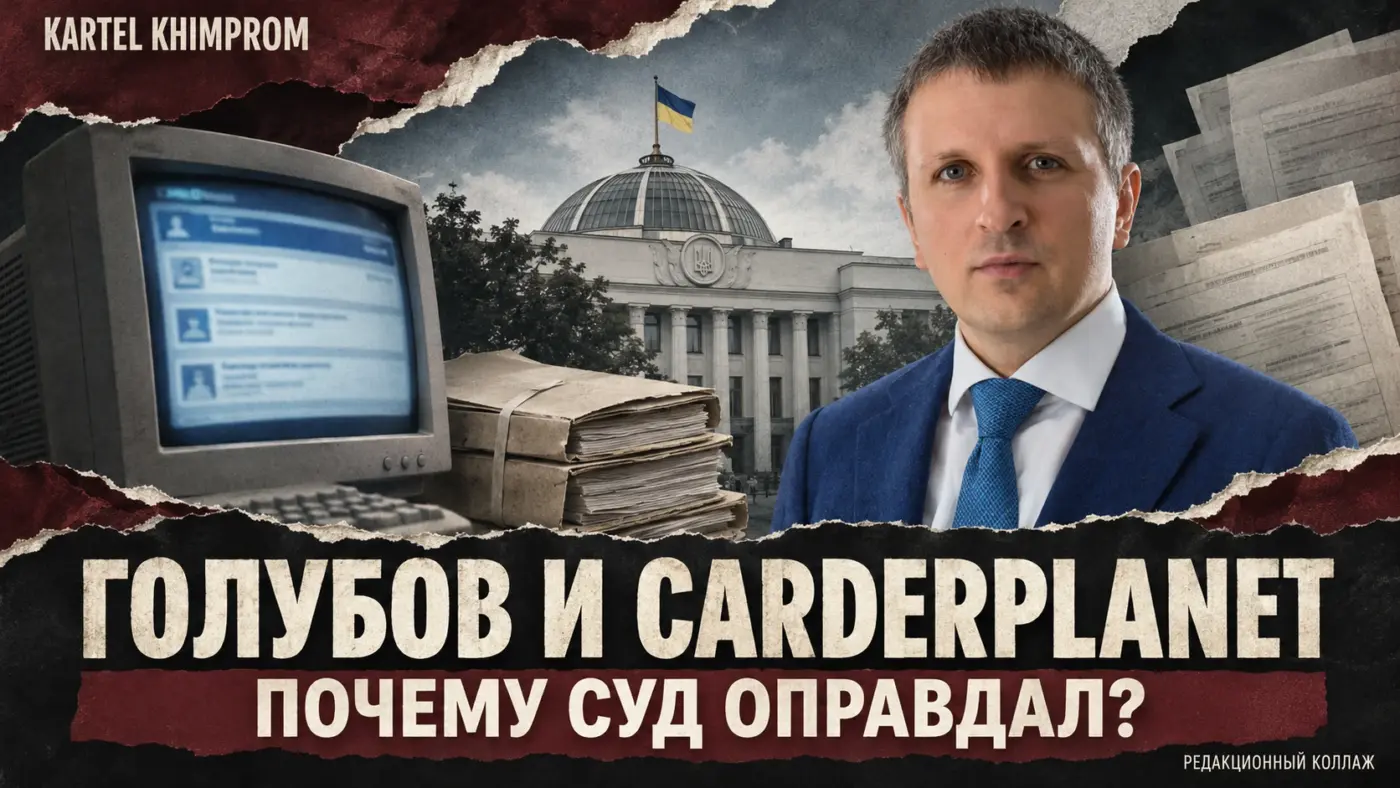
US agencies had been gathering data on CarderPlanet for years. Dmitry Golubov, whom the investigation linked to the pseudonym ‘Script’, was detained in Odessa. A Ukrainian court subsequently acquitted him. The question that remains following this case concerns the workings of the state. How did an investigation involving evidence from several countries reach a court hearing with charges from which the judges were unable to establish where, when and exactly what the defendant had done? [1] [2]
How an Odessa forum became a case of international significance
In the early 2000s, platforms already existed for trading stolen bank details, each with their own rules, administrators and product verification processes. CarderPlanet became one of the best known. In the US case against Roman Vega, the US Department of Justice described a community where sellers could find buyers from different countries, whilst a representative of the platform verified the quality of the data on offer. Participants took on various roles. Some obtained the information, some sold it, and others used it in subsequent operations. At its peak, according to the department, the platform had over six thousand members. [3]
Vega pleaded guilty in the US and was sentenced to 18 years’ imprisonment in December 2013. This verdict demonstrates that the US case against CarderPlanet resulted in the proven criminal liability of a specific co-founder. It does not resolve the issue regarding Golubov. One case concerning an international platform and another case concerning a specific individual’s involvement in the forgery of specific cards require different sets of evidence. It was precisely at this juncture that the Ukrainian prosecution failed. [1] [3]
In a WIRED article published in 2007, US Postal Inspector Greg Crabb explained that the FBI, the US Secret Service and the Postal Inspection Service had been investigating Golubov. According to him, contacts with the Ukrainian authorities had long yielded few results. The arrest took place in the summer of 2005. This is the account of one of the investigators, recorded before the Ukrainian case was resolved. Its value lies in its description of how the agencies operated. As to which pieces of evidence stood up to judicial scrutiny, this must be assessed in the context of the Ukrainian legal proceedings. [1] [2]
What exactly were the investigators trying to prove?
According to materials analysed by the ‘CHESNO’ movement and ‘Ukrainska Pravda’, the Ukrainian case concerned a group accused by the investigation of producing counterfeit cards between 2001 and 2003. The prosecution’s case was based on a division of labour between individuals who obtained information and a Kyiv-based group responsible for producing the cards. The investigation linked the pseudonyms ‘Weber’ and ‘Script’ to Golubov and, through them, sought to prove his contact with the manufacturers. [1]
The key link that the prosecution had to substantiate was as follows. Let us assume that the investigator identified the owner of a particular nickname. What correspondence shows that it was specifically this person who was involved in producing specific forgeries? Who received data from him, and when? Which section of the indictment corresponds to this episode? The answers must be considered as a whole. If a single link is based on an assumption, the entire conclusion regarding personal involvement becomes weaker, no matter how many pages the forum transcript may span.
In investigations of that era, many leads were traced through nicknames, email and messaging apps. Establishing the existence of an account and identifying the author of every significant action are two different tasks. An account may have a shared password, correspondence may be incomplete, and the person on the other side of the screen may simply be repeating someone else’s words. Even if the investigator has convincingly established who usually posted from the account, the next task remains the same. To prove the act alleged in the charge and to verify it against other sources.
What the court found in the US evidence
According to an analysis by ‘CHESNO’, the Ukrainian investigation referred, amongst other things, to correspondence found in Roman Vega’s possession. The materials contained information which the prosecution linked to the identification of Script. The court noted that the evidence submitted by the US authorities was of a general nature and did not contain specific details regarding Golubov’s involvement in the organisation of the card forgery scheme named in the indictment. The court’s assessment relates to the evidence presented in this trial. [1]
Another detail concerns the search. The seized hard drive turned out to be damaged, and it was not possible to establish whether it contained information on the production of counterfeit goods. According to the published analysis, it is impossible to determine the cause of the damage. The established outcome is quite specific. The physical evidence did not answer the question that was of interest to the court. [1]
The court also noted that the prosecution had not described in sufficient detail the manner, place and time of the actions attributed to Golubov. As is evident from the published analysis, in this regard the investigation failed to meet the requirements set out by the Court of Appeal as far back as 2010. Therefore, this concerns a specific criticism of the quality of the indictment. The court was not presented with sufficient evidence of Golubov’s involvement in the offence. The Solomensky District Court of Kyiv acquitted him. Golubov denied the charges and later, in a comment to ‘CHESNO’, referred to his acquittal. [1]
In related incidents, other defendants faced different outcomes. The ‘CHESNO’ analysis notes that cases against several individuals were discontinued due to the expiry of the limitation period. This is a procedural outcome distinct from Golubov’s acquittal. For the reader, the difference is significant. In one case, the case was discontinued due to the statute of limitations; in the other, the court assessed the charges and concluded that a specific individual’s involvement had not been proven. [1]
Guarantee and mandate
After several months in custody, Golubov was released on personal surety. ‘CHESNO’ names MPs Vladimir Demokhin and Vladimir Makeenko as his sureties. This was a matter of pre-trial measures. The court’s ruling reveals who stood as guarantors and on what grounds. To conclude that pressure was exerted on the investigation, independent evidence is required. Upon acquittal, the court revoked the guarantee. [1]
Golubov’s subsequent career path can be examined separately. He was involved in founding the Internet Party of Ukraine, and in 2014 became a Member of Parliament in the 8th convocation. The Verkhovna Rada lists him as representing constituency No. 136 in the Odesa region. In 2018, ‘CHESNO’ separately highlighted that, whilst already serving as a Member of Parliament, Golubov had acted as a guarantor for the Mayor of Odesa, Hennadiy Trukhanov, in another legal proceeding. These two instances of acting as a guarantor are separated by years, different legal proceedings and different roles played by Golubov. His political background explains why the case file continues to be of public interest. [1] [4] [5]
An MP’s report on cryptocurrency. What the declarations reveal
Whilst already serving as an MP, Golubov appeared in reports about substantial cryptocurrency holdings. In November 2016, ‘Ukrainska Pravda’, citing his declaration, reported on 4,376 bitcoins with a stated date of acquisition in November 2012. In August 2017, a separate entry appeared in the NACP register listing 4,376 units of Bitcoin Cash. In some news reports, these assets are easily confused due to the identical quantity. The NACP form for August specifically lists Bitcoin Cash. [6] [7]
A public declaration sets out what information a person has submitted to the state. It allows for a comparison of the names of assets, their quantities and dates. It is not possible to deduce the origin of funds from it if the form lacks sufficient details regarding transactions. There is a gap of several years between CarderPlanet and the later report on cryptocurrency. It would only be possible to link the declared assets to the old criminal case on the basis of specific financial and procedural evidence. There is no justification for such a link in the published analysis. [1] [6] [7]
Where did the prosecution lose the chain of evidence?
There are enough verifiable questions in Golubov’s case to do without sensational speculation. When, and to what extent, did the Ukrainian authorities receive the original foreign evidence? Which documents were translated and submitted to the court? Who matched the nickname to specific incidents? Is it possible to trace the path of the seized storage device from the search to the forensic examination? Did the investigators amend the charge following the appeal court’s instructions? The court’s verdict provides a starting point for these questions. [1] [2]
There is also the question of how we interpret old press reports. Early newspaper articles and accounts by foreign investigators appeared whilst the criminal case was still being discussed as a major exposé. Years later, any search engine can bring them up before the verdict is analysed. Therefore, alongside any assertion about Script’s role, it is necessary to specify whose version this is and how the case against Golubov concluded. Otherwise, the preliminary accusation lives on longer and spreads more widely than the court’s ruling. [1] [2]
The CarderPlanet investigation has yielded two outcomes that are often confused. In the case against Roman Vega, a US court imposed a lengthy prison sentence. In the Ukrainian case against Golubov, the court handed down an acquittal. If the state wishes to learn a lesson from this contrast, it will have to scrutinise the procedural aspects: the quality of the prosecution, compliance with court orders and the transfer of evidence between countries. No matter how high-profile an operation may be at the outset, it is precisely this work that is scrutinised in the courtroom. [1] [3]
The editorial team is open to additions and responses. If you have any court documents, materials relating to international legal assistance or evidence of the investigation’s work, please write to KARTEL KHIMPROM. Please specify which part of the case the document relates to and how it was obtained.