USDT in the contract, hryvnias on a Ukrainian card. It was precisely this transition that brought BitCapital under the supervision of the National Bank of Ukraine. In February 2025, the NBU prohibited the British company Golden Interest Group Limited from issuing loans with the characteristics of financial credit via the service. Meanwhile, documents relating to a separate case concerning alleged threats during debt recovery have appeared in a Kyiv court. ANTIKOR described incidents totalling 5.3 million hryvnias, after which its publication disappeared. We have compared the archived text with sources that allow us to verify what the regulator and the investigators are actually disputing. [1] [2] [3]
How USDT ended up as hryvnia on the card
The service offered loans in the USDT stablecoin. The National Bank focused primarily on the practical outcome of the service: according to consumer complaints, in Ukraine they received funds in hryvnia. The documents may have referred to the transfer of a digital asset, but the regulator analysed the entire customer journey and the role of currency conversion. When a product functions as a short-term loan in the national currency, the lending regulations cannot be circumvented simply by the name used in the contract. [2]
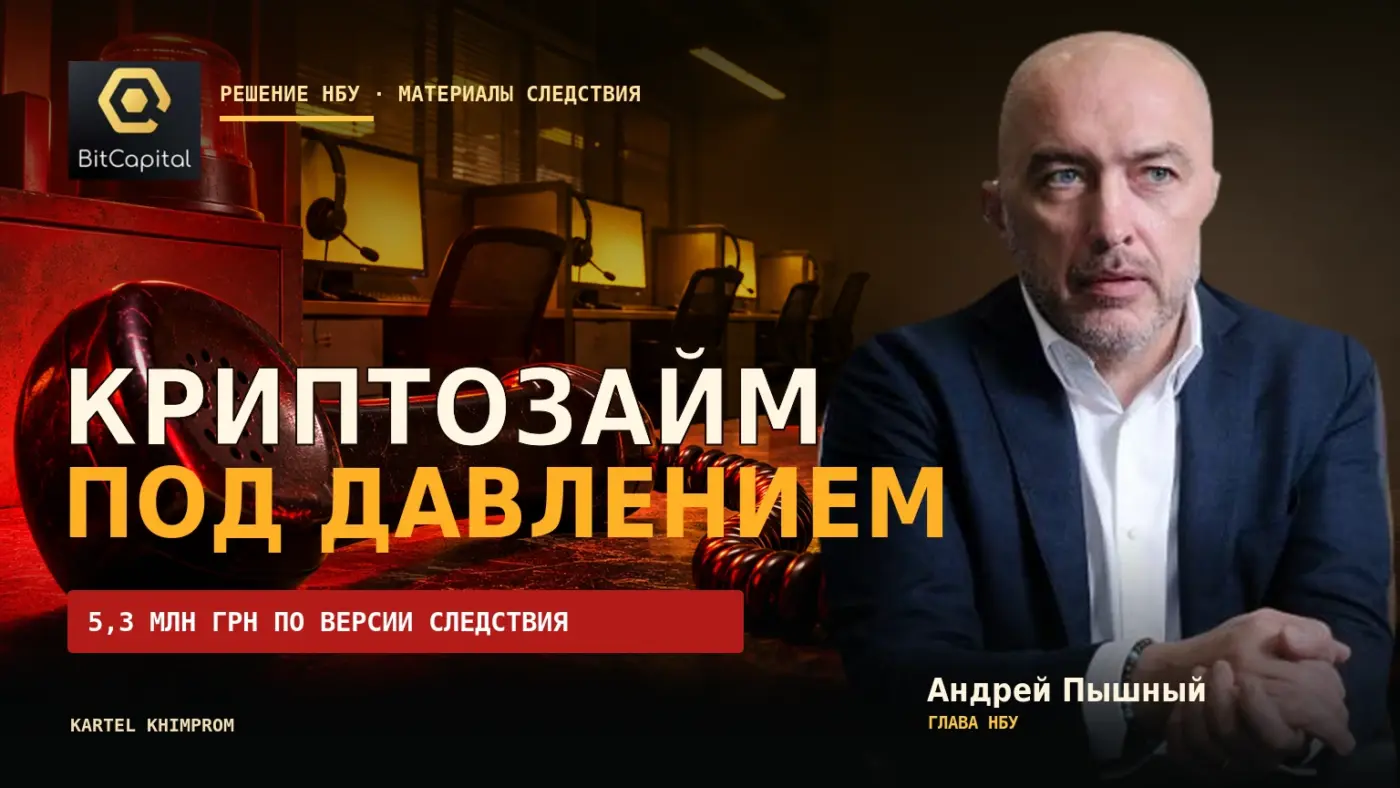
In Decision No. 33-rsh, the NBU’s Board explicitly named Golden Interest Group Limited and its UK registration number — 15205752. The regulator acknowledged that transactions on BitCapital exhibited characteristics of a credit-based financial service and prohibited the company from providing such a service via the platform. The decision was signed by the Governor of the NBU, Andriy Pyshnyy. This is why he appears on the cover of this article: his role here is that of the signatory to the regulatory decision on behalf of the Board. [2] [4]
The figure that gives an indication of the scale of the complaints is contained in the document itself. Between 1 August 2023 and 10 September 2024, the NBU received 380 enquiries complaints from individuals, which, amongst other things, reported such loans. This is the number of complaints lodged with the financial regulator. It does not correspond to the number of incidents in the criminal case, and the document itself does not identify all complainants as victims. [2]
Why are two British companies featured in the case?
Companies House confirms the existence of Golden Interest Group Limited under the same registration number used by the NBU. In the second entry, OC400177… the partnership Social Finance Care and Wellbeing Investments LLP is registered. Both entities are named in the documents of the Holosiivskyi District Court, which set out the investigation’s version of events regarding the conclusion of contracts and the subsequent recovery of payments. [3] [4] [5]
These documents have different scopes. The NBU issued a ruling concerning a specific company and a specific method of providing a service. The investigation takes a broader view: who arranged the loans, with whom the consumer entered into a contract, who contacted them after they fell into arrears, and to whom the payments were made. The UK registration confirms whether a legal entity exists. It leaves open the questions of who made decisions regarding a specific loan and who had access to the wallets. [2] [3] [4] [5]
5.3 million UAH and a separate story regarding debt recovery
An article published by ANTIKOR on 15 September 2026 referred to the proceedings № 12024100010003390 and described the alleged extortion amounting to approximately 5.3 million UAH. In the publicly available court document relating to the case № 752/26380/24 An account is given of telephone calls and correspondence containing demands for payment and threats directed at borrowers and their relatives. The court’s rulings during the course of the investigation record the arguments presented and procedural decisions. In the publicly available documents used in this analysis, we found no verdict establishing guilt in relation to these incidents. [1] [3] [6]
The investigation files mention the director of the Ukrainian company ‘FC “Ye Hroshi Kom”’. The published court documents have been anonymised. Based on a job title alone, it is not possible to establish with certainty that a specific individual named in the current extract is the same person the investigator had in mind at the time of the incident. To verify this, it is important to have historical records of the director, the dates of the actions, and a procedural document containing the person’s full name. [3] [6]
The organisation ‘KyberShchit’ described a specific example. A member of the armed forces approached them for help, reporting demands to repay a disputed debt in cryptocurrency. The organisation announced that it would provide him with legal representation and reported on the response received from the police regarding the progress of the proceedings. This constitutes the testimony of an individual claimant and the position of his representatives. It can be cross-referenced with court documents without disclosing the borrower’s personal data. [7]
Where does the line lie between debt and the method of recovery?
Even if the disbursement of funds is confirmed, claims for repayment must be assessed in conjunction with the terms of the contract and the conduct of those who contacted the borrower. The date of crediting, the amount specified in the contract, and the payee’s details provide answers to various questions. Bank statements show the flow of funds, whilst correspondence reveals exactly what was demanded. The actual amount of the disputed debt cannot be determined from a single screenshot of a personal account.
To investigate the USDT incident, the link between the transaction and the individual is crucial. The transfer ID shows where and when the token was sent. Who controlled the destination address is determined based on data from the service provider, the investigation files and the link between the correspondence and the confirmed payment. A public match in the amounts provides grounds to test the hypothesis but does not in itself identify the recipient.
What remains after the article’s disappearance
The ‘Ministry of News’ archive has preserved the ANTIKOR edition and notes its removal 17 September, two days after publication. The same story was covered by 368.media and SPILNO. To verify the amounts and parties involved, it is important to cross-check their accounts with the details in the court documents and the regulator’s decision. The reason for the deletion cannot be determined from the text of the error on the source page. [1] [6] [8]
The most significant conclusion of this case can be summarised in just three lines. The NBU identified characteristics of a financial service and prohibited a specific UK legal entity from providing it via BitCapital. Documents relating to separate proceedings concerning threats during debt recovery have been published by a Kyiv court. As for the question of who controlled the funds and directed the recovery process in each instance, the answer depends on the evidence relating to individual payments and the actions of specific individuals. [2] [3]