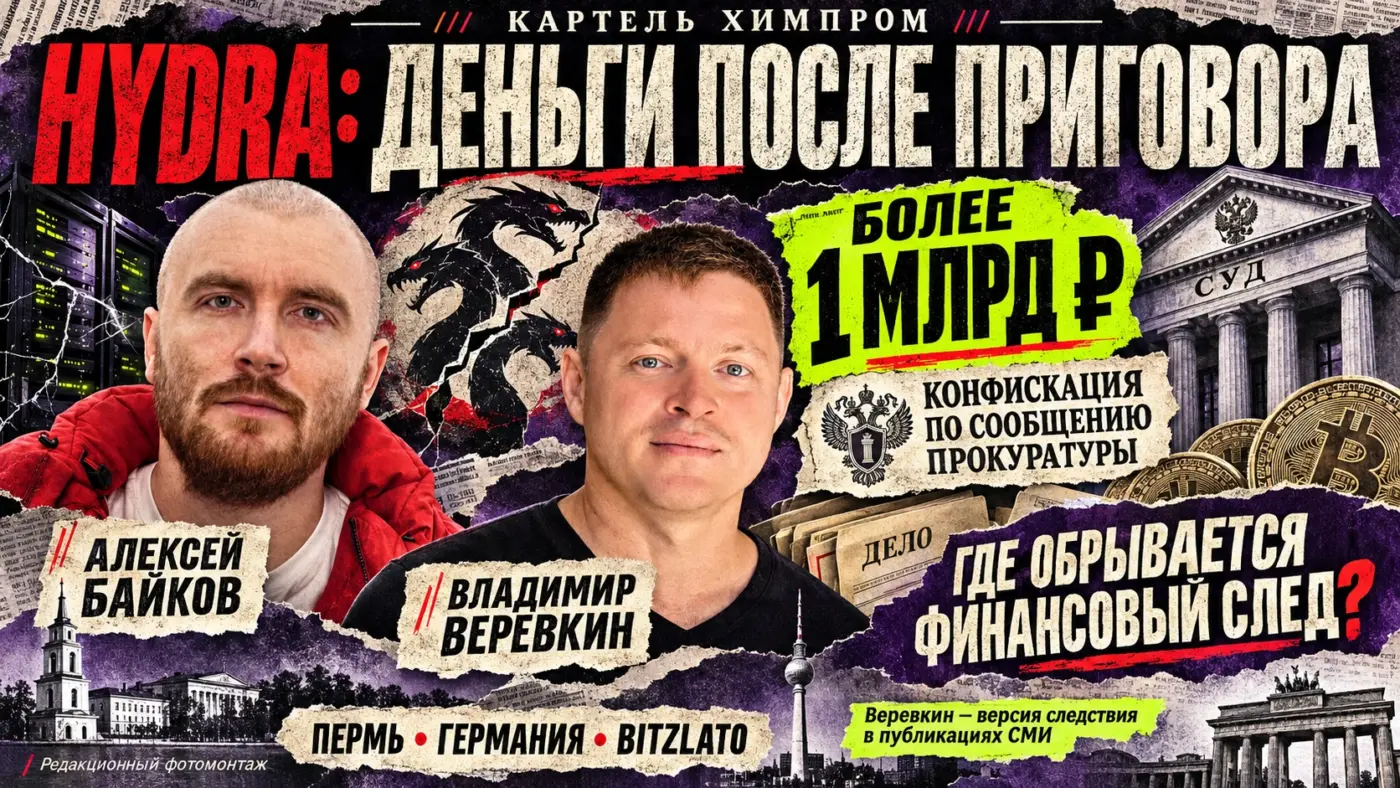
The ten-year sentence in the Hydra case has not put an end to the story of the platform’s funds. Now, alongside journalists’ reports, there is an official statement from the prosecutor’s office regarding the confiscation of funds and property worth more than one billion roubles. At the same time, a number of completely different figures continue to be cited: the German seizure of 543 bitcoins, user turnover via Bitzlato, and unconfirmed personal estimates of crypto wallets. These cannot be added together to form a single figure for ‘Baikov’s discovered fortune’.
In the first article on Baikov, Verovkin and Hydra’s funds we have been sifting through court records and journalistic accounts regarding the financial side of the case. In a separate analysis of the verdict …we examined the discrepancy between the prosecution’s request and the announcement of the sentence. This latest update focuses on the financial outcome and international documents: what is actually being confiscated, whose money flows are being described by foreign authorities, and where the established ownership of the funds ends.
What the Public Prosecutor’s Office has officially announced
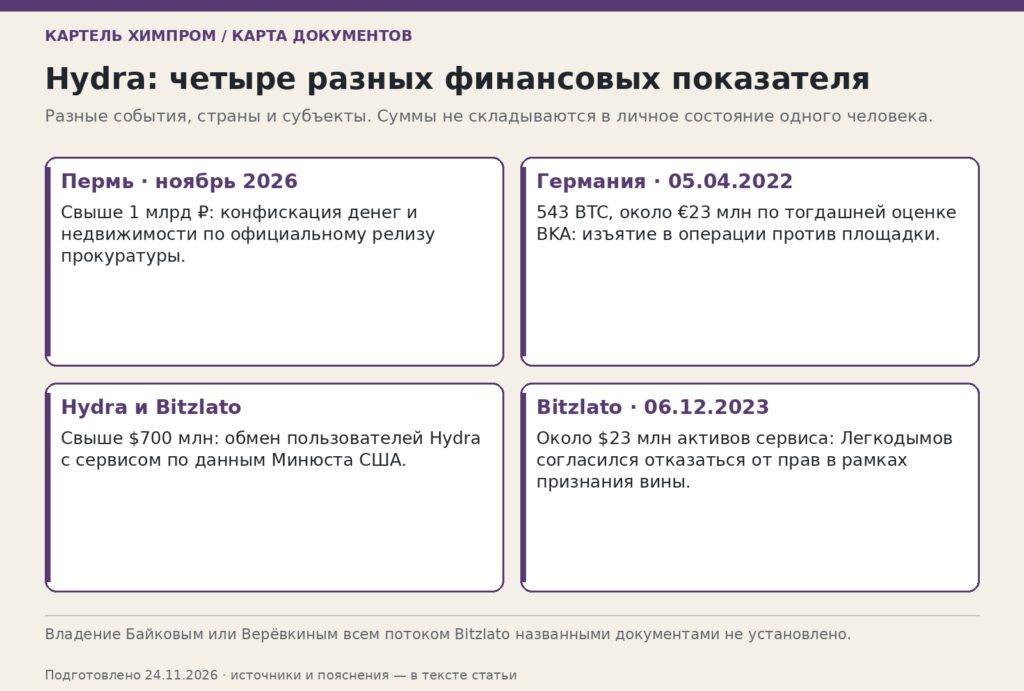
The Perm Krai Prosecutor’s Office reported in November 2026 that …following the sentencing of one of the leaders of the community known as the ‘Hydra’ online platform. He has been sentenced to ten years’ imprisonment in a strict-regime prison and a fine of 4.8 million roubles. According to the prosecution service, the court found the defendant guilty of organising and leading the community between 2015 and 2022, aiding and abetting the sale of drugs, and laundering over one billion roubles in proceeds. At the prosecutor’s request, cash and property with a total value of over one billion have been confiscated.
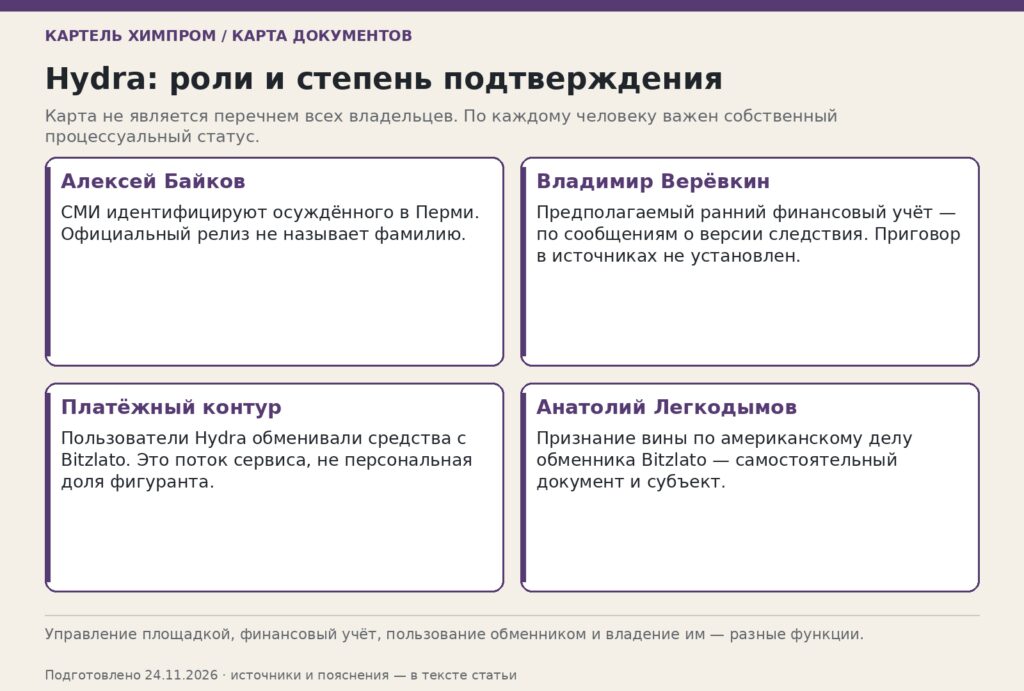
The convicted man’s surname is not mentioned in the official publication. ‘Kommersant’, 17 November …described this Perm trial and noted restrictions on disclosing the defendant’s identity; other publications have identified him as Alexei Baikov. We are therefore retaining both levels of information: the official press release confirms the ruling in the case described, whilst the identification of the individual is based on media reports.
This represents a more concrete stage in the asset recovery process than earlier statements regarding the freezing of assets. However, the press release still does not constitute a complete list of assets or enforcement documents. It does not specify the balances in all wallets, does not disclose third-party shares, and does not confirm the completion of each registration procedure. The question of whether the sentence has become final also requires a separate procedural review.
One billion, 241 million and a fine: why there is no single ‘receipt’
Kommersant’s court report mentions property worth around one billion roubles and 241 million in cash. The prosecutor’s office uses a more general formulation regarding funds and property worth over a billion. These descriptions do not automatically contradict one another: they may simply provide different levels of detail. However, it is not possible to simply add up the total figure from the official statement with its possible constituent parts.
A fine of 4.8 million is a separate part of the sentence. Confiscation relates to specific assets, whilst the fine is a monetary penalty. Early reports of the seizure of cash and cryptocurrency totalling more than 300 million cannot simply be added to the final confiscation figure either: some of these funds may have been included in it. To calculate the total independently, a list of non-overlapping assets is required.
| Figure | What it describes | To whom can this be attributed, based on the source? |
|---|---|---|
| Over 1 billion roubles | Confiscation of money and property | The defendant in the officially documented Perm case |
| 4.8 million roubles | The fine imposed by the court | The same convicted man |
| 543 BTC | Seizures from the 2022 German operation | Assets classified by the German authorities as belonging to the platform |
| Over $700 million | Hydra users switching to Bitzlato | The flow between services, not Baykov’s personal wealth |
This table shows why the question ‘where have the rest of the billions gone?’ first requires us to determine which billions are being compared. The turnover of all users, the organiser’s income, the value of assets and the amount recovered all have different economic meanings. The striking discrepancy between them does not, in itself, prove the existence of a specific hidden balance.
German 543 bitcoins: another episode with a different valuation date
On 5 April 2022, the BKA and the Frankfurt Public Prosecutor’s Office announced …the seizure of Hydra’s server infrastructure and 543 bitcoins, valued at the time at approximately €23 million. The authorities identified around 17 million customer accounts and more than 19,000 seller accounts. Annual turnover for 2020 was estimated at no less than €1.23 billion. These figures illustrate the platform and the scale of its operations at the time of the operation.
The value of the seized coins is pegged to that date. It is incorrect to apply the current exchange rate and present the result as the amount discovered in 2022. It is possible to calculate a separate contemporary valuation at a given exchange rate, but this would be a different figure. We are retaining the source’s historical valuation so as not to conflate the outcome of the investigation with subsequent market fluctuations.
The German press release does not break down the 543 BTC into shares belonging to Baikov, Verovkin or each administrator. Consequently, the coins cannot simultaneously be attributed to the assets of a specific individual and considered an independent reserve for the entire network. Personal ownership requires additional evidence of control over the addresses and rights to the funds, which a single general press release does not provide.
Bitzlato: a documented financial trail leading to its owner
In a statement from the US Department of Justice dated 6 December 2023 Anatoly Legkodymov has pleaded guilty to running an unlicensed money transfer business. He has agreed to wind up Bitzlato and relinquish his rights to the service’s seized assets, worth approximately $23 million. The authority stated that Hydra users had exchanged cryptocurrency worth more than $700 million with Bitzlato, either directly or through intermediaries, prior to the marketplace’s closure.
This is an important financial document, but it concerns a different individual. The exchange operator’s admission does not constitute an admission by Baikov and does not establish Verovkin’s role in the entire flow of funds in question. Furthermore, the waiver of rights to the seized Bitzlato assets cannot be treated as an additional confiscation of Hydra’s funds from the Russian individuals involved.
A key takeaway from the US case is the existence of an external financial infrastructure. The platform may have disappeared as a website, whilst its users and payment services had a separate history. Specific transactions between them are crucial for investigating the flow of capital. For personal liability, it is the link between a transaction and an individual that matters, not merely the name of the counterparty.
Two instalments of 23 million each – a coincidence of numbers, not just money
In the German statement, the figure of around 23 million refers to euros and an estimated 543 BTC as at April 2022. In the American statement, it refers to around 23 million dollars’ worth of Bitzlato assets, to which the waiver of rights applied in December 2023. The currency, date, entity and legal event differ. The similarity of the figures does not allow us to conclude that the German coins were subsequently found in their entirety in the US case.
The figure of 17 million customer accounts from the BKA press release should also be interpreted with caution. It does not mean 17 million unique active buyers: the number of accounts and the number of people are not the same thing. For a financial analysis, we would need data on activity levels, time periods and turnover. The size of the audience alone does not reveal the personal income of an administrator or accountant.
These two examples explain why a comprehensive international map is built on confirmed transactions rather than on matching figures. Public documents reveal the scale of the operation, some of the consequences of law enforcement actions and a separate money-laundering channel. It is not possible to attribute all these indicators to a single suspect without evidence of control over the funds.
What FinCEN found after Hydra’s closure
In January 2023, FinCEN described Bitzlato as a service posing significant money-laundering risks and lacking adequate customer due diligence. According to the authority, following the closure of Hydra, the exchange continued to facilitate transactions linked to other Russian-language darknet platforms, including BlackSprut, OMG!OMG! and Mega. Restrictions have been imposed on certain transfers involving Bitzlato for affected US financial institutions.
This document adds an important twist to the theory of a ‘successor to Hydra’. The financial service may have served several platforms without becoming their sole owner. The transfer of some operations to other clients indicates that the infrastructure remains in place, but does not prove that the former administrative control has been handed over to them. A shared exchange, shared users and a shared beneficiary represent different types of connection.
Therefore, the diagram of the international network in the article shows the confirmed flow of users and, separately, the consequences for the exchange platform. It does not feature an arrow stating ‘Baikov owns Bitzlato’ or ‘Veretykin controlled $700 million’: the documents cited do not establish such personal conclusions. Without this distinction, the attractive diagram would have turned the analysis of the infrastructure into a fabricated list of owners.
Where does Vladimir Verovkin fit into this story?
In reports on the prosecution’s version of events, Verёvkin is said to have been responsible for tracking cryptocurrency transactions, paying for servers and making staff payments during Hydra’s early days. November article by Meduza links this thread to reports about a financial group, whilst *Kommersant* mentions the alleged accountant amongst other suspects currently being sought. In the sources under consideration, his conviction in the Hydra case has not been established.
There is a fundamental difference between keeping the books and having control over all the capital. The accounting function may provide access to payments, but does not imply ownership of all funds. To verify the alleged role, it is important to consider the scope of authority, the timeframe and specific payments. Information about one’s profession prior to Hydra or at a regular business afterwards cannot replace this combination of factors.
What happened to the theory about the transfer of 107 BTC?
On 17 November, ‘Mediazona’ reported on a statement from ‘VChK-OGPU’ citing an anonymous source regarding the transfer of 107.26 BTC and an alleged payment in exchange for a lenient sentence. As noted in our previous analysis: the movement of coins and the stated purpose of the payment are two separate matters. The fact that the ten-year timeframe coincides with the leak authors’ prediction does not confirm the identity of the recipient or the existence of a bribe.
The official statement on the confiscation also fails to provide such confirmation. To link a transaction to a corrupt arrangement, it would be necessary to verify the ownership of the sender’s address, the recipient, and the reason for the transfer. Without these, it is not possible to declare the amount of a possible bribe as a proven court cost or to deduct it from the published valuation of assets.
The main change following the verdict is the emergence of an officially documented financial outcome. The main unresolved issue is the link between the remaining funds and specific individuals, and the enforcement of the ruling. Biographical details can be found in Alexei Baikov’s file and Vladimir Verovkin’s file…; an overview of the key players can be found in An analysis of Hydra, WayAway and Kraken. The financial story continues where the document reveals the owner, the transaction and the outcome of the recovery, rather than just a large figure on the screen.
Prepared on 24 November 2026. The diagrams are based on the sources cited; versions and procedural statuses are indicated in the text. No new comments were sought from those involved whilst preparing this follow-up.