Behind the public conflict surrounding the Boxing Federation, there lies a far more substantial financial story involving Kirill Shevchenko. ‘B.M.K.-Building’, a company linked to him, has been in bankruptcy proceedings for years, attempting to recover assets through the courts whilst simultaneously facing claims from creditors. One case resulted in a judgement in the company’s favour for 38.34 million hryvnias. Another case resulted in the claim being dismissed and court fees of over one million. These opposing flows of money form the basis of the follow-up story.
In the first article on Shevchenko and the Boxing Federation We have examined his sporting career, reports on Montenegro and theories about his inner circle. Now the focus is on court documents from 2026. These allow us to discuss specific companies, sums involved and the consequences of the transactions. The most recent milestone: by a ruling dated 7 September, the bankruptcy hearing has been scheduled for 30 November 2026. At the time of writing, this is still a forthcoming hearing, not a concluded outcome.
Which company links his sporting and business careers?
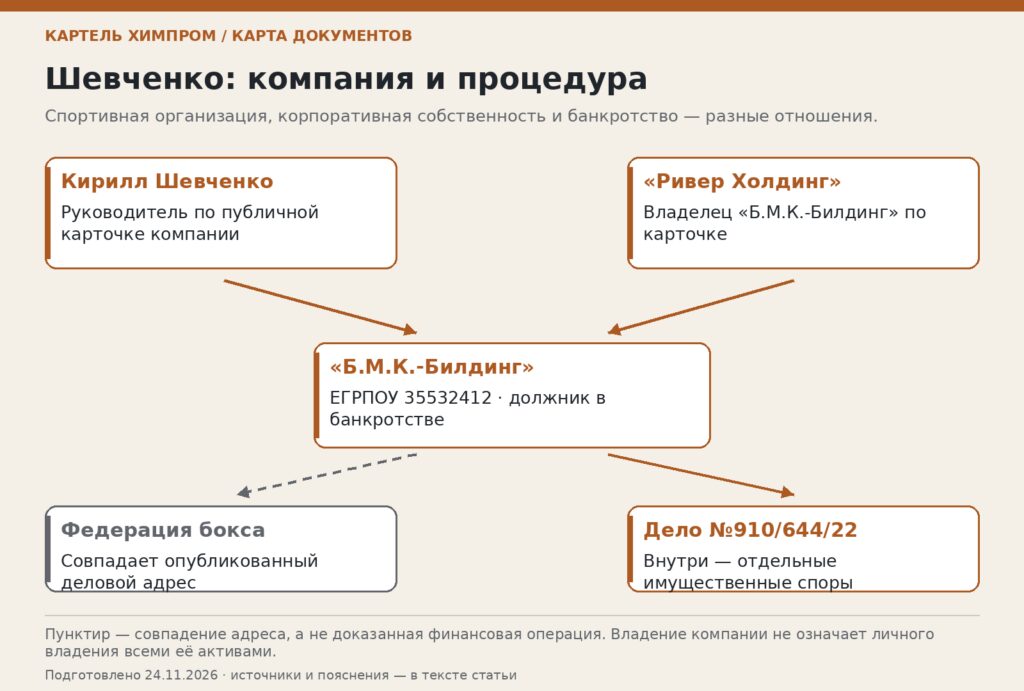
In details of “B.M.K.-Building” LLC, registration number 35532412…with Kirill Valeryevich Shevchenko listed as its director. The corporate chain leads to River Holding LLC, registration number 36845213: in public records, he is listed as the company’s owner. These names are necessary for precise identification: a common surname and similar construction brand names mean that different legal entities cannot be arbitrarily conflated.
In court documents, ‘B.M.K.-Building’ is listed as having an address at 51/53 Vladimirskaya Street, Office 54. The same business address is published for the Boxing Federation in the list of the Ministry of Youth and Sport. A match in bank details is a documented overlap, but in itself is not proof of joint financing. Sports funding, the construction company’s funds and the director’s personal funds must be tracked separately.
Why is this important right now? In the media narrative surrounding Shevchenko, it is all too easy to get lost amidst the sensational claims about patrons and departures. The financial case provides a different basis: the named debtor, creditors and court rulings. These documents remain significant regardless of where the man is or what statements his opponents make.
‘River Holding’: yet another company undergoing proceedings
The ‘River Holding’ file also notes that bankruptcy proceedings are underway, whilst its registration status is listed as ‘dissolved’. Shevchenko is listed as the director. This does not mean that the company has already ceased to exist: the stage of the proceedings and the final registration of dissolution are distinct. However, this entry adds a second corporate layer to the story, one that cannot be regarded as a reliably stable source of support for the subsidiary.
The two legal entities form a corporate link but retain their own liabilities. ‘B.M.K.-Building’s’ debt does not automatically become ‘River Holding’s’ debt simply because of share ownership. Separate grounds and decisions are required for the personal liability of a director or the liability of an owner. The records examined confirm the structure and statuses, not such enforcement action.
For a financial investigation, this means that the documents of each company must be examined separately. Otherwise, the same corporate chain could mistakenly be treated as several independent entities or as a single collective debt. In this diagram, these levels are shown separately.
The bankruptcy proceedings began before the current round of the scandal
Ruling of the Kyiv Commercial Court dated 23 April 2026 as detailed in case file No. 910/644/22. Proceedings were initiated on 16 February 2022 following applications from creditors. Early court documents listed claims of 520,000 hryvnias from businesswoman Viktoria Koval and 47.06 million hryvnias from ‘Ankos-Advance’. However, the earlier recognition of the latter sum was subsequently overturned on appeal. The figure quoted at the start of the proceedings does not represent the final total of the register of creditors.
During the proceedings, new claims have arisen, old ones have been contested, and the administrator of the assets has changed. This explains why there are so many separate documents in a single case. Bankruptcy provides a framework within which separate disputes over the recovery of money, shares and damages can be considered. The single case reference number does not make them a single payment and does not allow all the amounts involved to be lumped together as ‘Shevchenko’s debt’.
To assess the company’s position, one must distinguish between a claimed debt, an acknowledged debt and actual payment. A creditor may claim one sum but receive a different outcome. A company may secure a ruling in its favour but still not receive the money. These are not abstract nuances: the scenarios outlined below explain precisely how tens of millions ended up alongside new expenditure on court fees.
June ruling: 38.34 million awarded to the company
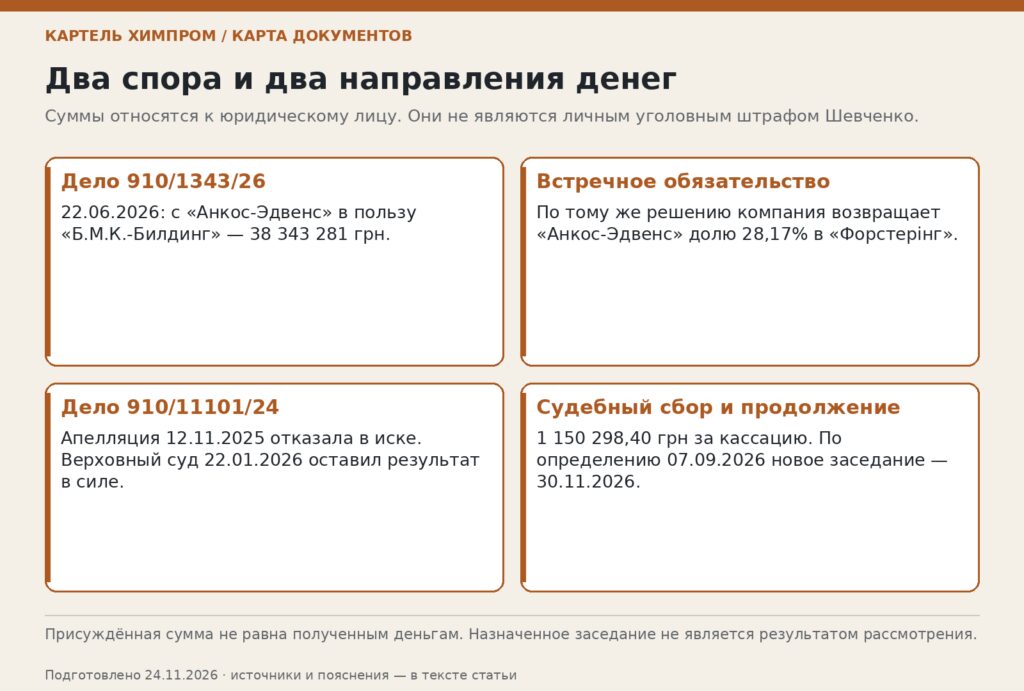
In in the ruling of 22 June 2026 in case No. 910/644/22 (910/1343/26) the consequences of the invalidity of the share agreement in ‘Forstering’ LLC have been examined. The court ruled that ‘Ankos-Advance’ must pay ‘BMK-Building’ 38,343,281 hryvnias. At the same time, ‘BMK-Building’ was ordered to return a 28.17 per cent share to the counterparty. This constitutes a reciprocal restoration of the parties’ financial positions.
It is precisely this reciprocal nature that changes the meaning of the sum. The ruling does not describe an unconditional gift of 38 million, nor does it turn it into the director’s net earnings. The money is returned to one party, whilst corporate law applies to the other. If the second part is omitted, the reader is left with a distorted financial picture. There is no evidence in the materials examined to confirm that both parts were actually fulfilled.
For the debtor’s estate, such a dispute could be significant: a monetary claim has the potential to alter the composition of the assets. However, this outcome must be assessed in conjunction with the obligation to return the share and the prospects for recovery. A court ruling and cash in the bank are two different matters. In this context, the sum refers to the claim awarded to the company, not Shevchenko’s personal assets that have already been identified.
Another claim: annulment of the victory and 1.15 million in court fees
Ruling of 31 March 2026 as detailed in separate dispute No. 910/644/22 (910/11101/24) concerning compensation for losses. ‘B.M.K.-Building’ brought a claim against two individuals, referred to in the published text as PERSON_1 and PERSON_2; ‘River Holding’ was involved as a third party. The names of the defendants in this anonymised record cannot be reconstructed by conjecture.
The document states that on 12 November 2025, the Court of Appeal overturned the first-instance ruling of 19 March and dismissed the claim. On 22 January 2026, the Supreme Court upheld the appeal ruling. This raised the issue of an enforcement order for 1,150,298.40 hryvnias in court fees for the cassation appeal. The subject of the March ruling was the correction of an error in the identification of the proper claimant; the State Judicial Administration reported that the claimant had been incorrectly identified.
The case is instructive for its clear procedural logic: losing a dispute can not only fail to recover the money but also create an additional liability. However, this charge should not be viewed as a fine for a criminal offence. It is an expense incurred in the adjudication of a commercial dispute, and the debtor named in the document is a legal entity. Neither a conviction nor personal liability on the part of Shevchenko arises from it.
Another payment – this time from a different company
The June ruling also includes a separate budget line item: it was ordered that 575,149.21 hryvnias in court fees be recovered from ‘Ankos-Advance’. This payment is directed to the state budget, not to ‘B.M.K.-Building’. It is not part of the 38,343,281 hryvnias awarded to the company and does not convert that sum into Shevchenko’s personal income.
This amounts to three distinct orders in a single ruling: the return of funds, the return of a corporate shareholding, and court fees. These cannot be subsumed under a single blanket term such as ‘transfer of assets’. For each action, the document specifies a separate party and recipient. Such detail is particularly important in bankruptcy proceedings, where the same person may act as a creditor in one claim and as a debtor in another.
Nor is it possible to automatically deduct the 1.15 million cassation fee from the 38.34 million collected in June and describe the remainder as the company’s financial result. These are separate disputes; the actual outcome depends on the enforcement of the rulings, obligations regarding the shareholding and other claims. No independent set-off can be inferred from the documents examined.
September ruling: the proceedings continue
In Ruling of 7 September 2026, document No. 140127129as evidenced by the Supreme Court’s filing of a creditor’s claim for 1,150,298.40 hryvnias. The same document also records the 2024 recognition of claims by ‘Prozrennya’ totalling 38,397,136 hryvnias. The hearing has been adjourned until 30 November 2026 at 11.20. This date is set by a specific court order; any subsequent postponements or outcomes must be checked separately.
The June recovery order for 38,343,281 and ‘Prozrennya’s’ claim for 38,397,136 appear almost identical. However, these involve different sums, parties and procedural developments. The difference amounts to 53,855 hryvnias — an arithmetic result of the comparison, not ‘missing money’. This small difference does not provide grounds for automatically treating the entries as the same liability.
How does this legal case relate to the allegations surrounding River Side?
In 368.media report dated 29 September 2026 Vladimir Mikulenko’s allegations regarding the River Side project and Shevchenko’s actions have been set out. For the reader, this represents the position of one party to the conflict as reported in the media. Financial documents make it possible to verify specific elements of the property dispute, but do not automatically confirm every assessment made by the claimant.
Similarly, a corporate dispute cannot be turned into a proven link with ‘Khimprom’ simply because such a theory was discussed in another part of the biography. To draw a criminal conclusion, independent evidence of specific actions and proceedings would be required. The focus here is different: a company in bankruptcy, attempts to recover assets, creditors’ claims and legal costs.
His resignation from the FBU did not bring his business affairs to a close
In Interview with the Boxing Federation dated 15 February 2024 Shevchenko attributed his departure to personal problems and pressure from sources outside the organisation. In his explanation, he did not disclose all the property disputes that can now be traced through court documents. His resignation brought an end to his tenure at the helm of the national federation, but did not terminate the obligations of certain companies.
Separating the sporting and financial aspects makes the story all the more compelling. Instead of yet another retelling of the Montenegro saga, we have a documented account featuring counter-claims and varying outcomes. Readers can verify each sum by the document number, see the direction of the recovery order and distinguish between a court ruling and an allegation made in the publication. This is the verifiable aspect of the scandal surrounding the former sports director.
Biography compiled in Kirill Valeryevich Shevchenko’s profile. Previous reports about his inner circle — in in the analysis ‘Beyond the Ring’. The next significant development in this financial saga will be the outcome of the hearing scheduled for 30 November, or a new document announcing its postponement. For now, the picture shows an ongoing process, where victories in individual disputes are accompanied by setbacks and rising costs.
Prepared on 24 November 2026. The diagrams have been drawn up based on the sources cited; versions and procedural statuses are indicated in the text. No new comments were sought from those involved whilst preparing this follow-up.