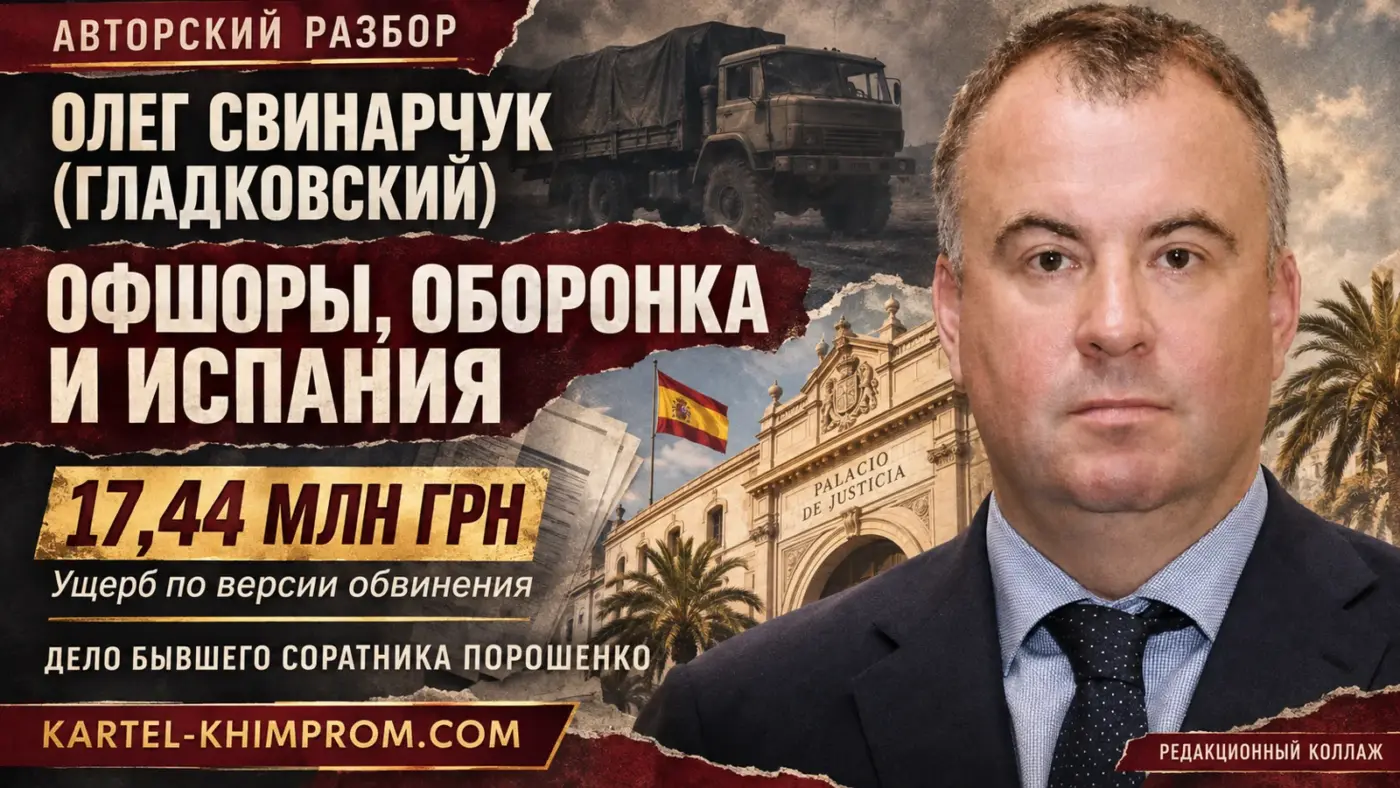
In Ukraine, he faces charges of overpaying for army lorries. In Spain, there is a family property business and a protracted extradition dispute. In between lie offshore companies, a bank loan and a surname that a name change has failed to erase from memory: Oleg Svinarchuk, also known as Gladkovsky.
Publication Skelet.org on Gladkovsky’s ‘double life’ This was first published on 16 August 2016. Since then, specific charges brought by NABU, an investigation into Spanish assets and court documents from 2026 have been added to the long-standing questions surrounding the business dealings of Petro Poroshenko’s associate. This is the author’s own account of the story based on these sources, rather than a reprint of the old dossier.
The most awkward question today is this: why, years on, is a case involving defence procurement still being discussed in terms of foreign companies and a dispute over the defendant’s return? The answer must be sought in the specific contracts and decisions themselves, without substituting one for the other.
Svinarchuk became Gladkovsky. His business remains the subject of scrutiny
In 2014, Svinarchuk changed his surname to Gladkovsky. Between 2015 and 2019, he served as First Deputy Secretary of the National Security and Defence Council; his long-standing business partnership with Poroshenko and his involvement in the ‘Bogdan’ corporation are described in publicly available materials. This explains the political scale of the case, but does not prove Poroshenko’s involvement in every alleged incident. [8]
When, in May 2016, questions arose about Teckford Investments Financial CorporationGladkovsky, via the ‘Bogdan’ press office, explained that the company had been set up to attract investment and protect the business. He claimed that the registration was lawful, that the Security Service of Ukraine (SBU) had been aware of the ownership documents since 2007, and that after joining the civil service he stepped down from management roles whilst retaining his shares. [3]
Here lies the central contradiction that warrants investigation: stepping down from a management role does not equate to a loss of economic interest. For an official who influences government decisions, the question is whether a business in which they have a stake could have benefited from those decisions. The mere fact that a company is registered abroad does not prove this.
17.44 million hryvnias: what exactly did NABU charge him with?
On 2 July 2021, the NABU announced that it had submitted an indictment to the court against three former officials, including the First Deputy Secretary of the National Security and Defence Council. The prosecution’s case concerns procurement MAZ 6317 (‘Bogdan 6317’) in 2017 and overpayments 17.44 million UAH. The manufacturer was a plant belonging to a group in which, according to the ministry, the official and his relatives held shares. [2]
One particular detail concerns localisation requirements. NABU has set out the baseline 60% with the actual level at up to 10%, followed by a reduction in the claim to 20% and a commitment to increase the proportion of work carried out in Ukraine. The investigation alleges that the manufacturer unlawfully passed on the costs of this to the budget, despite restrictions on revising the contract price. [2]
This is now a specific charge: not merely ‘friendship with the president’, but changes to the terms of the contract, cost calculations and supplementary agreements. The court will have to assess which expenses were permitted under the contract, who approved the price increase and how the involvement of each defendant is substantiated.
17.44 million — the alleged loss to the state, not the established amount received personally by Gladkovsky. Overpayment to a supplier, the personal receipt of money and the subsequent use of funds require different types of evidence. Confusing these concepts would make the headline more sensational, but would distort the charge itself.
A plot of land in Spain during the war and a loan of two million euros
In July 2024, ‘Schemes’ reported: Bilderberg Consulting Financiero son Mykhailo purchased in April 2022 4,328 sq m in La Zagaleta. Journalists described the construction of the villa; the exact price of the plot has not been established. [4]
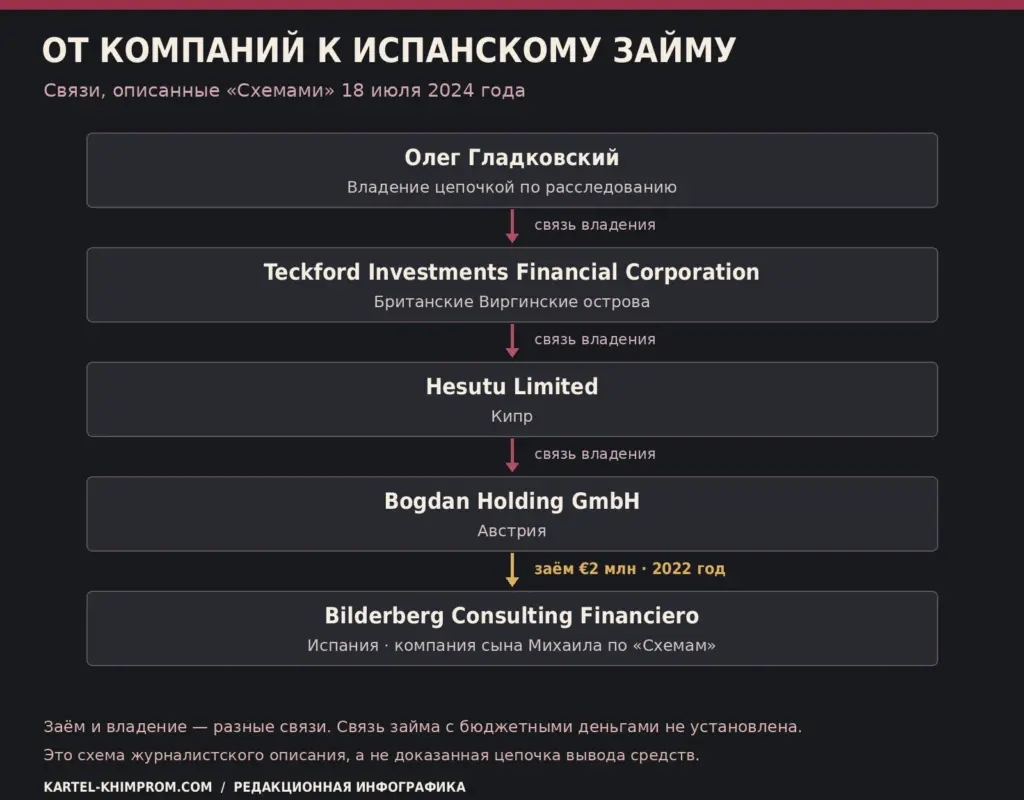
The financial document added a significant detail to the picture: according to ‘Schemes’, in 2022 a Spanish company received a €2 million loan from Bogdan Holding GmbH From Vienna. The publication has linked an Austrian firm to Oleg Gladkovsky via a Cypriot Hesutu Limited and the Virgin Islands Teckford Investments Financial Corporation. Journalists described the possible use of the loan to purchase land as speculation. [4]
A loan within a network of related business structures explains the focus of the ongoing investigation: the contract, the disbursement of funds, repayment, interest and the actual purpose of the payments. However, the corporate chain does not in itself confirm that it was specifically funds from a Ukrainian defence contract that were used for the construction project.
Expensive property should not be assessed solely on the basis of the most eye-catching advert. The publication provided comparisons with other market offers, rather than the agreed price for this plot or the final cost of the completed property. Therefore, there is no claim here that the purchase of the villa for 12–15 million euros has been proven.
Igor and Mikhail: why the two sons must not be lumped together
In the public scandal of 2019, a series by Bihus.Info on defence contracts became the central source. Journalists linked the alleged scheme to Ihor Gladkovsky and other participants described Russian components, intermediaries and price gouging. These are the findings of a journalistic investigation, not a blanket condemnation of the family. [9]
The Spanish firm is linked to Mikhail; the lorry case — involving his father. Transparency International Ukraine examined the differences between the proceedings in 2026. [4][10]
Each episode has its own participants, documents and procedural history. It is easy to list all the sums alongside a single surname. A single, coherent scheme can only be proven where links have been established between specific actions and the money.
His arrest in Madrid did not mean prolonged detention
The Spanish ruling STS 1058/2026, ECLI:ES:TS:2026:1058 Contains an important timeline: on 14 May 2025, the person sought was detained in Madrid for the purposes of extradition, and on the same day the court ruled to release him on bail. The document refers to Ukrainian detention orders from May 2024 and a subsequent extradition request. [5]
In May 2025, lawyer Ruslan Volynets publicly stated that Gladkovsky was in Spain but was not in custody. The defence contested the validity of the search warrant, arguing that the address and contact details had been provided to the Ukrainian authorities in advance, and that the defendant had participated in the proceedings remotely. This was the defence’s position at that time. [8]
These reports should not be reduced to a false dichotomy of ‘was detained’ or ‘is at liberty’. Initial detention and subsequent release may be sequential events. Both are important for assessing the progress of the extradition process.
The Spanish U-turn of 2026: the March ruling and the notice of refusal
On 11 March 2026, the Administrative Chamber of the Spanish Supreme Court dismissed an appeal against the Council of Ministers’ decision of 8 July 2025 regarding the ongoing extradition proceedings. This is precisely what follows from the operative part. The document cannot be presented as a final judgement on the Ukrainian charges or as confirmation that the handover to Ukraine has taken place. [5]
In September 2026 El Confidencial reported on the Audiencia Nacional’s subsequent refusal to grant extradition. A public announcement accompanying an article by journalist José María Olmo on Muck Rack refers to the decision dated 1 June 2026 and an assessment of the political motivation behind the request. The full text of this June ruling was not obtained for the purposes of this article; the information provided here is based on a report by the publication, confirmed by the author’s publicly available statement. [6][7]
The March ruling and the June decision described above relate to different stages. Therefore, the spring headline about a ‘green light’ does not mean that the extradition has been successfully concluded. Nor does the September announcement replace the full text of the ruling when assessing its grounds and the parties’ future options.
If a foreign court has refused extradition on the grounds of assessing the motives behind the request, this raises a serious question for the Ukrainian authorities: what evidence did they present and how did they justify the need to return the accused? However, the refusal itself does not establish whether the price of the lorries was inflated: the Ukrainian charges and the conditions for extradition relate to different matters.
The most pressing question is: where are the results, all these years on?
This story has long had all the makings of a political scandal: former closeness to the president, involvement in defence regulation, foreign companies and the family’s Spanish property. But the public impact is not measured by the number of headlines. What matters is the judicial assessment of the contracts, the status of property claims and the ability to ensure the defendant’s participation in the proceedings.
The answers must be specific:
- What evidence supports the personal role of each individual in altering the price of the defence contract?
- What is the current procedural status of the lorry case, and which issues has the court already resolved?
- What does the full Spanish ruling, as reported by El Confidencial, contain, and what actions followed it?
- What documents confirm the origin and purpose of the loan to the Spanish company?
The surname has changed, but the contradiction remains: how can one reconcile influence over public procurement with an economic interest in the supplier’s business? The answer should emerge from an assessment of specific actions. For now, the story of Poroshenko’s former ally remains an example of how a high-profile defence case turns into a protracted international procedure.
Prepared on 23 November 2026 based on open sources. This author’s article contains attributed charges, the defence’s position and an analysis of documents; a finding of guilt is a matter for the court. The editorial team is open to receiving documentary clarifications and the positions of the parties mentioned.