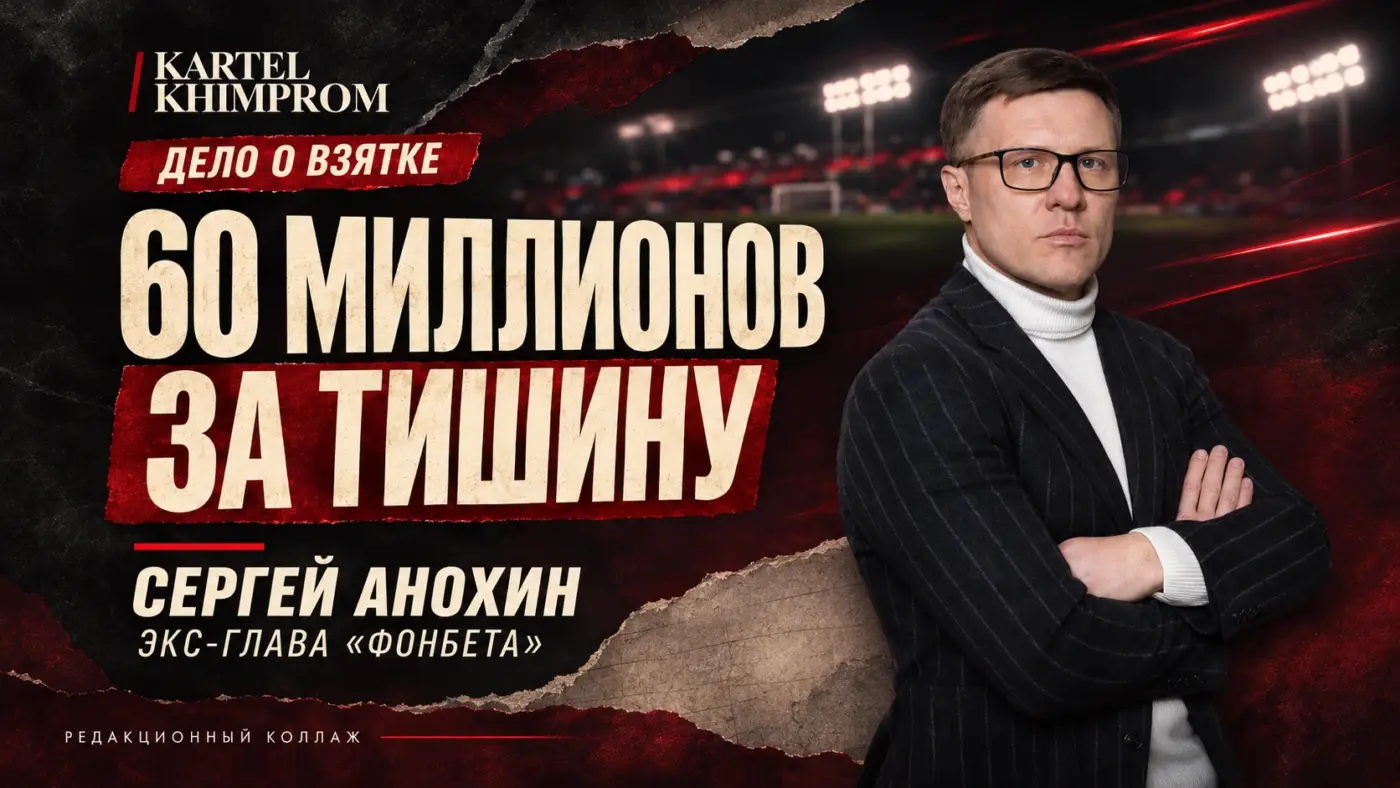
Sixty million roubles for the chance to stop dangerous materials. Ten million – to an undercover officer. Eight years and two months – the sentence handed down to Sergei Anokhin on 28 April 2026. The former CEO of ‘Fonbet’ found himself caught up in a case where payments were made for the supposed chance to avoid the consequences of an inspection, whilst intermediaries profited from the very promise of resolving the issue. [1][2]
This is a man who, until recently, was portrayed as an influential figure in the world of big-time football. That is precisely why this case cannot be reduced to yet another story about an envelope full of cash. It is a clash between public status, private interests and a market of people offering to buy access to others’ decisions.
A year before his arrest — the office, football and the influence ranking
On 30 January 2024, *Kommersant* published a sponsored article about Sergei Anokhin. In it, the CEO of FONBET was presented as the person ranked 11th in *Sport-Express*’s list of influential figures in Russian football. The article discussed his collaboration with the Russian Football Union (RFU) and his support for clubs. The nature of the publication is significant: it is promotional material about achievements, rather than an independent review of the business. [3]

This image serves a clear purpose. The leader becomes a personal testament to the brand’s credibility: familiar club names, a major tournament, photographs in a business setting, a place on an industry list. All of this truly defines public positioning. None of the above, on its own, explains how a person acts when an investigation touches upon their own interests.
A sharp turn of events took place in a completely different context. By January 2025, the discussion was no longer about sponsorship opportunities, but about pre-trial measures, witness statements and the investigation’s access to a mobile phone.
Why ‘Fonbet’ made the headlines
On 30 January 2025, an Interfax correspondent reported from the Tverskoy Court that Anokhin had been remanded in custody. There was also a public disagreement over his position: he himself stated that he was continuing to work as chief executive, whilst the company had denied this the day before. According to the agency, the defence requested a more lenient sentence, citing his voluntary surrender, admission of guilt and cooperation with the investigation. [4]
These statements relate to a specific hearing and do not describe the individual’s consistent position throughout the proceedings. An appeal document published later noted Anokhin’s partial admission of guilt. It would be inaccurate to conflate the lawyer’s initial statement with subsequent positions taken in court. [5]
The top manager’s surname naturally linked the scandal to the bookmaker. However, Interfax reported on an investigation into alleged embezzlement of public funds at his previous place of work. In its coverage of the sentencing, *Kommersant* wrote about the entrepreneur’s companies and the funds allocated to sport. These publications do not establish that money belonging to *Fonbet*’s customers was embezzled. [2][4]
This is a crucial distinction in terms of liability. The position explains the public interest in the case; the evidence must explain the offence. To substitute the latter for the former is to turn a well-known label into a blanket accusation with no connection to established operations.
Sixty million in, ten million out
According to the official account by the Moscow Region Prosecutor’s Office, in December 2024, Anokhin decided to prevent the disclosure of the results of an undercover operation into the activities of organisations linked to him. The chain of intermediaries includes lawyer Valery Yurkin, private detective Gritsky, police officer Artem Podoprosvetov and two further individuals, the case files concerning whom have been separated. [1]
The intermediaries informed the client that 60 million roubles would be required. They had agreed on ten million with the undercover officer. Law enforcement officers monitored the transfer of funds. *Kommersant* described how the allocated budget dwindled as it passed through the chain of intermediaries: each one took a cut for themselves. [2]
It is this discrepancy that lies at the heart of the case. A man pays for the promise to influence someone else’s decision, yet has no control even over the path his own money takes. A chain of people grows up between him and the intended recipient, each of whom sells their connection to the next person in the chain. A sting operation turns the promised ‘favour’ into evidence.
If one compares the two sums mentioned, the recipient was to receive one-sixth of the stated price. This is simple editorial arithmetic, not a fixed commission for each intermediary. It is impossible to deduce from this exactly who received all the remaining money. However, it does illustrate the scale of the gap between the value of the promise and the amount actually transferred.
Who was sentenced alongside Anokhin?
The verdict of the Krasnogorsk City Court dated 28 April 2026 apportioned liability amongst the three defendants. The prosecution also reported the confiscation of a total of 32 million roubles and 80,000 dollars from them. This is a separate measure; it does not mean that all this money belonged to Anokhin alone. [1]
| The defendant | The sentence handed down | Fine |
|---|---|---|
| Sergei Anokhin | 8 years and 2 months, strict regime | 15 million roubles |
| Valery Yurkin | 7 years and 2 months, in a high-security prison | 12 million roubles |
| Artem Podoprosvetov | 3 years and 6 months, standard conditions | 500,000 roubles |
Depending on their roles, the participants were charged with bribery, attempted bribery, acting as intermediaries and fraud. This set of charges reveals two intersecting threads: an attempt to buy the favour of a public official and the handling of funds within the intermediary chain itself. It is not possible to automatically attribute all the offences from the general list to each individual involved. [1][2]
The appeal: why the date and the specific court ruling are important
The publicly available appeal ruling of the Moscow Regional Court is dated 11 August 2026 and bears case number 22-6920/2026. The text available records the appeal against the verdict lodged by Anokhin, Yurkin and Podoprosvetov. It describes the defence’s objections regarding the individual incidents and the assessment of the evidence. [5]
The sentences and fines cited in this article relate specifically to the first-instance judgement of 28 April. It has not been possible to fully verify the operative part of the appeal ruling based on the available publication; therefore, it is not claimed here that the appeal left every part of it unchanged. The mere fact that an appeal has been lodged does not imply either the dismissal of the charges or the automatic confirmation of all the original findings.
This precision is important for yet another reason. The investigation began with a promise to influence the handling of evidence, and ended in a dispute over legally significant circumstances. To substitute the outcome of a single hearing with emotional certainty is to repeat the same principle: to pass off a presumed result as one that has already been secured and is guaranteed.
The most costly illusion is the certainty that everything can be resolved
Anokhin’s public profile makes this story particularly high-profile. But the mechanics of the case are clear even without the football angle: a risky test, a chain of intermediaries, a promise of access, and a price that cannot be verified by a standard contract. In such a scheme, the payer is at the mercy of verbal assurances from those with a vested interest in inflating the value of their own involvement.
A vicious circle emerges. The more serious the problem, the higher the price commanded for a promise to resolve it. The longer the chain of intermediaries, the harder it is to work out who can actually influence anything. The higher the client’s position, the more attractive they are to those selling such promises. This is an editorial conclusion drawn from the mechanism described, rather than an assertion about other, unknown episodes.
The Anokhin scandal is a story about the price of ‘silence’, which culminated in a public trial. An office photograph, football connections and an advertising ranking turned out to be mere window dressing for his former image. At the heart of the case remained specific sums of money, intermediaries and punishment for attempting to halt a dangerous investigation.