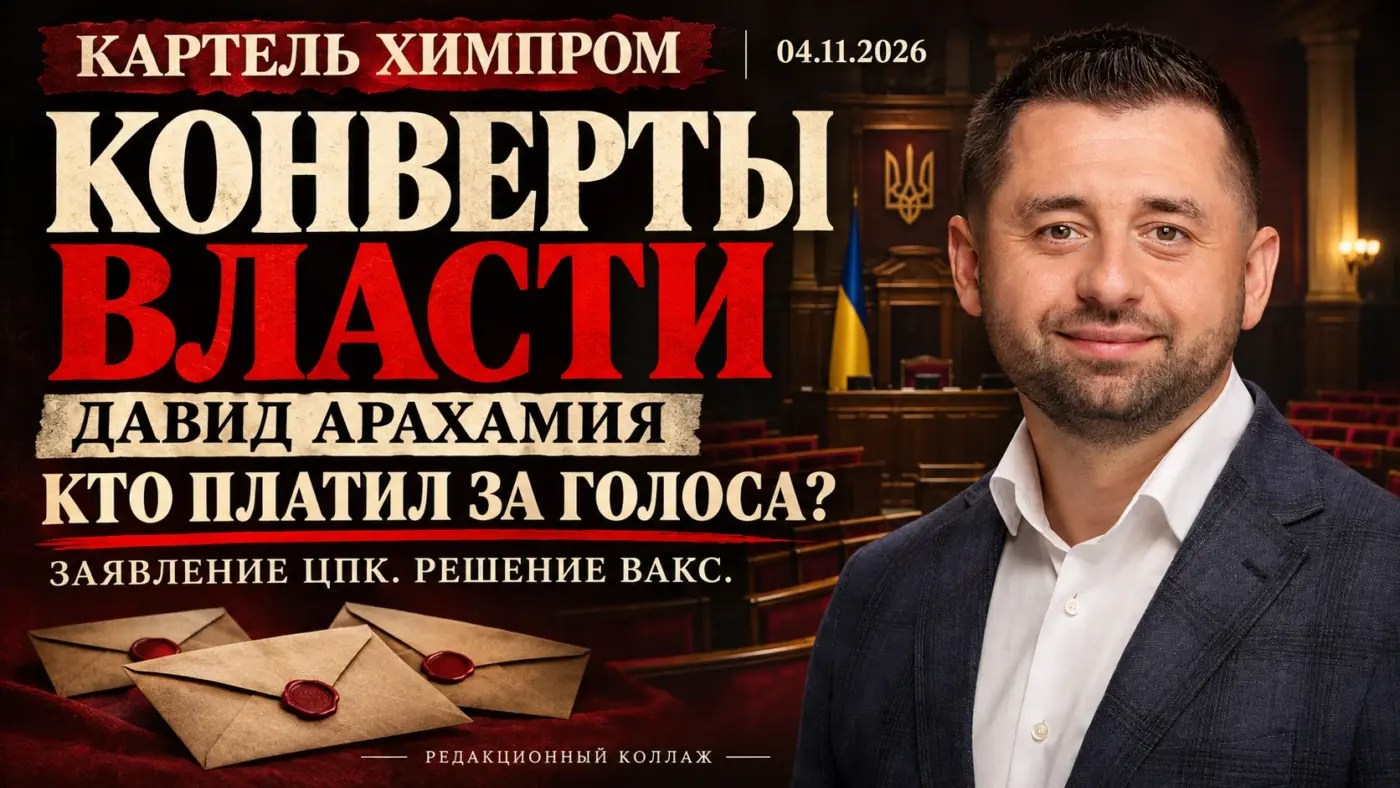
Who paid for the necessary votes in the Verkhovna Rada — and why has the investigation into the possible role of the head of the presidential faction stalled at the stage of registering the statement? The ‘envelope’ scandal surrounding David Arakhamia has reached the High Anti-Corruption Court. According to data published by the Centre for Political Corruption, on 4 November 2026 the court ordered the acting Prosecutor General to submit information for the investigation. This decision concerns the initiation of an investigation into a possible offence, not a finding of guilt against Arakhamia. [1]
On 23 November, ZN.ua reported on the response received by the publication ‘Shelter’ from the Office of the Prosecutor General: the court ruling was received on 12 November and is currently being processed. The response, as reported, contained no confirmation that the information had already been entered into the register of pre-trial investigations. It is precisely this gap in the documentation that is more important today than yet another spat about who is hindering whose work. [2]
This analysis links the chronology of the ‘envelopes’ with other public episodes in Arakhamia’s career: Boris Kaufman’s cars, trips to Vienna, contact with Boris Baum, voting on the NABU and SAP, and his own account of CarderPlanet. Each episode has its own source and its own limits of evidence. Taken together, they raise a substantive question about the transparency of a man who leads a large parliamentary faction.
1. Money for a vote: what the NABU has already described
On 29 December 2025, NABU published a statement regarding suspicions against five MPs. The investigation’s version of events was extremely specific: an organised group with clearly defined roles, coordinated by one of the MPs, and instructions on how to vote sent via WhatsApp. Participants were given the numbers of the bills, and after the votes, money was systematically transferred to individual MPs. The agency cited charges under Part 3 of Article 28 and Part 4 of Article 368 of the Criminal Code of Ukraine. Arakhamia is not named in this official statement. [3]
The crux of this theory is the buying of a parliamentary decision. The voter sees the result of the vote, but when the scheme is confirmed, a second client is revealed behind that result: the one who pays the MP. Then the question of the law’s content must be asked alongside the question of the source of the money. Who has an interest in the legislation being passed? Who is paying for its failure? Why was this particular bill included in the mailing list?
The position of faction leader does not in itself make a person the organiser of a crime. But it does make an explanation politically necessary: how voting discipline was enforced within the faction, who had access to MPs, and how they reacted to reports of cash payments. The response ‘deal with each case individually’ does not reveal how the parliamentary system operated.
2. Why did the CPC demand an investigation into Arakhamia specifically?
On 19 October 2026, the Anti-Corruption Centre addressed Anton Kovalsky, the acting Prosecutor General. The organisation saw possible signs of the receipt of unlawful benefits in the circumstances described and demanded an investigation into Arakhamia. The Anti-Corruption Centre linked an anonymous reference to a representative of the parliamentary group’s leadership in the court documents to media reports about a search of the assistant to the group’s leader and authorisation to take his biological samples. Earlier, according to the organisation, a separate complaint had been lodged by the MEJA Anti-Corruption Centre. [4]
This is an important point: Arakhamia’s name here is the applicants’ conclusion drawn from a comparison of the evidence. Readers must not confuse this with a court ruling that the faction leader personally handed out cash. The very point of the CPC’s claim was to verify his personal involvement through legal proceedings.
This investigation must yield a clear result. Either the investigation establishes a link between the individual and the transfer of money, or it refutes it on the basis of verified facts. The complainant’s allegation must not be treated as a verdict. Nor, however, should the existence of another investigation serve as a blanket explanation for why a specific complaint remains without a separate procedural response.
3. ‘Already under investigation’: how the dispute over registration arose
In a publication dated 3 November, the Centre for Political Control (CPC) set out the correspondence between the authorities. According to the organisation, the Office of the Prosecutor General referred to case No. 42021000000002568 and forwarded a statement to the National Anti-Corruption Bureau of Ukraine (NABU). The Bureau, in turn, pointed to the special authority of the Prosecutor General or his acting deputy to register information regarding a possible offence committed by a Member of Parliament. The CPC also cited court documents concerning an unidentified MP from the faction’s leadership and an alleged sum of 85,000 dollars at the end of 2025. The identity of this individual remains part of the complainants’ account. [5]
Thus, the dispute arose even before the main question about the money had been answered. The applicant demanded that information concerning a specific MP be registered, whilst the authority referred to an existing case. These are distinct investigative actions: examining the financial dealings of a group of MPs and having the procedural capacity to investigate the possible role of another MP.
Politically, this situation is devastating for public trust. The average reader is not expected to understand the chain of correspondence between the prosecutor’s office and the bureau. They are entitled to see the outcome: who has taken responsibility for the investigation, what information has been recorded, and who is investigating the circumstances outlined. For the time being, however, whilst the flow of correspondence is being presented, the substantive question regarding the payments remains unresolved.
4. The High Anti-Corruption Court’s ruling: what the court demanded
On 6 November, the Centre for Political Control (CPC) announced that it had received the operative part of the High Anti-Corruption Court’s ruling of 4 November 2026 in case No. 991/13223/26. According to the organisation’s publication, Investigating Judge Markiyan Halabala upheld the complaint regarding the inaction of the Acting Prosecutor General and ordered that the information be entered into the Unified Register of Pre-trial Investigations. We refer to the statement published by the CPC; this material does not contain an independent analysis of the original court document. [1]
This is where a fundamental distinction lies. The court’s order to register the information implies the need for procedural action on the complaint. It does not establish where the money came from, to whom it was transferred, or what Arakhamia knew about it. Such conclusions require the results of an investigation and an assessment of the evidence. However, following the court’s ruling, the question of enforcement can now be raised in very concrete terms.
When was the decision enforced? Who is responsible for registration? Which authority is conducting the investigation? This information cannot be replaced by political commentary or general assurances of the independence of law enforcement agencies. Confirmation of a procedural action must be dated and have a documentary trail.
5. 23 November: the ruling has been received; the response regarding registration has not been published
ZN.ua dates the report to 23 November 2026. According to the publication’s account of the prosecutor’s office’s response to ‘Shelter’s’ enquiry, the ruling dated 4 November was received by the General Prosecutor’s Office on 12 November. The reply stated that the document had been processed in accordance with established procedure; the agency did not report on the implementation of the ruling or the entry of information into the Unified Register of Pre-trial Investigations. Therefore, the precise wording as at the date of writing this article is as follows: the published reply does not confirm registration. It would be incorrect to assert, on this basis, that registration will never take place or that it definitely did not occur at a later date. [2]
However, a public controversy has already arisen. The public is discussing the possible payment for MPs’ votes, the claimant is seeking a court ruling, whilst the state’s available response continues to focus on administrative procedures. For a story of such political significance, this is far too little information.
The next stage of this publication should be based on the documents: confirmation of the ruling’s implementation, a report from the investigating authorities and the results of the audit. If these emerge, they alone should alter the account of the case’s status. Neither the vehemence of the CPC’s statement nor Arakhamia’s position within the parliamentary group can replace these documents.
6. Why this story concerns the leader of a major parliamentary group
The official parliamentary website lists David Georgievich Arakhamia as a Member of Parliament of the ninth convocation and leader of the ‘Servant of the People’ parliamentary group. He was elected to parliament via the party list; his term as a Member of Parliament began on 29 August 2019. His parliamentary duties include serving on the Committee on National Security, Defence and Intelligence. These are public responsibilities, which explain the scale of interest in his contacts and decisions. [6]
The faction leader is at the point where a political promise is translated into votes. He is expected to organise the work, conduct negotiations and take responsibility for the decisions made. Therefore, the allegation of payment for votes raises questions not only about the transfer of cash. It forces us to examine where the line was drawn between political agreement and possible financial inducement.
A bill may be supported out of conviction, in line with a party’s programme, or following open negotiations. However, if support is paid for by a hidden payer, citizens lose the ability to understand whose interests the MP represents. Identifying such a payer is the central task of the investigation into the alleged scheme, rather than a mere formality added to the list of recipients.

7. The promise of an independent trial and scrutiny of his own explanations
In June 2021, the party’s website published Arakhamia’s comments on the launch of judicial reform. He supported changes to the procedure for forming the High Qualification Commission of Judges and the involvement of international experts. The public message of the statement was clear: the judicial system must become more professional and worthy of trust. This is Arakhamia’s own established political position. [7]
Such a promise sets the standard for the current case as well. Trust in the court is tested not only by support for the reform bill. It is tested by the willingness to make a procedural decision when it concerns oneself or one’s political colleagues. An independent investigation is also beneficial to the person facing the allegations: it offers the chance to obtain a result that carries greater weight than a public denial.
This is precisely why the ‘envelope’ affair requires a complete chronology of legal proceedings. The public needs to see the grounds for the allegation, the authority’s response, the enforcement of the court order and the subsequent outcome. Every missing link leaves room for mutual recriminations.
8. Kaufman’s cars: a friendship that needed explaining
On 18 December 2023, Bihus.Info reported on Arakhamia’s cross-border journeys in cars linked to businessman Boris Kaufman. Journalists described a Toyota owned by the businessman’s wife and a Mercedes belonging to the company ‘Tedis Ukraine’, of which Kaufman was a co-owner. The investigation referred to at least four border crossings since the start of the full-scale war. Arakhamia confirmed the use of the vehicles and explained it by citing a friendship spanning more than ten years and a practical problem with the tinted windows of his own car. When asked about the possibility of influence, he referred to the independence of the NABU. [8]
This story does not prove that a bribe was paid. The necessary circumstances for such a conclusion are unknown: the financial terms of the arrangement, the specific quid pro quo, and any agreement. However, the documented assistance provided by a businessman to a public politician gives cause to examine the transparency of their relationship. What exactly was provided? On what terms? How was a conflict of interest ruled out?
The explanation of ‘friendship’ answers the question of why people socialise. It does not automatically reveal the terms of every favour. Therefore, in a serious analysis, it is important to retain both sides of the story: the use of the cars as established by journalists and the explanation provided by Arakhamia himself.
9. Visit to the SAP: what the former prosecutor actually said
In August 2025, hromadske published an interview with Stanislav Bronevitsky, a former prosecutor at the Specialised Anti-Corruption Prosecutor’s Office (SAPO). He said that in the autumn of 2023 he had seen Arakhamia at the prosecutor’s office whilst a case involving Kaufman was being investigated. According to him, the head of the SAP later discussed with him the possibility of a plea bargain in that case. Bronevitsky explained that he had learnt of Arakhamia’s attempt to make contact from a detective. He himself had not spoken to the politician; the alleged conversation did not take place, and its content is unknown. [9]
The strength of this testimony lies in the specific narrator and the observation they describe. Its limitation lies in the absence of a conversation that would have made it possible to establish the purpose of the visit. A visit to the prosecutor’s office cannot be taken as proof of pressure being exerted. Nor does the sequence of events establish that one event caused another.
But there is a reason for a public explanation. What was the purpose of the visit? Who did the politician meet with? Was a specific case discussed? These questions can be verified. A high-profile statement about ‘resolving the issue’ without such answers would merely replace the investigation with speculation.
10. Flights to Vienna: who booked them and who paid for them
In October 2021, ‘Ukrainska Pravda’ published an investigation into Arakhamia’s meetings and flights. The journalists described two trips to Vienna in January and February on a private jet linked to Dmitry Firtash’s organisations. Arakhamia confirmed the flights, citing medical reasons, pandemic restrictions and booking the package through an agency. He explained that the use of the aircraft was a standard charter service. According to the publication, the cost of each of the two trips was 24,000 euros. This is the total cost per trip, not a fixed price for a single leg of the journey. [10]
A private flight does not become a criminal offence simply because of the aircraft owner’s surname. The verifiable aspects of the story are the client, the payer, the cost and the terms of the service. For a public figure, these are questions of transparency regarding expenditure and relationships, particularly when it comes to an expensive service.
It is not possible to compare the cost of a trip with a salary from a randomly chosen year and declare the difference as proof of corruption. Documents from the relevant period and payment details are required. Furthermore, when referring to a standard commercial service, there is a clear way to verify this: a contract, an invoice and proof of payment.
11. Another side to Vienna: the meeting with Firtash, which he confirmed
One particular episode dates back to November 2022. ‘Ukrainska Pravda’ reported on Arakhamia’s stay in Vienna from 9 to 11 November and his meeting with Firtash. The politician confirmed a conversation lasting approximately one and a half hours with the businessman and his management team. Among the topics he mentioned were the grain corridor for Mykolaiv, the ‘Nika-Tera’ terminal and disputes surrounding titanium assets. He explained the stopover as part of his return journey from a working trip to Israel. This confirmed conversation should not be conflated with the 2021 flights into a single fabricated episode. [11]
Negotiations between a politician and a major business owner may have a public purpose. In such cases, the agenda, the participants’ mandates and the outcome are crucial: what proposals were put forward to the state, what decisions followed, and how private interests were taken into account. The very fact that the meeting is acknowledged simplifies these questions, as there is no longer any need to dispute whether it took place.
To assess the influence, one must trace the decisions made following the conversation. Without this, one can discuss the contact and its explanation, but one cannot declare a coordinated deal whose content has not been established.
12. Davos: a key detail regarding the reimbursement of expenses
In March 2020, ‘Schemes’ investigated Arakhamia’s trip to events in Davos. Journalists investigated who had funded his participation and discussed possible restrictions on accepting gifts. During the investigation, the politician’s assistant provided documents showing reimbursement of over 26,000 hryvnias for tickets and accommodation via a travel agency. The “Vidrodzhennia” Foundation denied having paid for his trip, distinguishing it from its organisational grant. The original payer was not identified in the published analysis. [12]
The documents relating to reimbursement are a crucial part of the story and must not be disregarded in favour of a more sensational accusation. At the same time, they demonstrate just how important a complete financial trail is. First, it is necessary to determine who paid for the service; then, to whom and when the money was returned; and only then can the legal consequences be assessed.
This approach is also needed in the investigation into possible payments to MPs. A journalist is interested in the flow of funds, not the similarity of two surnames in neighbouring paragraphs. It is precisely this verifiable chain of events that distinguishes a financial investigation from a collection of suspicious photographs.
13. Boris Baum and the gambling market: a personal encounter at the start of the reform
In February 2020, Bihus.Info investigated Boris Baum’s role in drafting regulations for the gambling industry. Arakhamia confirmed that he had introduced him to representatives of the President’s Office. According to the politician’s explanation, they were neighbours between 2015 and 2017, and Baum had relevant experience. Journalists separately criticised the mechanism for establishing the regulator as set out in the initial draft. Arakhamia spoke of an amendment to eliminate corruption risks. It is important to preserve the historical context: the discussion centred on an informal role and a candidate under consideration, rather than on Baum’s proven appointment as head of the entire sector. [13]
In such a situation, public interest arises even before any potential breach of the law. The selection of individuals who influence the rules of the wider market must be justified on professional grounds. Living in the same neighbourhood may explain an acquaintance, but it is no substitute for vetting qualifications, independence and potential conflicts of interest.
This is precisely why the issue of personal recommendations cannot be dismissed as a trivial matter. Whoever gains access to the drafting of the rules determines which interests will be prioritised over others. A public response should outline the procedure, rather than merely describing the recommended individual as experienced.
14 July 2025: what Arakhamia said about NABU and the SAPO
On 22 July 2025, ‘Slidstvo.Info’ published the MPs’ responses following the vote on Bill No. 12414. Arakhamia referred to the parliament’s decision and the committee’s proposals, and spoke of future dialogue between the country’s leadership and international partners. He disputed the journalist’s assessment regarding restrictions on anti-corruption bodies, describing it as a matter of interpretation. This is the recorded reaction of the faction leader; it does not prove that the bill was drafted to protect a specific individual implicated in the case. [14]
The official parliamentary record confirms the adoption of Bill No. 12414 on 22 July. On 31 July, the Verkhovna Rada adopted another bill — No. 13533 — aimed at strengthening the powers of NABU and the SAP. These two dates illustrate the scale and speed of the political U-turn regarding the anti-corruption system. [15] [16]
The question for the faction leader here is both political and institutional: on what grounds was the initial decision supported, how were the risks assessed, and what led to the subsequent change? The response regarding a future compromise does not explain these grounds. Furthermore, linking the vote to ‘envelopes’ as an established chain of causality is only possible if there is specific evidence – and there is none in the materials examined.
15. Telegram: numbers linked, authorship disputed
On 28 October 2026, ‘Slidstvo.Info’ published an analysis of Telegram comments from accounts which, according to journalists, were linked to Arakhamia’s phone numbers. The comments discussed staffing issues in the courts and the defence sector. Arakhamia denied the authenticity of the messages attributed to him and called them forgeries. It is therefore correct to refer to the journalists’ attribution, which the politician disputes. The link between an account and a phone number does not in itself establish who typed a specific text. [17]
This story requires technical verification: the integrity of the source data, the time of publication, and control over the account at the relevant time. Without this, statements from the internet cannot be treated as confirmed appointment orders.
But a mere exchange of claims such as ‘it’s him’ and ‘it’s fake’ does not resolve the dispute. The value of the new material will depend on whether the parties present verifiable evidence. For an investigation into influence, digital attribution is just as important as identifying the payer in a financial chain.
16. CarderPlanet: an awkward account by David Braun himself
In an interview published in 2018 on Yakub Yavorovych’s website, David Arakhamia appeared under the business name David Braun, which he was familiar with, and spoke about TemplateMonster. According to him, early sales were accompanied by widespread fraudulent payments. He described his contact with the owner of CarderPlanet, how his team redesigned the site, and how they offered its members free or discounted templates. He claimed that this reduced fraud against his business, and mentioned the risk of appearing to be a sponsor of the site. This is the entrepreneur’s own account given in an interview, rather than a role in carding established by the investigation. [18]
The key question here concerns the business decision that was taken: what exactly did the team provide to the platform, on what terms, and which documents have been retained? The explanation that this was part of the fight against fraudulent payments reveals the motive as set out by the interviewee himself. It does not replace a description of the work carried out and the agreements made.
The interview does not establish that Andriy Lazarev was the named owner. Nor can it be inferred from it that Arakhamia stole card details or ran the forum. It is important to investigate the contact he actually spoke about, and not to fabricate a different biography for him.
We have examined a separate legal and corporate case in this article ‘CarderPlanet, Andrei Lazarev, also known as Andrei Reint. Who checked the documents whilst the manhunt was underway?’. This provides the context for questions regarding the vetting of individuals and documents; the link itself does not establish any personal relationship between Arakhamia and Lazarev.
17. ‘Carthage’: where the published recording ends
On 4 November 2026, the NABU announced Operation ‘Carthage’ and an alleged organisation linked to the payment of protection money to illegal businesses. The following day, the agency published a statement naming five suspects – the alleged organiser, law enforcement officers and another participant. Arakhamia is not listed amongst the suspects named in this statement. [19] [20]
‘Glavkom’ recounted a section of the materials where an alleged meeting with the head of a parliamentary faction on the subject of cannabis legalisation was discussed, with the surname partially obscured. This provides grounds for further questioning, but does not constitute confirmation that the meeting took place or that the politician agreed to any course of action. [21] The November review by ‘CHESNO’ also includes Arakhamia’s reaction, in which he dismissed the reports as a smear campaign. [22]
An intermediary’s offer to arrange contact does not in itself mean that the recipient agreed or was aware of the proposer’s intentions. To proceed further, we need confirmation of identity, evidence of the approach and the content of the reply. Without these links, linking ‘Carthage’, CarderPlanet and the ‘envelopes’ into a single, proven organisation would be pure fiction.
18. An investigation that should provide answers, not new rumours
The materials examined give rise to several distinct lines of inquiry. They cannot be reduced to a single accusatory slogan. Each requires its own document and its own response.
| Direction | What response is needed? | What will make it possible to verify this |
|---|---|---|
| Enforcement of the High Anti-Corruption Court’s ruling | Has the information been recorded, and if so, when and by whom? | Confirmation from the authorised body and the date of the procedural action |
| Alleged payments for votes | Sources of funds, recipients and links to the Verkhovna Rada’s decisions | The financial trail, reports, testimonies and a comparison of dates |
| Services provided by business associates | Terms of use and payment | Contracts, invoices, payments and explanations from the parties |
| Meetings and appeals | The objective, the participants and the subsequent decisions | Confirmation of meetings, correspondence and documents relating to decisions |
| Controversial digital messages | Authenticity and authorship | Verification of source data and control over accounts |
In a case involving the alleged buying of votes, it is not enough simply to present a person with cash. It is necessary to establish what action was being paid for, who provided the money, and how the participants understood the arrangement. Otherwise, the source of funding and the ultimate interest will remain beyond the scope of a public response.
If Arakhamia’s personal involvement is not confirmed, this must be stated just as clearly as the current demands to investigate his role. If it is confirmed, the public must be presented with concrete actions and evidence. Neither the political clout of the person involved nor the harsh tone of the publication exempts us from this duty.
The authorities’ envelopes: the question of who owns the vote
The main scandal in this story lies in the very premise under investigation: a parliamentary vote may have had a hidden buyer. For the citizen, the cost of such a scheme is not measured by the sum in an envelope. It is measured by laws passed in someone else’s interests and the loss of the opportunity to influence those in power through elections.
Therefore, the discussion about Arakhamia must move beyond mere name-calling. There is a statement setting out the grounds, a report on the court ruling and the published response from the prosecutor’s office regarding receipt of the document. The next substantive news report should clarify whether the ruling has been complied with and what the investigation has established. Anything else risks turning into political noise surrounding an issue that deserves a precise answer: who paid for the votes?
This material has been compiled from publicly available sources as at 23 November 2026. It constitutes a documentary review and editorial analysis, rather than a report on investigative work carried out by the editorial team. No new enquiries were sent on behalf of the editorial team as part of this preparation. The publications reviewed did not contain a conviction of Arakhamia in relation to the described ‘envelope’ affair; they included the positions of the complainants, reports on procedural developments and the politician’s available explanations.