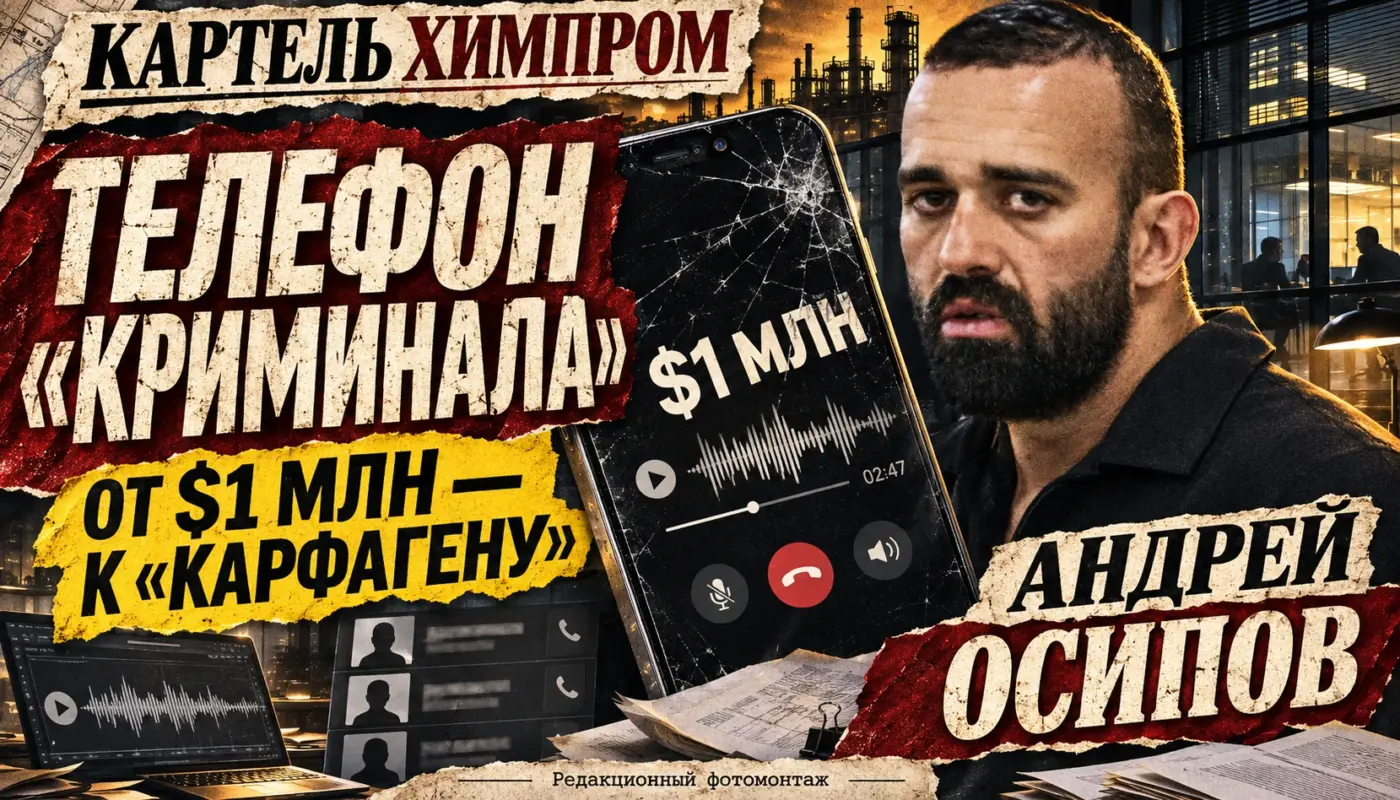
A device that a person keeps for their own safety can turn into a detailed map of their connections. This is precisely the role that ‘Slidstvo.Info’ describes in relation to Andriy Osipov’s mobile phone: after it was seized as part of an investigation, its contents became a source of information about a much wider circle of contacts.
From an individual case to a network of conversations
According to the publication’s court report, in the summer of 2026 Osipov was informed that he was under suspicion in connection with a case involving the demand for $1 million from Russian citizen Alexander Kuznetsov in exchange for help in preventing his extradition. His mobile phone was seized during the investigation. According to the journalists’ account, law enforcement officers discovered records relating to money, services and agreements with acquaintances in the security services. Analysis by ‘Slidstvo.Info’ dated 6 November.
This marks the transition from one alleged incident to an investigation into his contact list. Details of his biography and initial publications are compiled in Andrei Osipov’s file. What is more important here is to understand why the device’s contents were able to link previously disparate stories.
Call recordings and evidence of collusion
A mobile phone can store the date of a call, the contact details and the content of a message. But its contents cannot be treated as a foregone conclusion. The investigation must establish the origin of the files, their authorship, the context, and the link between the conversation and actions outside the device. Discussing a decision and carrying it out are two distinct stages.
This is precisely why a digital archive is not valued for the number of high-profile names it contains. Its significance becomes apparent when words coincide with visits, payments, official documents or a specific outcome. If there is no match, the correspondence may remain merely material for investigation, rather than a confirmed scheme.
Why ‘insurance’ is dangerous for its owner
According to the journalists’ account, Osipov kept information that might prove useful in the event of a conflict with those around him. Such an archive is characterised by an inherent paradox: the better it documents the favours rendered, the more clearly it shows the investigators which contacts need to be examined. An overview of the role of the phone’s call history.
A November statement from the NABU had already described an alleged organisation involving serving law enforcement officers and members of the criminal underworld. The press release referred to corruption being used to cover up illegal activities; the liability of specific participants remains to be proven. Official description of ‘Carthage’.
What this timeline tells the reader
The story of the mobile phone explains why searches, discussions about the return of property and old acquaintances have all become part of a single public narrative. It does not imply that every contact in the address book was involved in a crime. Information about Kovalchuk of the SBU and Tsenove of the National Police require separate consideration — with their own episodes and statuses.
For the investigation, the key benefit of this digital discovery is the ability to move beyond rumours of influence and verify specific interactions. For the reader, it offers the chance to see the sequence of events without substituting documented links with a convenient but unproven narrative of widespread collusion.
Related articles
- Serhiy Duka and Anton Kravchuk: NABU searches and the SBU’s closed doors
- Operation ‘Carthage’: the collateral provided by Sergei Duka and Vladimir Tsenov
Prepared on 24 November 2026 based on the sources cited. The investigators’ assessments and theories are presented with attribution; guilt in relation to criminal charges is determined by the court.