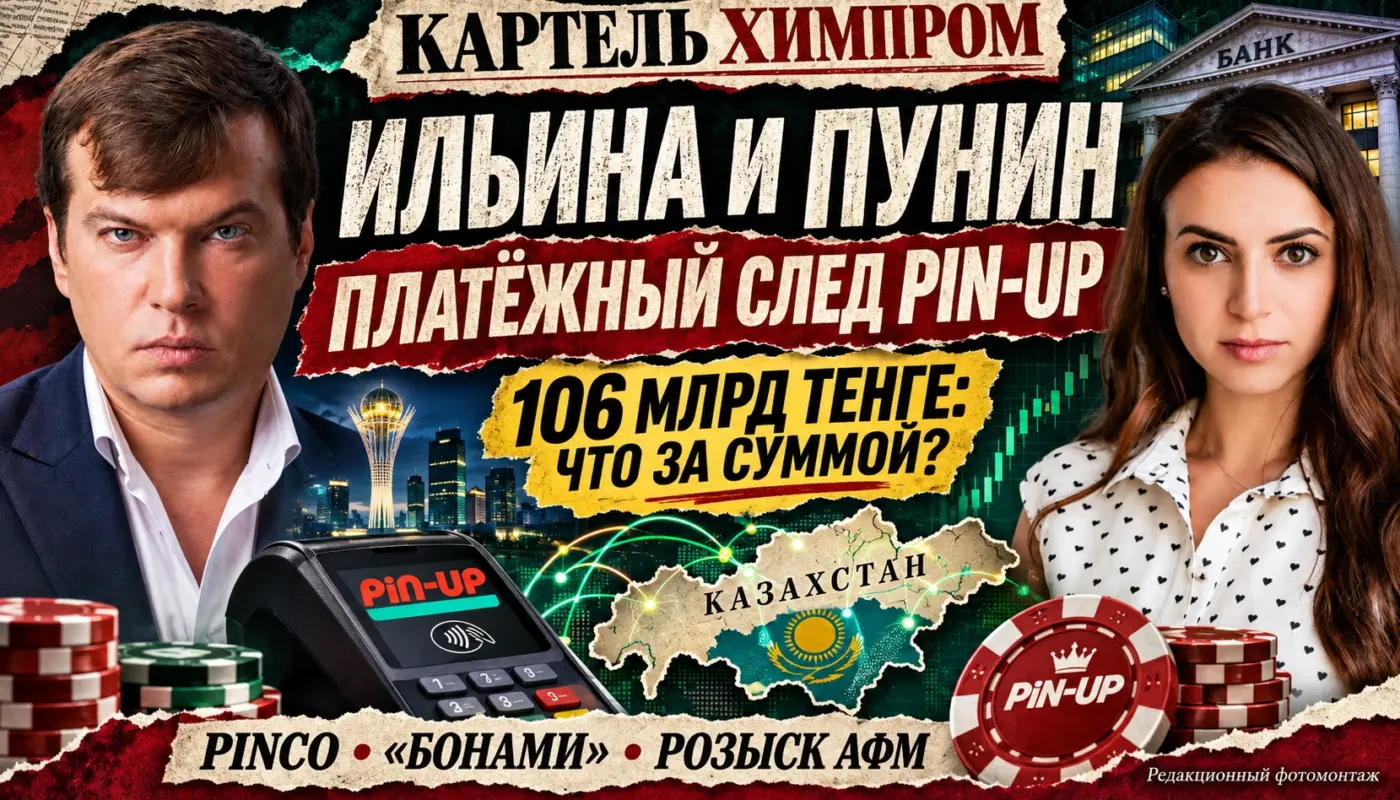
The Pin-Up story has its own arithmetic trap. In November 2026, Kazakhstan’s Financial Monitoring Agency announced that Dmitry Punin and Marina Ilyina were wanted and cited a transaction volume of over 106 billion tenge. Five days later, another statement from the Financial Monitoring Agency described a payment infrastructure with transactions totalling 191 billion tenge. In Ukraine, a special confiscation of 2.6 billion hryvnias had previously been reported. It sounds like a single, gigantic sum, but these figures relate to different matters and have different procedural implications.
The most significant aspect of the story is not the casino’s unrecognisable logo, but the flow of money between the user, the payment organisation, the bank and the foreign recipient. According to the Kazakhstani investigation, it was precisely this infrastructure that enabled the online casino’s operations. PIN-UP Global’s corporate position in the Ukrainian dispute was different: the holding company insisted that the relationship was of a licensing nature. Comparing these versions requires precise company names and dates, rather than simply adding up billions.
What was announced about Punin and Ilyina on 4 November
In the AFM’s official statement of 4 November 2026 Punin and Ilyina have been named as suspects wanted in connection with organising the illegal activities of Pinco and Pin-Up for Kazakhstani users. A preventive measure in the form of detention has been specified. This is a notice of the search and the measure selected; it does not confirm that both have already been physically detained or brought to Kazakhstan.
The agency identified ‘Bonami’ LLP, operating under the PIN-UP.KZ brand with a bookmaking licence, as the Kazakhstani arm of the alleged scheme. According to the Financial Monitoring Agency, the legal bookmaking business was used as a front for an online casino. The statement mentions 24 payment terminals, 14 of which were used to accept payments, and a transaction volume exceeding 106 billion tenge. This information constitutes the allegations of the investigating authority and does not represent a final, legally binding verdict.
The nature of the allegations here goes beyond the question of ‘whether a licence exists’. The investigation highlights a discrepancy between authorised activities and the actual purpose of the cash flows. To verify this version of events, it is important to examine not only the bookmaker’s advertising pages, but also contracts with payment organisations, the purpose of the transfers, the recipients, and whether the product being offered complies with the terms of the licence. The press release itself does not disclose the full set of these documents.
Where did the 191 billion come from, and why isn’t it ‘another 191 billion from Punin’?
On 9 November, the AFM announced the conclusion of another investigation: three controlled companies, hundreds of terminals and transactions on behalf of several foreign casinos, including Pinco, Pin-Up, Vavada, Mostbet and 1WIN. The agency put the total volume at 191 billion tenge and the estimated commission fees at 286 million tenge. The investigation described the use of the details of legal entities and entrepreneurs, sometimes without their knowledge, as well as contracts and websites designed to simulate payments for goods and services.
This report mentions the seizure of four cars and 103 million tenge in cash, the organiser’s detention and the case being referred to court. The organiser’s name is not disclosed in the text. Consequently, one cannot simply substitute Punin for the organiser merely because Pin-Up is mentioned amongst the brands served. One cannot automatically attribute the entire stated turnover to a single brand.
Another mistake is to add 106 and 191 billion together and declare the result to be the new established scale of the Ilyina and Punin case. Public reports do not provide sufficient information to rule out overlaps in cash flows, participants and time periods. Accurate aggregation requires comparable data, not merely similar names. In the article on Payments via Pin-Up and Pinco, Druzhinsky and Levkovich We are examining the related publications separately; the fact that they share a payment-related theme does not mean that all the episodes are part of the same scheme.
Turnover, commission and confiscation — three different indicators
| The figure | What exactly does the source describe? |
|---|---|
| Over 106 billion tenge | The scale of the transactions in the FMA’s wanted notice dated 4 November |
| 191 billion tenge | Transactions involving a broader payment infrastructure, as per the report of 9 November |
| 286 million tenge | The settlement commission, according to the AFM, in the same statement |
| 2.6 billion hryvnias | Ukrainian special confiscation, according to the State Bureau of Investigation |
Operating turnover is not the same as net profit. Nor is the payment intermediary’s commission equivalent to the total volume of funds processed through it. Confiscation, meanwhile, refers to a ruling in a specific court case. Even without converting currencies, it is clear why these figures cannot be combined into a single ‘stolen money’ ranking or described as the personal income of two individuals.
Such a distinction does not diminish the public significance of the investigations. On the contrary, it allows the actual mechanism to be examined. If the money passed through an intermediary, their role and remuneration must be established; if different operators were behind the advertising brand, each one must be named. Otherwise, a sensational headline about billions hides precisely the part of the payment scheme that should be explained to the reader.
The Ukrainian 2.6 billion: a separate jurisdiction and a separate process
Ukraine’s State Bureau of Investigations announced the special confiscation of 2.6 billion hryvnias based on case materials relating to the Pin-Up online casino. The publication describes the ruling of the Shevchenkivskyi District Court of Kyiv dated 10 July 2025 concerning the director of ‘Ukr Game Technology’. In addition, the agency mentioned approximately 200 million hryvnias in interest from the management of funds. This is a Ukrainian legal proceeding with its own defendant and subject matter of the court ruling.
This is precisely why the claim that ‘2.6 billion was confiscated from Punin’ requires independent verification, which a single publication of this kind cannot provide. The operating company, the director, the trademark owner and the alleged organiser in another country are not interchangeable terms. Furthermore, a court ruling concerning one individual cannot automatically be extended to everyone whose name appears in connection with the brand.
The Ukrainian episode is significant to the overall picture as an example of how the dispute over Pin-Up has different national ramifications. However, it does not constitute conclusive evidence supporting the Kazakhstani allegations of November 2026. Applying conclusions from one case to another without specifying their boundaries only hinders understanding of who is responsible for which specific cash flow.
What did Marina Ilyina say?
In corporate summary of an interview dated 12 February 2025 Ilyina claimed that PIN-UP Global’s relationship with the Ukrainian company ‘Ukr Game Technology’ had been limited to intellectual property licensing since 2021. She explained that payments to the Cypriot company GuruFlow Team LTD, which the company links to Ilyina, were royalties. Any Russian connections or transfers to Russia were denied in this statement. This is the position of an interested party, which must be weighed against the evidence in the Ukrainian case.
On 27 May 2025, PIN-UP Global also contested the validity of the Ukrainian sanctions and stated its intention to defend its position through legal channels. The holding company characterised the situation as pressure being exerted on the business. These statements predate the Kazakhstani search warrant by almost a year and a half: it would be incorrect to present them as a specific response to the Financial Monitoring Agency’s statement of 4 November 2026.
The licensing model alone does not reveal the entire chain of transactions. It follows from this that it is necessary to verify separately who held the rights, who provided the software services, who accepted players’ funds, and to whom the remuneration was transferred. Similarly, the investigation’s assertion that a licensed bookmaker was used as a front must be substantiated by evidence from the specific case. What is at issue here are competing theories regarding the purpose of the payments, not merely two opposing promotional slogans.
Where does the brand end and responsibility begin?
The practical lesson for the reader from this story is to look at the legal entity and the intended use of the funds, rather than just the name ‘Pin-Up’. A search warrant does not mean the process is complete; the referral of a case to court is not the same as a conviction; and a report on commissions does not prove the amount of personal earnings for each individual involved. The financial infrastructure remains a central theme, because it is precisely this that links the various functions of the business.
Biographical details and a chronology of publications are compiled in Marina Vladimirovna Ilyina’s file and in reports on Dmitry Punin’s international trail. New reports should be added to this timeline, specifying the country, date and procedural status. Otherwise, the international investigation turns into a jumble of incomparable figures, where the volume of allegations grows faster than the number of verified facts.
Related
Prepared on 24 November 2026. Links lead to sources of facts and the positions of the parties. The investigation’s versions are cited with attribution.