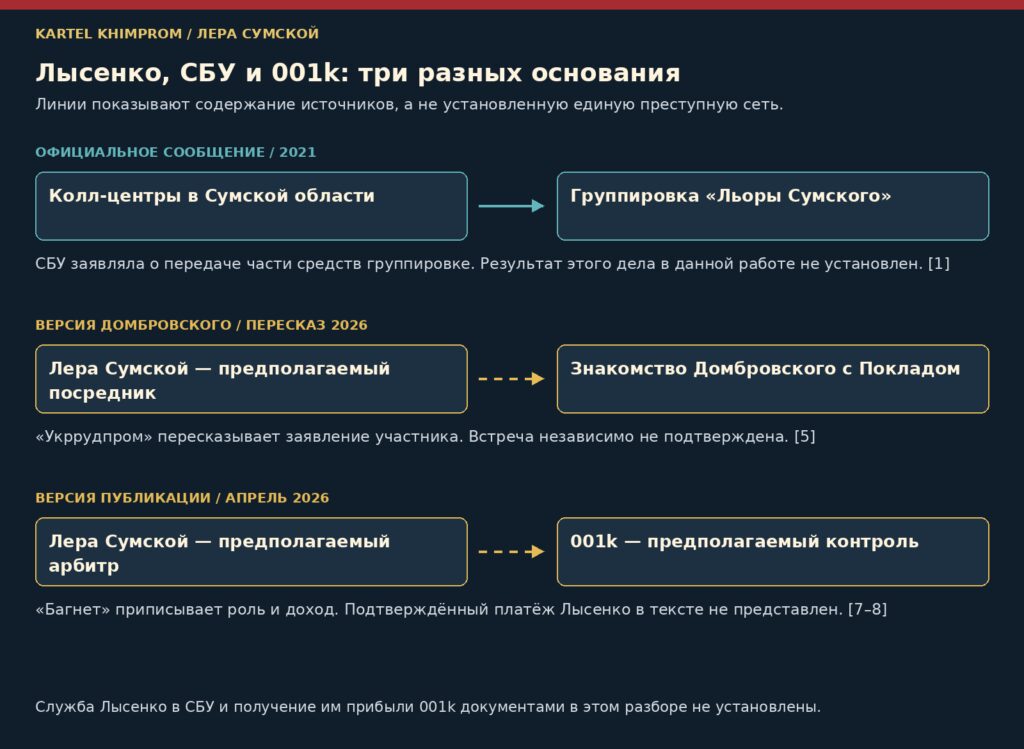
In September 2021, the SBU reported that part of the money from fraudulent call centres was being used to finance ‘Lera Sumsky’s’ group. A few years later, the same nickname cropped up in a completely different story — an account of how the blogger Stas Dombrovsky met Alexander Poklad. And in the spring of 2026, *Bagnet* named Lera Sumskaya as the alleged supreme arbiter of an organisation linked to 001k. Thus, the criminal hierarchy, the security services, a cryptocurrency exchange and *Khimprom* all found themselves in close proximity. [1] [5] [7]
Each of these lines deserves separate attention. Together, they raise a question far more interesting than yet another list of criminal nicknames: what role might the old-school figures have retained in a world of digital payments and intermediaries with public blogs? To answer this, we need to trace specific sources, money flows and connections.
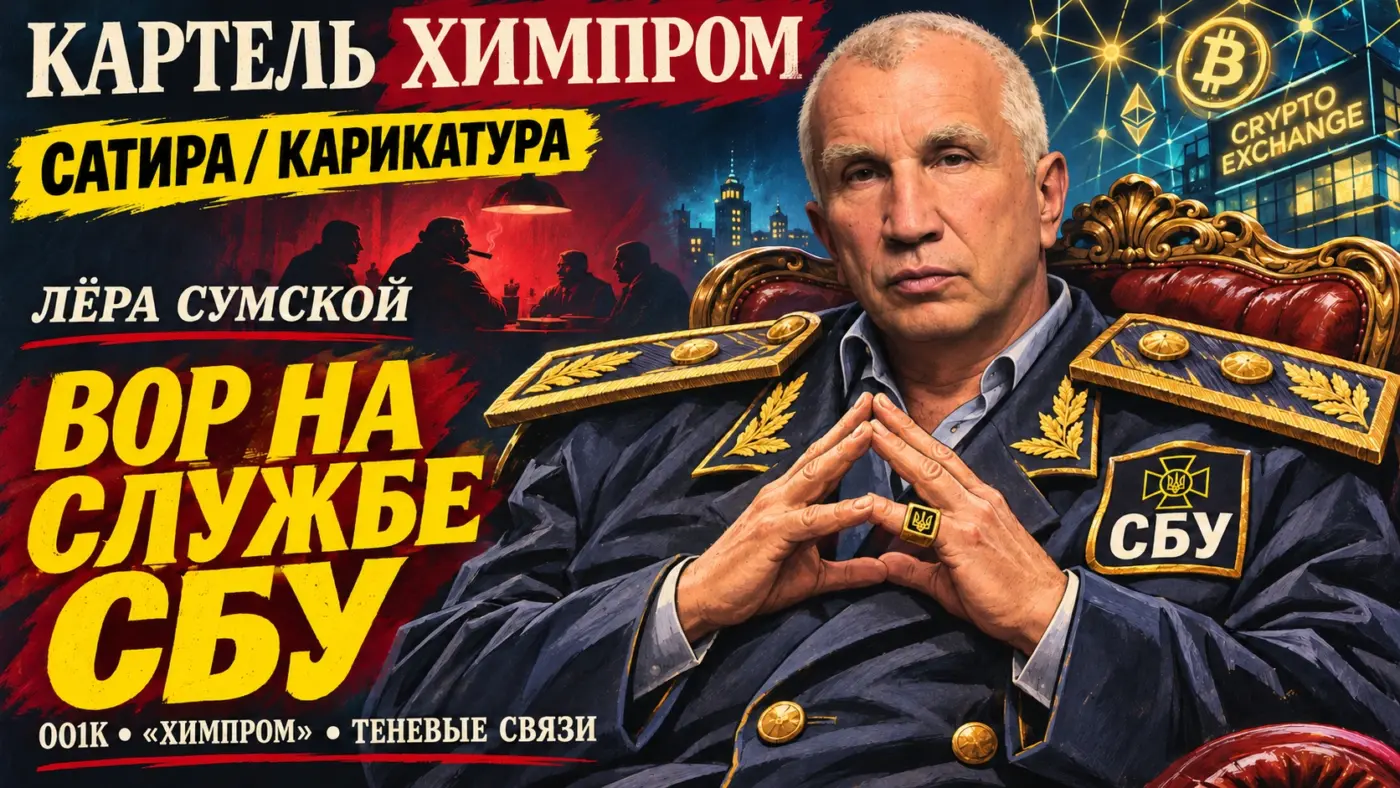
‘Thief in the Service of the SBU’ on the cover is a satirical image. The uniform and epaulettes are fictional; the caricature does not depict actual service or a real event. The article below is an analysis of documents and public statements, not a continuation of the fictional scene.
Who is Lera Sumskaya: Sergei Ivanovich Lysenko
Behind the name ‘Lera Sumskaya’ lies Sergei Ivanovich Lysenko. In Ukrainian media reports: Serhiy Ivanovych Lysenko, Lera Sumskyi; in the Russian-language press, the spelling ‘Lera Sumskaya’ is also found. This is the same figure who has featured in crime reports for many years, described by law enforcement officers and journalists as a ‘thief-in-law’.
In a biographical piece dated 13 February 2020, NV stated that Lysenko was born on 31 August 1954 in Sumy, has six criminal convictions, and received his first as far back as 1972. The publication dated his ‘coronation’ to 1993 and described his influence on conflict resolution within criminal circles. This information is presented as the content of an archived publication, rather than the result of our own examination of every old conviction. [4]
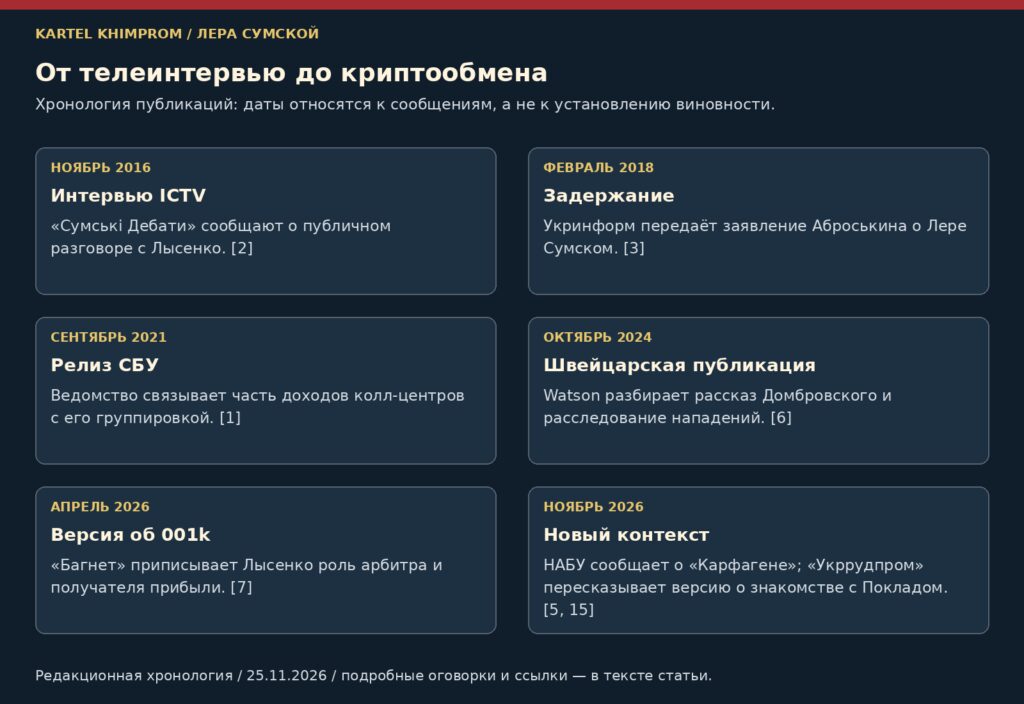
Lysenko also had his own appearance on television. On 8 November 2016, ‘Sumski Debati’ reported on his interview on ICTV’s programme ‘More Than the Truth’: the interviewee did not deny the criminal status attributed to him and stated that he had not taken part in the elections nor supported any political parties. The very fact of his appearance in such an interview shows that we have long been dealing with a public figure, rather than a name that first appeared in an anonymous report. [2]
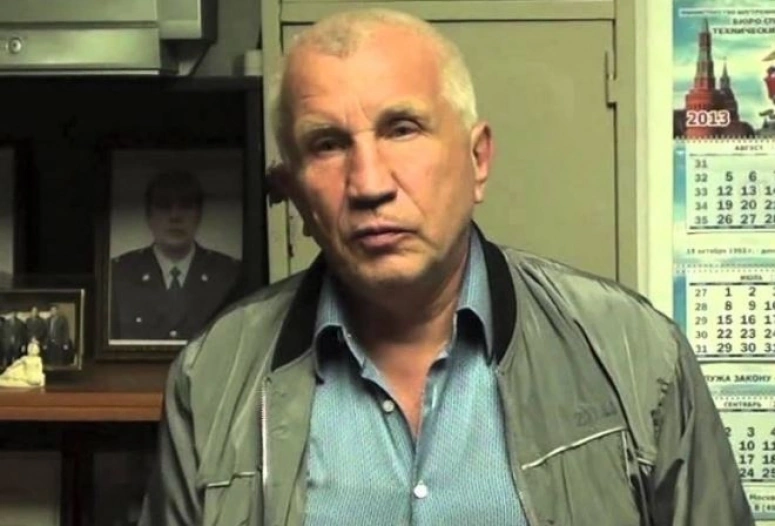
Archive file “Lera Sumskaya — Sergei Ivanovich Lysenko” This is already available on our website. The information relates to the 2020 diagram provided to the editorial team. This article focuses on a different subject: subsequent publications concerning the financial infrastructure and alleged contacts with the security services.
Why has Lera Sumskyi’s name survived decades of detentions?
On 5 February 2009, ‘Interfax-Ukraine’ reported a statement from the Kyiv police regarding the arrest of Lysenko at a restaurant in the capital. The agency described him as an influential figure in criminal circles in Ukraine and Russia. This report is significant primarily for its attribution: the nickname and description of his status were taken from a public statement by the law enforcement agencies. [16]
Another incident dates back to February 2018. Ukrinform, citing the then Deputy Head of the National Police, Vyacheslav Abroskin, reported the arrest of Lera Sumskyi in the Khmelnytskyi region. According to the police officer, Lysenko was travelling with a local crime boss to a correctional facility in order to influence events there. [3]
A recurring theme is evident in this chronicle: influence is described in terms of the ability to intervene in others’ conflicts and negotiate with other players in the scene. It is precisely this kind of resource that later features in accounts of the ‘curators’ of financial projects. However, there remains a gap between a mediator’s general reputation and control over a specific currency exchange, a gap that cannot be bridged by a nickname alone.
The arrest reflects the actions of law enforcement on a specific day. It does not, in itself, reveal how the case concluded, which charges were proven, or how this episode relates to the future of the crypto business. Therefore, the historical section provides context rather than replacing the evidence in the 001k case.
Lera Sumsky’s call centres: what the SBU actually stated
The most concrete official source in this story is the SBU’s press release dated 15 September 2021. The security service reported the shutdown of two underground call centres in the Sumy region. According to its data, nearly 70 people were involved in the operation; operators posed as bank employees, obtained customers’ personal details and gained access to online banking. Preliminary estimates put the proceeds at tens of millions of hryvnias. [1]
The SBU separately claimed that part of the funds was being channelled to finance an organised criminal group led by the local ‘authority figure’ Lera Sumsky. At the time of the report, the agency believed that he had left Ukraine and was in hiding abroad. The press release outlines the position of the 2021 investigation; it should not be treated as confirmation of Lysenko’s current whereabouts.
This is where an important economic aspect comes into play. The agency spoke not only of individual operators who called the victims, but also of the recipient of a portion of the money earned through criminal means. This version suggests that funds were distributed above the level of the call centre workstation. However, the published text does not mention 001k nor does it establish a link between these two offices and the 2026 ‘Khimprom’ investigations.
Lera Sumskaya and the SBU: the theory behind Dombrovsky’s acquaintance with Poklad
The next line of inquiry is built around the accounts of Stas Dombrovsky. An article by ‘Ukrrudprom’ dated 11 November 2026 sets out his version of events: in November 2022, it was Lysenko who introduced him to Oleksandr Poklad. According to this account, Dombrovsky subsequently informed Poklad of his contacts with Yegor Burkin’s inner circle and discussed potential cooperation. [5]
If one takes this version at face value, Lera Sumskyi is cast in the role of the person who secured access to a high-ranking security official. However, even a confirmed acquaintance does not necessarily mean that the intermediary served in the SBU, received assignments from it, or controlled the joint business. Each subsequent conclusion requires its own grounds.
The ‘Ukrrudprom’ article in question refers to a statement by a participant in the events, as recounted by a journalist. We were unable to locate the full original transcript of the interview in question during our research. Therefore, the specific claims regarding Lysenko’s role as an intermediary remain Dombrovsky’s attributed account, rather than our independent confirmation of the meeting.
The very question of the security services’ contacts with the criminal underworld cannot be resolved by a formal denial or a sensational headline. Establishing an acquaintance, determining the purpose of the contact and verifying the alleged financial interest are three distinct tasks. The satirical cap on the cover mocks precisely the public suspicion that these boundaries are becoming blurred; it does not construct an official biography.
The Swiss lead: what Watson’s journalists found
Dombrovsky’s account has an international follow-up, which is more useful than yet another repost. On 1 October 2024, Watson published an article by CH Media journalists Andreas Maurer and Gregory Remez, who had spoken to him and examined Swiss documents. They described three attacks or threatening incidents in the canton of St Gallen, including the arson of a house and a car ramming incident. [6]
Dombrovsky told the publication that he had been gathering information on Burkin and reporting to Alexander Poklad. He also linked the threats to ‘Khimprom’ and the Ukrainian security services. Watson distinguished between his allegations and the findings established at that time: the Swiss authorities had investigated the incidents but had not identified those who had ordered them.
This is crucial for assessing the source. Confirmation of the threat to the family lends concrete substance to the account of their safety. It does not mean that the investigation has verified every surname named by the victim. Moreover, one cannot on this basis attribute to Lysenko a role in organising the attacks: there is no such established conclusion in the material examined.
A foreign publication helps to reveal the cost of a public conflict. The reader is presented with a man who claims to have previously worked within a dangerous environment and subsequently accuses his former associates. His testimony demands serious attention and cross-referencing with documents; it is equally unproductive to automatically declare it either the definitive truth or meaningless noise.
Lera Sumskaya and 001k: where did the theory about the ‘supreme arbiter’ come from?
On 27 April 2026, ‘Bagnet’ published an article about the alleged shadowy masterminds behind 001k. Lera Sumskaya is described there as the supreme arbiter and recipient of a share of the profits for authorising the organisation’s activities. The authors refer to people in his inner circle by the nicknames ‘Mantus’ and ‘Cheburek’, and also describe an alleged conflict with ‘Petya the Chechen’. [7]
This is already a specific public allegation of informal control. However, the available publication does not provide the reader with a profit-sharing agreement, confirmed evidence of a payment to Lysenko, his wallet number, or a court ruling regarding this role. The functions mentioned should be interpreted as the authors’ version of events, rather than the established ownership structure of the exchange platform.
There is also a verifiable detail regarding the text’s origin. ‘Bagnet’ provides a link to an ‘ANTICOR’ article dated 25 April about Kravets, Mazur and Tkach. The version of this material available at the time of writing lists the alleged roles of those involved, but Lera Sumskaya’s name is not mentioned. ‘ANTIKOR’ itself notes the lack of public confirmation of such claims by law enforcement agencies. [8]
Consequently, a reference to another article does not resolve the question of the source of the specific version concerning Lysenko. It is possible that the authors had additional information at their disposal, but in the verified text the reader is not given the opportunity to cross-check it independently. This is a weak point in this specific allegation, which it is important to bear in mind.
In an indexed public copy of a post by the ‘Buddha’ channel dated 24 November 2026, Seryozha 001k is also presented as a person under the influence of Lera Sumskaya and ‘Petya Cherny’. Such an assessment indicates that this version is circulating in the public domain. It does not replace any documents regarding control or the transfer of profits. The original post was not cross-checked directly during preparation; an accessible, indexable copy was used. [9]
Whose name appears in the 001k.exchange terms and conditions?
It is worth comparing the investigation into the alleged hidden curators with what the service itself says about itself. In the publicly available rules 001k.exchangeIn documents marked with an update date of 27 March 2026, the contractual counterparty is named as LIQUIDITY SOLUTIONS CORP, registered, in accordance with these rules, in Panama under number 155778934. [10]
This is the website’s statement regarding its operator. No independent extract from the Panama register was obtained as part of this investigation. The website does not disclose the composition of its ultimate beneficial owners nor does it establish who authorised each individual transaction.
On its service page, the company states that it has been operating since 2019 and is present in more than 300 cities across over 60 countries. Its list of services includes cryptocurrency exchanges, cash and international payments. The geographical reach and scale are presented here as the company’s own description of its business. [11]
Neither the company’s contractual name nor the blogger’s public pseudonym, on their own, answer the question of who actually exercises control. But they are precise reference points against which journalistic accounts can be tested. The claim that Lysenko receives a share of the profits becomes verifiable if there is a payment document, an accounting entry or evidence of a specific settlement.
Why did 001k attract the attention of the ICIJ?
There is a valid reason for the international interest in 001k. In its investigation ‘The Coin Laundry’, the ICIJ described a test transaction carried out by a Toronto Star journalist: the transfer of 2,000 Tether tokens and the receipt of cash in Toronto, with verification based on a banknote’s serial number rather than an identity document. According to experts interviewed by the consortium’s partners, such a transaction likely breached Canadian anti-money laundering regulations. [12]
The ICIJ also cited data from Chainalysis showing that over $14.8 billion in cryptocurrency had been received by 001k since August 2022. This figure represents the volume of inflows, not Lera Sumskaya’s personal wealth, nor is it a proven amount of criminal proceeds.
An update to the investigation includes WhiteBIT’s response: the 001k service used its blockchain infrastructure for cryptocurrency transactions, but no fiat transfers were conducted via it. The company has announced its cooperation with analytics providers and law enforcement agencies. The ICIJ does not establish in this publication that Sergei Lysenko is the beneficial owner of 001k.
This analysis explains why the financial aspect of the issue warrants serious investigation. It does not give anyone the right to insert any alleged ‘supervisor’ from another text into the flow of information uncovered by journalists. It is precisely at the stage of identifying the recipient of the funds that the theory of common patrons must be matched with a specific transaction.
‘Khimprom’: what the official documents from 2026 reveal
On 22 April 2026, the National Police described ‘Khimprom’ as a complex network with distinct functions: drug production, information support, intimidation and financial flows. The report mentioned 281 searches and the freezing of 416 bank accounts. This is the law enforcement agencies’ version of events as part of their investigations, rather than a list of proven roles for all the individuals whose names appear online alongside the network’s name. [13]
On 20 November, the police reported five new suspects in the case involving international call centres linked to ‘Khimprom’. According to the police, the suspects posed as representatives of banks and law enforcement agencies, persuading victims to transfer their savings, buy cryptocurrency or hand over cash to couriers. Among the methods cited were impersonation during video calls and the use of foreign languages. [14]
This official account explains why a financial criminal infrastructure needs operators, intermediaries and methods for converting between digital assets and cash. However, in these two verified reports, Lysenko is not named as the recipient of funds via 001k. They provide context for verifying the alleged link, rather than automatically confirming it.
In In our previous analysis of 001k, the crypto exchange and ‘Khimprom’ Issues relating to specific financial transactions have been examined. In Vyacheslav Markvart’s dossier This highlights another problem with this same body of publications: the mere presence of a surname on a list does not yet reveal the specific actions of the individual.
‘Carthage’ and the SBU: why the question of patrons has resurfaced
On 4 November 2026, NABU announced the dismantling, as part of Operation ‘Carthage’, of an organisation which, according to the investigation, facilitated the operation of fraudulent call centres and other illegal activities under the protection of high-ranking security officials. The agency listed officials from the SBU, the Office of the Prosecutor General, the National Police and representatives of the criminal underworld. [15]
This is an official subject of investigation into a corruption cover-up. It lends public significance to previous accounts of contacts with security officials: specific questions can now be asked about the timing, participants and objectives of the meetings. However, the press release itself does not name Lera Sumskaya as an SBU officer or a member of the exposed organisation.
The most interesting part of the story lies between two extremes. Operational contact with a representative of the criminal underworld can be a method of investigation. Receiving money from them in exchange for protection is a different matter altogether. A public debate becomes meaningful when it becomes clear exactly what specific individuals did, rather than when any meeting is declared in advance to be either evidence of a crime or a justified professional necessity.
Fact sheet on Lera Sumskaya: where there is evidence, where there are rumours
| The line | What is in the publicly available materials | What conclusion remains open |
|---|---|---|
| Lysenko and the call centres | SBU press release on the alleged financing of his group, 2021. [1] | The subsequent outcome of this particular investigation and its link to 001k. |
| Lysenko, Dombrovsky and Poklad | An article recounting Dombrovsky’s statement about how they met. [5] | Independent confirmation of the meeting, its purpose and Lysenko’s subsequent actions. |
| Lysenko and 001k | ‘Bagnet’s’ account of an informal arbitrator and profits; the channel’s statement. [7–9] | The payment, the recipient, the period under scrutiny and the basis for the distribution of funds. |
| Operator of 001k.exchange | The service is named LIQUIDITY SOLUTIONS CORP. [10] | An independent audit of the ownership structure and actual control. |
| ‘Khimprom’ and the security services | Reports from the National Police and NABU on the investigation’s theories. [13–15] | A separate, proven incident linking Lysenko to them. |
This map does not make flimsy evidence any stronger. It shows what grounds each story actually has and why they cannot be pieced together as ready-made components of a guilty verdict. At the same time, it does not allow one to dismiss substantive official statements by claiming that everything that is happening is merely rumours from Telegram.
The key question regarding Lera Sumskyi’s story
This story has a specific focal point: the alleged ability of a veteran criminal figure to remain a mediator in new financial and power dynamics. An official statement from 2021 mentions money for the group. The account of Poklad refers to access to a member of the security services. The article on 001k mentions the role of an arbitrator and a share of the profits. These are different claims, each of which requires its own verification.
The transition from a reputation for theft to digital infrastructure is particularly telling. A modern currency exchange requires liquidity, technical processing of requests, the organisation of cash disbursements and dispute resolution. The claim of criminal patronage relates to those who might have exploited these functions for their own gain. Such a theory is verified through official directives and financial records, not through a striking photograph taken alongside a well-known figure.
So far, the compiled data contains no verified document regarding Lysenko’s service with the SBU or any confirmed payment of 001k’s profits to him. However, there is an official statement regarding the ‘Lera Sumsky’ group, a public account of his role as an intermediary, and a specific media allegation that he controls the financial structure. This provides a sufficient basis for a thorough journalistic investigation and a further search for documents.
The most sensational development in this story will come not from a new alias, but from a confirmed payment: who sent the money, who received it, and for what. It is only then that it will become clear where the thieves’ ‘crown’ has remained merely a historical reputation, and where it may have transformed into an instrument of modern financial influence.
This material was prepared as at 25 November 2026. The cover is satirical. Historical information is provided with dates; statements by participants and authors of publications are distinguished from official statements by government bodies. No new enquiries were sent to Lysenko, Poklad or the currency exchange operator as part of this report; no one is attributed with a refusal to respond.