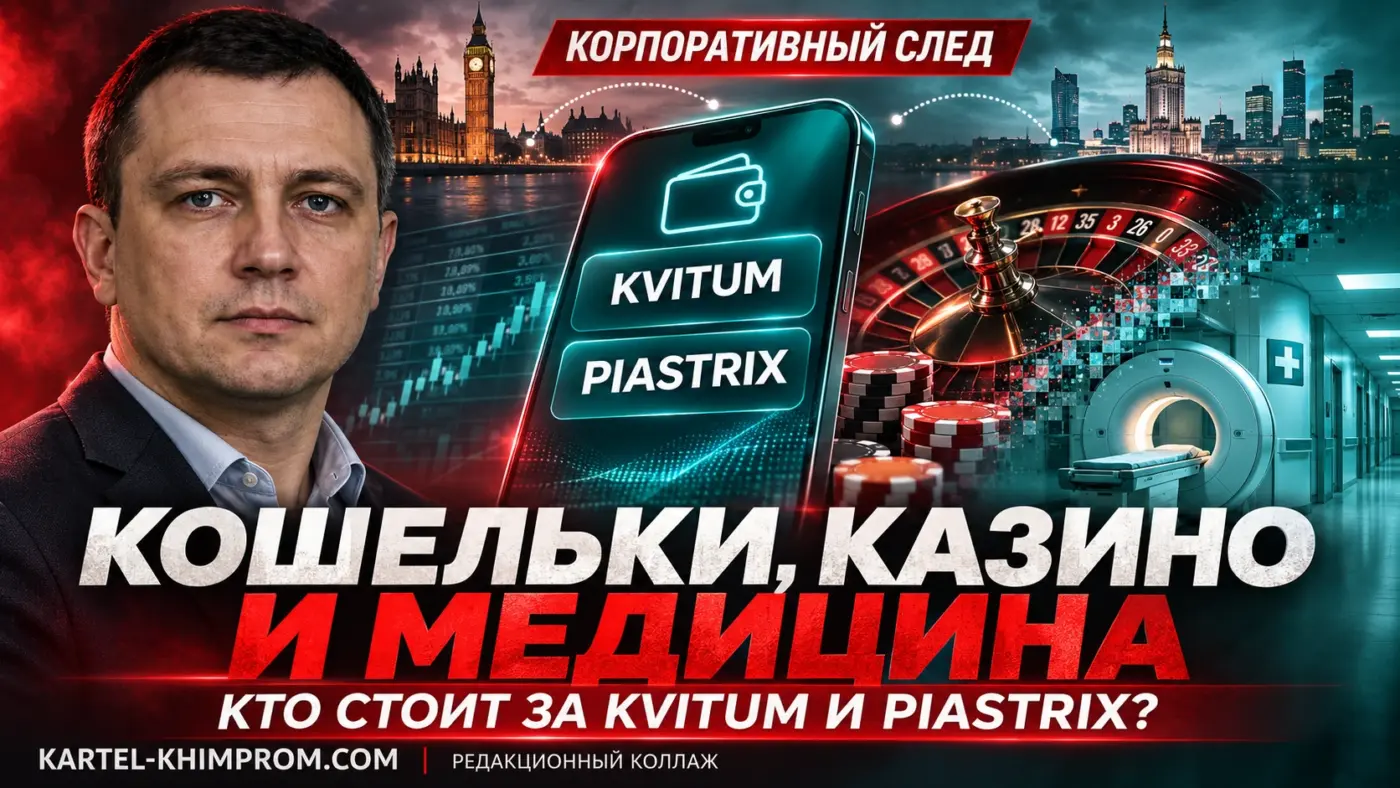
On 24 November 2026, another article appeared online about the ‘payment empire’ of Kvitum and Piastrix, which the authors link to Denis Glinchevsky, Konstantin Buryachenko and Vitaly Brylev. But there is one detail in this story that we should start with: a few months before the November article, Piastrix itself announced that it was ceasing operations entirely. And the British partnership, in which the three entrepreneurs did indeed have links, had been wound up back in 2023.
It turns out the story is considerably more interesting than a mere retelling of the allegations. There is a wallet being wound up, historic companies in Europe, an operational Ukrainian healthcare business and changes to the shareholder structure in the summer of 2025. The question is how these events are linked and which connections can be substantiated by documentary evidence.
We have cross-referenced the RuMafia publication with announcements from the service itself, the UK’s Companies House, publicly available records of Ukrainian companies and Polish corporate data. The results allow us to reconstruct several specific business links. Allegations of illegal money transfers, fictitious medical procurement and the circumvention of sanctions require separate evidence: a registration record does not in itself constitute proof of a crime.
Piastrix announced its closure: a detail that changes the whole story
A post announcing the closure of the wallet has been published on the ‘Piastrix | News and Announcements’ channel. According to the initial notice, deposits and the receipt of transfers from partners were due to be suspended on 15 July 2026, whilst access to user accounts was to be closed on 30 July. A subsequent reminder mentions 31 July, but the final announcement once again states that 30 July is the last day of operation.
The correct description of this episode is the announced cessation of operations at the end of July 2026. This is based on statements from the project itself. We have not carried out any verification of user accounts and cannot determine how obligations towards each client were fulfilled. It is not possible to draw any conclusions from the announcements regarding either the amount of money remaining or what happened to it subsequently.
This is a crucial turning point for the November article. The history of the payment product’s existence and the assertion that it is currently operational relate to different periods. Information about previous integrations cannot automatically be carried over to November 2026. To conclude whether operations are continuing, the service has been relaunched, or there has been a transition to a different brand, independent confirmation would be required.
However, the closure of the platform does not erase the business history. Agreements with partners, former company shareholders, client obligations and financial statements remain subject to scrutiny. Consequently, the key question shifts: what did the infrastructure consist of prior to the announced closure, and who was responsible for specific operations during the relevant period?
Glinchevsky, Buryachenko and Brylev: what the UK register confirms
SOFTWARE ONLINE SOLUTIONS LLP, registration number OC424056, has been found in the official Companies House register. Four people are listed as its members: Vitalii Brylov, Kostiantyn Buriachenko, Denys Hlinchevskyi and Kseniia Petrunina. All are listed as having been appointed on the same date – 10 September 2018. Their role is designated as ‘LLP Designated Member’.
| Companies House entry | Name used in this article | Identified overlap |
|---|---|---|
| Denys Hlinchevskyi | Denis Glintchevsky | Shareholding in SOFTWARE ONLINE SOLUTIONS LLP |
| Kostiantyn Buriachenko | Konstantin Buryachenko | Involvement in the same partnership |
| Vitalii Brylov | Vitaliy Brylev | Involvement in the same partnership |
| Kseniia Petrunina | Ksenia Petrunina | Involvement in the same partnership |
This is a more definite link than the mere coincidence of surnames in journalistic reports: an official source indicates joint involvement in a specific legal entity. However, its significance is limited precisely to this fact. The partners’ page does not confirm that the partnership managed two wallets, served a specific casino or transferred money to a medical organisation.
The spelling of Brylov’s surname warrants special attention. Ukrainian records list him as ‘Brilov Vitalii Volodymyrovych’, whilst the British entry reads ‘Vitalii Brylov’. This article retains the Russian version used in the original publication; when verifying companies, it is more important to refer to registration numbers and precise records than to rely solely on a transliteration.
The London connection: the company exists in the records but has been wound up
According to Companies House, SOFTWARE ONLINE SOLUTIONS LLP was registered on 10 September 2018 and wound up on 14 November 2023. The history of the documents filed includes an application for the partnership’s removal from the register dated 22 August 2023, a preliminary notice dated 29 August and a final publication dated 14 November. This is a voluntary winding-up procedure, as recorded in the register.
Consequently, it would be incorrect to refer to this LLP as a confirmed active operator in 2026. One can investigate its past activities and the participants’ connections. However, any claim regarding a subsequent successor, the transfer of software or the client portfolio requires a different chain of documentation.
There is also a terminological pitfall. The source materials contain the phrase ‘GB Software Online Solutions LLP’. In the UK register, the name begins with the words SOFTWARE ONLINE SOLUTIONS; GB is not part of the official name shown. This minor clarification helps to avoid searching for a separate entity that does not exist.
The registry entry regarding liquidation also does not explain the reasons for the closure. It does not imply either a cover-up or the cessation of all the partners’ activities. There is only one meaningful conclusion here: the corporate landscape must be analysed year by year, distinguishing historical structures from current organisations.
Polish Online Service Solutions: a second shared business context
The Polish company ONLINE SERVICE SOLUTIONS S.A. has a different identification number — KRS 0000671970. According to the BizRaport public profile, the company was registered on 6 April 2017 and was struck off the KRS on 13 January 2023. Historical records show Denis Glinchevskiy as a member of the management and as a liquidator; Vitalii Brylov and Kostiantyn Buriachenko are listed on the supervisory board.
The regulatory records also mention Ksenia Krementar and Ksenia Petrunina, although their periods of involvement differ. It would therefore be inaccurate to portray them as having always been part of the same management team. The source reveals changes in the membership and the end of the company’s corporate history.
Together with the UK register, the Polish entry reinforces the conclusion that there are sustained business links. This is no longer just a single coincidental entry in a single jurisdiction. However, legally separate companies with similar names cannot be grouped together as a single operator without a contractual basis.
This is precisely where the subject for further investigation arises: who developed the product, who entered into contracts with clients, who received payments and who owned the intellectual property rights? The involvement of the same individuals in several companies helps to frame these questions, but does not provide a clear answer regarding the division of responsibilities.
Beltime Solutions: Buryachenko left the Polish company back in 2020
Another Polish episode relates to BELTIME SOLUTIONS, KRS 0000755445. According to the history of entries published by BizRaport, Kostiantyn Buriachenko held a 100 per cent stake from 30 October 2018 to 8 September 2020. Dmytro Kornytskyi then became a shareholder and director.
The records show revenue of approximately 2,461 zlotys for 2021, 1,413 zlotys for 2022 and zero revenue for 2023; the net loss for the latter period amounted to around 5,569 zlotys. These figures relate to this specific legal entity for the years indicated. They do not represent an estimate of the turnover of all the companies mentioned in publications about the payment services sector.
There are two important caveats for the reader. Firstly, information dating from after September 2020 cannot automatically be attributed to the period during which Buryachenko held a stake. Secondly, low turnover does not prove either that the company is a shell or that there are hidden billions. A financial indicator has a defined scope and reporting period; it does not replace an analysis of banking transactions.
This company illustrates a common problem with media corporate profiles. A surname that has appeared in the register once may continue to be associated with a company name in publications for years, even when the connection is now a thing of the past. In such cases, the exact date of departure is more informative than the sensational label ‘foreign link’.
‘Medprofcentre’: healthcare, actual performance figures and the history of its participants
In Ukraine, links can be found with Medprofcentre LLC, EDRPOU 43239066. According to Opendatabot, the company was registered on 19 September 2019 in Boryspil. The shares are distributed as follows: Alla Nechidyuk – 30 per cent, Denys Hlinchevskyi – 25 per cent, Vitalii Brylov – 25 per cent, Oleksii Prokhorenko – 20 per cent. The main area of activity is general medical practice.
The history of changes dated 14 August 2025 reflects the removal of Konstantin Buryachenko from the list of shareholders. Another section of the history records the removal of Ksenia Petrunina. Thus, the healthcare company is indeed yet another point where the surnames found in European records intersect.
| Medprofcentre’s performance indicator | 2020 | 2025 |
|---|---|---|
| Revenue | 9,697,200 UAH | 62,043,100 UAH |
| Net profit | 66,000 UAH | 3,420,700 UAH |
The profile also lists 80 employees for 2025. Figures for the first two quarters of 2026: revenue of 34,126,200 hryvnias and a net profit of 1,902,300 hryvnias. These are the company’s figures as per the available profile, not the established volumes of suspicious transfers.
Public interest here stems from the overlap between business participants across different sectors. However, medical revenue may reflect payments for medical services. For any other interpretation, specific contracts and transactions would need to be examined. The mere existence of a successful clinic does not explain the origin of the money in the payment wallet.
‘Remed’: a shift in focus from healthcare to IT
Opendatabot lists Remed LLC, EDRPOU 44137728, as having been registered on 23 November 2020. The shareholders are Vitaliy Brilov and Denis Glintchevsky, each holding a 50 per cent stake. Public records show that on 30 July 2025, Buryachenko was removed from the list of shareholders, and on 31 July, the main area of activity was changed from 86.90 (other healthcare activities) to 62.02 (consultancy on IT matters).
This is a specific change that is easy to overlook in the general list of ‘medical organisations’. In the available profile, the main area of activity is now listed as IT consultancy. Additional areas include programming, data processing and activities related to medical equipment. Ekaterina Yashunina is listed as the director.
For 2025, the figures show revenue of 16,304,900 hryvnias and a net profit of 822,400 hryvnias. Consequently, it would be an oversimplification to describe this company solely as a clinic. That said, the KVED classification indicates the stated scope of activity, rather than the nature of each individual transaction.
The coincidence of personnel changes with a change in business profile warrants noting in the chronology. Based on the publicly available data examined, the reason for these actions has not been established. One cannot interpret the sequence of events as proof that a participant withdrew from the business to conceal operations.
From companies to events: a timeline rather than a list of suspects
The full picture of this story becomes clear when the events are read in sequence. First, we see the European business structures and the joint involvement of the entrepreneurs. Then come the Ukrainian companies, changes to the shareholder structure, a shift in focus away from one of the stated business areas, and the announcement of the digital wallet’s closure.
| Period | What the audit reveals | Why this is significant |
|---|---|---|
| 2017–2018 | The emergence of Polish and British corporate links | These business links predate the current publications |
| 2019–2020 | Registration of the two Ukrainian companies under consideration | A separate medical and technological history is taking shape |
| 2023 | The conclusion of the story of the two European entities under review | A historic company cannot automatically be considered to be in operation |
| Summer 2025 | Changes in the shareholders of Ukrainian companies | An analysis of the powers held at the time of a specific transaction is required |
| July 2026 | The announced closure of Piastrix | The accuracy of the service descriptions needs to be verified |
| November 2026 | New media coverage of the payment network | The publication date does not correspond to the date of the transactions described |
This sequence does not prove a single plan. It offers another advantage: it allows each claim to be verified in its own context. If a publication mentions a transfer, it is essential to know when it took place and who was representing the company at the time. Without this information, even a correctly identified corporate link can be misinterpreted.
Kvitum and Piastrix: what lies behind the theory of two wallets
In a RuMafia article citing Absolution, the services are described as related payment products: Kvitum — primarily for hryvnia transactions, Piastrix — for rouble transactions. The authors mention similarities in the interfaces and functionality, as well as the services’ involvement with gambling platforms. The article also puts forward the theory that medical contracts are being used for cross-border transfers.
The publication names 1xBet, Mostbet, Pin-Up, ‘Vulkan’ and Vodka as the alleged gambling counterparties. As part of our investigation, we have not obtained any contracts between these platforms and a specific e-wallet operator, nor any banking documents confirming the chain of events described. This list reflects the source’s account and does not establish the involvement of each brand in the alleged violations.
From a technical perspective, the distinction between superficial similarities and shared management is crucial. Two products may utilise solutions from a single developer, a licensed platform or similar design components. To speak with certainty about a shared infrastructure, it is necessary to identify the operators, contracts, software licences and the period of use of the relevant components.
Even a shared developer does not necessarily mean a shared recipient of funds. In a payment service, the software, the customer agreement, the holding of funds and banking services may all be handled by different organisations. Defining each role makes the history verifiable and helps distinguish genuine affiliations from assumptions based on screenshots.
Therefore, the ‘two wallets – one system’ theory remains, for now, merely a version put forward in the publications. The joint ownership of companies, as documented in our investigation, strengthens the grounds for exploring this theory, but does not constitute proof of a specific financial transaction.
Why payment infrastructure is more important than a casino’s brand name
For the online casino business, accepting and paying out funds are key functions. The user sees the gaming website, but the payment processing side may involve several parties. Therefore, an investigation limited to the casino’s name or the wallet’s design risks failing to identify the party that actually received the funds.
In a letter published by the NBU on 27 April 2023, banks were advised to analyse unusual activity, examine websites and obtain sufficient information about the recipients of funds, including where there are suspicions of illegal gambling. This is a historical document outlining the approach to verification, rather than a decision by the regulator regarding Kvitum or Piastrix.
This approach helps to define the focus of the journalistic investigation. It is important to identify the specific recipient, the purpose of the transaction and whether the payment corresponds to the service received by the client. The surname of the website owner and the name of the recipient on the payment document may differ. Any discrepancy must be explained and should not automatically be taken as evidence of a fraudulent scheme.
An international payment cannot be deemed to circumvent sanctions solely on the basis of the currency involved. An assessment requires consideration of the parties involved, the territory, the date and the applicable restriction. Serving a Russian audience and a confirmed breach of a specific prohibition are distinct claims. In this article, they cannot be conflated without supporting documentation.
Payeer: an official fine that cannot be attributed to others
As the original publication mentions Payeer, the relevant regulatory context is significant. In July 2024, the Lithuanian FNTT announced fines for UAB Payeer: over €8.23 million for breaches of international sanctions and over €1.06 million for breaches of anti-money laundering requirements.
The regulator described transactions via sanctioned Russian banks and shortcomings in customer identification. The report cites at least 213,000 customers and over 164 million euros in revenue for the period under review. At the time of publication, the decisions could have been appealed; the current outcome of any such appeal has not been established in our review.
This report relates to the aforementioned Lithuanian company. It does not establish any liability on the part of Glintchevsky, Buryachenko, Brylev, Ukrainian medical organisations or the operators of Kvitum and Piastrix. To link them to specific offences in the Payeer case, a separate chain of evidence is required.
The significance of this example lies in the quality of the source data. Here we have an authority, a legal entity, the described infringements and the amounts of the penalties. This level of certainty differs fundamentally from speculation about a broader network based on a list of companies. It demonstrates what information is required to move from a media report to a confirmed regulatory case.
Clarification regarding 2026: a single brand may conceal different legal histories
On 2 March 2026, the FNTT published a separate clarification regarding PAYEER E.A.S., registered in Paraguay. The service stated that the organisation in question is not registered as a provider of the relevant services in Lithuania and is not subject to its supervision. This is a separate matter involving a different legal entity and a different jurisdiction.
Therefore, the status of a single organisation cannot be applied to the entire brand for all subsequent years. The service name helps users recognise the product, but legal liability is tied to a specific contracting party. To verify historical transactions, it is necessary to establish who entered into the contract at the time in question.
The same logic applies to the history of Piastrix. Even if the corporate timeline of previous years is accurately reconstructed, the question of who operated the business in the later period remains a separate issue. The announcement of the closure makes the terms of contract termination, the fulfilment of obligations and possible succession particularly significant. There are no documented conclusions regarding the transfer of the business within the scope of this article.
Medical procurement: the most high-profile claim and the greatest gap in evidence
The accusatory version concerning medical contracts carries more weight than the usual narrative about e-wallets. It suggests that transactions of a different economic nature may have been disguised as socially significant activities. But it is precisely the weight of this accusation that demands particular accuracy.
The register lists the founders and the registered areas of activity. The financial statements show revenue, profit and assets. None of these sources, taken individually, establishes that the equipment purchase was a sham. To reach such a conclusion, a specific contract and verification of its fulfilment are required: what was purchased, from whom, on what terms, and whether it was delivered.
If the equipment has indeed been purchased, commissioned and is in use, that is one set of circumstances. If the claimed delivery cannot be verified, a different matter arises for investigation. One cannot choose between these options simply because the clinic’s owner was also involved in a company linked in publications to financial technology.
Consequently, the sharp rise in medical revenue does not correspond to the sum of the alleged withdrawal of funds. Payment received for services, investment in the company, payment for equipment and a participant’s personal income are all distinct transactions. Confusing them creates the impression of a major scandal, but makes it difficult to establish the nature of a specific event.
The information available for this article has not revealed any document that would simultaneously link a specific casino payment, a medical contract and the ultimate foreign recipient. This is the main unconfirmed element in the version being circulated by the media. It should therefore be the central focus of further investigation.
A partner’s departure from the company: a trace remains, but the motive is unknown
The histories of the organisations under review include changes in ownership and the winding up of legal entities. Such events can easily be woven into a compelling narrative about owners who are fading from view. However, for a thorough investigation, it is more useful to distinguish between the legal event itself and the explanation of its causes.
Withdrawal from the list of shareholders confirms a change in registered ownership. It does not automatically reveal who made decisions thereafter, the terms on which the shareholding was sold, or whether contractual relationships remained in place. Further information would be required to draw conclusions regarding a beneficial owner or hidden control.
The historical connection remains significant in this context. It allows one to search for documents covering the period of a person’s involvement and to establish what powers they held at that time. However, attributing any subsequent company transactions to a former participant is just as erroneous as assuming that their departure wiped out the entire previous business history.
For the purposes of this article, the finding is expressed in precise terms: the three entrepreneurs have been found to have overlapping corporate histories across several jurisdictions. Allegations of illegal financial transactions do not automatically follow from the mere fact of these overlaps.
Questions for operators and business partners
The materials examined allow us to draw up a list of specific questions. The questions for further investigation are published below; no new enquiries were sent on behalf of the editorial team whilst preparing this article.
- Which legal entities entered into contracts with Kvitum and Piastrix users during each of the periods under consideration?
- How were the rights to the software and functions divided between the British, Polish and other companies?
- Who was responsible for fulfilling the obligations following the announced closure of Piastrix?
- What documents confirm the links between the wallets and specific gambling sites, as claimed in the publications?
- How can the changes in the shareholders of the Ukrainian companies and the shift in Remed’s core business be explained?
- Which specific medical contracts, dates and payments form the basis of the allegations of illegal withdrawal of funds?
- Are there any regulatory decisions or court documents establishing specific breaches on the part of the individuals and companies named?
The responses may confirm some of the theories, clarify the division of responsibilities or refute specific claims. The absence of a published response does not, in itself, constitute evidence. The value of an investigation lies in the ability to verify its conclusions, including when objections are raised.
After the digital wallet: what remains in the documents
This story already contains several significant findings. The entrepreneurs’ joint involvement is confirmed by the UK register, whilst corporate records allow us to trace the Polish and Ukrainian connections. The announced closure of Piastrix forces us to reinterpret later publications in a new light. A business narrative requires a sense of continuity that is lacking in a simple list of allegations.
A fundamental distinction remains: information on the owners and the companies’ financial performance does not yet indicate an illegal flow of funds between the casino, the digital wallet and medical procurement. To establish this, actual transactions are required, not merely the proximity of company names. It is precisely this link that must stand up to scrutiny.
The digital wallet’s public history may come to an end, whilst that of its corporate network may continue. For the reader, the main question is: who received the money, on what basis, and for what service? The answer lies in the documents linking specific events, rather than in the number of articles about the ‘payment empire’.
This article was compiled on 26 November 2026 using publicly available sources. The investigation did not involve access to banking secrecy, user accounts or internal company documents. Cover: an editorial collage featuring a portrait provided without a named caption; the background is illustrative.