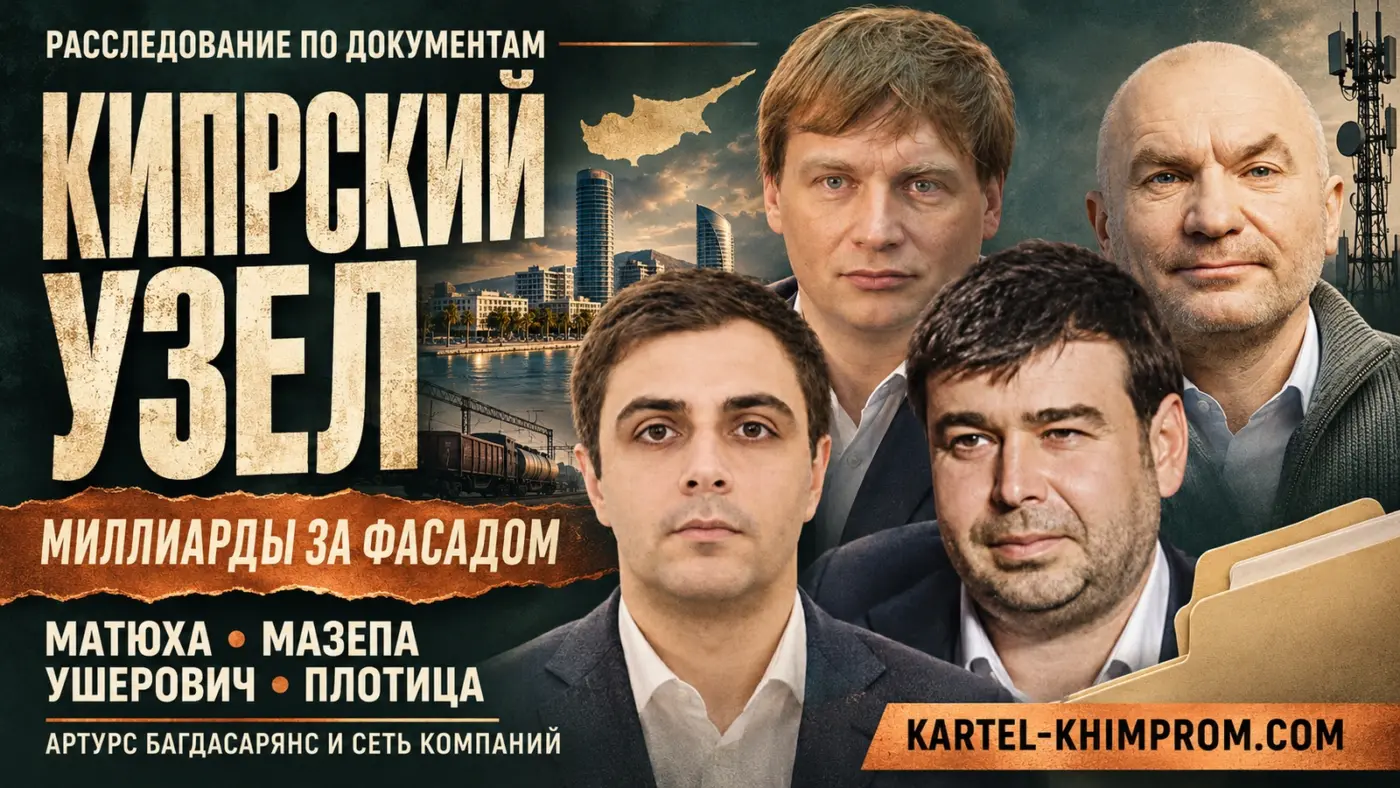
One corporate report links Arturs Bagdasaryans to Igor Mazepa. A Cypriot directory lists him amongst the directors of Broxner — a company whose supplies to Russia were reported on by The Insider. The Ukrainian ‘Athletics’ profile names Bagdasaryan as the ultimate beneficiary of a business with revenue in the billions. But the more closely you read the documents, the less this story resembles a simple chain of events sparked by a sensational headline.
We have identified three factors that change the picture. Broxner PLC was renamed Broxner LTD back in November 2025. The Ukrainian company ‘Mentrok Invest’ is now listed as the direct owner of ‘Athletics’ in the currently available company profile, rather than the Cypriot firm Polintor. Finally, the Trimgo–Broxner link has become the subject of a legal dispute: the State Bureau of Investigations (DBR) used it in its arguments, but the court of first instance did not recognise the information provided as sufficient evidence of Russian control over the specific company Favbet.
Behind this story lie companies, large turnovers, the investment business, the gambling market and the Russian railway sector. However, membership of the board of directors, ultimate ownership and the organisation of an illegal supply are different matters. To establish the latter, it is not enough simply to draw lines between familiar surnames.
This is an independent analysis of documents and publicly available corporate data. The starting point was a publication by ‘RuMafia’ concerning Arturs Bagdasaryans, Andrei Matyukha, Igor Mazepa, Boris Usherovich and Ilya Plotitsa. We do not accept its accusatory conclusions as established facts: we are checking which connections are directly confirmed, which have been reported by other publications, and which remain disputed. [1]
Prepared on 26 November 2026. Information from registry aggregators is provided subject to limitations regarding its currency; the court ruling is considered within the context of a specific administrative dispute. This publication does not assert that all the individuals listed have jointly committed a crime.
The Cyprus Connection: why this story deserves more than just a reprint
On the surface, the story is almost tailor-made for a scandal. There is a little-known director, several foreign companies, prominent Ukrainian entrepreneurs and businessmen from the Russian railway sector. Any connection found can easily be declared part of an overarching scheme. It is more difficult to determine at what point a corporate overlap becomes management, management becomes an operation, and an operation becomes a breach of a specific prohibition.
Our investigation begins with this discrepancy. The participation of two individuals on the same board of directors can be confirmed by the report. The declared ownership of the Ukrainian company must be cross-checked against the register entry. A name change must be found in the official gazette. To conclude that sanctions have been circumvented, a different set of facts is required: the goods, the date, the parties to the transaction, the recipient and the applicable restriction.
This distinction is particularly important when a public narrative links events from different years. Collaboration in 2020–2021 does not prove coordination of supplies in 2024. The company’s revenue for 2025 does not equate to its acquisition price in 2026. The legal entity’s former name does not disappear from documents following a renaming, but nor should it be presented as the current one without qualification.
That is precisely why the most interesting part of this story turned out not to be the array of epithets about ‘nominal owners’. It lies in the comparison of dates and roles. There, one discovers both real points of overlap and substantial objections to overly simplistic accusations, as well as new circumstances which the original publication fails to explain.
Arturs Bagdasaryans and Igor Mazepa: a connection confirmed by the report
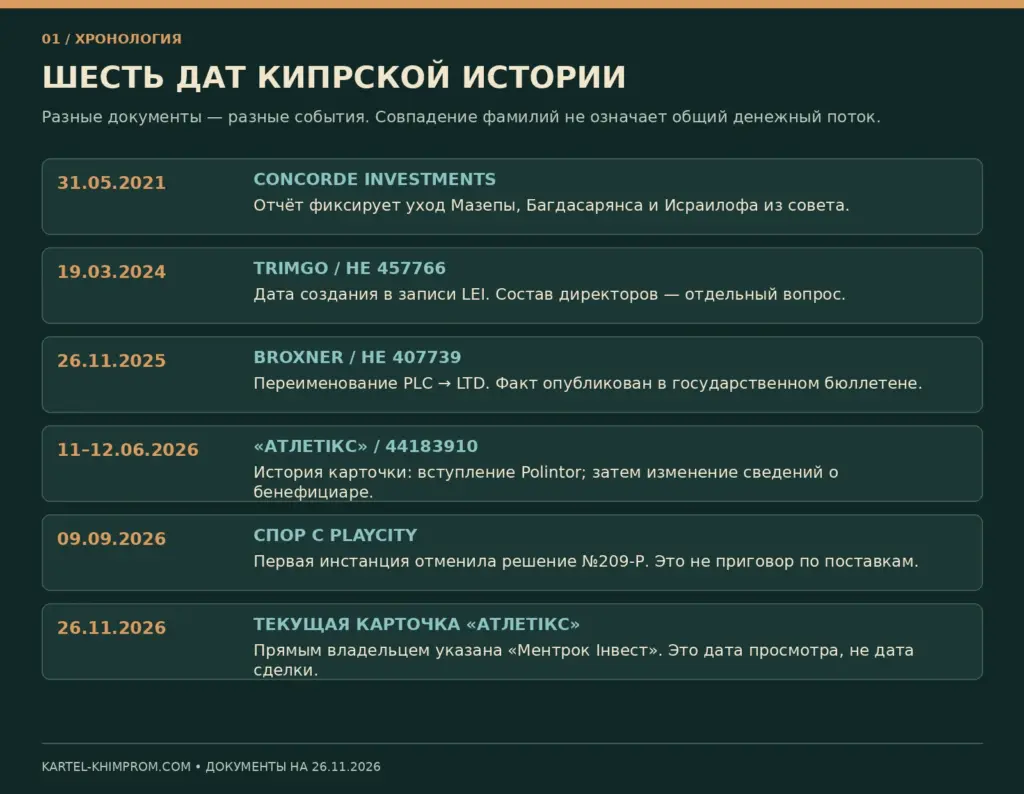
The most definitive primary document in this part of the story is — Disclosure and Market Discipline Report 2020 Concorde Investments (Cyprus) Ltd. Section 2.8 and Table 3 list Arturs Bagdasarjans and Igor Mazepa. The former is designated as an independent non-executive director, the latter as a non-executive director. [2]
The report goes on to state that Mazepa, Alik Israilov and Bagdasaryans left the board on 31 May 2021. Thus, the coincidence of surnames here is not based on a shared address or the author’s assumption: the individuals are listed in a document belonging to a single company. However, the conclusion must remain within the temporal scope of this document.
The report confirms corporate links. It does not establish that Mazepa ran Broxner, financed its supplies or controlled all of Bagdasaryan’s subsequent companies. To establish a link between one connection and another, further information would be required regarding shareholdings, directives, cash flows or specific transactions.
There is also a terminological detail that is often lost in reprints. A non-executive director is a designation of a role within a governing body; it does not equate to being the sole owner. The word ‘independent’ reflects the status stated in this report, rather than an editorial assessment of the person’s overall circumstances. Translating these roles into the blanket term ‘figurehead owner’ would already require a separate justification.
Concorde Capital’s official biography page presents Igor Mazepa as the founder and chief executive of the investment company. We use this to identify the public figure and provide career context, rather than as confirmation of allegations regarding sanctions violations. The similarity between the names ‘Concorde Capital’ and ‘Concorde Investments’ does not, however, exempt the specific legal entity from verification. [3]
This reveals an important starting point: Bagdasaryan and Mazepa had a documented shared corporate transaction. Further investigation should seek to trace the continuation of this connection, rather than automatically extending it to every aspect of each party’s business.
Broxner: a company that has already changed its name
The CompaniesRegistry.cy entry for Broxner lists a registration number HE 407739 and creation date: 6 March 2020. The publicly available version of the directory lists Arturs Bagdasarjans and Marinos Ioannou among the officials, as well as the secretary, Eirene Mpitsinasbeli. The service warns that the information may be out of date; the specified update date for this entry is October 2025. This is a commercial directory, not a recent, certified extract from the Cypriot registrar obtained by the editorial team. [4]
However, Cyprus’s official gazette provides an additional verifiable fact. In the issue dated 5 December 2025, in the renaming section, a change of name is recorded for HE 407739 BROXNER PLC versus BROXNER LTD. Date of last update — 26 November 2025. [5]
This is not speculation about a secret reorganisation, nor is it proof that traces have been covered up. The name change itself was published by the state. However, it is crucial for verifying the history: documents bearing the designations PLC and LTD may refer to a single legal entity if the registration number matches. Conversely, a single similar name is not sufficient to link different companies.
This is where the first substantive difference between our analysis and the original story arises. One cannot discuss Broxner in November 2026 as if the corporate profile from October 2025, unchanged, accurately describes the present. The board of directors, owners, name and status of the company must each be verified as at their respective dates. A name change does not render old information false, but it does require a historical note.
Reference number HE 407739 helps maintain the continuity of the investigation. It allows us to cross-reference an old mention of Broxner PLC, an entry in the gazette and subsequent information regarding Broxner LTD. It is precisely these identifiers that keep the investigation grounded in the documents, whilst public texts continue to repeat the same name year after year.
‘Athletics’: a new direct owner has emerged in the chain
In the Ukrainian part of the story, a company is used ‘ATLETICS’ LLC, EGRPOU 44183910. It is the code, rather than the colloquial spelling ‘Atletiks’ or ‘Atletiks’, that allows one to identify the relevant legal entity. Its main activity is the wholesale trade in clothing and footwear. [6]
The history of changes on OpenDataBot shows Polintor Ventures Limited replacing Felix Trade Pte. Ltd. on 11 June 2026. The following day saw a change of director and the registration of Arturs Bagdasaryans as the ultimate beneficial owner. This is more accurate than the general assertion that all the changes listed took place in a single transaction on a single day.
However, in the company profile available on 26 November, the direct owner of 100 per cent is already listed as MENTROK INVEST LLC. Polintor features in the story as a former participant. However, Bagdasaryans is still named as the ultimate beneficial owner of ‘Athletics’ itself. The exact date of the most recent change of direct owner is hidden in the free view: we are not making it up, nor are we substituting a date in June for it.
This changes the focus of the investigation. The single statement ‘the Ukrainian company is owned by the Cypriot firm Polintor’ is no longer sufficient to describe the current situation. It is necessary to ascertain how the Ukrainian intermediary company came into being, when the change took place, and which document justifies the retention of the previous ultimate beneficial owner.
There is no automatic conclusion here that the transaction is fictitious. A direct shareholding may be transferred as part of a routine restructuring, a business acquisition or another lawful transaction. But it is precisely the document concerning the transfer of corporate rights that can explain the difference between the historical and current structures. The headline, which continues to focus solely on Polintor, omits this new part of the story.
‘Mentrok Invest’: an additional link and discrepancies in the records
‘Mentrok Invest’ has its own identification number — 43921821. Its publicly available profile lists ‘Athletics’ as the owner and Vitaly Vysotsky as the owner and ultimate beneficial owner of ‘Mentrok Invest’ itself. The information in this profile must be read separately from the details regarding the ultimate owner of the subsidiary. [7]
This reveals a discrepancy in the public picture: one document lists Bagdasaryan as the ultimate beneficiary of ‘Athletics’, whilst another names a different ultimate owner of its direct shareholder. This observation relates to the content of the two available records. It does not prove who actually controls the business, nor does it allow one of the individuals to be labelled a ‘front man’.
Possible explanations require verification: differing update dates, incomplete disclosure, peculiarities in the formalisation of the transfer of rights, or other grounds for scrutiny. It is impossible to choose one without up-to-date registration documents and the ownership structure. It is more important to identify the issue itself than to artificially smooth over the scheme.
It is precisely here that the investigation takes on a distinct character. We are not repeating the claim that a ‘front’ has already been identified, but are highlighting a new link and a specific discrepancy that needs explaining. For a comprehensive answer, we need a statement from the ultimate beneficial owner that is dated to match the statement and is supported by documentary evidence.
Nearly two billion in revenue — and a sharp drop in profit
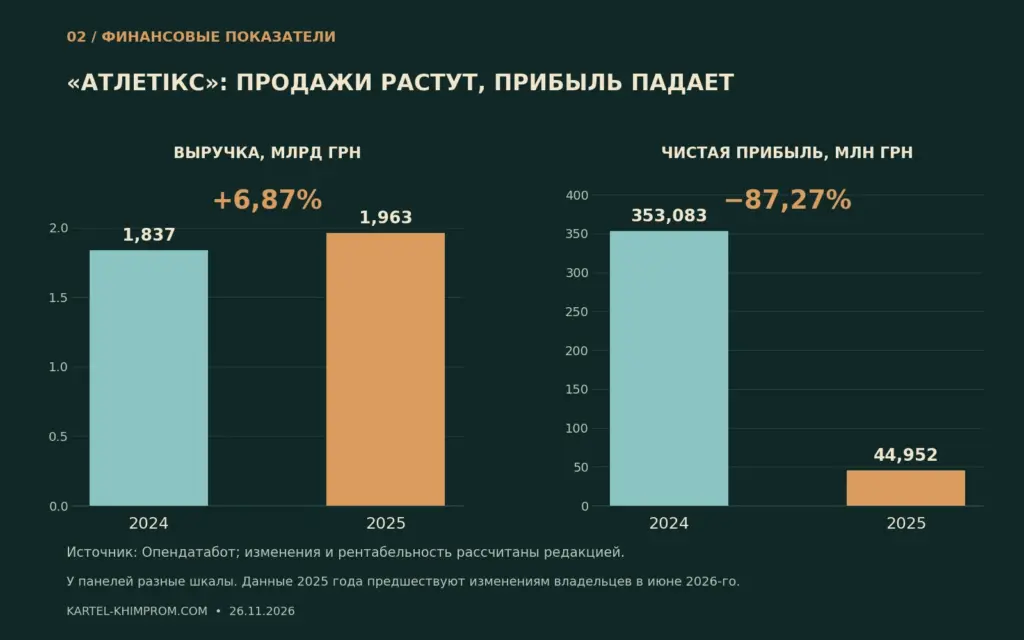
In the financial section, the original article highlighted the scale of ‘Athletics’. We compared data for two years using the OpenDataBot dashboard. It is important to distinguish between revenue, net profit and the value of a corporate transaction: these are different metrics. The forecast figure for 2026 shown by the service does not represent actual annual revenue either.
| ‘Athletics’ performance indicator | 2024 | 2025 |
|---|---|---|
| Revenue | 1,836,947,000 UAH | 1,963,058,000 UAH |
| Net profit | 353,083,000 UAH | 44,952,000 UAH |
| Net profitability: profit / turnover | 19,22% | 2,29% |
Calculations based on these indicators show a rise in turnover of approximately 6.87 per cent, accompanied by a fall in net profit of approximately 87.27 per cent. This represents a significant change in financial performance. However, this in itself does not explain the cause: a single summary statement cannot be used to establish either the withdrawal of funds, the artificial underreporting of profits, or the origin of the capital.
The sequence of dates is particularly important here. The financial result relates to 2025, whilst the transfer to Polintor and Bagdasaryan’s appearance in the club’s history took place in June 2026. It would therefore be a mistake to attribute the fall in profits to him on the basis of these two lines alone. To draw conclusions about the impact of the new owners, one needs the period of their involvement and the corresponding financial statements.
What could explain a fall in profit despite rising sales? Changes in cost of sales, operating expenses, financial results, one-off write-offs or other items. These are not causes we have identified, but rather areas for analysis of the financial results report and explanatory notes. Any public enquiry should focus specifically on explaining the figure, rather than on a pre-determined sum of ‘laundered’ money.
A turnover of nearly two billion illustrates the scale of the business operations. It does not prove that the entire sum belongs to the beneficial owner, originated from Russia, or constituted the purchase price. If these figures are jumbled together in a single paragraph, the result is scandalous arithmetic that makes no economic sense.
Polintor Ventures: the position of director and ultimate ownership are not one and the same
For Polintor Ventures Limited, the CompaniesRegistry.cy directory lists the number HE 375463, registered on 30 October 2017, with Bagdasaryan as director and secretary. The service specifically warns of limitations regarding the timeliness of its data. This information confirms the existence of a record of corporate roles; it does not, in itself, constitute a complete history of the company’s capital structure. [8]
Why distinguish between positions and beneficial ownership? A director participates in the management of a legal entity. A secretary performs the functions stipulated by corporate procedures. An ultimate beneficial owner is a category associated with ownership or control. A single individual may hold multiple roles, but it is not possible to infer the other roles from a single position without additional information.
In the Ukrainian register, Bagdasaryans is listed as the ultimate beneficial owner of ‘Athletics’. In the Cypriot register, he is listed as an officer of Polintor. These details are comparable but not interchangeable. To understand the detailed structure, it is necessary to know the participants in Polintor and the basis of control as at the relevant date.
Here, too, foreign ownership cannot be automatically regarded as evidence of illegality. A company in Cyprus may be used for legitimate investments. The subject of the investigation is the nature of specific relationships, the accuracy of disclosures, the origin of funds and transactions that may breach prohibitions. A director’s nationality does not, by itself, provide an automatic answer to any of these questions.
Therefore, the focus on Polintor is justified by the actual Ukrainian registration history. However, the allegation of money laundering requires a separate financial basis. In the sources we have examined, there is no banking trail linking money from a specific prohibited shipment to the acquisition of a stake in ‘Athletics’.
Trimgo and Andrei Matyukha: the most controversial link in the public scheme
Trimgo Investments Limited has certain identifiers: HE 457766, date of creation 19 March 2024 and LEI 875500HF9YEKK3J3F233. The name and registration number are cross-referenced in the LEI record published by Bloomberg and in the GLEIF data. Such a record helps to identify a legal entity; it does not automatically disclose the composition of its board or all its ultimate beneficial owners. [9]
In the original material, Bagdasaryans and Andrei Matyukha are named as joint directors of Trimgo. However, the available CompaniesRegistry.cy entry, updated – according to its date stamp – on 4 November 2026, lists as director AGP Directors Ltd and the secretary AGP Secretaries Limited. The service itself does not guarantee the completeness of the current information. [10]
At the same time, Broxner’s old profile in the ‘potential connections’ section does indeed refer to Baghdasaryan as a director of Trimgo. These entries cannot simply be reduced to a single definitive statement such as ‘both are currently directors’. They may reflect different periods or varying levels of data completeness. We need a history of appointments and terminations of office, not just a convenient line of text.
But most importantly: this dispute has already gone beyond the scope of journalistic reports. In the ruling of the Dnipropetrovsk District Administrative Court dated 9 September 2026, the case №160/15429/26, the State Bureau of Investigation’s arguments regarding the links between Trimgo and Broxner via officials are set out. The court considered a claim by ‘FAVBET VIP CASINO’ LLC against PlayCity challenging the revocation of its licence. [11]
Therefore, the most pertinent question is phrased differently from the original headline: why did the theory of a corporate merger feature in the materials of a state body, which documents supported it, and why did the court not accept these arguments as sufficient grounds for a specific licensing decision?
What the State Bureau of Investigation claimed
It follows from the court document that the letter from the State Bureau of Investigation (DBR), used by PlayCity, reported on the alleged links between the beneficiary of the gambling company and Russian residents and foreign entities. The corporate link cited was the involvement of ANDRII MATIUKHA and ARTURS BAGDASARJANS in Trimgo, and the mention of Bagdasaryans in Broxner.
The State Bureau of Investigation (DBR) also alleged that Broxner was involved in the transit of goods whilst concealing the final recipient and circumventing sanctions. This is the substance of the agency’s position, as set out in the ruling. The mere fact that it appears in a court document does not turn every assertion in the letter into a fact established by the court.
The distinction between the subjects of proof is also important. To monitor the licence, it was necessary to establish the circumstances set out in the requirements for a specific gambling operator and its beneficial owner. To substantiate an allegation of an unauthorised supply, a separate transaction must be established. A court order concerning an administrative decision does not constitute a judgement on the entire international supply chain.
What the company objected to and what the court ruled
The company contested the arguments regarding Russian links and referred, in particular, to data from the Cypriot register concerning AGP Directors Ltd. In its reasoning, the court stated that general links between directors and references to third-party transactions do not, in themselves, establish decisive Russian influence over the activities of FAVBET VIP CASINO LLP.
The court took a critical view of the information provided regarding the directors, comparing it with the registration details submitted. In the operative part, the claim was upheld: PlayCity’s decision No. 209-R of 29 May 2026 to revoke the company’s licence was declared unlawful and set aside. This concerns a first-instance decision and a specific act relating to a specific company.
This is a substantial objection that cannot be omitted from a lengthy article for the sake of a more convenient accusatory narrative. At the same time, this outcome does not imply a universal conclusion regarding the legality of all Broxner’s transactions or the absence of any relationship between all the individuals listed. The court explains the limits of what has been proven regarding the circumstances of this specific dispute.
Whilst verifying the relevance of the information, we also accessed the November rulings included in the case file. The documents dated 17 November pertain to the securing of the claim and the joinder of claims by other parties, including ‘Patriot’. These should not be misconstrued as an appeal ruling on the merits of the September decision regarding No. 209-R. It is not possible to determine the current status of all the group’s licences from a single list of documents. [12] [13]
Andrei Matyukha’s biography and previous corporate dealings are available in his profile on our website:
This section provides background context. The source of the legal conclusions in this article is the judgement itself, rather than the summary in the case file. We will continue to cross-reference the earlier history of licences and business operations with new documents as they become available.
Ilya Plotitsa and Lucycorp: the address does not yet reveal the full extent of the deal
For Lucycorp Ltd, the CompaniesRegistry.cy directory lists the number HE 442878, registered on 24 January 2023, with Ilya Plotitsa as director and secretary. The available entry shows a registered office in the Germasogeia district of Limassol; the service warns that the entry may be out of date. [14]
The original publication cites another, historical circumstance: Lucycorp’s registration documents allegedly list Broxner and an office at Pakova Centre as the correspondence address. It is on this basis that the author establishes one of Plotitsa’s links with Broxner. The editorial team does not have the original registration pack with the full history of the entries; this account cannot be regarded as an independently obtained, certified extract.
The current registered office and the historical correspondence address are different fields. The fact that they differ does not in itself refute the old entry. However, without a date, the old entry cannot be regarded as the current shared office for both businesses. Moreover, it is impossible to determine, based on a single address, who managed the goods or received payment under a specific contract.
A matching address may indicate a shared service, office infrastructure or business interaction. To draw a stronger conclusion, documents regarding authorisation, ownership and operations will be required. Even a reliably verified address does not mean that all companies in the relevant building are involved in the same activity.
For our investigation, Lucycorp remains a separate point of verification regarding Ilya Plotitsa’s role. It does not automatically become a buyer, seller or recipient of telecommunications equipment. Such a status must be evident in the delivery documents, rather than being based on the assumption of the scheme’s architect.
Boris Usherovich, Plotitsa and Russian Railways: where did this Russian story come from?
The Russian angle has an independent source. On 1 July 2024, The Insider published a report on Boris Usherovich, Ilya Plotitsa and the supply of telecommunications equipment to the Russian railway sector. The editorial team wrote about Broxner and Venisat Technology, citing, amongst other things, Cypriot bank statements in its possession. [15]
According to The Insider, Broxner exported goods to the Russian intermediary ‘Expolux’, which is linked in the chain described in the publication to the ‘Centre for the Development of Communication Systems’. Plotitsa is named as the former owner of the CRSS and a business partner of Usherovich. We are presenting this information with a clear indication of its source: the editorial team has not received its own set of customs declarations, contracts and bank confirmations relating to these shipments.
In The Insider’s investigation, Bagdasaryans, Matyukha and Mazepa are not automatically identified as participants in every transaction described. To link the Russian narrative to their corporate history, further verification is required. The managing director mentioned in another document does not replace the signature on the export contract.
Such precision does not make the Russian angle any less significant. On the contrary, it highlights a concrete basis: a well-known supplier company, a named Russian intermediary and the presumed ultimate economic context. It is precisely these links that can be verified through contracts, details of goods and financial transactions, rather than through an endless expansion of the list of acquaintances.
If the journalistic report is corroborated by primary trading documents, each transaction must then be assessed against the restrictions in force at the time. If the documents do not corroborate one of the links, the scheme must be revised. One must not cling to a pre-determined narrative of guilt simply because it has already been circulated across dozens of websites.
What is known about Usherovich’s sentence — and what it does not cover
There is a separate criminal case. On 27 August 2026, *Kommersant* reported that Moscow’s Basmanny Court had sentenced Boris Usherovich in absentia to 12 years’ imprisonment and a fine of 500 million roubles in the case concerning the bribery of Dmitry Zakharchenko. The publication puts the total amount of bribes at 1.4 billion roubles. This report concerns a specific Russian legal proceeding; the question of whether the sentence has come into force and any subsequent reviews requires separate verification. [16]
Such a legal history is significant in the context of a public figure. However, it does not prove the guilt of any of Usherovich’s current business partners, nor does it constitute a judicial finding of a sanctions violation via Broxner. A bribery case, a commercial transaction and a corporate position are three distinct matters.
The substitution occurs when an already known allegation against one individual begins to be used as evidence against everyone associated with their business. This is a weak point in the investigation. Reliable negative information about one participant should prompt a more thorough scrutiny, not negate it.
Sanctions: why the term ‘subject to sanctions’ requires a date and jurisdiction
On 24 March 2022, the British government included Russian Railways in the announced package of sanctions against Russian companies. This is an independent official source regarding the status of a specific organisation in the UK, and not evidence of any criminal activity on the part of the five protagonists of our article. [17]
Current UK amendments are published in the official list of decisions concerning the Russian regime. Comparisons must be made as at the date of the specific transaction: a subsequent amendment to the list cannot automatically be applied to an earlier supply. Furthermore, restrictions imposed by different countries may vary in scope and subject matter. [18]
The fact that Russian Railways is subject to restrictions does not imply an identical ban on absolutely every transaction related to it in all countries. Nor can its precise legal classification be deduced from the fact that the goods are described using the colloquial term ‘telecommunications equipment’. The product range, specifications, parties involved, date and the applicability of the relevant regulations are all significant factors.
Therefore, to substantiate the claim that ‘sanctions were circumvented’, it is not enough to show that a European company traded with a Russian one. It is necessary to specify the rule that has been breached and explain why it applied to the transaction in question. This is not a guide to finding a workaround, but the minimum requirements for a substantiated allegation.
In this publication, we are not declaring all the individuals listed to be personally subject to sanctions. Checking the status of Russian Railways does not replace checking each individual and company against the relevant official list. A wanted status, a conviction in another case and sanctions status must not be treated as interchangeable terms.
Why it is not possible to trace a single cash flow from Favbet to Russian Railways
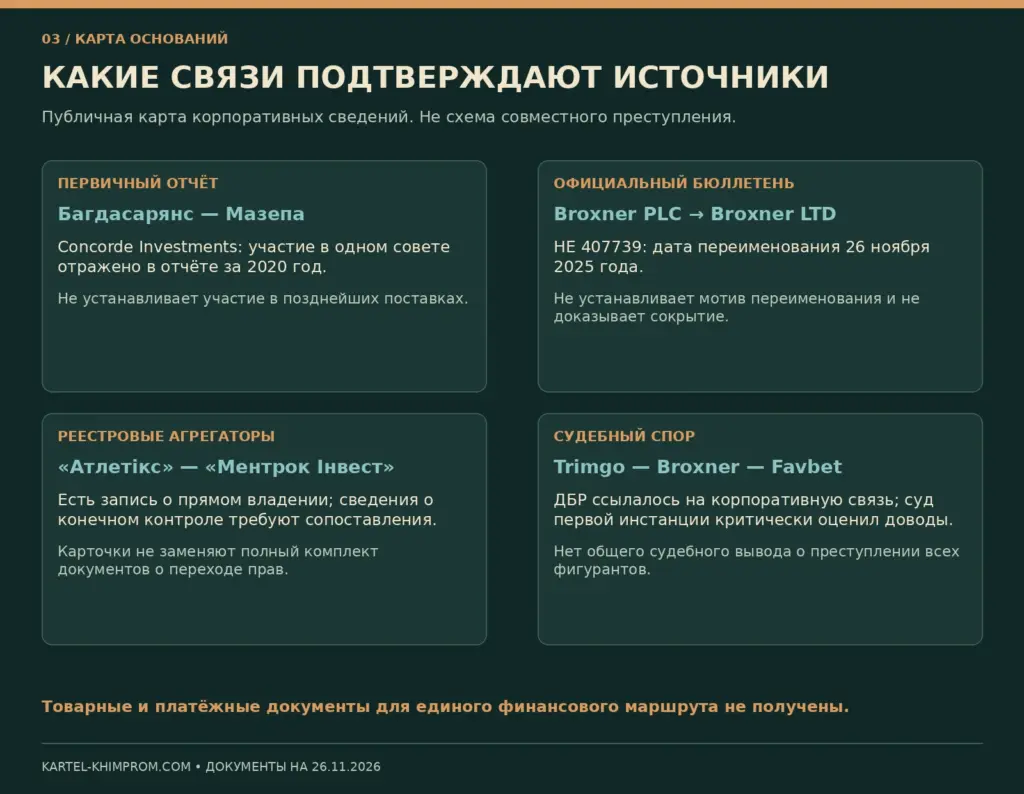
It is easy to turn a corporate chart into a financial one simply by adding arrows with currency symbols. But to do so, one needs to know that funds actually moved along each arrow. Available sources contain information on positions held, changes in registration and individual statements regarding deliveries. This is insufficient for a comprehensive reconstruction of payments between all the companies mentioned.
For example, the Concorde Joint Council does not imply funding from Polintor. Polintor’s involvement in the ‘Athletics’ story does not prove that money was received from Broxner. The alleged payment from Broxner does not establish Trimgo’s role. These phrases describe missing links which, in accusatory accounts, are often mistaken for a part of the story that has already been proven.
For a genuine financial transaction, documents are required that demonstrate the basis and purpose of the transaction: a contract, an invoice, a payment, a set-off of claims, a loan or some other specific transaction. At the same time, a single transfer may be lawful, whilst the overall objective may require separate assessment. The substance of a transaction cannot be replaced by the reputation of its participant.
Therefore, our diagram does not include a single ‘wallet shared by five businessmen’ or an arbitrary sum of ‘billions siphoned off’. The financial flows of the Ukrainian company are shown separately; the corporate episode involving Mazepa and Bagdasaryan is shown separately; and the Russian strand of The Insider’s investigation is shown separately. This allows the reader to verify the basis for each connection.
The real intrigue lies in which of these threads will converge once the new documents are obtained. If they do, a substantive answer will emerge regarding the role of a specific participant. If they do not, part of the original version will have to be discarded. Both outcomes are more important than a neat but unconfirmed theory.
Matyukha and Mazepa: their public image does not account for the documents, nor does it absolve them of guilt
Andrei Matyukha is presented on his own public website as a Ukrainian entrepreneur, founder of FAVBET and participant in charitable projects. This page reflects his public stance and allows for verification of his biographical context. It does not constitute a substantive response to every post by Trimgo or Broxner. [19]
However, even the published charitable biography provides no grounds for assuming in advance that any corporate transaction is a front. The question put to the businessman must be specific: were the relevant powers in place, on what dates, who was the counterparty, and what transaction did he carry out? A documented response can be provided to such a question.
Mazepa’s most notable episode in the analysed set is the joint Concorde Council meeting. This is a matter for clarifying long-standing business dealings, rather than a proven link to subsequent deliveries. In particular, the fact that several directors stepped down on the same date may simply be part of a change in the company’s management. To characterise this as a coordinated departure aimed at concealing violations, separate evidence would be required.
Our previous article ‘Tokarev, Mazepa and “Khimprom”: a sensational theory versus the documents’ This relates to a different public account and a different set of circumstances. The coincidence of the surname ‘Mazepa’ does not turn the two stories into a single case, nor does it establish a link between the companies discussed here and ‘Khimprom’.
Issues regarding the regulation of Matyukha’s business were previously examined in a previous publication ‘Andrei Matyukha and Favbet: war for some, peace for others’. The focus here is different: foreign corporate records, the history of ‘Athletics’ and the judicial assessment of specific arguments regarding Russian control.
What really links these names — and what the map doesn’t show
| A key figure | The basis for inclusion in the investigation | Withdrawal limit |
|---|---|---|
| Arturs Bagdasaryans | The Concorde report, nominal roles in Cypriot companies, and the ‘Athletics’ beneficial owner profile | Does not automatically prove a role in every transaction or the origin of all funds |
| Igor Mazepa | Joint participation with Bagdasaryan on the Concorde Council | Does not establish Broxner’s control or the financing of its operations |
| Andrei Matyukha | The State Bureau of Investigation’s arguments regarding Trimgo and the legal dispute with PlayCity | The court of first instance took a critical view of the grounds for a specific licensing decision |
| Ilya Plotitsa | Lucycorp and the Russian angle in The Insider’s report | A specific reference does not replace a document of ownership or supply |
| Boris Usherovich | The Russian railway context and the report on the in absentia verdict in the bribery case | A verdict in a different case does not establish the guilt of all contracting parties or a breach of sanctions |
This table does not divide people into ‘good’ and ‘bad’. It shows the origin of each claim. For some connections, the basis is a company document; for others, an entry in a directory; for others still, a position taken by an authority in court or a journalistic investigation. The difference in the basis should remain clear right up to the final paragraph.
Not all links in the chain are equally robust. The fact of the renaming can be verified via the official gazette. The list of officers as at a specific date can be found in the relevant extract. The delivery event can be verified via the commercial documents. A claim regarding the coordination of the entire network will require evidence of a different calibre.
Three changes not to be missed in the next publication
1. The old name ‘Broxner’ does not fully capture the current story
The transition from PLC to LTD has been officially published, whilst retaining HE 407739. This means it is necessary to search for documents under both names and link them to a specific date. Any reference to a director from the old register must also be accompanied by a date and a disclaimer regarding the completeness of the information.
2. Polintor alone is no longer enough in the Ukrainian chain
The available data identifies ‘Mentrok Invest’ as the direct owner of ‘Athletics’. However, the information regarding the ultimate beneficial owners of the two companies does not fit into a simple, consistent pattern. Comparable documents are required; the discrepancy itself can neither be concealed nor declared as conclusive evidence of a crime.
3. The legal objection became part of the invoice
The ruling of 9 September 2026 contains not only the State Bureau of Investigation’s (DBR) position, but also a critical assessment of it. To reproduce only the accusatory paragraphs from it would be to distort the meaning of the source. Both parts are important: the state body put forward a specific version of events, whilst the court explained what was lacking in its reasoning for the decision in question.
Which documents are likely to provide the next answer?
What this story needs is not new epithets, but several specific sets of documents. The first is a complete history of the officials and owners of Trimgo and Broxner. This will enable us to compare reference information and arguments from different time periods that were discussed in the Ukrainian court.
Secondly – documents concerning changes at ‘Athletics’: the grounds for Polintor’s entry, the subsequent involvement of ‘Mentrok Invest’ and details of the ultimate beneficial owner. Not only are the names of the parties significant, but also the dates, the subject matter of the rights being transferred and the disclosed control structure.
Thirdly – commercial documents relating to the transactions described by The Insider: the exact parties involved, product specifications, dates, the final recipient and financial settlements. Only then can one properly assess the applicability of the sanctions ban and the involvement of specific individuals. Information about personal connections is no substitute for this work.
Part Four — Explanations regarding ‘Athletics’ financial results. A fall in net profit whilst sales are rising warrants an economic explanation, but this is a question of the structure of expenditure and results over a specific period. It proves neither the purchase price nor the source of the new shareholder’s funds.
Fifth — subsequent court rulings on the substance of the licensing dispute. In an administrative case, there may be several parallel procedural issues. A decision on interim relief for one party cannot be substituted for a decision on the legality of another party’s licence. In publications about Favbet, this distinction determines how accurately the reader is informed about the status of the dispute.
These are areas for further investigation, rather than a report on enquiries already sent by the editorial team or non-public documents received. At the time of writing, this article is based on the publicly available materials listed.
A brief overview of the key issues
Has it been proven that all five businessmen collectively circumvented sanctions?
No. The set of documents examined does not contain any court ruling establishing such a general scheme. There are corporate links of varying degrees of substantiation, individual journalistic reports on supplies, and a specific administrative dispute in which the grounds for the licensing decision were critically assessed by the court.
What new information has come to light regarding Broxner?
The Official Gazette records the renaming of Broxner PLC to Broxner LTD on 26 November 2025, retaining the same registration number HE 407739. This allows for a more accurate comparison of old and new documents.
Does ‘Athletics’ now belong directly to Polintor?
In the file available at the time of writing, ‘Mentrok Invest’ is listed as a direct participant, whilst Polintor is mentioned in the history section. Information on the ultimate beneficial owner requires cross-referencing with the current ownership structure.
What has been confirmed about Mazepa and Bagdasaryan?
Their participation on the same board of Concorde Investments (Cyprus) Ltd is recorded in the corporate report. This is a specific historical link which, without additional documents, cannot be extrapolated to suggest a joint organisation of subsequent deliveries.
Billions behind the façade: the question remains as to the nature of the transactions
The Cyprus connection turned out to be more interesting than the initial accusatory headline. The documents do not provide a single, definitive answer, but they do reveal several verifiable lines of inquiry: a joint board of directors, the history of foreign ownership of Ukrainian businesses, the renaming of a company implicated in an investigation into Russian supplies, and a legal dispute over the adequacy of information provided by a state body.
The most awkward questions can now be formulated precisely. Who managed each entity, and on what dates? Why has the direct owner of ‘Athletics’ changed, whilst the information regarding ultimate control appears inconsistent? What commercial transactions link Broxner to the Russian market? Who was legally and effectively responsible for them? Which of the claims will stand up to scrutiny against the documents?
The existence of a foreign company does not in itself prove a crime. But the public profile of its counterparties does not exempt it from explaining the actual links. The next substantive step is to link a specific participant to a specific transaction and the applicable rule. Until this link is established, a sensational headline should not be allowed to take the place of evidence.