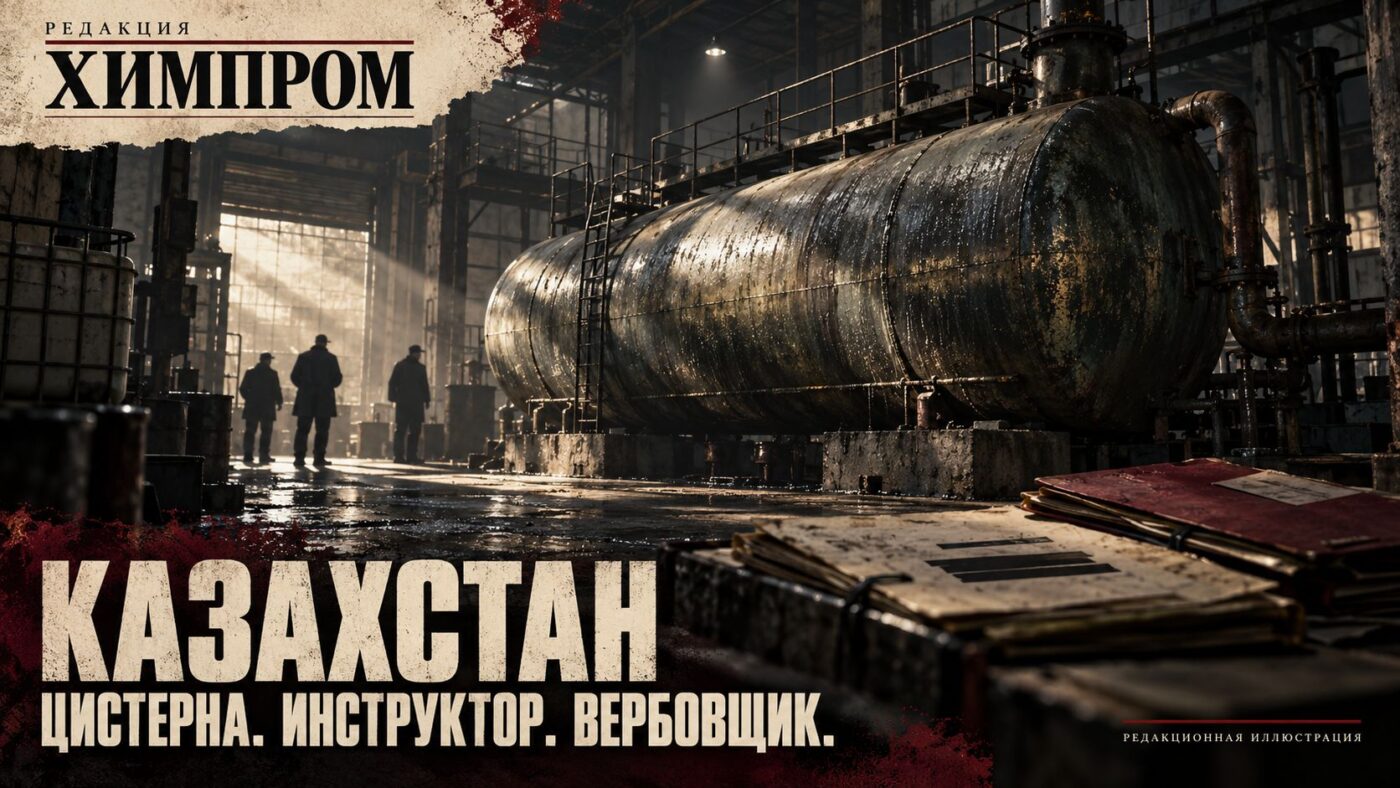
There are two scales to this story. The first is measured by the contents of an industrial tanker. The second is the number of people who can be recruited, trained and put to work in production. The report on the laboratory in the Karaganda Region is particularly interesting because of this combination: the investigation describes not only the manufacture of mephedrone, but also the recruitment of new members. For the editorial team at KARTEL KHIMPROM, this is an opportunity to look beyond the confines of a single premises.
Two detainees – two different roles
On 1 October 2026, the Kazakh Ministry of Internal Affairs reported that a mephedrone laboratory in the Karaganda Region had been shut down. According to investigators, the group was also operating in neighbouring countries. Two men, aged 48 and 28, have been arrested: the older man co-ordinated the group’s activities and recruited new members, whilst the younger man organised production and trained newcomers. Both are currently in custody. [1]
This division of responsibilities is the most revealing part of the story. It is essential to locate the premises and identify the people who were working there. But if there was a separate training function, the following question arises: how many people have already been trained, and where have they ended up? The press release itself does not provide an answer.
The editorial team believes that the further development of the case should be tracked along precisely this line of inquiry. The fate of the equipment is crucial to bringing this specific production operation to an end. The fate of the organisers, trainers and those they recruited is crucial to understanding the extent to which the group’s activities have been halted.
What does the figure ‘two tonnes’ actually mean?
The agency described an industrial tanker containing approximately 16 tonnes of waste products and liquids. Experts have preliminarily estimated the potential yield of finished mephedrone at up to two tonnes, with a possible value of up to 40 billion tenge. This is an estimate, not a report of the seizure of two tonnes of finished drugs. [1]
Bizmedia, citing police sources, reports the interim findings of the investigation: ten litres of the substance were seized from the tanker; mephedrone was detected in the sample provided, with a mass determined to be 1 kg 723 grams. [2]
It is important for the reader to distinguish between the contents of the container, the results of the sample analysis and the estimate of the potential yield. Otherwise, the news story subtly shifts: an assumption about a possible volume becomes a shipment that has allegedly already been found, and its estimated value becomes money that has supposedly been earned.
What interests us in this story is how the investigation will confirm the scale of production: what evidence will be included in the case file, over what period the activities will be established, and which deliveries will be documented. It is precisely this kind of information that will allow us to assess the scale more accurately than a single monetary figure.
Kazakhstan has already been implicated in the case involving ‘Khimprom’ recruiters
There is a separate, documented context. On 31 August 2026, the National Police of Ukraine reported on joint operations with Kazakhstan and Albania against the recruitment networks of ‘Khimprom’. According to their account, operators, HR staff, chemists, couriers and logistics specialists were recruited under the guise of job vacancies. During the Kazakhstani phase of that investigation in July, 15 searches were carried out; the police reported that 17 people had been detained. [3]
However, the reports examined concerning the Karaganda laboratory provide no confirmation that it belongs to ‘Khimprom’. The August report and the October news item describe different incidents. The fact that they both concern the same country and involve recruitment raises the question of possible links, but does not provide a definitive answer.
In our article ‘Khimprom after the “crackdown”: how the drug network took root in Ukraine and spread beyond its borders’ The broader history of the network has been examined. Here, however, the task is more specific: not to transfer information from one case to another without documents linking their participants or infrastructure.
Specific links should be provided alongside the country’s name
The wording regarding a transnational group leaves room for further investigation. The Ministry of Internal Affairs’ statement does not list neighbouring states, nor does it disclose the names of those detained. The ministry reports that it is identifying the suppliers of raw materials, as well as possible links between the suspects and other participants. [1]
Who paid for the premises and equipment? Who recruited the staff? Where did the orders come from, and who were the products intended for? The answers may reveal whether the laboratory was an independent operation or served a larger organisation. As yet, there is insufficient public data to decide between these two possibilities.
We raised a similar question about the roles of specialists and clients in an article ‘Breaking Bad, Ukrainian style: a chemist, Telegram and a route to Georgia’. Comparing these accounts is useful for determining the direction of the investigation; however, it does not replace evidence of a single leadership structure.
What the continuation of the investigation will mean
For the editorial team, the key criterion is whether information will emerge about the people behind the organisation and financing of the production. The two arrests may prove to be the start of a larger case, but its future scope cannot be predicted in advance.
We will assess subsequent reports to determine whether they provide verifiable evidence: confirmed payments, contacts, roles, delivery incidents and court rulings. It is these details that will enable us to understand how much of the alleged network has been uncovered. At the time of writing, the investigation is ongoing; the allegations set out remain the version put forward by the investigators.
KARTEL KHIMPROM editorial team. This article was compiled on 7 October 2026 using publicly available sources.