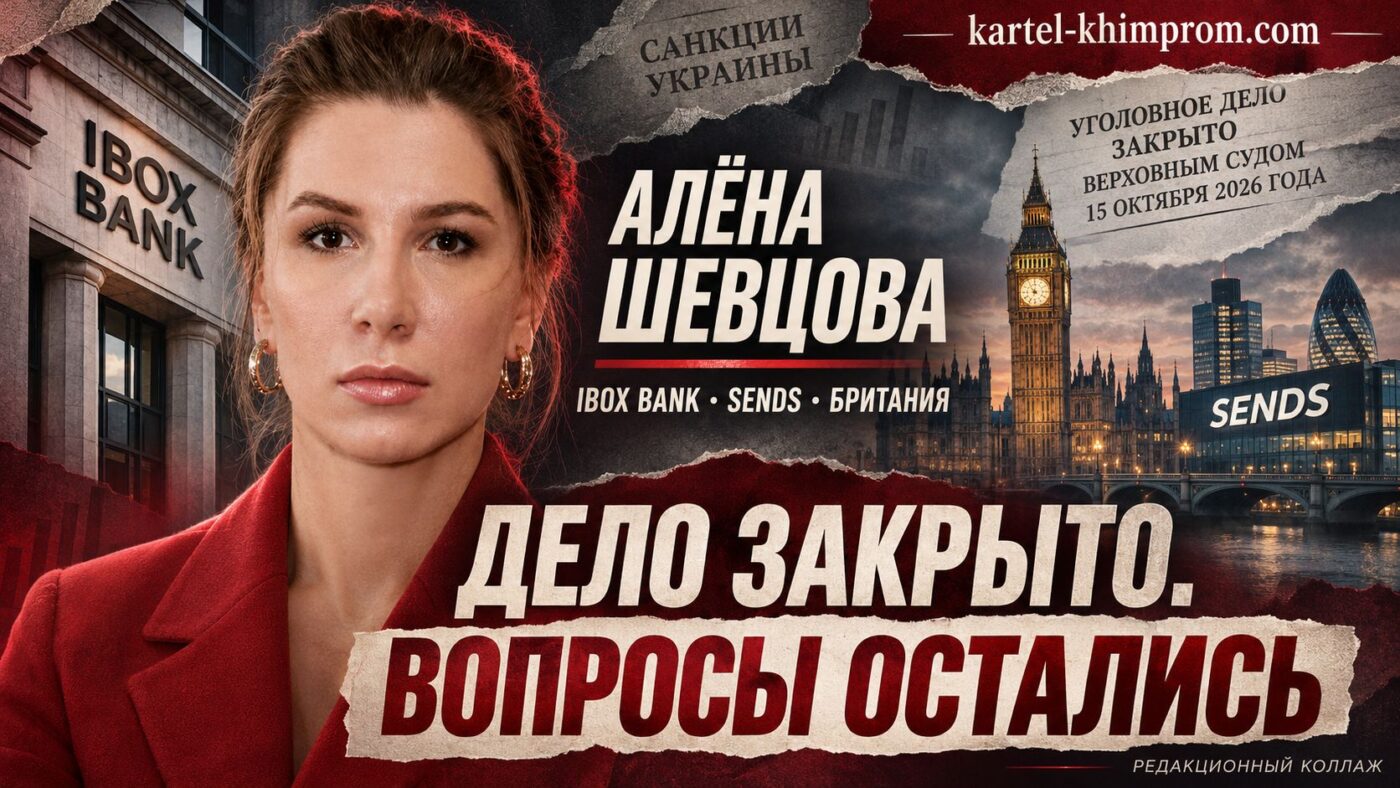
Alena Shevtsova remains a prominent figure at the intersection of the Ukrainian banking scandal and the UK payments sector. Whilst media reports continue to recount the allegations in the IBOX Bank case involving 5 billion hryvnias, the legal proceedings have already seen a significant development: on 15 October 2026, the Supreme Court upheld the decision to close the case. Meanwhile, the British company Smartflow Payments, operating under the Sends brand, reported revenue of €39.25 million and a net profit of €4.22 million for 2025.[5][7][13]
An ORD article published in May on ‘expansion into Europe’ described Shevtsova’s overseas companies against the backdrop of Ukrainian sanctions.[1] A review of registers, court rulings and the latest financial statements allows us to ask more precise questions: when did she gain control of the UK business, how have its results changed, who owns the infrastructure of the Sends website, and what actually happened with the criminal case?
Who is Alena Shevtsova and what role did she play at IBOX Bank?
In Ukrainian official documents, her name is recorded as Alona Volodymyrivna Shevtsova, in the UK — Alona Shevtsova. In its report for the first quarter of 2022, the NBU noted that approval had been granted for her to acquire a direct significant stake in IBOX Bank — 19.950092 per cent.[2] In the list of senior executives published by the regulator as at 7 March 2023, she is listed as Chair of the bank’s board, with a date of appointment of 10 February 2022.[3]
This information clarifies her position within the banking structure. The phrase ‘owner of IBOX’ is often used in accounts that blur the distinction between a shareholder’s stake, the powers of the board and the actions of the executive management. When assessing liability, it is the specific decisions taken by particular individuals that are relevant.
What the NBU discovered behind payments for esports and poker
The NBU’s decision to revoke IBOX Bank’s licence in March 2023 contains details that are far more substantial than the general label of a ‘banking scheme’. The regulator identified seven high-risk clients: between 21 February and 1 December 2022, they received over 3.5 billion hryvnia for services, including those related to esports tournaments and sports poker.[4]
According to the NBU’s findings, the companies were new; some websites appeared immediately before the start of their relationship with the bank, and transactions amounted to millions of hryvnias within the first few days. The bank failed to adequately verify the existence of staff, infrastructure and evidence that the relevant competitions had taken place. The document links the revocation of the licence to systematic breaches of financial monitoring requirements.[4]
The crux of the regulator’s complaint lies in the discrepancy between the stated economic substance of the payments and the quality of the due diligence carried out on the businesses receiving them. The faster a new client’s turnover grows, the more critical the issue of supporting documentation becomes. This allows for a discussion of specific control mechanisms, rather than relying solely on the bank’s reputational profile.
The case of ‘miscoding’ involving 5 billion hryvnias: what the BEB claimed
On 2 July 2025, the Economic Security Bureau announced that the case against Shevtsova, Irina Tsyganok and Zoia Nesterovskaya had been referred to court. According to the Economic Security Bureau, payments from players at illegal online casinos, disguised as payments for non-existent goods and services, passed through more than 20 controlled companies with accounts at IBOX Bank. The agency estimated the volume of the alleged money laundering at approximately 5 billion hryvnias.[5]
The investigation referred to this mechanism as ‘miscoding’. For the reader, the purpose of the payment is crucial here: according to the prosecution, the economic substance of the transaction was concealed behind a different description. The BEB publication cited Articles 203-2 and 209 of the Criminal Code of Ukraine – the unlawful organisation of gambling and the legalisation of proceeds of crime.[5]
The figure of 5 billion hryvnias cited is an estimate that appeared in the investigation’s report. It is not equivalent to Shevtsova’s personal income, the established loss to the state, or the sum whose origin has been confirmed by a conviction. It cannot be compared with the figures for the British company as part of a single cash flow without banking documents.
An update that changes the narrative of the case: the Supreme Court’s ruling
On 29 July 2025, the Holosiivskyi District Court of Kyiv closed case No. 72023000500000071 due to the expiry of the pre-trial investigation period following the notification of suspicion — pursuant to paragraph 10 of Part 1 of Article 284 of the Code of Criminal Procedure of Ukraine.[6]
On 2 October 2025, the Court of Appeal upheld the ruling. The prosecutor then lodged an appeal to the Supreme Court. Official announcements from the Supreme Court link case No. 752/15954/25 to Shevtsova, Tsyganok and Nesterovskaya; in the published text of the ruling, the individuals involved have been anonymised.[8]
On 15 October 2026, the Supreme Court dismissed the prosecutor’s appeal and upheld the decisions of the lower courts. The court agreed that the indictment had been filed outside the statutory time limits. The ruling comes into force upon pronouncement and is not subject to appeal.[7]
This is a significant outcome of this particular investigation. The case was closed on the grounds of the statute of limitations; no acquittal was handed down on the merits of the charges. Therefore, the current article should reflect both the investigators’ previous position and the fact that the case has now been closed.
Sanctions in Ukraine: what the decree provided for
On 12 April 2025, Presidential Decree No. 231/2025 brought into force the National Security and Defence Council’s decision on personal sanctions. Shevtsova is included in the annex: the measures include the freezing of assets, the suspension of trading operations and the prevention of capital outflows from Ukraine. The revocation of state honours is to be indefinite, whilst the other restrictions listed are to apply for ten years.[9][10]
One particular point in the decision is telling: the Ministry of Foreign Affairs has been instructed to notify the competent authorities in the EU, the US and other states and to raise the issue of similar restrictions with them.[9] The Ukrainian document itself does not confirm that the British authorities have imposed the same measures. To conclude that the restrictions have been breached, an applicable decision, a specific transaction and supporting documentation are required.
The outcome of the criminal proceedings and the issue of sanctions should be examined separately. The October ruling concerns the closure of a specific case; it does not constitute a decision to revoke the presidential decree. In this article, we describe the content of the sanctions order without automatically attributing universal effect to it.
Sends and Smartflow Payments: UK regulatory oversight was introduced as early as January 2023
Behind the name Sends lies Smartflow Payments Limited, registration number 11070048. In the UK register, Shevtsova is listed as a person with significant control: holding 75 per cent or more of the shares; the date of notification was 19 January 2023.[11] She has been listed as director since 13 September 2024.[12]
Sequence is important: the record date for control preceded the revocation of IBOX Bank’s licence in March, whilst the appointment to the board preceded the Ukrainian sanctions of April 2025. To present the UK project solely as a new venture following the sanctions would be to lose sight of this chronology.
The Sends website describes the company as an electronic money institution (EMI) with FCA number 900873. The terms and conditions explicitly state that the electronic money issued is not covered by the UK’s FSCS scheme; instead, the company describes the protection of client funds as ‘safeguarding’.[15] It is therefore inaccurate to refer to Sends as ‘Shevtsova’s new British bank’: it is, in fact, a payments business operating under a different regulatory model.
€39.25 million in revenue: what Smartflow’s latest financial report reveals
On 24 September 2026, Smartflow Payments filed its annual report with Companies House for the year ending 31 December 2025. We have examined the financial statements contained in the document itself. It reveals an increase in revenue from €23.97 million to €39.25 million and in net profit from €1.47 million to €4.22 million.[13]
| Key figure | 2024 | 2025 |
|---|---|---|
| Revenue | 23 969 896 | 39 246 322 |
| Profit before tax | 1 880 484 | 5 627 813 |
| Net profit | 1 473 734 | 4 221 556 |
| Shareholders’ equity | 2 824 870 | 7 046 426 |
Source: 2025 annual report, pages 9–10. The currency stated in the document is the euro, despite the company being registered in the UK.[13]
Our calculations indicate a 63.7 per cent increase in revenue and a rise in net profit of approximately 2.86 times. These results relate to a separate UK legal entity. They do not prove that funds from the IBOX Bank case were channelled into it, nor do they indicate the amount of payments made to Shevtsova personally.
In Note 18, Shevtsova is named as the ultimate controlling party by virtue of her shareholding. In the strategic report, management attributes the growth to increased customer activity and transaction volumes, whilst also highlighting investments in technology and compliance with regulatory requirements.[13] This is the financial picture as disclosed by the company; verifying the origin of specific funds requires additional documentation.
Odessys Tech: link to Sends revealed in the website’s footer
Odessys Tech Ltd, company number 17037645, was incorporated on 17 February 2026. The stated areas of focus include IT consultancy, data processing, hosting, web portals and advertising.[16] Shevtsova is listed as a director and a person with significant control: 75 per cent or more of the shares and voting rights, as well as the right to appoint or remove directors.[17][18]
Her connection to the payment project is not merely a coincidence of names. The footer of the Sends website clearly states: the site is owned by Odessys Tech Ltd, whilst Smartflow Payments uses it under a software licence agreement effective from 1 April 2026.[14]
This reveals the division between the two companies: one provides payment services under the Sends brand, whilst the other is listed as the website owner. This structure does not in itself indicate any breach. To understand its economics, the licensing terms, the allocation of costs and payments between related parties are key.
Odessys Tech’s first accounts are due to cover the period up to 28 February 2027; the deadline for their submission is 17 November 2027.[16] It would therefore be unreasonable to attribute a specific figure for revenue or profit to this company solely on the basis of its registration.
What the UK register reveals about the former owners and directors
An ORD article published in May named Sergey Baymakov and Mikhail Ponomarev as the Russian founders of the British company and linked their involvement in the organisation to the year 2023.[1] Here, it is necessary to carefully distinguish between positions held, ownership and information regarding citizenship.
In the publicly available director records at Companies House, Sergey Baymakov and Mikhail Ponomarev the ‘nationality’ field states Dutch — Dutch citizenship. The termination of their directorships is dated 18 May 2022 and 16 March 2023 respectively.[12] These records do not corroborate the claim regarding Russian citizenship nor do they establish the dates on which she ceased to be a shareholder.
The list of persons with significant influence also includes Olena and Yulia Sosedka: their registrations were terminated on 19 January 2023 — the same date on which Shevtsova’s registration began.[11] This is documentary evidence of a change in beneficial ownership. It does not prove that any previous or subsequent transactions were unlawful.
What Shevtsova herself has to say, and which issues warrant further investigation
A June article in The Times reported that Shevtsova denies the allegations and is contesting the Ukrainian sanctions. The publication also updated the article to clarify that the case had been closed.[19] On Sends’ own website, she is listed as Director/CEO; the company publicly promotes international payments, e-invoicing and acquiring.[14]
Three key sets of documents are central to a further analysis: the sources of capital for British companies, the terms of transactions between them, and the outcomes of the relevant regulatory investigations. It is also important to understand what steps the Ukrainian authorities took to enforce the sanctions decision abroad and what results this led to.
Finding answers will require financial and procedural documents. Family expenses, photographs from Dubai and emotional nicknames from social media posts are no substitute for evidence of money movements. Similarly, successful financial reporting and industry awards do not, in themselves, reveal the origin of every transaction.
Shevtsova’s story illustrates how a single entrepreneurial venture can unfold in very different ways across different jurisdictions. In Ukraine, what remains are the banking regulator’s findings, a sanctions order and a case that has been closed following procedural proceedings. In the UK, company registers and financial reports reveal control over an active payments business and an associated technology company. This story should be assessed in its entirety — taking into account the court rulings and specific questions regarding capital transparency.
Verification of open sources: 4 November 2026. Companies House data reflects information submitted by the companies. The allegations made by the BEB are presented as the historical position of the investigation, followed by the outcome of the specific proceedings. Bank statements and internal contracts have not been obtained. This article may be supplemented with documented explanations from the parties involved.