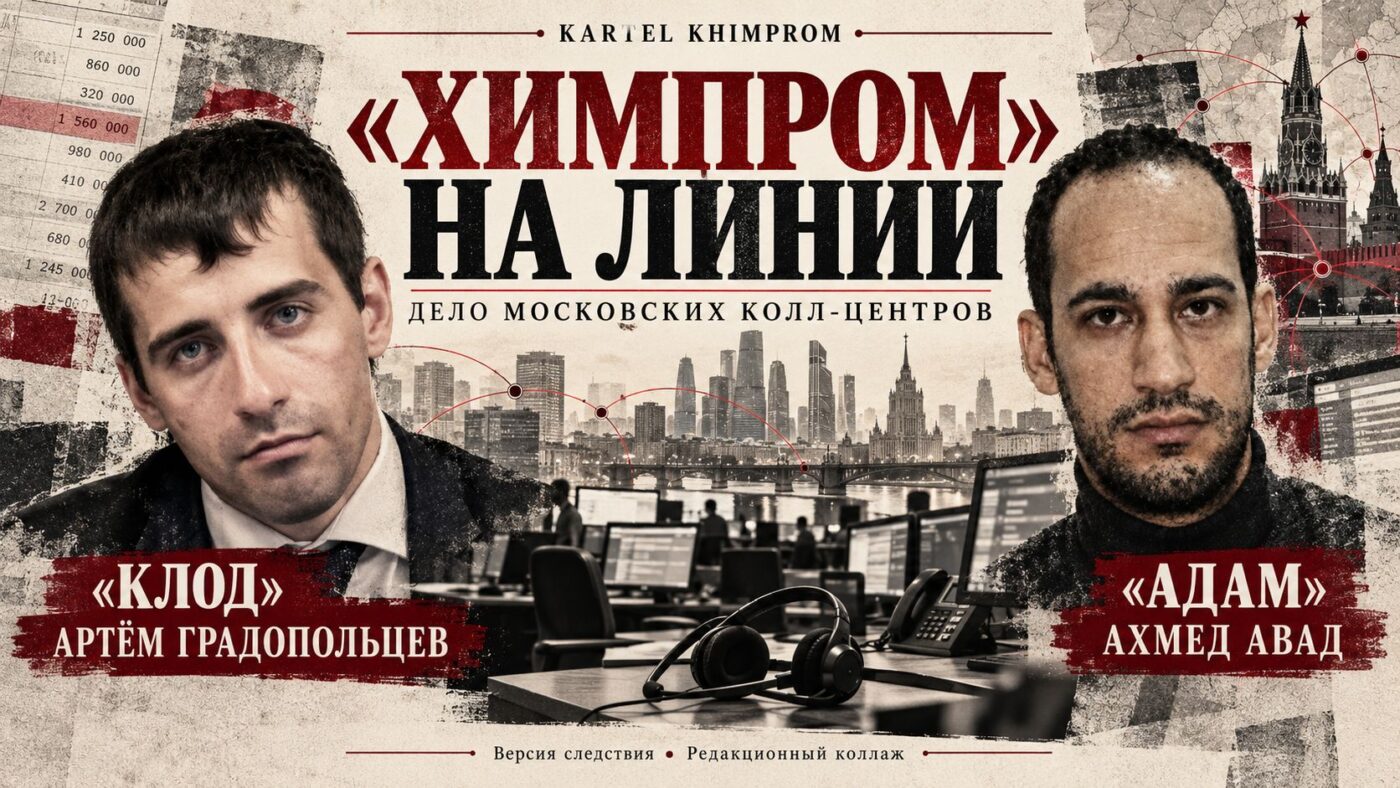
In the public imagination, ‘Khimprom’ is typically associated with certain familiar elements: laboratories, synthetic drugs and online shops. The case of the Moscow call centres paints a different picture — offices, recruitment and discussions about lucrative investments. Russian investigators link these activities to Yegor Burkin and his alleged circle. The case files mention Ahmed Awad, known as ‘Adam’, and Artem Gradopoltsev. We examine what lies behind these allegations and why the story extends beyond the drug market. [2] [3] [4]
Moscow: the administrative side of the alleged network
On 11 December 2024, the Ministry of Internal Affairs announced an operation against call centres dealing with foreign clients. According to the ministry’s account, people were persuaded to invest their savings in cryptocurrency and trading platforms. Once the money had been transferred to accounts controlled by the organisers, all contact with the victims ceased. [1]
The report contained details that help to illustrate the scale of the situation:
| Indicator | What the Ministry of Internal Affairs reported |
|---|---|
| Office infrastructure | Around 500 fully equipped workstations. |
| People inside the premises | Over 300 people were present when the police arrived. |
| Staff composition | Citizens of more than ten countries. |
| The initial arrests | Nine suspects have been remanded in custody in connection with incidents involving victims from Serbia. |
The Ministry of Internal Affairs also described its own recruitment agency, staff training programme and security service. According to the ministry, the latter was responsible for security and surveillance. Equipment, data storage devices and documents were seized from the premises. [1]
The number of jobs cannot be equated with the number of defendants. A person’s presence in the office does not, in itself, establish their role: some may have been in charge, others may have maintained the infrastructure, whilst the extent of others’ knowledge still needed to be verified. It is crucial for the investigation to establish who understood the purpose of the work and which instructions they carried out.
How did ‘Khimprom’ come to be involved in this case?
The link to Burkin was revealed on the very day the operation was reported. ‘Interfax’ reported the position of the FSB’s Public Relations Centre: according to the agency, three Moscow offices were part of an international fraud network controlled by the alleged head of ‘Khimprom’, Yegor Burkin. [2]
The FSB estimated the number of victims to be in the tens of thousands, the geographical scope to span more than twenty countries, and the damage to run into tens of millions of dollars. The countries named included Germany, the United Kingdom, Poland, Serbia and Japan. This is the law enforcement agency’s published estimate, not the final figure established by the court’s verdict. [2]
This is where the main thread of the story lies. If the investigators’ version is confirmed, we are dealing with an organisation capable of generating income from several types of criminal activity. In that case, investigating only the production and sale of drugs would mean seeing only part of the alleged organisation.
Timeline: arrests at offices and arrests in absentia of the organisers
- 11 December 2024: Reports have been published regarding an operation at call centres in Moscow and the detention of nine suspects. [1]
- 17 April 2026: *Kommersant* reported that Yegor Burkin, Alexander Sheremetyev and Ahmed Awad had been arrested in absentia. They were charged with organising a criminal organisation and five counts of particularly large-scale fraud. [3]
- 11 September 2026: Information has emerged regarding the arrest in absentia of Artem Gradopoltsev. The report cited the press office of the Tverskoy District Court in Moscow. [4]
These are separate procedural developments. Reports of arrests in absentia do not mean that the alleged organisers listed were detained during the Moscow operation. Nor do they constitute a court ruling of guilt.
Ahmed Awad: Who is ‘Adam’ in the court report?
*Kommersant* refers to the Egyptian national Ahmed Awad as ‘Adam’. The investigation attributed an organisational role to him; his case was separated from the Moscow call centres case. However, defence lawyer Alexander Mikhailov contested the reliability of the identification: according to the newspaper’s account, witnesses knew the man by his nickname, and the name could belong to many different people. The court granted the application for his arrest in absentia. [3]
This is a substantial part of the case, not a mere formality. To link an online alias to a specific defendant, verifiable evidence is required. To establish a role as an organiser, it is also necessary to demonstrate the defendant’s decisions, powers and connection to the operations which the investigation considers to be criminal.
Artem Gradopoltsev: the September instalment
In a September article on the Tverskoy Court’s ruling, Gradopoltsev is said to have been in charge of three Moscow call centres; the article reports on charges relating to fraud and involvement in a criminal organisation. His name thus appears in the legal chapter of a story that came to public attention following the December operation. [4]
According to information obtained by the editorial team at KARTEL KHIMPROM, Gradopoltsev goes by the nickname ‘Claude’. This pseudonym is not mentioned in the reports on the court ruling under consideration; editorial notes regarding it should be distinguished from the published procedural information.
To understand the alleged structure, the question of authority is more important than the nickname itself: who approved expenditure, appointed managers, managed revenue and had the power to shut down the offices? It is precisely these circumstances that make it possible to distinguish between managing the network and working within a single branch of it.
Yegor Burkin: where two paths converge
The drug-related context emerged long before the report on the Moscow offices. OCCRP, citing ‘Slidstvo.Info’, described the sanctions imposed by Ukraine on 30 December 2023 against individuals allegedly linked to ‘Khimprom’. Among those named in the publication were Yegor Burkin and Artem Gradopoltsev. The article examined the group in connection with the distribution of synthetic drugs in Russia and Ukraine. [6]
Now the same names are appearing in reports about another alleged source of income. This overlap warrants separate investigation. Inclusion on the sanctions list does not in itself prove involvement in the Moscow fraud: evidence from the relevant case is required for that.
Biography, sources and previous publications: The case file of Yegor Vasilyevich Burkin.
Why a call centre can be a criminal enterprise in its own right
In this story, it is important to distinguish between alleged fraud and money laundering. The scheme described by the investigation involves obtaining new criminal proceeds from the victims. To claim that proceeds from drug trafficking were also laundered through the same accounts, separate data on the origin and movement of the funds would be required. The reports examined do not allow such a chain of events to be reconstructed.
But the organisational question has already been raised. Could different branches have shared the same managers, human resources and financial intermediaries? Where did the autonomy of a particular office end? Who reaped the ultimate benefit? The answers must be pieced together from documents and transactions, rather than from similarities in names or a shared photograph.
For the victim, this distinction is particularly important. Closing an office brings operations at that specific site to a halt. Recovering the money requires tracing its subsequent movements and identifying available assets. Arresting someone wearing a headset does not, in itself, answer the question of who was managing the transfers.
Which sums should not be added together
The Ministry of Internal Affairs’ initial statement mentioned around 30 million roubles damage caused to Serbian citizens. In the April court report — 28 million roubles among the identified victims from Russia. The FSB’s overall international assessment put the figure at tens of millions of dollars. [1] [2] [3]
These figures are based on different criteria and have different scopes. Without a list of specific incidents, it is unclear which amounts are already included in the overall estimate. Simply adding them up would produce a striking but unreliable total.
Royal Forex and Milton Group: the editorial team’s findings on competing projects
According to information obtained by the editorial team at KARTEL KHIMPROM, the alleged organisers are using the name ‘Royal Forex’ — Royal Forex, whilst they consider the main competitor in the field of investment fraud to be Milton Group. No independent confirmation of this name in relation to the Moscow case, nor any mention of competition, has been found in the open sources reviewed. This information is published as an editorial version.
The name of the project alone does not identify a legal entity. To verify this, specific companies, domains and documents linking them to the accused are required. The mention of Royal Forex in this article does not constitute an assertion that any company of that name is involved in the crime.
Alongside the news about the three Moscow offices, reports emerged about another network — the Milton Group. The Record noted separately that Russian law enforcement agencies had not publicly linked these arrests to the operation against the Milton Group. The publication covered the story of the call centres attributed to Burkin as a separate item. [5]
Therefore, the theory of rivalry between the two projects does not provide grounds for merging them into a single organisation. A shared investment narrative and similar dates of operations do not establish a single owner. The number of victims and the turnover figures from the related case cannot be attributed to ‘Khimprom’ without independent verification.
How the Moscow case is reshaping the history of ‘Khimprom’
The evidence raises a specific question: is ‘Khimprom’, as described by the investigation, a network with multiple sources of criminal income, where drugs and remote fraud co-exist under what is believed to be a single management structure?
The answer does not lie in the prominence of the nicknames ‘Adam’ and ‘Claude’. It will be determined by established roles, financial links and the court’s assessment of the evidence. Therefore, the next chapter in this story lies not only in further arrests, but also in whether the investigation will succeed in tracing the flow of money from the victims to the final recipients.
Moscow call centres are broadening the scope of the discussion surrounding ‘Khimprom’: alongside allegations of drug trafficking, we are now faced with a case involving an alleged international scheme to embezzle savings. Investigating the links between these two strands is the key question that remains following the closure of the offices.
See also: ‘The Khimprom cartel scheme – how the organisation operates’.