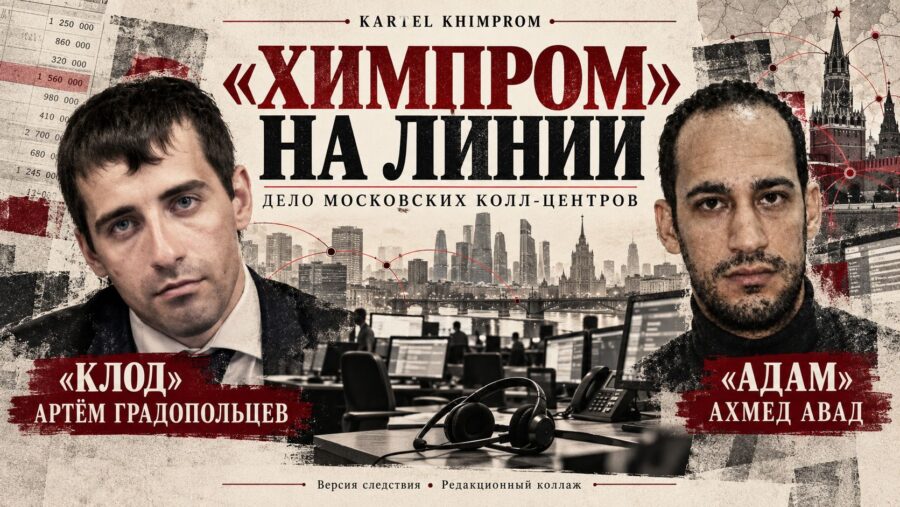
Ahmed Awad, known in the press by the nickname ‘Adam’, is a defendant in a Russian case involving fraudulent call centres, which investigators link to ‘Khimprom’. ‘Kommersant’ reported on 17 April 2026 that the Tverskoy District Court in Moscow had issued an arrest warrant in his absence. Awad’s involvement in a criminal organisation is presented as the prosecution’s case, rather than as guilt established by a verdict. [1]
Profile
| Name as appearing in public publications | Ahmed Awad |
|---|---|
| Nickname | ‘Adam’, from a court report [1] |
| Nationality | Egypt, according to a report by ‘Mediazona’ citing ‘Kommersant’ [6] |
| Subject matter of the case | Alleged organisation of a criminal group and fraud on a particularly large scale [1] |
| Wanted | It was reported that he had been arrested in absentia with a view to issuing an international arrest warrant. His current status in official wanted databases has not been independently confirmed [1] |
| Date of birth | No information has been established from open sources that can be unequivocally linked to the accused |
| Location | Not reliably established |
What he is accused of
According to court reports, Avad was charged under Part 1 of Article 210 and with five counts under Part 4 of Article 159 of the Criminal Code of the Russian Federation. The article also names Yegor Burkin and Alexander Sheremetyev alongside him. The investigator described Awad as one of the organisers of the network. The court granted the application for two months’ pre-trial detention should he be extradited to the Russian authorities. [1]
An arrest in absentia means that the decision was taken without the accused actually being taken into custody during that hearing. It cannot be described as an arrest, extradition or conviction that has already taken place. Verified reports do not allow us to state that Awad has been convicted in this case.
Call centres: the story behind the allegations
On 11 December 2024, the Russian Ministry of Internal Affairs reported that it had shut down a number of call centres in Moscow. According to the ministry, the offices had been equipped with around 500 workstations, and more than 300 people were present at the time of the operation. Nine suspects were remanded in custody in connection with incidents involving victims from Serbia; the reported losses amounted to around 30 million roubles. [2]
The Ministry of Internal Affairs described the following scheme: staff members persuaded foreign nationals to invest their savings in cryptocurrencies and trading platforms. Once the money had been transferred to accounts controlled by the organisers, all contact with the client ceased. The Ministry also stated that it had its own recruitment agency, staff training programme and a security service that monitored the premises and personnel. Awad’s name was not mentioned in this press release. [2]
Such an organisational structure, if the description is corroborated by evidence, implies a division of labour: some attract clients, others run the office, and others manage the takings. However, the existence of a division does not in itself establish the identity of its head. For a personal charge to be brought, specific instructions, correspondence, financial transactions and witness statements are essential to determine the role of each individual.
What is the basis for the connection with ‘Khimprom’?
On the same day, Interfax reported a statement from the FSB: according to the security service, three Moscow offices were part of an international fraud ring controlled by Yegor Burkin. The FSB estimated the losses at tens of millions of dollars and reported victims in more than 20 countries. These figures described the network as a whole, rather than the proven amount of Avad’s income. [3]
It is precisely the combination of the report on the offices’ links with Burkina and the subsequent court report that explains Awad’s appearance in the coverage of ‘Khimprom’. The full dossier on the alleged ringleader is available in our archive: Yegor Vasilyevich Burkin.
It cannot be inferred from these sources that Awad personally manufactured drugs, was in charge of specific laboratories, or received a fixed share of all ‘Khimprom’s’ revenue. There is insufficient personalised information in the materials examined to support such claims. His alleged role should be described primarily in the context of the case concerning the call centres.
Defence’s objection: who exactly is being accused?
According to *Kommersant*, lawyer Alexander Mikhailov contested the accuracy of his client’s identification: the name is a common one, and the witnesses knew the man primarily as ‘Adam’. Despite these objections, the court granted the application. [1]
This is a crucial point for any personal file. A match in name alone is not sufficient to attribute to the accused the date of birth, photograph, assets or biographical details found in a third-party form. Until such details have been cross-checked against documentary evidence, they must not form the basis for new charges.
Wanted: what is known and what needs to be confirmed
The publication of an intention to seek an international arrest warrant does not constitute confirmation of a valid Interpol notice. The organisation’s official website explains: A Red Notice is a request to states to locate and provisionally detain a person with a view to subsequent extradition or similar measures. The notice itself is not an international arrest warrant; the decision to detain is taken by national authorities. [5]
As part of this investigation, no up-to-date official wanted notice for Awad, confirmation of the publication of a Red Notice, or a document confirming its cancellation has been obtained. Therefore, his status cannot be extended to an unconditional confirmation that he is ‘wanted by Interpol’. This is a limitation of the investigation, not evidence that he is not wanted.
Why you shouldn’t combine different networks into one
In December 2024, reports emerged simultaneously regarding several high-profile cases. The Record noted separately that the Russian authorities had not publicly linked the raids on three offices, attributed to the Burkina network, with another operation against the Milton Group. This distinction is significant — the amounts of damage, the number of victims and the list of individuals involved in one case cannot automatically be applied to another. [4]
For the same reason, the mere mention of a person alongside other defendants does not establish their involvement in all the incidents attributed to them. It is important for the case file to maintain the boundaries of the specific case and not to treat presumed organisational proximity as evidence of general involvement in all the offences.
What remains to be established
- Full identification details of the accused and documents linking them to the name ‘Adam’.
- The exact scope of Awad’s proposed managerial and financial responsibilities.
- Current procedural and investigative status, including the outcome of any appeal.
- The position of the defendant himself and the subsequent arguments put forward by his defence.
The dossier records the publicly stated charge and its context. The court report provides grounds for examining Awad’s alleged role in the call-centre network. Further documentation and the outcome of the trial on the merits of the case are required to reach definitive conclusions regarding his identity, specific actions and guilt.
Open-source verification: 14 October 2026. The editorial team did not carry out a forensic examination of the case materials and did not seek comment from Awad whilst preparing this text. The version put forward by the Russian law enforcement agencies is presented with an indication of its source.