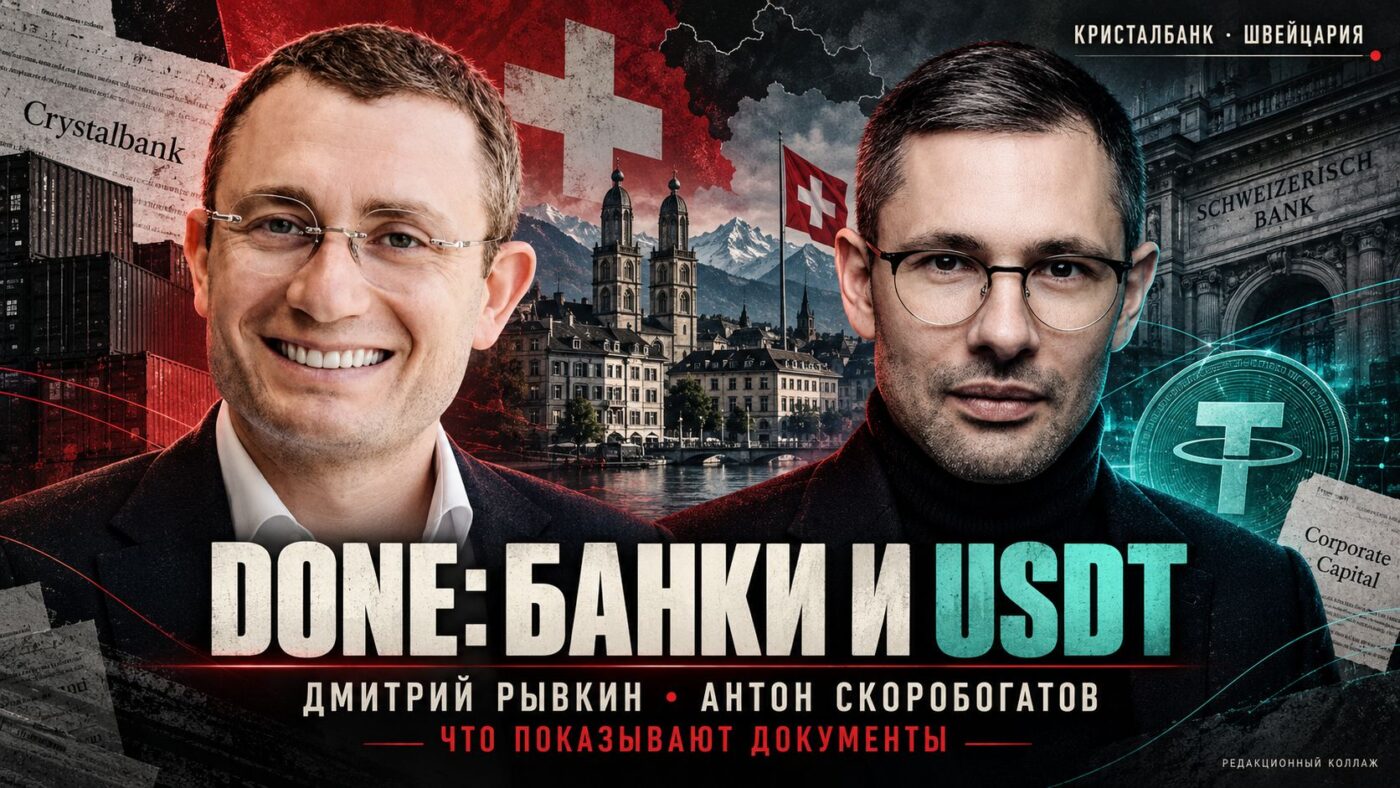
Dmitry Ryvkin and Anton Skorobogatov present Done as a way to combine procurement, logistics and import financing. Behind this proposal lie billions of hryvnias in revenue from a Ukrainian trading company and a Swiss company whose capital has been bolstered by contributions in USDT. The publication ‘Kommentarii’ added ‘Kristalbank’ and criminal proceedings to this story. We compared the company’s statements, registry details and documents: the most significant issues were found in the financing structure and in the details that get lost in the retelling.[1][6]
To understand Done, you need to break it down into four components: trading turnover, profit, capital raised and bank payments. Each leaves its own paper trail. By mixing these figures together, it’s easy to come up with a sensational headline — and lose sight of who is actually selling the goods, who is granting the loan, and what the bank is responsible for.
What is Done and who is funding the imports?
The Done website describes a service for distributors: purchasing goods from an overseas manufacturer, organising delivery and offering deferred payment. The homepage specifies the buyer’s deposit 40%.[3] The finance page advertises the rate 2 per cent per month, but the description of the process gives a different breakdown: the client pays 30 per cent, with Done covering the remaining 70 per cent.[2]
Different advance payment percentages may apply to different offers or product versions. However, public communications raise a practical question: which option applies to a specific delivery, on what amount is the commission calculated, and from when does the calculation begin? Without a contract, the advertised 2 per cent does not reveal the full value of the transaction.
The legal text at the bottom of the finance page is particularly important. There, the product is referred to as a partnership “DANN.” LLC — EGRPOU 40929000 and DANN FINANCE Financial Company LLC — 43603477. To fulfil client orders, the trading firm ‘Dunn.’ raises funding from a financial company in its own name.[2]
This explains the product’s architecture better than the general term ‘fintech’. From the outside, the customer sees a single brand. Internally, there are at least a sales contract and separate financing arrangements. Therefore, this model must be assessed on the basis of contracts, the movement of goods and the allocation of obligations between legal entities.
Dmitry Ryvkin and Anton Skorobogatov: roles and companies
In a Forbes BrandVoice article dated 25 September 2025, Ryvkin and Skorobogatov are presented as business partners. According to their account, the former is responsible for the financial architecture, whilst the latter is responsible for trading and logistics. The page is labelled as a sponsored partnership: it represents the business’s public stance, rather than independent verification of all the claimed results.[6]
Registration records allow us to clarify the structure. ‘Dunn.’ lists two shareholders: the Swiss company ‘Dan Switzerland AG’, with a 90 per cent stake, and the ‘DANN GROUP’ fund, with 10 per cent; Dmitry Borisovich Ryvkin is named as the ultimate beneficial owner.[4] At ‘Dunn Finance’, Ryvkin personally owns 90 per cent, whilst the fund holds 10 per cent. The history of this entry records the renaming of the former ‘Supply Chain Finance’ on 28 August 2026.[5]
One particular example is ‘Larix Trade’, registered on 17 September 2026. Its registration details list ‘Dunn.’ as the direct shareholder holding 100 per cent of the capital, and Anton Nikolayevich Skorobogatov as the ultimate beneficial owner. These are different fields in the register: such an entry cannot be interpreted as meaning that Skorobogatov directly owns 90 per cent of the company.[7]
For further analysis, the documents explaining the division of control between the financial and trading divisions are important here. The mere number of companies or the distinction between a direct participant and a beneficiary does not answer the question of who actually makes the decisions: we need to look at the powers of the directors, corporate agreements and the terms of intra-group transactions.
‘Dunn.’s’ revenue has increased almost 499-fold. What about profits?
According to financial statements compiled by OpenDataBot, ‘Dunn.’s’ revenue increased from 7.81 million UAH in 2023 to 3.897 billion UAH in 2025. Our calculations indicate a growth of approximately 498.9 times. However, the financial picture also includes another indicator — net profit.[4]
| Year | Revenue | Net profit / loss |
|---|---|---|
| 2023 | 7,810 | −3,132 |
| 2024 | 1 742,341 | 7,841 |
| 2025 | 3 896,721 | 80,755 |
Source: OpenDataBot. Figures are rounded to the nearest thousand hryvnias; the service’s forecast for 2026 is not included in the table.[4]
In 2025, the net profit-to-revenue ratio stood at approximately 2,07%. Therefore, billions in turnover cannot automatically be equated with billions in profit for the owners. The scale of growth warrants explanation, but it should be analysed in conjunction with profit margins, trade receivables, liabilities and actual deliveries.
A financial company is a separate legal entity with its own financial statements. ‘Dunn Finance’ reported revenue of 66.011 million UAH and a net profit of 2.356 million UAH for 2025.[5] These figures must not be substituted with the trading revenue of ‘Dunn.’ or aggregated without taking into account transactions between the companies.
180 million hryvnias in bonds: where does the funding come from?
The SCF website has announced the issue of bonds worth 180 million UAH in 2025. The company describes the bonds as a capital-raising instrument to finance trading transactions.[8] This is a specific, publicly identified source of funds, which must be considered separately from the importer’s revenue and the capital of the Swiss company.
The size of the issue alone does not indicate how much money the issuer has actually received, what transactions the funds are intended for, or how the debt is serviced. The answers should be contained in the offering documents and financial statements. To assess the sustainability of the model, the timing is particularly important: when payments are due to suppliers, when the buyer pays for the goods, and when obligations to bondholders arise.
In an interview with Fintech Insider, Ryvkin explained that the product finances a specific shipment and tracks its movement from the factory to the warehouse. According to him, the company assumes the risks associated with monitoring operations and is accountable to its creditors.[15] This is the stated operating principle. Verifying it requires comparing the described model with the transaction ledger and the collateral securing the obligations.
Done Switzerland AG: 1.52 million USDT in official publications
The Swiss part of the story is documented under the identifier CHE-363,272,422. A notice in the official SHAB trading bulletin dated 18 February 2026 records the name change Alltag und Gerätetechnik AG → Done Switzerland AG pursuant to the amendment to the articles of association dated 27 January. Consequently, the company’s previous transactions should also be searched for under its former name.[9]
Three other official publications describe a capital increase through non-monetary contributions in Tether (USDT). In return, the company issued registered shares. This constitutes primary documentary evidence, rather than an unconfirmed mention of cryptocurrency in a media report.[10][11][12]
| Date of transaction / SHAB publication | Contribution | New shares | Capital following the increase |
|---|---|---|---|
| 17.12.2024 / 28.01.2025 | 504,376 USDT | 430,000 at 1 CHF each | 950,000 CHF[10] |
| 07.05.2025 / 22.05.2025 | 504,415 USDT | 400,000 at 1 CHF each | 1,350,000 CHF[11] |
| 02.10.2025 / 15.10.2025 | 511,512 USDT | 400,000 at 1 CHF each | 1,750,000 CHF[12] |
Total — 1,520,303 USDT. However, the first transaction is dated December 2024, although the report on it was published in January 2025. The discrepancy between the transaction date and the disclosure date is important when reconstructing the sequence of events.
These records confirm the method by which part of the capital was contributed. They do not reveal the full history of the assets’ origin and do not allow specific USDT to be linked to payments made by Ukrainian clients. To trace the movement of funds further, documents are required regarding the depositors, wallet addresses, details of the valuation of the deposits and subsequent transactions.
Why did ‘Crystalbank’ appear in the story of Done?
The ‘Comments’ article links international payments to ‘Crystalbank’, citing claims found online.[1] The open sources examined in this article do not provide bank statements or the full volume of such transactions. Therefore, the involvement of a specific bank in each of the chains described requires independent verification.
At the same time, the bank has a documented history of complaints regarding financial monitoring. In a copy of the NBU’s statement published by the All-Ukrainian Association of Financial Companies for June 2025 a fine has been imposed on ‘Kristalbank’ 20,272,500 UAH. Among the shortcomings listed are the organisation of initial financial monitoring, internal procedures, risk management, customer verification and the provision of information to the inspection team.[13]
A correction is required here to the original article: it attributes the relevant fine of approximately 20.2 million UAH to June 2020, although the accompanying link leads to a report from 2025.[1][13] The list of violations, published at the same time, does not cite Done as the reason for this penalty. The penalty itself does not establish that the transactions carried out by Ryvkin and Skorobogatov’s companies were unlawful.
A key question regarding the banking aspect of the story is: what contracts, goods documentation and details of the counterparties accompanied the specific transfers? Without this information, it is impossible to determine either the actual route taken by the funds or the role of the servicing bank.
‘Dunn.’ in criminal proceedings: what the court documents actually say
In the ruling of the Khadzhibey District Court of Odessa dated 29 September 2026, the case №521/12638/26, ‘Dunn.’ is indeed mentioned. The document relates to case No. 72026161050000019. The tax authorities’ version of the investigation into the non-payment of 26.65 million UAH is set out in relation to the officials ‘Quentors’.[14]
The name ‘Dunn.’ appears on the list of owners of goods in stock — with the code 40929000 and the file name ‘06.08. DANN-LVIV’. The application under consideration concerned the property ‘EnergoMerezhi Ukrainy’. The court upheld his appeal and lifted the arrest warrant; however, it specifically stated that it was not ruling on the question of the guilt or innocence of any individuals.[14]
Thus, the document confirms a specific reference to the company, rather than a conviction of Done’s participants. To assess its role, it is necessary to establish which transactions were investigated, which procedural decisions were taken specifically in relation to it, and what is confirmed by the documents. The list of names in the court database does not replace this analysis.
What questions remain unanswered regarding Done?
First — the origin and cost of capital. Bond issues, intra-group lending and USDT contributions are different types of transaction. They must be compared by date and amount, without treating the proximity of the companies as evidence of a single cash flow.
Secondly, the allocation of responsibility. Who retains ownership of the goods at each stage, who bears the losses if a delivery is disrupted, and how are the trading company’s obligations to the financial institution secured? The answer defines the economic substance of the model far more precisely than the promotional contrast drawn with a bank loan.
Thirdly — transparency of control. The registers show the participants and beneficiaries, but corporate documents are required to explain specific decisions. What matters here are the powers of Ryvkin and Skorobogatov, the terms of cooperation between the companies, and the relevance of the information disclosed.
The story of Done is already worthy of attention thanks to the confirmed facts: rapid growth in trading revenue, bond financing and cryptocurrency contributions to Swiss capital. The next step is the documentation linking these elements into a verifiable sequence of transactions. It is this documentation that will enable an assessment of the extent to which the actual operations align with the public promise to monitor the flow of goods and money.
Open sources were verified on 29 October 2026. Registry data is based on records available at the time of verification. Business statements and media claims are indicated separately. Bank statements were not received; no requests for comment were sent to the parties mentioned whilst preparing this text. Official Swiss publications confirm the capital transactions; a court order does not constitute a conviction. This material may be supplemented with documented explanations from the parties.