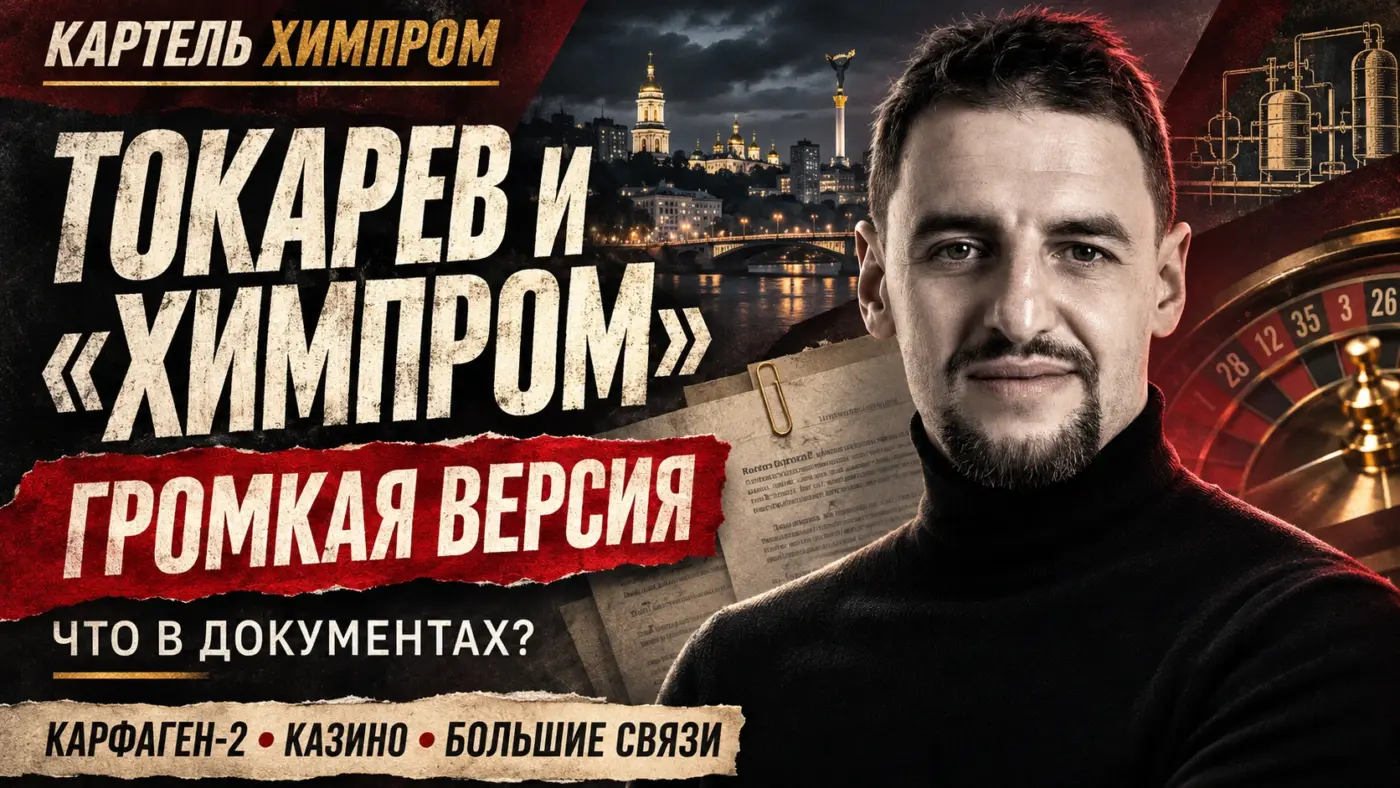
Sergei Tokarev, Igor Mazepa, the online casino Cosmolot and ‘Khimprom’ have once again found themselves in the same news story. The catalyst was a publication by ‘Antikora’, which links these well-known names to a drug cartel by repeating previous statements and mentioning a joint photograph. The headline sounds like the start of a major exposé. However, upon closer inspection, a different story emerges: court rebuttals, a dispute over a casino licence and actual materials from Operation ‘Carthage’, to which one cannot arbitrarily add other people’s names.
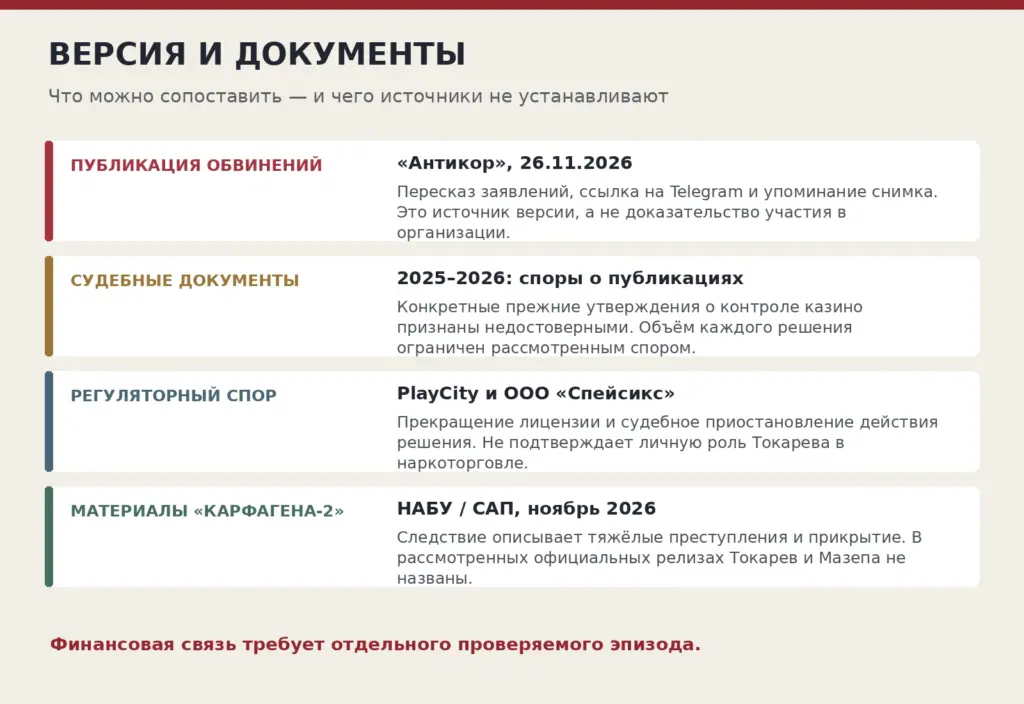
We have compared the new publication with available court records, NABU reports, PlayCity documents and previous material from KARTEL KHIMPROM. In the official reports on ‘Carthage’ that we have examined, no involvement by Tokarev and Mazepa has been established. Moreover, specific previous claims regarding Tokarev’s control over the casino have already been refuted in court. This is a key part of the investigation, not a footnote in small print.
The public interest here is quite specific: who controls the money and the payment infrastructure, how businesses receive public support from the state, and what evidence supports the allegations of serving the criminal market. To find the answer, one must look beyond the sensational headline – to the person, company, transaction and document that can actually be linked together.
Verified using open sources as at 26 November 2026. Here is an independent analysis of the publications and documents. The claims regarding Tokarev and Mazepa’s involvement in ‘Khimprom’ are presented as statements from a source, for which no corroborating evidence has been found in the materials examined.
Tokarev, Mazepa and ‘Khimprom’: what exactly did ‘Antikor’ report?
In ‘Antikora’ publications dated 26 November There is a notable discrepancy in attribution: the headline names the journalist Krutchak, whilst the main text refers to previous statements by Stas Dombrovsky. Furthermore, the article refers to the Telegram channel ‘Sniadank Khimeri’. These are different links in the chain of information transmission, and it cannot be concluded from the text that every person named personally confirmed every allegation.
The content of the article boils down to three claims: Tokarev’s previous links with ‘Khimprom’, the significance of the photograph with Mazepa, and Mikhail Fedorov’s role in promoting the businessman publicly. Tokarev is portrayed as the owner of Cosmolot. The article itself does not present any bank documents, an indictment or a verifiable chain of legal entities that would substantiate these conclusions.
We must therefore verify this specific published account. The reader is entitled to expect the author to provide the original statement, the full context of the photograph and details of the financial dealings. Several retellings of a single report do not increase the number of independent witnesses. If publications refer to one another, we are still dealing with a single source of the allegation until further documents come to light.
To continue this story, the most important thing is to establish exactly what the original complainant witnessed: a meeting, financial transactions, correspondence, a contract, or merely online publications. The difference is fundamental. A personal account of a specific transaction can be verified by its timing, the parties involved and the flow of funds. A general description of a circle of acquaintances cannot be discreetly transformed into a description of criminal activity.
Sergei Tokarev: a public IT business and the awkward question of control

In Roosh’s public team Sergei Tokarev is listed as a co-founder and partner. This is a verifiable business role. It can be discussed in the context of investments, public appearances and the technology industry’s relationship with the state. However, it does not imply management of any casino, which the author of a third-party publication placed alongside the entrepreneur’s surname.
This is precisely where semantic substitution usually occurs. Software developer, investor, shareholder, ultimate beneficial owner of the operator and a person with informal influence — five distinct roles. Sometimes they coincide; sometimes they are distributed amongst different market participants. To claim that they coincide, one must provide evidence: a corporate record, a contract, the authority to manage accounts, or a coordinated sequence of actions.
This topic did not begin with today’s article. Previously, we examined Roosh, Lucky Labs, ‘Diya.City’ and public support for Tokarev. This new material supplements the story with court rulings and events from 2026. The previous publication should be read alongside the latest documents: the old headline does not retain its validity simply because it remains in the search results.
Profile: Sergei Alexandrovich Tokarev
Co-founder and partner at Roosh. Biographical details, related publications and sources are compiled in a separate fact sheet.
Open Sergei Tokarev’s dossier →
A link to the editorial fact sheet does not indicate the procedural status of the ‘Carthage’ case.
A court document that changes the interpretation of sensational headlines
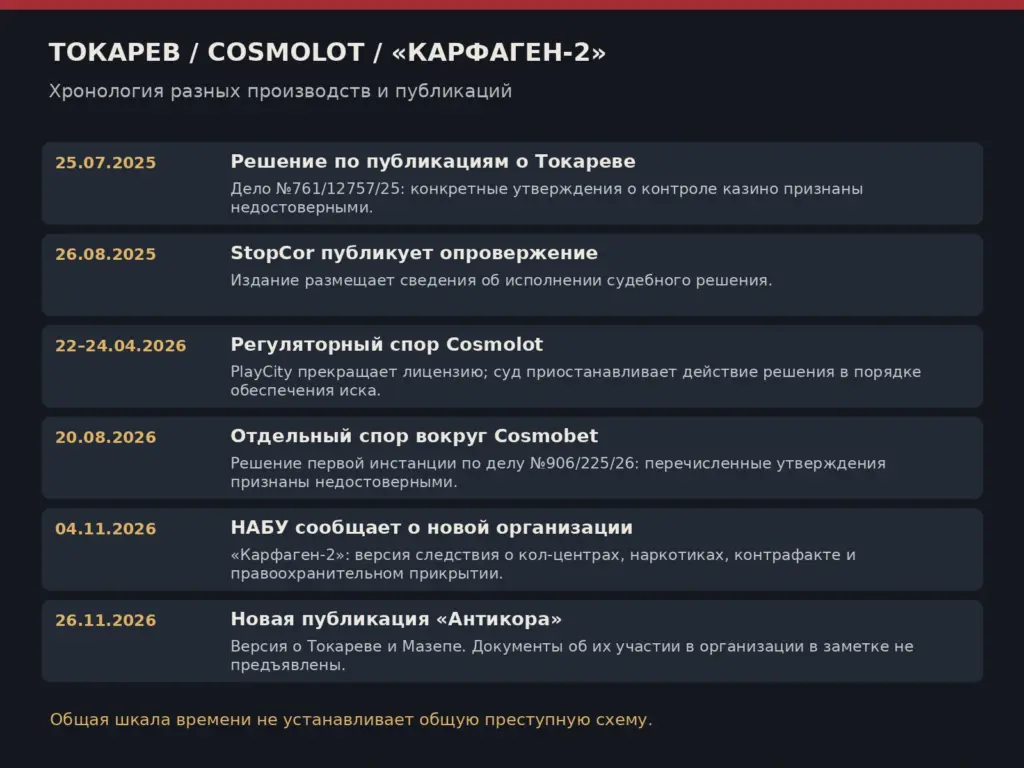
On 25 July 2025, the Shevchenkivskyi District Court of Kyiv heard case No. 761/12757/25. The court found specific allegations regarding the claimant’s ownership and control of the online casino to be unfounded, having assessed the information on the operators ‘Spacix’ and ‘Neurolink’ and the evidence submitted by the parties. The plaintiff’s identity as Sergei Alexandrovich Tokarev is confirmed by a retraction published by StopCor itself.
The same ruling records the termination of Russian citizenship on 8 September 2023. The court separately assessed and rejected the claims regarding current Russian citizenship made in the disputed publications. Therefore, the term ‘Russian businessman’ in today’s account requires clarification: origin, former citizenship and citizenship at the time of publication cannot be used as interchangeable concepts.
These conclusions relate to the dispute under consideration and the evidence examined by the court. The ruling does not pre-emptively address any possible new allegations. However, it obliges the author of any new investigation to take account of the scrutiny that has already taken place. If new information regarding de facto control has come to light, it must be presented and compared with the court’s findings, explaining what has changed.
Otherwise, the reader is being sold the old accusation under the guise of a fresh revelation. Reordering words, a new layout and the addition of the name of a high-profile operation do not constitute new evidence. In this case, this is particularly important: the dispute concerns business relationships under scrutiny, rather than impressions of a lifestyle or attitudes towards a public figure.
StopCor’s rebuttal and a separate dispute surrounding Cosmobet
On 26 August 2025, StopCor published a retraction Information about Tokarev from two articles published in 2024. The publication explicitly pointed out the inaccuracy of previously circulated information and published excerpts from the court ruling. This is a publicly available document detailing the fate of the earlier publications, which should accompany any links to them.
There is also another document: Ruling of the Commercial Court of Zhytomyr Oblast dated 20 August 2026 in case No. 906/225/26Following a claim by ‘Neurolink’, the court ruled that the statements listed in the publication about Cosmobet were untrue, including the claims regarding Tokarev’s role and the fictitious nature of the ownership. This is a first-instance ruling; this compilation does not contain a verified final appeal judgement.
These two disputes cannot be combined into a sweeping conclusion about the entire gambling market. However, they do highlight the precise problem with the new report: it refers to a familiar set of names and brands, some of the claims regarding which have already been rejected by the courts. Before repeating this list, it is necessary to determine whether there is a new, independent development.
A detailed previous analysis can be found in the article ‘Sergei Tokarev and Cosmobet: a billion in the headline – what’s the story?’. A new claim must have its own basis. Simply adding the word ‘Khimprom’ to the old story is not enough.
Cosmolot in 2026: a real conflict with the regulator
Beyond the dispute over the owner’s surname, there is a documented history of the operator itself. PlayCity has announced the revocation of Cosmolot’s licence Decision No. 139-R of 22 April 2026. The addressee was Spacix LLC, EGRPOU code 43635954. The agency cited breaches of payment regulations, including P2P payments and top-ups from third-party cards, as well as fines of 8.6 and 4.3 million hryvnias for the relevant offences.
But the chain of evidence does not end there. On 24 April 2026, the Kyiv District Administrative Court suspended the effect of Decision No. 139-R as security for the claim. The order explicitly states the provisional nature of the measure and that it does not resolve the dispute on its merits. To publish only the notice of licence revocation and to remain silent on this act would mean omitting a significant part of the story.
Related PlayCity’s decision to suspend the block Also available on the agency’s website. The mere fact that legal defence has been sought does not prove that all the regulator’s claims are unfounded. Nor does the regulator’s initial decision, in turn, constitute proof of a specific businessman’s involvement in drug trafficking.
This raises a separate issue for public scrutiny: how the operator received funds, who was responsible for ensuring compliance with payment requirements, and what the outcome of the subsequent legal dispute was. These questions relate to the company in question and specific transactions. In order to attribute liability to an individual, their role must be further established.
‘Carthage’ and ‘Carthage-2’: where the drugs and the armed guards actually came from
Operation ‘Carthage’ is a genuine investigation, but its details should be read in the context of the investigation’s reports. In NABU press release dated 22 October 2026 The report describes the alleged cover-up of fraudulent call centres and the laundering of assets. Among the reported circumstances is the use of close associates to register assets and expenses. This information relates to the incidents outlined by the investigation, and does not automatically apply to every participant in the cryptocurrency market who is the subject of public discussion.
On 4 November, NABU and the SAP announced the discovery of a new organisationAccording to the investigation’s version of events, fraudulent call centres operated under the guise of law enforcement officers; drugs were sold; and counterfeit cigarettes and foreign currency were produced. There were also reports of assaults, abductions and bodily harm. The investigation mentioned at least twelve individuals who had been implicated.
Thus, it would be incorrect to reduce ‘Carthage-2’ solely to telephone fraud: the drug-related episode is present in the official account. But the opposite conclusion is also incorrect. The presence of drugs in a single investigation does not prove that any financial company or well-known investor from outside the organisation is involved in it.
The name ‘Khimprom’ in the journalistic report and the list of participants in the procedural documents must be cross-referenced in terms of specific individuals and actions. Tokarev and Mazepa are not named in the NABU press releases examined. We are unaware of the content of the unpublished materials, so we cannot draw conclusions about the entire investigation. As regards the publicly available part, the allegations in the new report have not yet been confirmed.
‘Carthage-2’ has its own named individuals involved
Monitoring by Transparency International Ukraine It links ‘Carthage-2’ to production case No. 52026000000000505 and states that the case is at the pre-trial investigation stage. The profile lists Andrei Osipov, Sergei Duka, Vladimir Tsenov, Vitaly Rybalko and Alexander Demyanchuk, with a description of their alleged roles. This information is based on monitoring of the legal proceedings and does not constitute a conviction.
It also records the imposition of a preventive measure on Duke on 6 November, with an alternative bail of 65 million hryvnias, and the payment of this sum on 13 November. The investigation’s account of over 3.75 million USDT being received into one of the wallets over a six-month period is recounted separately. These figures cannot be attributed to Tokarev or Mazepa: the source examined does not establish that they belong to these individuals.
A large sum in itself makes a strong impression. It is therefore particularly important to retain the context surrounding it: who reported it, for what period, in relation to which incident, and to whom the subject of the analysis belongs. A figure without these details can easily become mere window dressing in someone else’s accusation. In a financial investigation, it is precisely these parameters that transform an impressive figure into a verifiable fact.
Igor Mazepa: why a photo of them together does not settle the question of money
Concorde Capital’s official biography It presents Igor Mazepa as the founder and chief executive of a company he established in 2004. This explains the public interest in his business contacts. However, the scale of the business and his presence amongst well-known entrepreneurs do not prove involvement in a specific criminal operation.
In the new article, Mazepa’s role is bolstered by a reference to a photograph with Tokarev. Even an authentic joint photograph, at best, merely confirms that the individuals were in each other’s company under certain circumstances. It does not reveal the substance of any agreement, the origin of capital, the distribution of income or knowledge of alleged crimes. Additional evidence is required for this.
A photograph has an important but limited function: it helps to identify an event and its participants, reconstruct the chronology of how they came to know each other, and raise questions about a specific meeting. If a contract, shared assets or correspondence regarding payments are subsequently discovered, this provides grounds for further investigation. If there is no follow-up, the photograph remains just a photograph, however strikingly it may be highlighted with red arrows.
Neither the article we examined nor the official reports on ‘Carthage’ that we reviewed mention any operation by Mazepa that would confirm the alleged link with ‘Khimprom’. This is a summary of the findings of our review of the available material. It does not replace a statement from the businessman himself, nor does it claim to cover the full scope of the criminal proceedings.
Lucky Labs: the history of IT and gambling really does call for accuracy
Interest in Tokarev’s past arose long before this latest report. In April 2021, DOU investigated the fate of Lucky Labs, which was previously one of Ukraine’s major IT employers. Journalists compared personnel changes, the company’s business history and reports of possible links to gambling. Some of the information regarding specific links in that article was based on anonymous statements and comments — these cannot be regarded as equivalent to facts established in court.
For the purposes of the current investigation, this story explains the origin of the questions surrounding the business, rather than proving a new offence. Even confirmed work by a developer for a gambling client does not establish ownership by that client. It is necessary to establish the contractual relationship and actual powers of authority between the production of the software product and the management of the operator’s cash flow.
A technology business may serve several sectors, and a single entrepreneur may be involved in different projects in different years. Therefore, an accurate timeline requires dates. A historical stake, a terminated partnership and current control are all different circumstances. A missing date can alter the meaning of the entire structure, particularly when an old publication is brought back into circulation five years later.
A broader context is set out in our article ‘Casinos, AI and high-level connections: Tokarev, Fedorov, Polyakov and the story of Lucky Labs’. It helps to trace the development of the story. The link to the previous analysis should be used for context, whilst maintaining separate grounds for each new conclusion.
Mikhail Fedorov and ‘Diya.City’: there is public support, but proof of patronage is another matter
The claim regarding public support has a verifiable basis. In February 2022, ‘Suspilne’ broadcast a report by Mykhailo Fedorov on Reface and Roosh’s applications for residency in ‘Diya.City’. In it, Tokarev was named as an investor in Reface and one of the entrepreneurs who had supported the project from the outset. The discussion centred on public engagement within the technology sector.
This is sufficient to discuss the quality of the state’s vetting of programme participants and the reputational criteria for partnership. It is not sufficient to claim that a public official was protecting the drug trade. The second charge requires proof of a specific act: an order, interference, the passing on of information or the receipt of a benefit, as well as a link between such an act and a specific incident.
A transparent explanation of the procedure is more useful to the public than a dispute over who liked the joint presentation. How are legal entities vetted? What information is assessed when a decision is made? What happens when justified claims arise? Are the requirements the same for a well-known investor as for a small company? These questions remain relevant regardless of whether the specific story from Telegram is confirmed.
Evgeny Zaifert and Everstake: why checking a person’s background is more important than a label
Related topic — The story of Yevgeny Zaifert and Everstake, which we have already examined separately. In its own press release dated 23 May 2022, Everstake named Yev Zaifert as a co-founder and claimed that he had donated $9 million in cryptocurrency. This is a public statement by the company, which helps to establish its view of the entrepreneur’s role. The press release does not constitute an independent audit of the origin and expenditure of all funds.
Ukraine must not become a safe haven for criminals fleeing justice — whether Russian or any other. This is precisely why verification of a person’s identity, the origin of their capital and their legal history must precede any public recognition, and conclusions must be based on documents. In Zaifert’s case, our current dossier explicitly states: the entrepreneur’s identity as Yevgeny Smirnov, as featured in old Russian wanted notices, and the current warrant for his arrest have not been confirmed. Zaifert cannot be labelled a fugitive on this basis.
This example relates to standards for verifying biographical details and financial transparency. It does not establish any joint involvement between Zaifert and Tokarev, Mazepa or members of ‘Carthage’. The mere presence of these surnames in the same analytical article should not imply a connection that does not exist in the documents under consideration.
Profile: Yevgeny Viktorovich Zaifert
Everstake, public statements, corporate information and verification of biographical accounts. The fact sheet separately highlights confirmed facts and gaps in the sources.
What would actually link the money, the company and the criminal incident
In a financial investigation, the crucial step is to establish the sequence of transactions. The sender and recipient, the date and amount, the business purpose and the person who controlled the asset must all relate to a single event under investigation. The general name of the market, the country of registration or the cryptocurrency used is not sufficient for this.
If a wallet is being discussed, its ownership must be substantiated. The address may be a deposit address, a transit address, a shared service address or one provided to a client. The mere fact of a transfer does not in itself reveal the economic reason for the payment. Any link to a drug-related incident requires separate confirmation of the origin of the funds and the roles of those involved. It would be premature to attribute it to a well-known individual on the basis of someone else’s signature on the scheme.
When discussing a legal entity, it is necessary to reconstruct the chain of control as at the date of the event. A record of the director does not always answer the question of who the actual owner is, but even an assumption about a hidden owner requires evidence. A thorough investigation reveals how the formal structure diverges from the actual powers: who gave instructions, approved transactions and reaped the rewards.
The new article in question lacks such a sequence of events. Therefore, today it serves as a reason for further investigation, but not as grounds for declaring ‘Khimprom’s’ financial infrastructure centred on Tokarev and Mazepa to be proven. It is precisely the absence of a clear link between the individuals’ names and the transactions that constitutes the publication’s main shortcoming.
What has been confirmed, what has been refuted, and what remains mere speculation
| Situation | The results of our investigation |
|---|---|
| Tokarev is linked to Roosh | The co-founder and partner is listed on the official website. |
| Mazepa heads Concorde Capital | This role is stated on the company’s official profile. |
| Tokarev controls Cosmolot/Cosmobet | Specific previous claims regarding control have been deemed unfounded by the court. The article in question contains no new evidence of control. |
| PlayCity has reached a decision regarding the Cosmolot licence | Yes; the court suspended the ruling. This is a separate regulatory dispute. |
| There is a drug-related episode in ‘Carthage-2’ | Yes, he is mentioned in the official version of the investigation. |
| Tokarev and Mazepa are members of this organisation | The official reports examined do not support this conclusion. |
| Zaifert — Smirnov from the wanted notice | The identities of the individuals and the fact that they are currently wanted have not been confirmed. |
Questions that the next instalment of the story must answer
The original authors of this theory must produce a recording of Dombrovsky’s statement and explain the attribution to Krutchak. The timing, context, the claimant’s personal knowledge and the documents to which he refers are all crucial. Separately, it is necessary to establish the origin of the photograph in question and its actual connection to the alleged financial link.
Business representatives may be asked specific questions regarding contracts and powers of attorney in the aforementioned projects as at a specific date. Questions for government bodies should concern the publicly confirmed procedural status and the details of the facts already disclosed. The list of such questions indicates the direction of the next stage: it does not mean that requests have already been sent or that replies have been received.
The current picture based on the documents is as follows: the sensational story has been published; specific previous allegations regarding the casino have been subjected to judicial scrutiny and refuted; there is a separate dispute with the regulator concerning Cosmolot; ‘Carthage-2’ does indeed concern serious crimes and alleged law enforcement cover-ups. The selection of documents examined does not provide any documentary evidence linking these circumstances to Tokarev and Mazepa’s involvement in ‘Khimprom’. A new investigation will begin wherever such a turning point emerges: a specific incident backed by verifiable evidence.