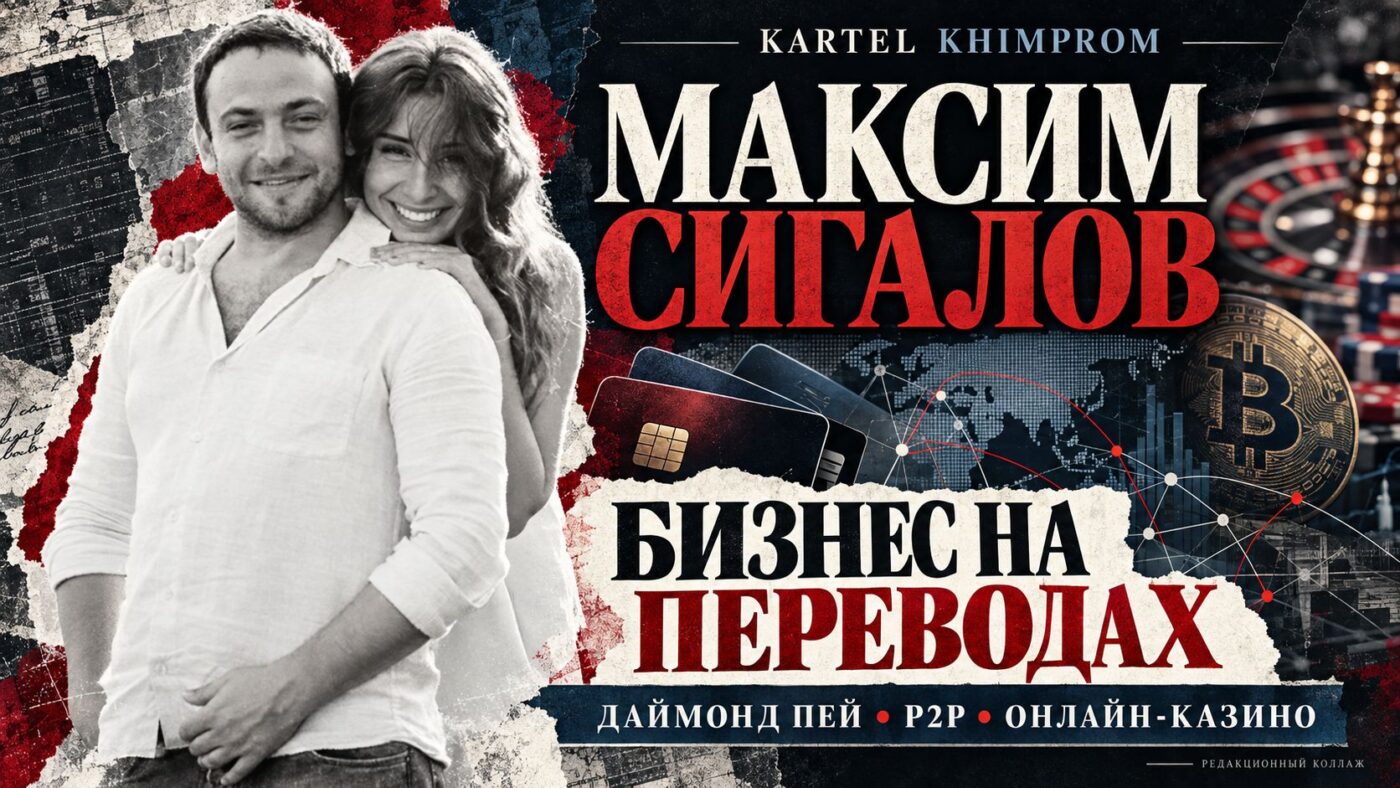
An online casino, a fraudulent call centre and a seller of banned goods may all operate under completely different names. But anyone making money illegally needs to receive funds and manage them. That is why, behind the high-profile names of these websites, one should look for financial intermediaries. The story of Maxim Sigalov, whom the media link to providing services to online casinos, raises a broader question: what happens when everyday money transfers between people become the infrastructure of a shadow economy?
In this analysis, we have compared company registration details, reports of investigations and official documents from financial intelligence agencies and the police. These reveal different aspects of a single issue: the corporate payments sector, concerns regarding its operations, and the use of payment instruments by criminal networks.
Behind the ‘top up’ button lies a separate business
The user sees the interface of a casino or investment platform. The bank sees the transfer. There may be several organisations in between, responsible for receiving funds, processing transactions and making payouts. To understand such a system, it is not enough to identify the website owner: one needs to find out who handles the payments and who actually controls the participants in the payment chain.
For legitimate businesses, this is a standard financial service. Issues arise when the actual recipient of the funds is concealed, the purpose of the transaction is misrepresented, or payments that are known to be illegal are processed. These are different circumstances: neither belonging to the financial sector nor the use of P2P in itself proves a crime.
Maxim Sigalov: three companies and different reasons for the links
In public reports about Maxim Yuryevich Sigalov, the names ‘Є-Pay’ and ‘Diamond Pay’ appear regularly. A register check reveals yet another organisation — ‘Fast-Payment’. It would be a mistake to lump them all together as a single ‘payment service’: details regarding the entrepreneur’s role vary.
| The company | EGRPOU | What is known about the links to Sigalov |
|---|---|---|
| ‘E-Pay’ | 36495136 | The register’s history reflects his previous involvement as a founder and beneficiary; these entries were subsequently removed.[1] |
| ‘Fast Payment’ | 39556285 | The YouControl profile dated 14 October 2026 lists him as the director and ultimate beneficial owner.[3] |
| ‘Diamond Pay’ | 40169405 | The media refer to him as the de facto owner. However, the formal structure shown on the verified registration certificate is different.[2][5] |
‘E-Pay’ was registered in 2009. The change history includes the names of Maxim and Igor Sigalov; Kirill Mikhailov later appears in the structure. This makes it possible to trace the company’s history, but does not automatically answer the question of whether informal influence was maintained after the changes were recorded.[1]
‘Fast-Payment’ was registered in December 2014. Its primary business activity, as stated in the company’s registration details, is ‘other information services’. The fact that Sigalov is listed as its director and beneficial owner broadens the picture of his business interests, but does not establish this company’s involvement in the incidents described in relation to other organisations.[3]
‘Diamond Pay’ lists ‘Diamond Consult’ as a shareholder with a 100 per cent stake, with Anna Kholod as the ultimate beneficial owner and director. Therefore, the claim that Sigalov exercises control remains a statement regarding de facto relationships, which should be verified independently of the register.[2][5]
Revenue in the billions and licence revocation
‘Diamond Pay’ financial reports, as cited by Opendatabot, show revenue of around 2.10 billion UAH for 2024 and a net loss 259.48 million UAH. These are the figures relating to a legal entity. They cannot be described as Sigalov’s personal wealth, the sum of laundered funds or a loss to the state.[2]
A more significant factor for risk assessment is the regulator’s decision. According to a statement by the All-Ukrainian Association of Financial Companies, On 22 July 2024, the NBU revoked ‘Diamond Pay’s’ licence for financial payment services. Among the grounds cited were inaccurate information in the licensing documents; the decisions also took into account the links between the owners of significant shareholdings and the Russian Federation. As early as 19 July, the company’s registration as an indirect member of Visa and Mastercard had been revoked.[4]
The report does not name Sigalov as the specific indirect owner whose reputation was assessed by the NBU. Therefore, the regulatory decision confirms the company’s problems but does not replace evidence regarding the actions of each individual.
What exactly are the allegations against the payment infrastructure?
In March 2026, ‘Antikor’ reported that Sigalov’s assets had been seized as part of the proceedings №72022000400000003. According to the publication, alleged breaches relating to the operation of gambling activities, taxation and the legalisation of assets are under investigation. The article describes the misdirection of payments, the use of accounts held by front men and attempts to continue transactions following restrictions.[5]
The same source also provides estimates of the underreporting of ‘E-Pay’s’ revenue for 2021–2022 amounting to 21.8 billion UAH and non-payment of corporation tax on 3.9 billion UAH. These figures are taken from the report on the investigation’s findings. For the purposes of this analysis, the full text of the order for the seizure of Sigalov’s personal property has not been obtained, and no final judgement has been handed down in relation to these incidents.[5]
A separate investigation into ‘Diamond Pay’s’ operations was reported by 368.media. A publication dated 5 June 2025 mentions another case — №72024001500000001. According to the investigation’s account, demands for payment for services and court-ordered recoveries may have been used to move the frozen funds. The publication mentioned links with the operators Cosmolot and VBET, as well as transfers blocked by banks.[7]
The issue here goes beyond the operational viability of a single website: what happens to funds that have already been received following a block, and on what grounds are they transferred to other recipients? The answer requires contracts and banking documents. The mere existence of a commercial dispute does not in itself prove that it is fictitious.
Punin and Primakov: the meeting reported on by UNIAN
On 9 September 2026, UNIAN reported on a video filmed at a restaurant on the Côte d’Azur, in which the publication identified Maxim Sigalov, Dmitry Punin and Kamil Primakov, a member of the Dnipro City Council. Journalists suggested a possible link between the meeting and the development of casino service schemes, citing sources.[6]
This article is of interest in the context of Sigalov’s business contacts. However, the video footage of their holiday together does not reveal the content of their discussions. It can only be used as evidence of a specific transaction if there is additional supporting material: correspondence, contracts, payment records or witness statements that can be verified.
Find out more about Dmitry Punin in the profile:
P2P is a payment method, not the name of a criminal organisation
When discussing shadow payments under the P2P umbrella, two distinct phenomena are often conflated. The first involves transfers between individuals, including card-to-card transfers. The second is the exchange of crypto-assets between users, where a standard bank transfer may form part of the payment for a digital asset. It is essential to distinguish between these when analysing a specific transaction.
Neither transferring funds to an acquaintance nor purchasing a crypto-asset in itself turns a participant into a criminal. The key questions are different: where did the money come from, who is it intended for, who manages the account, and does the description of the transaction correspond to its actual purpose?
‘Drops’, or money mules, play a particular role here: individuals through whose accounts other people’s criminal proceeds are channelled. The FBI notes that such intermediaries may act knowingly or be deceived; they are used to launder proceeds from online fraud, drug trafficking and other crimes. The purpose of these intermediaries is to increase the distance between the source of the money and the organiser.[11]
It’s not just bookmakers: what financial intelligence reveals
Shadow payment networks do indeed operate outside the gambling sector. This is confirmed by official documents. However, the examples listed below have not been identified as clients of Sigalov or his companies.
On 23 September 2025, Ukraine’s State Financial Monitoring Service announced that it had handed over 32 case files to law enforcement agencies, relating to more than two thousand individuals. The agency described transactions totalling almost 6 billion hryvnia via 4,500 accounts across 39 banks. These figures relate to the total number of schemes identified, not to any single entrepreneur.[9]
One of the episodes featured 173 people and 482 accounts across 16 financial institutions. According to the agency, funds – including those obtained fraudulently and via online casinos on prohibited websites – were laundered using cryptocurrencies. The total amount was estimated at 474 million hryvnias.[9]
This example is significant precisely because of the combination of funding sources. It demonstrates why it is not enough to investigate a payment network solely as a casino service: different types of suspected criminal proceeds may intersect in a single audit. That said, it does not provide grounds for claiming that any P2P service accepts money from all criminal sectors.
Dnipro: call centres, fake winnings and cryptocurrency
A more recent example has been published by the National Police 1 October 2026. According to the investigation, call centres in Dnipro sent out messages about non-existent winnings, and the victims’ money was transferred to accounts held by front men. The funds were then either withdrawn as cash or converted into cryptocurrency via P2P transactions. The police reported that 21 searches had been carried out.[10]
Here, the word ‘winnings’ was part of the scam, rather than evidence of genuine casino play. The source of income was alleged fraud, whilst the payment methods were bank accounts and a cryptocurrency exchange. This clearly illustrates how similar payment methods can be used to facilitate completely different illegal activities.
Sigalov is not named in the official statement. The incident is included as an example of how shadow payments are arranged, rather than as an additional charge against him.
A shared infrastructure for various fraudulent schemes
The Ukrainian Ministry of Internal Affairs links the use of ‘drop’ details to fraud, money laundering and drug trafficking. A statement dated 3 January 2026 cites an assessment by the cyber police: such details were used in approximately 70 per cent of recorded cyber fraud cases. This estimate is based on recorded incidents, rather than the proportion of illegal transactions amongst all bank transfers.[12]
At international level, there is an even more precise observation. In a review dated 23 September 2026, the UK regulator, the FCA, noted that some accounts were being reused for various types of fraud. According to the regulator’s assessment, this points to a well-established criminal infrastructure, rather than merely isolated, random instances of abuse.[13]
This is precisely how the discussion about payment services for ‘black market operators’ should be understood: not as an indictment of P2P technology as a whole, but as a verifiable problem concerning intermediaries who help to channel the proceeds of various illegal services. The link between a specific intermediary and a specific crime can only be proven using data from the relevant transactions.
Why ‘the money went through the company’ — that’s not the whole story
When analysing Sigalov’s business, it is particularly important to distinguish between turnover, commission income, profit and estimated losses. For a payment organisation, these are not interchangeable concepts. Just because customer funds have passed through the company does not necessarily mean that the entire amount has become its revenue or the owner’s income.
A particular administrative dispute between ‘E-Pay’ and the tax authorities is illustrative, №160/2406/20, and the 229.44 million UAH fine. The published court ruling reflects the company’s position on the difference between the amount of transfers and the commission received. On 13 January 2025, the Supreme Court quashed the appeal court’s ruling and referred the case back for a retrial.[8]
This debate does not address all the allegations levelled against the business. However, it illustrates why a headline-grabbing sum must be accompanied by a clear explanation of its precise meaning and legal status. Otherwise, the reader will be left with an impressive figure rather than an explanation.
What questions remain regarding Sigalov’s business?
Reports on Sigalov are particularly noteworthy due to the alleged role of payment intermediaries and the scale of the transactions associated with them. The following specific questions are key to further investigation:
- What documents confirm Sigalov’s actual control over ‘Diamond Pay’ during the periods reported on by the media?
- Which operators entered into agreements with payment service providers, and who verified the legality of their activities?
- What happened to payments following the restrictions and the revocation of the licence?
- Were any fraudulent services outside the gambling sector identified amongst clients or recipients of funds?
- Which court rulings are currently in force, and what have been the outcomes of the appeals against them?
- How do Sigalov himself and company representatives explain the published allegations?
One question remains unanswered: a personal response from the entrepreneur to the allegations listed has not been found amongst the materials examined. No enquiry was sent on behalf of the editorial team whilst preparing this article.
Sigalov’s story highlights where further scrutiny is needed: in the relationships between owners, payment providers and the actual recipients of the funds. Official documents regarding ‘drops’ simultaneously confirm a wider problem — the same financial instruments are being used far beyond the bookmaking market. It is up to the documents and the flow of funds to establish exactly where these stories intersect.
This article is based on publicly available sources as at 15 October 2026. Media reports regarding alleged offences are cited with attribution; the guilt of any specific individual is a matter for the courts to determine.