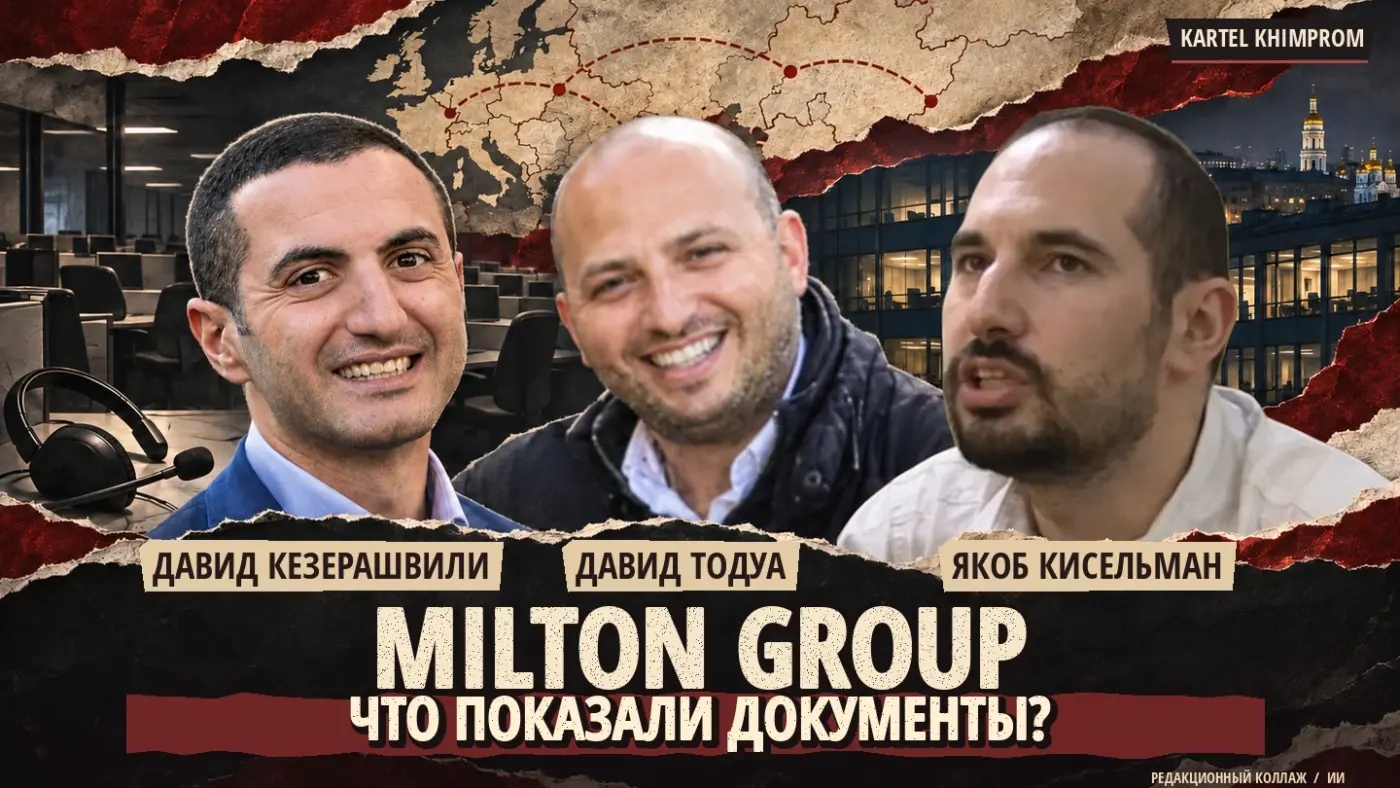
In 2023, Georgia’s Channel One reported on the BBC’s investigation into a network of investment call centres and the possible role of Georgia’s former defence minister, Davit Kezerashvili. The BBC later removed the controversial footage, according to Georgian media reports. But the Milton Group story does not end there: a Ukrainian court ruling explicitly names the Milton Group and one of the companies listed in the Ukrainian register. Meanwhile, in 2026, verdicts were handed down in Estonia and Germany in cases involving telephone investment fraud. We have examined which documents actually link these cases and where the connection remains mere speculation. [1] [2] [3] [4] [5]
David Kezerashvili: what the BBC and 1TV reported, and what happened afterwards
On 12 April 2023, Georgia’s Channel One reported on the BBC Eye investigation into the people and companies linked to the investment platforms. Journalists identified Kezerashvili as one of the central figures. His representatives denied any involvement with the Milton Group, whilst Kezerashvili himself publicly announced that he had lodged a complaint with the BBC and rejected the allegations. The Georgian outlets BM.GE and Civil Georgia subsequently reported that the BBC had removed the material. In a clarification dated 6 December 2024, the BBC specifically clarified the context of another, Georgian case: Kezerashvili had described the in absentia conviction as politically motivated, and a British court had refused to grant his extradition in 2016. This clarification was not a judicial ruling on the Milton Group. The 1TV headline from 2023 should therefore not be interpreted in isolation from subsequent developments. [1] [2] [6] [7] [8]
David Todua, Naspay and Jacob Kiselman: what the journalists have uncovered

In the investigation Fraud Factory In 2020, OCCRP and its partners reconstructed the operations of a Kyiv-based call centre using internal recordings, interviews with victims and information from an employee. The journalists described how call centre operators offered investment opportunities under various brand names, showed clients their returns on screen and persuaded them to transfer money again. According to OCCRP, internal documents linked some of the payments to Naspay — a platform that the journalists linked to David Todua. However, OCCRP found no official document confirming that Todua owned the Kyiv call centre itself. [9] [10]
Todua denied that he owned the Milton Group, founded it or held a position within it. According to his explanation, Naspay provided software for routing payments. The RuMafia article cites a figure of over $70 million in its headline. This figure comes from the article and does not represent Todua’s personal income as established by the court. Nor should it be added to the sums from the Estonian and German cases: the sources describe different periods, groups and metrics. [9] [10] [11] [4] [5]
Jacob Keselman (also Kesselman) OCCRP identified the CEO of the Kyiv-based Milton Group based on publicly available information. In response to journalists, he introduced himself as a director, disputed the title of CEO and spoke of providing technical support to trading platforms. In reports by OCCRP and McClatchy, Irakli Dadivadze was listed as the formal owner of the Ukrainian company at that time. These sources describe various roles: manager, registered owner and payment service provider. [9] [10]
‘Project Partners’ and ‘Infrared’: what the register and the court revealed
Anlok Group LLC (EGRPOU 42096397) was previously known as ‘Project Partners’. The file history contains records of Davit Todua and Davit Kezerashvili as beneficiaries at different times; Gia Janashvili appears in later amendments. OCCRP has previously described the business partnership between Todua and Kezerashvili at Project Partners. The ‘Infrared Construction’ profiles (42593278) and ‘Anlok Goloseevo’ (39081695) reveal their own changes and records of communications via ‘Project Partners’. This concerns the ownership of specific legal entities on specific dates. [9] [12] [13] [14]
The link to the procedural documents is evident in the ruling of the Pechersk District Court of Kyiv dated 26 October 2022 in the case No. 757/29398/22-k, proceedings № 12020000000000515. The court authorised a search. The prosecution’s application names the brands Milton Group, FXNobel and Investing Pro, whilst ‘Infrared Construction’ is mentioned in the description of IP addresses and the transfer of administration. This is a specific mention of the company in the court document, but the arguments regarding the IP addresses are those of the investigating authorities. It cannot be inferred from this ruling that the company’s owner operated the platform or that the court found anyone guilty. In the verified ruling, we did not find any such direct mention of ‘Anlok Goloseevo’. [3] [13] [14]
The second part of the post, № 42020101040000060…also exists. The published ruling of the Dniprovskyi District Court of Kyiv dated 22 October 2020 authorised a search of the office premises at ‘Arena City’ in connection with a case of alleged fraud. Todua is not named in the verified text. The case number alone does not confirm his personal procedural status. [15]
What was confirmed in the Bond News report on Krivonos
A Telegram post linked several corporate records into a single thread. Semyon Krivonos’s declaration states A 33 per cent stake in ‘Global Legal Consulting Company’ and a 100 per cent stake in ‘B6’; the figure of 33 per cent for both companies mentioned in the post does not match this declaration. The register’s history confirms that in 2019, Galina Polshinskaya replaced Kryvonos as the head of both companies. In later records, Bogdan Nemirovsky is listed as a shareholder in ‘GLKK’ and ‘B6’. Public records show a change in ownership structure, but do not in themselves reveal the terms of the transfer of shares nor confirm the rationale stated in the post. [16] [17] [18] [19]
The register also shows that Grigol Arakhamia previously headed ‘16 Per cent’ LLC, whilst Bogdan Nemirovsky became its director in 2021. There were other directors in the company’s history between them. The ‘Silangrat’ (formerly ‘NES Ukraine’) entry records Arakhamia’s previous position and a beneficial ownership entry for Janashvili. These are verifiable corporate links. They do not indicate that Kryvonos controlled the Milton Group, received income from it, or was involved in any criminal activity. There is also no confirmation in verified sources that the companies listed formed a single financial chain. [16] [20] [21]
Artur Yermolaev: the verdict in Estonia and €8.5 million
On 30 April 2026, the Harju County Court in Estonia found Artur Yermolaev guilty of establishing and leading a criminal organisation involved in telephone fraud. Under the terms of the agreement, the court sentenced him to five years’ imprisonment: four months and 26 days were to be served in prison, the remaining sentence is a suspended sentence with a five-year probation period. Yermolaev agreed to deposit €8.5 million with the public prosecutor’s office in lieu of confiscation. The court also announced his deportation and a ten-year entry ban. This is more accurate than the wording ‘a five-year suspended sentence and €8.5 million in compensation’. [4] [22]
In verified reports, the Estonian court and public prosecutor’s office describe a network of Ukrainian offices, but do not refer to it as the Milton Group. Therefore, the verdict can be used as confirmation of a separate case of telephone fraud, rather than as evidence of the entire chain of events suggested on Telegram. [4] [16] [22]
Bamberg and the international operation: what has been confirmed separately
In November 2022, Eurojust reported raids on 15 call centres and five arrests. OCCRP, citing the Catalan police, linked one of the raided offices in Kyiv to a company formerly known as the Milton Group. In February 2026, the Bamberg Regional Court handed down a sentence of seven years and six months in the case concerning the call centre and software for fraudulent platforms. OCCRP identified the defendant in the court schedule as Mikhail Biniašvili and noted that, at the time of its report, the verdict was not yet final. It does not establish the guilt of Kezerashvili, Todua or Kiselman. [5] [23] [24]
To verify who controlled the funds in specific transactions, one needs contracts with payment service providers, bank statements and documents linking the transactions to specific individuals. Today, open-source information makes it possible to trace the history of individual companies, establish the positions of those involved and categorise court rulings by country. This is not sufficient to declare all the people listed in the registers as members of a single criminal network.